Bengali Panjika vs Odia Panchang Two Lunar Solar Worlds
By Pt. Nilesh Sharma
Comparative Study of Eastern India’s Vedic Timekeeping Traditions
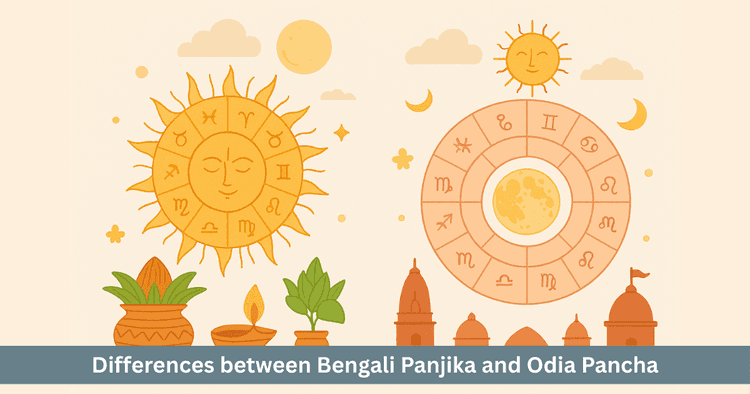
Table of Contents
This article is based on moon sign. To find your moon sign, check the position of the Moon at the time of your birth. The moon sign is the zodiac sign in which the Moon was positioned at birth.
Two important almanacs from Eastern India, the Bengali Panjika and the Odia Panchang, represent two distinct lunar-solar worlds while sharing a common Vedic astronomical heritage. Both systems guide the religious, agricultural and cultural lives of their respective regions but they differ fundamentally in their primary method of time calculation and calendrical structure. While the Bengali Panjika is primarily a solar calendar based on Sankranti (solar transitions through zodiac signs), the Odia Panchang presents a unique hybrid system that combines solar civic months with Purnimanta (full moon ending) lunar phases for religious dates.
Historical Origins of Bengali Panjika
The Bengali calendar traces its origins to the seventh century CE when King Shashanka, the first independent ruler of unified Bengal, established it around 593-594 CE to commemorate his ascension to the throne. The term Bangabda (Bangla year) appears in Shiva temple inscriptions many centuries older than the Mughal era, suggesting that a Bengali calendar existed long before external influences.
The calendar underwent significant modification during the Mughal period under Emperor Akbar's reign. Akbar commissioned his royal astronomer Fathullah Shirazi to create a new calendar combining the lunar Islamic Hijri calendar with the solar Hindu calendar. This reform addressed the administrative difficulty of collecting land taxes according to the lunar Hijri system, which did not align with the solar agricultural harvest cycles. This reformed calendar was known as Tarikh-e-Elahi or Fasholi San (Harvest Calendar).
The resulting Bengali calendar adopted a solar structure while retaining traditional Sanskrit month names and Vedic astronomical principles. Akbar's grandson Shah Jahan later reformed it to use a seven-day week beginning on Sunday and the month names were changed to match the existing Saka calendar.
Beginning of Bengali Sambat
The Bengali era is called Bengali Sambat (BS) with a zero year starting in 593/594 CE. The current Gregorian year minus 594 equals the Bengali year before Pohela Boishakh (New Year) or minus 593 after Pohela Boishakh. The Bengali calendar year consists of 365 days, structured to align with the solar year.
Structure and Features of Bengali Panjika
The Bengali calendar is fundamentally a solar calendar, unlike most other Indian calendars which are lunisolar. It follows the sidereal solar cycle, with months corresponding to the Sun's transit through the twelve zodiac signs (rashi). Unlike the Gregorian calendar which begins the year in winter, the Bengali calendar starts with Baishakh rather than Chaitra, marking the beginning of the harvest season.
Month Beginning Rules
Bengali months begin based on Sankranti (solar transition) timings with specific calculation rules. When Sankranti occurs between sunrise and midnight, the year begins on the following day. If Sankranti occurs after midnight, the year begins two days later.
Calendar Reform of 1966
The Bengali calendar in Bangladesh underwent scientific revision in 1966 by a committee headed by Muhammad Shahidullah under the Bangla Academy. This reform addressed the discrepancy between the 365-day calendar year and the actual solar year of 365 days, 5 hours, 48 minutes and 47 seconds.
| Month Name | Romanization | Days India | Days Bangladesh | Zodiac Sign | Season | Gregorian Period |
|---|---|---|---|---|---|---|
| Baishakh | Boishakh | 30 or 31 | 31 | Mesha (Aries) | Grishsho (Summer) | April-May |
| Jyeshtha | Jyoishţho | 31 or 32 | 31 | Vrishabha (Taurus) | Grishsho (Summer) | May-June |
| Ashadh | Ashaŗh | 31 or 32 | 31 | Mithuna (Gemini) | Bôrsha (Monsoon) | June-July |
| Shravan | Shrabon | 31 or 32 | 31 | Karkataka (Cancer) | Bôrsha (Monsoon) | July-August |
| Bhadra | Bhadro | 31 or 32 | 31 | Simha (Leo) | Shôrôd (Autumn) | August-September |
| Ashvin | Ashshin | 30 or 31 | 31 | Kanya (Virgo) | Shôrôd (Autumn) | September-October |
| Kartik | Kartik | 29 or 30 | 30 | Tula (Libra) | Hemonto (Dry) | October-November |
| Agrahayana | Ôgrohayon | 29 or 30 | 30 | Vrischika (Scorpio) | Hemonto (Dry) | November-December |
| Poush | Poush | 29 or 30 | 30 | Dhanu (Sagittarius) | Sheet (Winter) | December-January |
| Magh | Magh | 29 or 30 | 30 | Makara (Capricorn) | Sheet (Winter) | January-February |
| Falgun | Falgun | 29 or 30 | 29 or 30 | Kumbha (Aquarius) | Bôsôntô (Spring) | February-March |
| Chaitra | Choitro | 30 or 31 | 30 | Meena (Pisces) | Bôsôntô (Spring) | March-April |
The revised structure includes the first five months with 31 days, the next six months with 30 days and Falgun adjusted to accommodate leap years. This system was officially adopted by Bangladesh in 1987, though the traditional version continues in West Bengal, Tripura and Assam.
Bengali New Year and Cultural Significance
The Bengali New Year, Pohela Boishakh, falls on April 14 in Bangladesh and April 15 in West Bengal. This date marks the Mesha Sankranti when the Sun enters sidereal Aries. The festival is a national holiday celebrated with cultural programs, the Mangal Shobhajatra parade, Boishakhi Mela (fairs) and Haal Khata (opening new account books).
Six Seasons of the Bengali Calendar
The Bengali calendar divides the year into six Ritus (seasons), each comprising two months:
- Grishsho (Summer): Boishakh to Jyoishţho
- Bôrsha (Monsoon): Ashaŗh to Shrabon
- Shôrôd (Autumn): Bhadro to Ashshin
- Hemonto (Late Autumn/Dry): Kartik to Ôgrohayon
- Sheet (Winter): Poush to Magh
- Bôsôntô (Spring): Falgun to Choitro
This division is deeply connected to Bengal's climatic conditions and agricultural cycles. Each season arrives with its distinctive weather patterns, crops and cultural activities.
Historical Introduction to Odia Panchang
The Odia calendar follows the Utkaliya era, which began in 592 CE on Bhādra Śukḷa Dvādaśī (the 12th day of the waxing moon fortnight of the Bhādra month). This date commemorates the legendary King Indradyumna, who established the icon of Lord Jagannath at Puri. The epoch is connected to the reign of Somavamshi King Yayati I as mentioned in the chronicle Madala Panji.
The modern Odia calendar incorporates scientific reforms initiated by the renowned astronomer Pathani Samanta. His astronomical observations using traditional instruments were recorded in his treatise Siddhanta Darpana (Mirror of Astronomical Principles), written on palm-leaf manuscript in 1869 and published in 1899. These findings were instrumental in preparing almanacs in Odisha, particularly by astrologers of the Jagannath temple at Puri.
Hybrid Lunisolar Structure of Odia Panchang
The Odia calendar represents a unique hybrid system that follows the sidereal solar cycle while using the lunar Purnimanta phase for religious dates. This distinctive dual structure distinguishes it from purely solar calendars like Tamil or Malayalam and purely lunisolar calendars like Vikram Samvat.
The civil calendar follows solar months based on the Sun's transit through zodiac signs, while religious observances and festivals follow the Purnimanta lunar system (full moon to full moon). This allows the calendar to maintain both astronomical precision for civil purposes and traditional lunar phases for religious practices.
Odia Month Structure and Features
Odia months have both lunar names (māsa) and solar zodiac associations (rāsi), reflecting the dual nature of the calendar:
| Odia Lunar Month | Days | Odia Solar Rashi | Zodiac Sign | Gregorian Period |
|---|---|---|---|---|
| Baiśākha | 31 | Mesa | Aries | April-May |
| Jyeṣṭha | 31 | Brusa | Taurus | May-June |
| Āṣāḍha | 32 | Mithuna | Gemini | June-July |
| Śrābaṇa | 31 | Karkaṭa | Cancer | July-August |
| Bhādraba | 31 | Singha | Leo | August-September |
| Āświna | 31 | Kanyā | Virgo | September-October |
| Kārttika | 30 | Tuḷā | Libra | October-November |
| Mārgaśira | 29 | Bichā | Scorpio | November-December |
| Pauṣa | 29 | Dhanu | Sagittarius | December-January |
| Māgha | 30 | Makara | Capricorn | January-February |
| Phālguna | 30 | Kumbha | Aquarius | February-March |
| Chaitra | 30 | Mina | Pisces | March-April |
Month Beginning Rules
Odia calendar months begin on the same day as Sankranti if the solar transition occurs before sunset. This differs from the Bengali system's midnight-based calculation.
Dual New Year System of Odia Panchang
The Odia calendar uniquely recognizes two distinct New Year dates:
First New Year Maha Bishuba Sankranti
The Odia Civil New Year is celebrated as Maha Bishuba Sankranti or Pana Sankranti. It occurs on the first day of the solar month Mesa (Aries), typically April 14 or April 13 in Gregorian leap years. This marks the Mesha Sankranti and is celebrated as Pana Sankranti, commemorating Lord Vishnu's Varaha incarnation rescuing Earth from the demon Hiranyaksha.
The festival features the traditional Pana drink made from jaggery, water and fruits, symbolizing hydration for the summer season. This is a significant celebration deeply embedded in Odia culture.
Second New Year Sunia
The Odia Financial New Year falls as Sunia on Bhādra Śukḷa Dvādaśī (12th day of the waxing moon) in September. This marks the official change of the Utkaliya calendar year for records, horoscopes and revenue collection. This day denotes the start of the financial calendar year and the publishing of almanacs and palm-leaf horoscopes carrying the reigning year of the Gajapati King.
Uniqueness of the Anka Year System
The Odia calendar employs a unique regnal year system called Anka, instituted by the Eastern Ganga kings. This system has distinctive features:
- Always starts on Bhādra Śukḷa Dvādaśī (Sunia)
- The number 1 was never used; coins were minted with Anka year 2
- All years ending in 6 are skipped (e.g., 5 to 7 directly, 15 to 17)
- All years ending in 0 are skipped, except Anka year 10
- No Anka years exist for 1, 6, 16, 20, 26, 30, 36, 40, 46, 50, 56, etc.
This system still marks the titular regnal year of the Gajapati Maharaja of Puri. It is a unique aspect of Odia cultural tradition that continues in modern times.
Paksha System and Tithi Calculation
The Odia calendar uses the Purnimanta lunar phase system, dividing each month into two fortnights (Paksha):
Shukla Paksha and Krishna Paksha
- Śukḷapakṣa (Waxing Moon): From Amābāsyā (new moon) to Pūrṇṇima (full moon), 15 days, Moon waxes
- Krushṇapakṣa (Waning Moon): From Pūrṇṇima to Amābāsyā, 15 days, Moon wanes
Each fortnight contains 15 tithis: Pratipada, Dwitīyā, Trutīyā, Caturthī, Pañcamī, Ṣaṣṭhī, Saptamī, Aṣṭamī, Nabamī, Daśamī, Ekādaśī, Dwādaśī, Trayodaśī, Caturddaśī and either Pūrṇṇima or Amābāsyā. This system allows precise date determination for religious observances.
Six Seasons of the Odia Calendar
The Odia calendar follows the traditional six-season division:
- Grīṣma (Summer): Baiśākha to Jyeṣṭha, April to June
- Barṣā (Monsoon): Āṣāḍha to Śrābaṇa, June to August
- Śarata (Autumn): Bhādraba to Āświna, August to October
- Hemanta (Pre-Winter): Kārttika to Mārgaśira, October to December
- Śīta (Winter): Pauṣa to Māgha, December to February
- Basanta (Spring): Phālguna to Chaitra, February to April
This division is in complete harmony with Odisha's climate and agricultural patterns. Each season arrives with its distinctive festivals, rituals and cultural events.
Comparative Analysis of Bengali and Odia Systems
| Aspect | Bengali Panjika | Odia Panchang |
|---|---|---|
| Calendar Type | Solar | Hybrid Lunisolar (Solar civic + Lunar religious) |
| Era Name | Bengali Sambat | Utkaliya Era |
| Zero Year | 593/594 CE (King Shashanka) | 592 CE (King Indradyumna) |
| Age Difference | Approximately 1-2 years older | Approximately 1-2 years younger |
| First Month | Baishakh (not Chaitra) | Baiśākha |
| New Year Date | April 14/15 (Pohela Boishakh) | April 14/13 (Pana Sankranti) |
| Secondary New Year | None | September (Sunia - Financial) |
| Month System | Pure Solar (Sankranti-based) | Solar months + Lunar tithis |
| Lunar Phase System | Not applicable (solar) | Purnimanta (Full Moon to Full Moon) |
| Day Begins | Sunrise | Sunrise |
| Sankranti Rule | After sunrise to midnight → next day | Before sunset → same day |
| Regional Use | West Bengal, Bangladesh, Tripura, Assam | Odisha |
| Calendar Reform | 1966 (Shahidullah Committee) | 1869 (Pathani Samanta) |
| Unique Feature | Starts with Baishakh (not Chaitra) | Dual New Year, Anka system |
Differences in Lunar Integration
In Bengali Panjika, daily almanacs present the five limbs Tithi, Nakshatra, Yoga, Karana, Vara alongside solar months, enabling Vedic tithi-based festivals like Durga Puja while keeping month boundaries by Sankranti. Modern editions often follow Vishuddha Siddhanta parameters after mid-20th century reforms to improve astronomical accuracy.
Odia Panji explicitly integrates Purnimanta lunar phasing for religious dates within the solar calendar, so lunar festival placement references the Purnimanta cycle even as civil months remain solar. This preserves distinctive temple observance patterns in Odisha.
Amanta and Purnimanta Context
Many peninsular regions use Amanta (new moon-ending) lunar months but Bengal and Odisha use solar month boundaries. Within this, Odisha references Purnimanta lunar phases for religious computation, distinguishing it from typical Amanta states.
This structural choice contributes to occasional divergence in festival datings or day-boundary interpretations between Bengali and Odia almanacs despite both being solar for civil months.
Computational Traditions and Modern Publications
Bengali Panjikas historically included multiple lineages. The Vishuddha Siddhanta Panjika and related modernized tables sought to reduce discrepancy by aligning closer to refined siddhantic ephemeris values post-reform era, producing consistent tithi and nakshatra data in print.
Odia Panjis are published by regional authorities and publishers, listing solar months with daily Vedic limbs and specific Odia era reckoning, maintaining a distinct year labeling alongside tithi-based observances.
Major Panchang Publications
Bengali Panjika Traditions: Major Panjika publications include traditional almanacs that provide Vedic astronomical data, festival dates and auspicious muhurtas. Despite being a solar calendar, Bengali Panjikas incorporate lunar phase information for religious observances tied to Hindu festivals.
Odia Panji Traditions: Prominent Panji traditions include Khadiratna Panjika, Samanta Panjika (based on Pathani Samanta's work), Biraja Panjika, Kohinoor Panji, Radharaman Panji (following Puri temple traditions), Bhagyadeepa Panji, Bhagyajyoti Panji and Bhagyachakra Panji. The Madala Panji, a chronicle of the Jagannath Temple dating from the 12th century, represents the historical foundation of Odia calendar-keeping.
Practical Effects on Festivals
Both systems compute festivals by Vedic tithi rules but Odia use of Purnimanta phasing and localized day-boundary conventions within a solar month can yield differing observance days from Bengali Panjikas for certain events, even when Sankranti anchors are identical.
Durga Puja and Navaratri timing in Bengal follows lunar tithis within Ashwin-Kartik while civil month names remain solar. In Odisha, temple directives align tithi observance with Purnimanta convention under the Odia Panji, maintaining a distinct regional cadence to the same Vedic framework.
Day Structure and Time Divisions
Both calendars use a seven-day week named after the Navagraha (nine celestial bodies). In Bengali calendar: Rôbibar (Sunday-Sun), Shombar (Monday-Moon), Mônggôlbar (Tuesday-Mars), Budhbar (Wednesday-Mercury), Brihôspôtibar (Thursday-Jupiter), Shukrôbar (Friday-Venus) and Shônibar (Saturday-Saturn).
In Odia calendar: Rabibāra (Sunday-Sun), Somabāra (Monday-Moon), Maṅgaḷbāra (Tuesday-Mars), Budhabāra (Wednesday-Mercury), Gurubāra (Thursday-Jupiter), Śukrabāra (Friday-Venus) and Śanibāra (Saturday-Saturn).
Traditional Vedic Time Units
The Odia calendar employs traditional Vedic time units:
- 1 Dibasa (solar day) = 24 Ghaṇṭā (24 hours)
- 1 Pakṣa (fortnight) = 15 Dina (15 days)
- 1 Barṣa (year) = 12 Māsa (12 months) = 365 Dina (365 days)
The Bengali calendar also begins the day at sunrise rather than midnight as in the Gregorian calendar. This unique feature reflects adherence to Vedic traditions in both systems.
Cultural Significance and Regional Identity
Both calendars reflect the deep integration of Vedic astronomical science with regional agricultural cycles and religious traditions. The Bengali calendar's solar structure facilitates tax collection aligned with harvest seasons, while the Odia calendar's hybrid system balances civil administration (solar) with religious observance (lunar).
The Bengali calendar is historically linked to the cultural life of the entire Bengal region, while the Odia Panchang is deeply tied to the traditions and rituals of the Jagannath Temple, Puri. This demonstrates the sophisticated adaptability of Vedic timekeeping systems to meet diverse societal needs across Eastern India.
Frequently Asked Questions
What is the main difference between Bengali Panjika and Odia Panchang?
Bengali Panjika is a pure solar calendar using Sankranti-based months, while Odia Panchang is a hybrid lunisolar system using solar months for civil purposes and Purnimanta lunar phases for religious dates.
When do both calendars celebrate their New Year?
Bengali New Year Pohela Boishakh is celebrated on April 14 or 15. Odia Civil New Year Pana Sankranti occurs on April 14 or 13 and a secondary Financial New Year Sunia is celebrated in September.
What is the Anka year system?
Anka is a unique regnal year system in the Odia calendar instituted by Eastern Ganga kings. It involves skipping years ending in 6 and 0 and following specific rules.
How does Sankranti calculation differ in both systems?
In Bengali Panjika, when Sankranti occurs between sunrise and midnight, the month begins the next day. In Odia Panchang, when Sankranti occurs before sunset, the month begins the same day.
Do both calendars use the same dates for festivals?
Both follow Vedic tithi rules but Odia use of Purnimanta phasing and localized day-boundary conventions can yield differing observance days from Bengali Panjika for certain festivals.
What does Sun Sign reveal about me?
My Sun SignDid you like it?
Author

Pt. Nilesh Sharma (63)
Experience: 20
Consults About: Family Planning, Career
Clients In: Punjab, Haryana, Delhi
Share this article with friends and family
WELCOME TO
ZODIAQ
Right Decisions at the right time with ZODIAQ
