Can India Have a Unified Panchang in the 21st Century
By Pt. Narendra Sharma
Technical Possibilities Cultural Challenges and Practical Solutions
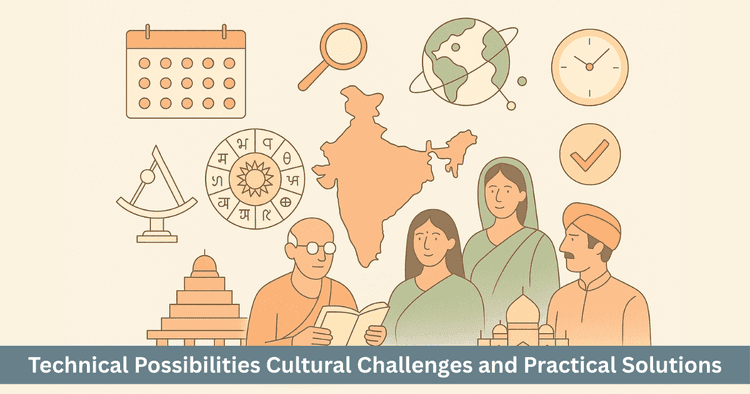
Table of Contents
The question of whether India can establish a unified national Panchang represents one of the most compelling yet complex challenges in contemporary Indian governance and cultural policy. The twenty-first century presents unprecedented technological capabilities such as GPS precision, digital algorithms, real-time calculations yet also reveals why previous unification attempts failed, what new opportunities exist and what fundamental obstacles remain rooted in India's profound cultural and religious diversity.
Historical Context: The 1957 Unified Calendar Attempt
The Meghnad Saha Committee (1952-1954)
In post-independence India, the newly formed government recognized that calendar fragmentation with thirty different calendar systems existing across regions created administrative difficulties and nationalist ambitions for uniformity.
Committee Composition and Mandate
Headed by Meghnad Saha, renowned Indian astrophysicist
Appointed by the Council of Scientific and Industrial Research
Mandate: Study all existing calendars and propose a unified system
Timeframe: 1952 to 1954, concluding with recommendations in 1954
The Committee's Findings
The committee undertook detailed analysis of India's thirty different calendar systems, revealing:
Fundamental incompatibilities between solar and lunisolar systems
Religious and cultural attachments to specific calendar traditions in each region
Astronomical inconsistencies in various traditional calculations
Administrative chaos caused by festival dates varying by region and school of Panchang makers
The Proposed Solution
The committee recommended two distinct calendars.
1. Fixed Tropical Solar Calendar (For Civil or Administrative Use)
Begin on vernal equinox (March twenty-one to twenty-two)
Twelve months with fixed lengths (thirty to thirty-one days)
Chaitra: thirty days (thirty-one in leap years)
Vaishakh through Bhadra: thirty-one days each
Kartik through Phalguna: thirty days each
Adopted month names from traditional Hindu calendars with minor adjustments
2. Tropical Lunisolar Calendar (For Religious Purposes)
Proposed but explicitly rejected by the government due to complexity
Rationale by Prime Minister Jawaharlal Nehru
In his preface to the committee's report (nineteen fifty-five), Nehru stated: They represent past political divisions in the country. Now that we have attained Independence, it is obviously desirable that there should be a certain uniformity in the calendar for our civic, social and other purposes and this should be done on a scientific approach to this problem.
The 1957 National Calendar Implementation And Its Failure
Official Adoption
The Indian national calendar was officially adopted on March twenty-two, nineteen fifty-seven (one Chaitra, eighteen seventy-nine Saka Era), becoming India's first unified calendrical system.
Intended Usage
Designated for use in the Gazette of India, News broadcasts by All India Radio, Government-issued calendars, Official government communications to the public.
Practical Reality: Complete Failure
Despite government mandate and scientific rationale, the unified national calendar achieved virtually zero public acceptance. Panchang makers rejected it and continued using regional systems. The general public ignored it and maintained their ancestral calendar systems. Religious communities were resistant and festival calculations remained tied to regional traditions. Current usage is limited almost exclusively to government offices and official documents.
Why the 1957 Attempt Failed
Religious and Cultural Resistance
Hindu festivals are fundamentally tied to lunar phases and regional Panchang traditions developed over centuries. The fixed solar calendar eliminated the theological significance of tithi-based observances. Different regions had four hundred plus years of established calendar practices and emotional attachments.
Practical Astronomical Issues
The proposed system artificially fixed month lengths that don't match actual astronomical transitions. It prioritized administrative convenience over astronomical reality. It created confusion rather than clarity for festival calculations.
Insufficient Authority
The government could not mandate private Panchang makers' calculations through decree. Authority required voluntary acceptance.
Modern Developments: The 21st Century Unified Panchang Initiative
The Central Sanskrit University Project (2024-2025)
After decades of the national calendar languishing in obscurity, a new unified Panchang initiative has emerged.
Recent Development
The Central Sanskrit University (formerly Rashtriya Sanskrit Sansthan) was entrusted with creating a unified Hindu Panchang for the entire country. A multi-institutional collaborative effort with astrologers from various central Sanskrit institutions across India worked for over one year. Expected publication under the auspices of President Draupadi Murmu.
Stated Objectives
Eliminate confusion regarding festival dates such as Janmashtami, Navaratri, Diwali varying by one to two days across regions
Standardize fasting and ritual observance timing
Address confusion about Amavasya (new moon) date calculations
Create an authoritative reference for both laity and religious practitioners
Key Acknowledgment of Complexity
The initiative explicitly recognizes that confusion arises not merely from Panchang differences but from fundamental theological questions. In Hinduism, festivals are often observed based on the sunrise date. Yet, there is no universally accepted approach in every circumstance. Some people decide festival timings based on local sunrise timings. According to religious scriptures, rituals, worship, fasting and festivals should be observed according to specific timing categories such as sunrise, midday, dusk, half of the night and midnight.
This nuanced acknowledgment suggests the modern initiative understands deeper issues than previous unification attempts.
Why Unification Remains Extraordinarily Difficult
1. Fundamental System Incompatibilities
The diverse regional Panchangs employ fundamentally different frameworks.
Solar versus Lunisolar: Tamil and Malayalam use pure solar calculations; most others use lunisolar
Amanta versus Purnimanta: Months end on new moon (South) versus full moon (North), creating fifteen-day shifts
Era Differences: Shalivahana Shaka (seventy-eight CE), Vikram Samvat (fifty-seven BCE), Saptarishi (three thousand seventy-six BCE), Kollam (eight hundred twenty-five CE)
Calculation Methods: Drik Ganita (modern) versus Vakya (traditional) produce different planetary positions
No single unified system can honor all these without essentially eliminating several regional traditions.
2. Religious and Theological Conflicts
The Sectarian Problem
Vaishnava traditions emphasize Purnimanta (full moon-based) calculations for Krishna-related festivals. Shaiva traditions prefer different Panchang authorities. Regional temples maintain century-old traditions tied to specific Panchang schools. Different communities interpret auspicious timing (Muhurat) differently.
Sacred Legitimacy Question
For many practitioners, only their ancestral Panchang carries sacred authority. Imposing a unified system undermines spiritual legitimacy.
3. The Tithi Overlap Problem
A fundamental astronomical reality persists: tithis (lunar days) have variable nineteen to twenty-six hour durations and frequently span two sunrise dates.
The Unresolvable Choice
When a tithi spans two solar days, different regions legitimately choose different interpretations. Some follow the Udaya Tithi (tithi present at sunrise). Others follow Madhyana Vyapini (tithi present at midday). Still others follow sunset-based rules for evening festivals.
No unified Panchang can impose a single rule without contradicting some theological or observational tradition.
4. Administrative versus Spiritual Purpose Conflict
The nineteen fifty-seven national calendar was designed for administrative uniformity but Panchangs serve spiritual and religious purposes. Government needs fixed, predictable dates for bureaucratic operations. Religious communities need festivals calculated according to sacred astronomical principles. These goals are fundamentally misaligned.
A calendar that satisfies administrators may alienate practitioners; one that satisfies practitioners introduces administrative complexity.
Contemporary Technological Possibilities
Digital Precision and GPS Integration
Modern technology offers unprecedented possibilities for Panchang unification that were inconceivable in nineteen fifty-seven.
Location-Specific Accuracy
GPS precision: Modern smartphones achieve one to five meter accuracy
Differential GPS: Can achieve centimeter-level precision (plus or minus one to two centimeters)
Real-time kinematic: Provides sub-centimeter accuracy globally
This means Panchang calculations could become location-aware and time-aware to unprecedented precision, accounting for exact sunrise times, elevation, latitude and longitude for every observation point.
Multi-Calculation Display
Modern digital Panchangs could simultaneously display Udaya Tithi interpretation (sunrise-based), Madhyana Vyapini interpretation (midday-based), Sunset-based calculations, Multiple Panchang authorities' calculations side-by-side (Drik Ganita, Vakya methods, regional traditions).
Rather than imposing unified results, technology could present all legitimate interpretations simultaneously, allowing practitioners to choose according to their tradition.
Real-Time Panchang Platforms
Applications exemplify how digital systems can provide real-time tithi, Nakshatra, Yoga, Karana calculations, GPS-location-specific sunrise and sunset times, Rahu Kaal and other inauspicious periods for specific locations, Comparative calculations from multiple Panchang methodologies.
A Hybrid 21st-Century Model: Unity Through Diversity
Rather than forcing artificial unification, a twenty-first-century model could leverage technology to achieve unified access while preserving regional diversity.
Proposed Framework
1. Cloud-Based Panchang Database
Centralized repository of all thirty plus regional Panchang systems
Updated real-time with GPS-accurate astronomical data
Accessible through unified interface
2. Multi-System Display Architecture
Users input their location (GPS) and preferred tradition (Amanta or Purnimanta, Drik or Vakya, regional system)
System calculates and displays all legitimate interpretations
Comparative view shows why different regions celebrate festivals on different dates
Educational value showing astronomical reasoning behind variations
3. Festival Consensus Reporting
For major pan-Indian festivals (Diwali, Holi, Janmashtami), show which regions celebrate on which dates, Astronomical basis for each date, Percentage of India celebrating on each date
Allows practitioners to choose between authentic interpretations rather than enforcing uniformity
4. Authority Preservation
Maintain lineage connections to specific Panchang schools (e.g., Srirangam traditions, Ujjwala Kislay's methods)
Credit original Panchang authorities
Preserve regional variations as features rather than bugs
Challenges Specific to Unified Implementation
1. Authority and Legitimacy
The Central Sanskrit University Initiative faces the same legitimacy challenge as nineteen fifty-seven. Why should Central Sanskrit University's calculations override Srirangam temple's five-hundred-year tradition? How will regional Panchang makers accept displacement? What institutional mechanism ensures continued refinement and accuracy?
2. Sectarian and Regional Resistance
No amount of technical sophistication can overcome. Devotional communities' attachment to ancestral Panchang authorities. Regional pride in specific calendar traditions. Religious belief that only specific Panchang lineages carry spiritual validity.
3. Implementation Governance
Who maintains the unified Panchang over decades? Central Sanskrit University (temporary institutional dependence)? Indian Meteorological Department (Rashtriya Panchang)? Dedicated statutory body (creating bureaucratic overhead)? Decentralized community stewardship (complexity and inconsistency)?
Scenarios for 21st-Century Panchang Development
Scenario 1: Unified Imposition Model (Low Probability)
Government mandates single Panchang through legislation. Similar to nineteen fifty-seven attempt. Likelihood: Less than ten percent previous failure and cultural resistance make this politically difficult.
Scenario 2: Voluntary Convergence Model (Moderate Probability)
Central Sanskrit University's unified Panchang gains gradual acceptance. Regional systems continue but increasingly reference unified version. Timeline: Twenty to thirty years for significant adoption. Likelihood: Thirty to forty percent depends heavily on quality, acceptance of methodology and institutional credibility.
Scenario 3: Technology-Enabled Diversity Model (High Probability)
Digital platforms (apps, cloud services) provide all Panchangs simultaneously. Users choose preferred systems. Natural convergence through digital interfaces without forced uniformity. Timeline: Already emerging (Drik Panchang apps, Kadigai, digital platforms). Likelihood: Fifty to sixty percent aligns with current technological trajectory and cultural diversity preferences.
Scenario 4: Hybrid Integration Model (High Probability)
Central Sanskrit University's unified Panchang used for administrative or educational purposes. Regional systems maintained for religious or community practices. Digital platforms bridge both approaches. Dual-track coexistence rather than replacement. Timeline: Emerging currently. Likelihood: Forty to fifty percent pragmatic compromise allowing both administrative needs and cultural preservation.
The Deeper Question: Should India Have a Unified Panchang?
Before discussing whether unification is possible, one must examine whether it's desirable.
Arguments FOR Unification
Administrative simplicity: Government functions, public holidays, official communications
Reduced confusion: Fewer disputes about festival dates
Scientific standardization: Modern astronomical accuracy applicable uniformly
Educational clarity: Unified framework for teaching calendrical concepts
National identity: Symbol of post-independence India's unity
Arguments AGAINST Unification
Cultural erasure: Eliminates centuries-old regional traditions
Religious significance: Different systems have theological meaning beyond mechanical calculation
Natural diversity: India's strength lies in accommodating multiple valid perspectives
Spiritual legitimacy: Communities need Panchangs from their own traditions
Practical ineffectiveness: The nineteen fifty-seven attempt demonstrated unification by decree doesn't work in diverse society
The Philosophical Paradox
If India's defining characteristic is accommodating profound diversity within unity, perhaps the Panchang's fragmentation represents not a problem to solve but a feature to preserve.
The 21st-Century Verdict
Can India have a unified Panchang in the twenty-first century?
Technically: Yes modern computational astronomy and digital technology make unified calculation and distribution feasible.
Practically: Partially some functions (government or administrative) can unify; religious or community functions will likely remain diverse.
Culturally: Unlikely for complete unification too many legitimate regional, sectarian and ancestral traditions.
Realistically: What will likely emerge is unified access to diverse systems a meta-platform (digital, institutional or hybrid) that acknowledges all legitimate Panchangs rather than replacing them.
Frequently Asked Questions
Why hasn't the National Calendar succeeded despite government support?
The national calendar was designed for administrative purposes but Panchangs serve deeply religious functions. Communities prioritize spiritual legitimacy over bureaucratic uniformity.
Could technology solve the unification problem?
Modern technology offers possibilities the nineteen fifty-seven effort lacked. Digital platforms could present multiple legitimate traditions simultaneously rather than imposing single uniformity.
What if India simply enforced a single Panchang?
The nineteen fifty-seven attempt demonstrated this approach fails. Legal mandates cannot override religious and cultural attachments to ancestral Panchang traditions.
Is complete Panchang unification desirable for Indian society?
This remains debatable. While administrative benefits exist, cultural erasure risks and the pragmatic ineffectiveness of forced uniformity suggest a hybrid approach may serve India better.
What does the future likely hold for India's Panchang system?
Most probably a hybrid model where digital platforms provide access to all traditions simultaneously, allowing communities to choose their preferred system while maintaining connection to ancestral practices.
Get your accurate Kundali
Generate KundaliDid you like it?
Author
Pt. Narendra Sharma (63)
Experience: 20
Consults About: Family Planning, Career
Clients In: Punjab, Haryana, Delhi
Share this article with friends and family
WELCOME TO
ZODIAQ
Right Decisions at the right time with ZODIAQ
