Kashmiri Saptarishi Panchang Revival of Vedic Chronology
By Pt. Abhishek Sharma
5,100 Years of Continuity and Living Legacy of the Navreh Tradition
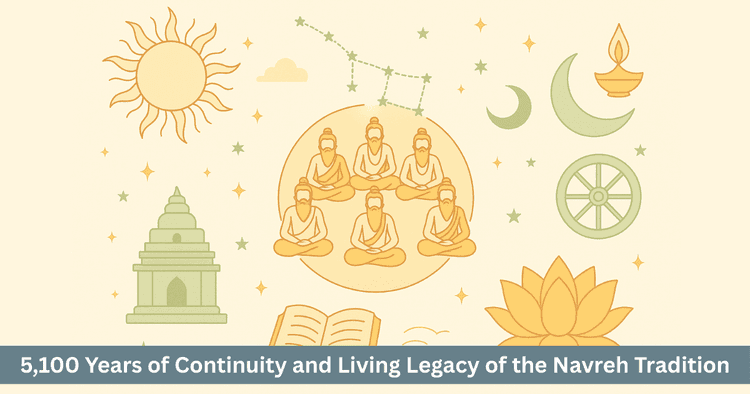
Table of Contents
The Kashmiri Saptarishi Panchang represents one of the oldest continuously functioning calendar systems in the world, serving as a living testament to Kashmir's profound Vedic civilization spanning over 5,100 years. This ancient lunisolar calendar, rooted in astronomical observations and spiritual traditions, embodies the essence of Vedic chronology and continues to guide the religious, cultural and agricultural life of Kashmiri Pandits despite centuries of historical upheaval. The Saptarishi Samvat is living evidence of Kashmir's civilization and its continuity for over 5,100 years.
Historical Origins and the 3076 BCE Epoch
The Saptarishi Samvat traditionally has its epoch at 3076 BCE, making it one of the most ancient calendar systems still in active use. The calendar's name derives from the Saptarishi meaning Seven Sages or Seven Rishis, referring to the seven revered sages of Hindu mythology namely Kashyapa, Atri, Bharadvaja, Vishvamitra, Gautama, Jamadagni and Vashistha who are believed to guide humanity through different ages or Yugas.
The calendar's origin is tied to the astronomical position of the Saptarishi constellation known as Ursa Major or the Big Dipper in Western astronomy. According to Vedic astronomical tradition, the calendar was established when this constellation reached a particular celestial position, marking the beginning of a new time cycle.
Legendary Foundation at Hari Parbat
According to Kashmiri tradition documented in the Nilamata Purana, the Saptarishis once assembled at Hari Parbat meaning Sharika Parbat, the sacred abode of Goddess Sharika. They gathered to pay obeisance to her Swayambhu Shrichakra form. When the first beam of sunlight touched the divine Shrichakra on the auspicious morning of Chaitra Shukla Pratipada meaning the first day of the bright fortnight of Chaitra, this sacred moment formed the basis of calculations for Navsamvatsara meaning New Year and the beginning of the Saptarishi Era.
Astronomical Cycle
The Saptarishi calendar is based on a cycle system where specific astronomical configurations recur periodically. Historical references indicate sophisticated understanding of celestial mechanics among ancient Vedic astronomers, who tracked stellar positions, planetary movements and their correlations with terrestrial events.
Contemporary with Yugabda
The Saptarishi Samvat is contemporary with the Yugabda Samvat, the oldest almanac in all of Bharatvarsha, which was established 26 years ahead of Saptarishi Samvat meaning in 3102 BCE. While Yugabda Samvat is currently observing year 5125, Saptarishi Samvat celebrated its 5100th year in 2024 meaning April 9, 2024. Both calendars are based on the lunisolar system of astronomical calculations where solar and lunar years are recognized as complementary and supplementary to each other.
Global Context
The Saptarishi Samvat stands among the oldest almanacs in the world, contemporary with ancient Egyptian, Assyrian, Babylonian, Chinese and Mesoamerican calendars. however unlike most of these ancient systems which have ceased to be functional, both Yugabda and Saptarishi Samvats remain working and living entities used for practical purposes.
Lunisolar Calendar Structure
Hybrid System
The Kashmiri Panchang is a sophisticated lunisolar calendar that integrates both lunar phases for determining festival dates and solar movements for tracking seasonal changes. This dual framework ensures synchronization with both agricultural cycles and religious observances. The calendar combines the Hindu Solar Calendar tradition based on Saptarishi Samvat with lunar elements, creating a comprehensive timekeeping system. Over centuries, it has also incorporated aspects of the Islamic Hijri Calendar and the Gregorian Calendar, reflecting the region's diverse cultural heritage.
Lunar Month System
The Kashmiri calendar follows the Amanta lunar tradition, where months end on Amavasya meaning new moon day and begin the day after. Each month is divided into two Pakshas meaning fortnights: Shukla Paksha meaning waxing phase from new moon to full moon and Krishna Paksha meaning waning phase from full moon to new moon.
Twelve Months
The Kashmiri calendar consists of 12 months with names derived from Sanskrit, reflecting its deep Vedic roots.
| Kashmiri Month | Sanskrit Origin | Gregorian Period |
|---|---|---|
| Chet | Chaitra | March to April |
| Vaisakh | Vaishakha | April to May |
| Jeth | Jyeshtha | May to June |
| Har | Ashadha | June to July |
| Sawan | Shravana | July to August |
| Bhadoon | Bhadrapada | August to September |
| Asuj | Ashwin | September to October |
| Kartik | Kartika | October to November |
| Mangir | Margashirsha | November to December |
| Poh | Pausha | December to January |
| Magh | Magha | January to February |
| Phagun | Phalguna | February to March |
The Five Elements of Panchang
The Kashmiri Panchang incorporates all five traditional Vedic astronomical components known as Pancha-Anga, providing comprehensive astrological guidance for daily life.
- Tithi or Lunar Day: The angular distance between Sun and Moon, with 30 tithis in each lunar month. Tithis determine fasting days, rituals and festivals.
- Nakshatra or Star Constellation: The 27 lunar mansions through which the Moon transits. Nakshatras are crucial for preparing birth horoscopes, naming ceremonies and selecting auspicious dates for weddings.
- Yoga: Specific angular relationships between Sun and Moon, with 27 yogas recognized, each having distinct astrological significance.
- Karana: Half of a tithi, with 11 types of Karanas recurring in specific patterns.
- Vara or Weekday: Seven days based on celestial bodies, used for determining auspicious timings for daily activities.
The Panchang combines lunar and solar movements to determine auspicious timings known as muhurtas for important life events including weddings, housewarmings, thread ceremonies known as Yagnopavit, religious rituals and agricultural activities. For generations, Kashmiris have relied on the Panchang to harmonize daily life with cosmic rhythms, preserving a sacred connection between time, nature and destiny.
Navreh The Kashmiri New Year
Date and Significance
Navreh derived from Sanskrit Nav-Varsh meaning New Year is celebrated on Chaitra Shukla Pratipada the first day of the bright fortnight of the month of Chaitra, marking the beginning of the new lunar year in the Kashmiri calendar. This typically falls in late March or early April according to the Gregorian calendar. In 2025, Navreh falls on March 30.
Historical Significance
The Nilamata Purana, the oldest indigenous Purana of Kashmir, mentions Navreh as Navavar Shotsava and describes how joyously it was celebrated in ancient times among the Kashmiri Pandit community. The festival also commemorates the victory of King Chandragupta Maurya over the Shakas. Navreh marks the day when the new Panchang or Almanac with astrological data of auspicious days and related information for the new Hindu calendar year in Kashmir is published. The calendar year of Saptarishi itself reveals the antiquity of Kashmiri civilization.
Dual Calendar System
Interestingly, Kashmiri calendar observes two New Year traditions.
- Navreh: The new moon day meaning Amavasya of Chaitra, celebrated as the beginning of the lunar year.
- Sonth: The first day of the solar calendar in Chaitra, marking the spring season.
Thaal Barun The Sacred Pre-New Year Ritual
Ritual Preparation
The most cherished tradition associated with Navreh is Thaal Barun performed on the night before the New Year. The term means filling the plate and represents a symbolic preparation for prosperity in the coming year.
Ritual Elements
On the evening before Navreh meaning the night of Chaitra Sud Okdoh, the eldest lady of the household fills a large decorative plate or Thali with uncooked rice and arranges various symbolic items on it.
- New Janthari or Panchang: The new almanac, occupying the place of honor.
- Rice: The principal diet guaranteeing abundance.
- Walnuts: In odd numbers meaning 3, 5 or 7, symbolizing regeneration and stability.
- Coins and gold ornament: A ring or bangle representing prosperity.
- Mirror: For dispelling evil influences.
- Katori with yogurt: Symbolizing fullness and stability.
- Pen with inkpot: Representing education, wisdom and knowledge.
- Fresh seasonal flowers: A twig, often of Vaagur meaning willow.
- Pinch of salt: For preservation.
- Lump of cooked rice: Sustenance.
- Piece of bread or Kulcha: Nourishment.
All items are arranged on the rice-filled Thali according to family traditions, creating a sacred tableau of prosperity symbols.
Buth-Vuchun Ceremony
On the early morning of Navreh, before sunrise, all family members perform the Buth-Vuchun ritual viewing the Thali with all its arranged items as the first thing they see upon waking. They especially look at their faces in the mirror placed on the Thali. This first viewing or darshan of auspicious items is believed to determine and influence one's fortune for the entire year ahead.
The ritual embodies the principle that what you see first on New Year's day shapes your destiny for the year. The mirror viewing is particularly significant, believed to dispel all evil influences present in the house and guarantee a carefree time ahead.
Post-Ritual Customs
After the Buth-Vuchun ceremony, the walnuts are thrown into flowing water as an offering and the rice is used to prepare Taher meaning yellow cooked rice which is consumed as Prasad meaning blessed food.
Kashmiri Panchang Tradition Nechipattri
Annual Publication
The Kashmiri Panchang, locally called Nechipattri, is provided annually by the Kulguru meaning family priest of Kashmiri Hindu families. This almanac contains comprehensive astrological data including planetary positions, tithis, nakshatras, muhurtas and predictions for the year.
Krichi Pattri
Along with the Panchang, an ornate scroll called Krichi Pattri featuring an image of Goddess Sharika is also provided. This decorative element connects the calendar to Kashmir's indigenous goddess tradition centered at Hari Parbat.
Jyotshi Families
The tradition of preparing and publishing annual Kashmiri Panchangs has been maintained by specialized Jyotshi meaning astrologer families, particularly those from Bijbihara in Kashmir. These families have preserved this knowledge through generations, ensuring continuity of the Saptarishi calendar tradition even during the forced exile of Kashmiri Pandits over the past three decades.
Six Seasons Shadharitu System
The Kashmiri calendar follows the ancient Vedic concept of Shadharitu meaning six seasons, adapted to Kashmir's unique climatic conditions.
Standard Six Seasons
- Vasant: Spring
- Greesham: Summer or Hot Season
- Varsha-Ritu: Rainy Season
- Sharad: Pre-Autumn
- Hemant: Autumn
- Shishir: Winter
Kashmiri Adaptation
In practice, Kashmir observes five seasons with appropriate Kashmiri names derived from Sanskrit originals.
- Sonth: From Vasant meaning Spring, lasting two months.
- Garmi: From Greesham meaning Summer, two months.
- Vehraat: From Varsharitu meaning Rainy season, two months.
- Harud: Amalgamation of Sharad and Hemant meaning Autumn, three months.
- Shisher-maas: From Shishir meaning Winter, three months.
The first three seasons consist of two months each, while the last two comprise three months each, totaling the twelve months of the year.
Major Kashmiri Hindu Festivals
The Kashmiri calendar determines dates for major festivals celebrated by Kashmiri Pandits.
- Navreh or Kashmiri New Year: Chaitra Shukla Pratipada, March to April.
- Herath or Kashmiri Shivratri: The most important festival for Kashmiri Pandits, celebrated with unique traditions distinct from Shivratri in other parts of India, typically in February to March.
- Zyeth Atham: Celebrated during Jyeshtha month in June.
- Mela Kheer Bhawani: An important pilgrimage to the sacred spring of Goddess Ragnya Devi at Tulmul village, celebrated in June.
- Janmashtami: Lord Krishna's birth anniversary in August.
- Diwali: Festival of lights in October to November.
Agricultural Integration
The Kashmiri Panchang is deeply integrated with the region's agricultural cycles. The calendar's structure aligns with seasonal changes, weather patterns, cropping cycles and socio-economic activities specific to Kashmir valley's unique climate. Farmers traditionally consult the Panchang to determine optimal times for sowing and harvesting crops, tracking weather cycles, solstices and eclipses before making major agricultural decisions.
Civilizational Continuity and Revival
Living Evidence
The Saptarishi Samvat serves as living evidence of Kashmir's civilization and its continuity for over 5,100 years. It represents one of four important pillars of Kashmiri civilization, alongside ancient art and architecture, written monumental compendiums and working cultural traditions.
Indigenous Identity
The calendar establishes that Kashmiri Pandits are the original indigenous inhabitants of Kashmir, with documented continuity spanning millennia. Both Kashmiri Pandits and Kashmiri Muslims are fundamentally the sole inheritors of the civilizational ethos and legacy of Kashmir.
Preservation in Exile
Despite their forced displacement over the past 35 years, Kashmiri Pandits have continued observing Navreh, maintaining the tradition of publishing yearly almanacs and celebrating their civilizational connect with Kashmir. This demonstrates the resilience and enduring vitality of the Saptarishi calendar tradition.
Digital Revival
Modern technology has facilitated the preservation and accessibility of the Kashmiri calendar through mobile apps, Panchang websites and online heritage projects. Scholars and cultural organizations are actively documenting and reviving the traditional Kashmiri timekeeping system, ensuring its transmission to future generations.
Contemporary Relevance
The Kashmiri Panchang remains essential for determining religious festivals, astrological consultations for weddings meaning selecting auspicious dates called Saath, naming ceremonies for newborns and planning important life events. Local astrologers continue to prepare personalized horoscopes and provide guidance based on the traditional Saptarishi Samvat calculations.
Frequently Asked Questions
When did the Saptarishi Samvat originate?
The Saptarishi Samvat was traditionally established in 3076 BCE, making it one of the oldest calendar systems still in active use.
What is the significance of Navreh?
Navreh is the Kashmiri New Year celebrated on Chaitra Shukla Pratipada and is associated with the Thaal Barun ritual that symbolizes prosperity for the coming year.
What is the Thaal Barun ritual?
Thaal Barun is a ritual performed on the night before Navreh where a plate is arranged with rice, Panchang, walnuts, mirror and other auspicious items which are viewed first thing in the morning.
How many seasons are in the Kashmiri calendar?
The Kashmiri calendar follows five seasons: Sonth meaning Spring, Garmi meaning Summer, Vehraat meaning Rainy, Harud meaning Autumn and Shisher-maas meaning Winter, adapted from the Vedic Shadharitu system.
Why is the Saptarishi Samvat still maintained today?
The Saptarishi Samvat is living evidence of Kashmiri Pandits' indigenous identity, civilizational continuity and Vedic heritage that guides religious festivals and cultural rituals.
Get your accurate Kundali
Generate KundaliDid you like it?
Author

Pt. Abhishek Sharma (63)
Experience: 20
Consults About: Family Planning, Career
Clients In: Punjab, Haryana, Delhi
Share this article with friends and family
WELCOME TO
ZODIAQ
Right Decisions at the right time with ZODIAQ
