North vs South Indian Panchang: Core Differences and Understanding
By Pt. Abhishek Sharma
A Complete Comparison of the Purnimanta and Amanta Systems
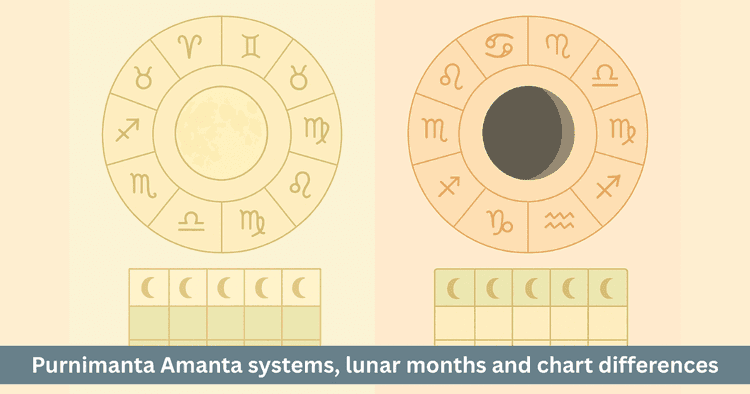
Table of Contents
The Panchang is an integral part of Indian culture, guiding religious rituals, festivals, muhurta determination and daily life activities. however across India's vast geography, two primary Panchang traditions prevail the North Indian Panchang and the South Indian Panchang. Although both are rooted in Vedic principles and calculate the Panch Anga (five elements: Tithi, Vara, Nakshatra, Yoga, Karana), fundamental differences in how lunar months are defined create significant variations between them. In this article, we will comprehensively understand the differences between these two Panchang systems.
Primary Difference: Purnimanta and Amanta Systems
The most prominent difference between North and South Indian Panchangs is whether the lunar month ends on Amavasya (new moon) or Purnima (full moon). This difference fundamentally alters the month calculation methodology.
Purnimanta System: North Indian Tradition
Purnimanta means ending on the full moon. In this system, the lunar month ends on Purnima day and the new month begins the next day. This system is predominantly followed in North and Northwest India. The Purnimanta system is considered the original Vedic-era system and is historically the older tradition.
Primary States: Bihar, Chhattisgarh, Haryana, Himachal Pradesh, Jammu and Kashmir, Jharkhand, Madhya Pradesh, Odisha, Punjab, Rajasthan, Uttarakhand and Uttar Pradesh. Nepal also follows the Purnimanta Panchang.
Structure: In this system, the month begins the day after Purnima. The first fortnight is Krishna Paksha (waning moon) and the second fortnight is Shukla Paksha (waxing moon). Thus, the month begins with Krishna Paksha and ends with Shukla Paksha.
Associated Calendar: Vikram Samvat is associated with the Purnimanta system. The Vikram Samvat era began in 57 BCE, making it approximately 56-57 years ahead of the Gregorian calendar.
Amanta System: South Indian Tradition
Amanta means ending on the new moon. In this system, the lunar month ends on Amavasya day and the new month begins the next day. This system is predominantly followed in South and East India. The Amanta system developed in the post-Vedic period and is considered a later adaptation.
Primary States: Andhra Pradesh, Assam, Gujarat, Goa, Karnataka, Kerala, Maharashtra, Tamil Nadu, Telangana, Tripura and West Bengal.
Structure: In this system, the month begins the day after Amavasya. The first fortnight is Shukla Paksha (waxing moon) and the second fortnight is Krishna Paksha (waning moon). Thus, the month begins with Shukla Paksha and ends with Krishna Paksha.
Associated Calendar: Shalivahana Shaka Samvat is associated with the Amanta system. The Shalivahana Shaka era began in 78 CE and was adopted as India's National Calendar in 1957.
Comparative Structural Differences
| Aspect | Purnimanta (North India) | Amanta (South India) |
|---|---|---|
| Month Ends On | Purnima (Full Moon) | Amavasya (New Moon) |
| Month Begins On | Day after Purnima | Day after Amavasya |
| First Fortnight | Krishna Paksha (Waning) | Shukla Paksha (Waxing) |
| Second Fortnight | Shukla Paksha (Waxing) | Krishna Paksha (Waning) |
| Cycle | Purnima to Purnima | Amavasya to Amavasya |
| Origin | Vedic origin, older system | Post-Vedic adaptation |
| Associated Era | Vikram Samvat | Shalivahana Shaka Samvat |
There is a significant difference in the structure of Pakshas. In the Amanta calendar, the first 15 days are Shukla Paksha followed by the next 15 days as Krishna Paksha. Conversely, in the Purnimanta calendar, Krishna Paksha comes first followed by Shukla Paksha.
15-Day Difference in Month Names
Due to different ending points, there is approximately a 15-day shift in when month names change. The Purnimanta calendar switches month names one Paksha (fortnight) earlier than the Amanta calendar.
Example: When the Amanta tradition is just starting Chaitra masa, the Purnimanta tradition will have already advanced one full Paksha into Chaitra masa. What is called Phalguna Amavasya in the Amanta tradition is called Chaitra Amavasya in the Purnimanta tradition.
This creates a situation where on the same date, North and South Indian Panchangs may display different month names, despite tracking the same lunar cycle. however this difference is purely nomenclatural and relates only to the timing of month transitions.
Month Name Change Table
| Lunar Position | Purnimanta Month | Amanta Month | Difference |
|---|---|---|---|
| Chaitra Krishna Paksha | Chaitra | Phalguna | 15-day difference |
| Chaitra Shukla Paksha | Chaitra | Chaitra | Same name |
| Vaishakha Krishna Paksha | Vaishakha | Chaitra | 15-day difference |
| Vaishakha Shukla Paksha | Vaishakha | Vaishakha | Same name |
As shown in the table, month names differ during Krishna Paksha but remain the same during Shukla Paksha. This 15-day difference continues throughout the year.
Uniformity in Festivals and Tithis
Despite the 15-day difference in month onset, there is no difference in festival dates between North and South Indian Panchangs. Festivals are celebrated based on the specific lunar phase (Tithi) rather than calendar dates, ensuring uniformity across regions.
Important Point: Both systems track the same lunar phases, so the actual Tithi, Nakshatra, Yoga and Karana calculations remain synchronized. Festivals fall on the same Tithi in both calendars, though the month name associated with that Tithi may differ by approximately 15 days.
Festival Date Examples
| Festival | Tithi | Purnimanta Month | Amanta Month | Actual Date |
|---|---|---|---|---|
| Diwali | Amavasya | Kartik | Ashwin | Same |
| Holi | Purnima | Phalguna | Phalguna | Same |
| Raksha Bandhan | Purnima | Shravana | Shravana | Same |
| Janmashtami | Krishna Paksha Ashtami | Bhadrapada | Shravana | Same |
| Mahashivaratri | Krishna Paksha Trayodashi | Phalguna | Magha | Same |
As evident from the table, the month names associated with festivals may differ but the actual date and celebration day remain the same.
Auspicious Muhurtas and Inauspicious Periods
Calculations for auspicious muhurtas and inauspicious periods are also identical in both Panchang systems because they are based on Tithi, Nakshatra, Yoga and Karana, which are the same in both. Rahu Kaal, Yamagandam, Gulika Kaal, Abhijit Muhurta, etc., are all calculated using the same formulas.
Historical Context and Development
The Purnimanta tradition was followed during the Vedic era and represents the original system. It was later replaced by the Amanta tradition before the 1st century BCE. In 57 BCE, King Vikramaditya restored the Purnimanta tradition in northern regions to return to Vedic roots, though the Amanta system continued in southern regions.
Vikramaditya's Contribution
King Vikramaditya was the great emperor of Ujjain who initiated the Vikram Samvat in 57 BCE after defeating the Shakas. He encouraged the Purnimanta system with the aim of revitalizing Vedic traditions. This decision was of religious and cultural significance because Purnima is considered auspicious and ending the month in Shukla Paksha was deemed more propitious.
Establishment of Shalivahana Shaka
Conversely, in South India, King Shalivahana established the Shalivahana Shaka in 78 CE. This era followed the Amanta system, which was the ancient tradition of the Deccan region. Shalivahana Shaka is recognized as India's National Calendar and is used in government documents.
Solar Calendars: South Indian Specialty
It is important to note that some South Indian states follow solar calendars rather than purely lunar systems. In solar calendars, months are based on the Sun's transit through zodiac signs rather than lunar phases.
Tamil Calendar
The Tamil calendar is a solar calendar where months are based on the Sun's movement through the zodiac cycle. The month names (Chithirai, Vaikasi, Aani, Aadi, Avani, Purattasi, Aippasi, Karthigai, Margazhi, Thai, Maasi, Panguni) differ from standard lunar month names. These Tamil months are actually Sauramana (solar) rashis and should be mapped to zodiac signs like Mesha, Vrishabha, etc. Tamil New Year (Puthandu) is celebrated on the first day of Chithirai month, typically around April 14.
Malayalam Calendar
The Malayalam calendar used in Kerala is also a solar calendar following the Kollam Era and beginning with Medam (April-May). The new year begins with Simha Sankranti. In the Malayalam calendar, the Vishu festival is celebrated as the new year.
Bengali and Odia Calendars
Both Bengali and Odia calendars follow solar-based systems. Month names sound similar to lunar months but are actually solar months. Bengali New Year (Poila Boishakh) and Odia New Year (Maha Vishuva Sankranti) are celebrated with the Sun's entry into Mesha rashi.
Difference in Horoscope Format
The visual representation of the birth chart, a cornerstone of Vedic astrology, also differs significantly between the two traditions.
North Indian Chart
The North Indian chart is diamond-shaped. Houses are in fixed positions, with the first house (Ascendant) always at the top. The zodiac signs rotate through the chart based on birth details. The chart is read anti-clockwise. This format is visually unique and immediately recognizable.
Features: Houses remain fixed, signs rotate. Ascendant is marked with a triangle or special symbol. Planets are placed according to their sign position.
South Indian Chart
The South Indian chart is square-shaped. Zodiac signs are in fixed positions (Aries is always the second box from the top left, etc.). Houses rotate and the Ascendant is marked to indicate the first house. This chart is read clockwise.
Features: Signs remain fixed, houses rotate. Ascendant is marked with a diagonal line or "As". Each sign's position is predetermined, making sign visualization easier.
Panchang Methods: Vakya and Drik
Two primary Panchang calculation methods are prevalent, differing mainly in planetary position calculations.
Vakya Panchang
Vakya Panchang is the traditional method using fixed verse tables from the Surya Siddhanta text. This method preserves traditional tabular positions for Sun and Moon that can diverge from modern computations by hours for transits and eclipses. Vakya Panchang is predominantly followed in Tamil Nadu where traditional temples adhere to it.
Features: Based on Surya Siddhanta, traditional calculation method, some divergence from modern astronomical calculation, prevalent in temples.
Drik/Thirukanitha Panchang
Drik or Thirukanitha Panchang uses computed positions from modern ephemera
ides or the national ephemeris while applying the same Vedic festival rules. Differences are in astronomical longitudes, not ritual methodology. Drik Panchang is considered more accurate and aligned with scientific calculations.
Features: Modern astronomical calculation, higher accuracy, precise eclipse and sankranti calculation, wider acceptance.
Geographical Distribution
The Purnimanta system is dominant in northern and northwestern states such as Uttar Pradesh, Rajasthan, Punjab, Haryana and Bihar. Many Hindus in Nepal also follow it.
The Amanta system predominates in southern and eastern states including Maharashtra, Gujarat, Karnataka andhra Pradesh, Telangana, Tamil Nadu, Kerala, Assam, West Bengal, Goa and Tripura.
State-wise Distribution Table
| Region | System | Primary States |
|---|---|---|
| North India | Purnimanta | Uttar Pradesh, Bihar, Rajasthan, Punjab, Haryana, Madhya Pradesh |
| East India | Amanta | West Bengal, Odisha, Assam, Tripura |
| West India | Amanta | Maharashtra, Gujarat, Goa |
| South India | Amanta (Lunar) / Solar | Karnataka, Andhra Pradesh, Telangana, Tamil Nadu, Kerala |
| Himalayan Region | Purnimanta | Jammu & Kashmir, Himachal Pradesh, Uttarakhand, Nepal |
Practical Implications and Usage
The only practical difference for users is the approximately 15-day variation in how lunar months are named and when month transitions occur. Religious observances, muhurtas and festival dates remain aligned because they are calculated based on universal lunar phases that both systems track identically.
Muhurta Determination
For auspicious activities like weddings, housewarmings and business initiations, muhurta determination follows the same principles in both Panchangs. Auspicious time is derived from the combination of Tithi, Nakshatra, Yoga, Karana and Vara, which is identical in both systems.
Vratas and Fasts
Vratas and fasts are based on Tithis, not month names. therefore Ekadashi, Pradosh, Sankashti Chaturthi, etc., are all observed on the same day in both systems.
Astrological Consultation
When seeking astrological consultation, it is essential to know which system your astrologer follows. Although planetary positions will be the same, the chart format may differ. North Indian astrologers use North Indian charts while South Indian astrologers use South Indian charts.
National Panchang: Attempt at Unification
Acknowledging these regional variations, the Government of India established the National Panchang based on the Shalivahana Shaka Samvat. The National Panchang is used in government documents, news broadcasts and official communications. It uses modern astronomical tables and provides uniformity in planetary positions.
Features of National Panchang:
Based on Shalivahana Shaka, begins on March 22 (or March 21 in leap years), solar month system, modern astronomical calculation, government recognized.
Important Points to Understand
To understand both Panchang systems, certain important points must be kept in mind.
Same Vedic Basis: Both systems are based on Vedic principles. Fundamental astrological calculations are the same.
Only Nomenclature Difference: The main difference is in the timing of month names, not in calculations. Tithi, Nakshatra, etc., are the same in both.
Festivals Same: All major festivals are celebrated on the same day in both systems because they are based on Tithi.
Regional Tradition: It is appropriate to follow the system prevalent in a particular region. Local temples and priests follow that system.
Chart Format: Chart format differs but planetary positions and house interpretations remain the same.
Frequently Asked Questions
Question 1: Are festivals celebrated on different days in North and South India?
No, all major festivals are celebrated on the same day in both regions because they are based on Tithi, which is the same in both systems.
Question 2: Which system is older, Purnimanta or Amanta?
The Purnimanta system is older and is considered the original Vedic-era system. The Amanta system developed in the post-Vedic period.
Question 3: If I migrate from North India to South India, which Panchang should I follow?
You should follow the local Panchang of your current place of residence. Local temples and community follow that system.
Question 4: Is there a difference in horoscope matching between the two systems?
The horoscope matching calculation method is the same. Only the visual chart format differs but planetary positions and guna milan (compatibility) remain identical.
Question 5: Which system is the National Panchang based on?
The National Panchang is based on Shalivahana Shaka Samvat, which is originally associated with the South Indian tradition but it uses a modern solar month system.
What does moon sign reveal about me?
My Moon SignDid you like it?
Author

Pt. Abhishek Sharma (63)
Experience: 20
Consults About: Family Planning, Career
Clients In: Punjab, Haryana, Delhi
Share this article with friends and family
WELCOME TO
ZODIAQ
Right Decisions at the right time with ZODIAQ
