Tamil Panchang The Pure Solar Calculation Tradition
By Pt. Narendra Sharma
Distinctive Calendar System Based on Solar Transit
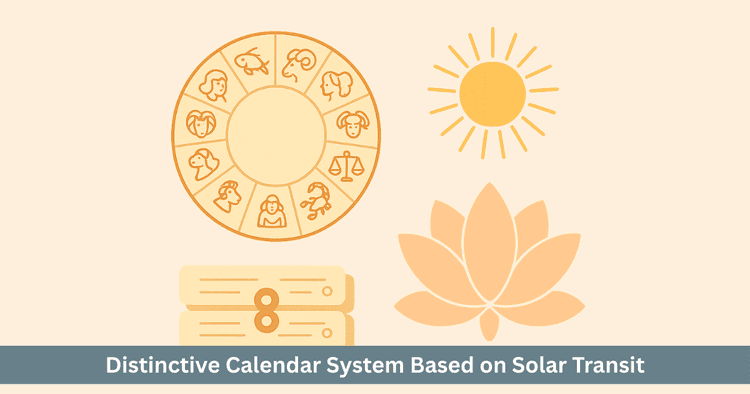
Table of Contents
The Tamil Panchang stands as one of the most distinctive astronomical traditions in the Indian subcontinent. It differs from most other Indian calendars in its adherence to a pure solar calculation system rather than the lunisolar framework employed by systems like Vikram Samvat and Shaka Samvat. While lunisolar calendars combine lunar months with solar adjustments, the Tamil calendar defines its months based solely on the Sun's transit through the twelve signs of the zodiac. This tradition forms an integral part of Tamil culture, religious observances and agricultural activities.
Historical Foundation and Vedic Basis
The Tamil calendar has ancient roots documented in early Tamil literature from the Sangam period. Nakkeerar, a third-century CE author, wrote in his work Netunalvatai that the Sun travels each year from Mesha (Aries) in mid-April through eleven successive signs of the zodiac. The same astronomical observation was referenced by Kudalur Kizhar in Purananuru. Tolkappiyam, the oldest surviving Tamil grammar text, divides the year into six seasons with Chittirai marking the start of the Ilavenil (summer) season.
The fifth-century CE treatise Cilappatikaram mentions the twelve rashis (zodiac signs) corresponding to Tamil months, while the sixth-century epic Manimekalai alludes to the Hindu solar calendar. Inscriptional evidence from Pagan in Myanmar (eleventh century CE) and Sukhothai in Thailand (fourteenth century CE) indicates that South Indian courtiers were tasked with defining the traditional calendar that followed this solar cycle.
The Tamil calendar is based on the Hindu system of calendrics derived from astronomical data, with the Tirukkanida Panchanga serving as the foundational reference. The system is categorized as a Nirayana (sidereal) calendar, meaning it follows the fixed zodiac based on the positions of stars rather than the tropical zodiac used in Western astrology.
Pure Solar Month Calculation
The most important feature of the Tamil calendar is that each Tamil month is based entirely on the Sun's transition from one rashi (zodiac sign) to another. This transition is called Sankranti. If the Sankranti occurs before sunset, the new month begins on that same day. Unlike lunisolar calendars that integrate both lunar phases and solar movements, the Tamil calendar employs an exclusively solar-based month system.
Each of the twelve Tamil months is named after the Nakshatra (star constellation) that appears on the Purnima (full moon) at the start of that solar month. The duration of each month equals the time the Sun takes to travel through one zodiac sign, which ranges from twenty-nine to thirty-two days. This variation occurs because Earth's orbit is elliptical, causing the Sun's apparent speed to vary.
The Twelve Solar Months
| Tamil Month | Transliteration | Rashi | Nakshatra | Gregorian Period | Days |
|---|---|---|---|---|---|
| Chittirai | Chittirai | Mesha (Aries) | Chittirai | Mid-April to Mid-May | 30-31 |
| Vaikasi | Vaikasi | Vrishabha (Taurus) | Visakam | Mid-May to Mid-June | 31-32 |
| Ani | Ani | Mithuna (Gemini) | Anusham | Mid-June to Mid-July | 31-32 |
| Adi | Adi | Kataka (Cancer) | Pooradam/Uthiradam | Mid-July to Mid-August | 31-32 |
| Avani | Avani | Simha (Leo) | Thiruvonam | Mid-August to Mid-September | 31-32 |
| Purattasi | Purattasi | Kanya (Virgo) | Pooratathi/Uthiratathi | Mid-September to Mid-October | 30-31 |
| Aippasi | Aippasi | Tula (Libra) | Ashvini | Mid-October to Mid-November | 29-30 |
| Kartikai | Kartikai | Vrischika (Scorpio) | Kartikai | Mid-November to Mid-December | 29-30 |
| Margazhi | Margazhi | Dhanus (Sagittarius) | Mirgashirsham | Mid-December to Mid-January | 29-30 |
| Tai | Tai | Makara (Capricorn) | Pusham | Mid-January to Mid-February | 29-30 |
| Masi | Masi | Kumbha (Aquarius) | Magham | Mid-February to Mid-March | 29-30 |
| Panguni | Panguni | Meena (Pisces) | Uttiram | Mid-March to Mid-April | 30-31 |
A Tamil calendar year consists of three hundred sixty-five or three hundred sixty-six days, aligning closely with the solar year.
Tamil New Year Puthandu
The Tamil New Year, known as Puthandu, begins when the Sun enters the first sign of the sidereal zodiac, Aries (Mesha rashi). This event is called Mesha Sankranti. It typically falls on April fourteenth of the Gregorian calendar and marks the start of the first month, Chittirai. This date is calculated based on the Nirayana system by adding the days corresponding to the twenty-three degrees of axial oscillation to the vernal equinox.
This same solar transition is celebrated across other Indian states under different names. In Assam it is Bihu, in Bengal Pohela Boishakh, in Kerala Vishu, in Odisha Vishuva Sankranti, in Punjab Vaisakhi and in Tamil Nadu Puthandu. This uniformity demonstrates the deep unity of Indian calendric tradition.
Distinction from Lunisolar Calendars
The Tamil calendar month starts several days after the corresponding Hindu lunar calendar month because the Tamil system is purely solar while most other Indian calendars are lunisolar. This fundamental distinction eliminates the need for Adhik Masa (intercalary month) adjustments that lunisolar calendars require to synchronize lunar months with the solar year.
The solar focus means Tamil months are directly correlated with the twelve zodiac signs (Rashis) rather than lunar phases. This alignment makes the Tamil calendar structurally similar to the Malayalam, Bengali and Odia calendars, which also follow solar systems. This feature keeps the Tamil calendar closely aligned with seasons, making it historically significant for agricultural planning.
Vakya and Thirukanitha Panchang - Two Calculation Traditions
Within the Tamil tradition, there are two methods for calculating the astronomical data presented in the Panchang.
Vakya Panchangam (Surya Siddhanta Method)
This traditional system is based on ancient Vedic astronomical texts, particularly the Surya Siddhanta. In ancient times, sages and rishis followed traditional methods documented orally in poetic formats for mnemonic retention. The algorithms for calculating planetary movements, including Rahu and Ketu, followed the Surya Siddhantic system or Vakya Siddhanta.
however modern observations and mathematical calculations have revealed that the Surya Siddhantic system contains inaccuracies, with variations of up to twelve hours in planetary positions. The Vakya system does not account for modern astronomical phenomena like the precession of equinoxes. Despite these known imprecisions, Vakya Panchangam continues to be published annually in Tamil Nadu due to deeply rooted tradition.
Many traditional temples still follow the Vakya system for determining festival dates. Examples include the work of M.S. Pachiappa Mudaliar, various temple Panchangams from Srirangam and Thirunallar and regional variants from Tirunelveli and Ramanathapuram.
Thirukanitha Panchangam (Drik Ganita Method)
The term Thirukanitha means calculated by method in Tamil. This modern computational system uses contemporary astronomical algorithms based on actual observation (drishti equals sight) and calculation (ganita equals calculated). Drik Ganita employs standard ephemeris data to obtain precise positions of celestial bodies. The system uses NASA ephemeris and sophisticated mathematical algorithms to calculate exact planetary positions.
The Government of India has supported modern ephemeris for the National Panchang (Rashtriya Panchang), with the Positional Astronomy Centre in Calcutta publishing the modern Indian Ephemeris since nineteen fifty-seven. Thirukanitha Panchangam aligns with actual observable planetary positions in the sky, making it preferred by astrologers who prioritize scientific accuracy.
Both systems use identical rules to calculate Hindu dates, festivals and tithis. The fundamental difference lies exclusively in the arithmetic methods used to determine celestial body positions. For astrological work requiring precise degree calculations, Thirukanitha is considered more accurate, while Vakya continues to be used for determining religious observances based on tradition.
Five Astronomical Elements (Panchangam)
Despite being a solar calendar, Tamil Panchang incorporates all five limbs (Pancha Anga) of Vedic astronomical calculation.
Tithi (Lunar Day)
Tithi is calculated based on the longitudinal angular difference between the Sun and Moon. There are thirty tithis in a complete lunar cycle. Tithis are divided into Shukla Paksha (waxing period, fifteen tithis from new moon to full moon) and Krishna Paksha (waning period, fifteen tithis from full moon to new moon).
Nakshatra (Constellation)
The twenty-seven star clusters or lunar mansions through which the Moon transits. Each Nakshatra has specific astrological significance. The Moon spends approximately one day in each Nakshatra.
Karana
Karana is half of a tithi. There are eleven unique Karana types occurring sixty times in a lunar month. The eleven Karanas are Bava, Balava, Kaulava, Taitila, Gara, Vanija, Visti, Sakuni, Catuspada, Naga and Kintughna.
Yoga
Specific combinations of Sun and Moon positions, with twenty-seven yogas recognized in Vedic astrology. Certain yogas like Sidha Yoga and Amirtha Yoga are considered particularly auspicious.
Vara (Vasara Solar Day)
The seven weekdays from Sunday to Saturday, each ruled by a planetary deity. Mondays, Wednesdays, Thursdays and Fridays are considered auspicious for commencing new ventures, while Saturdays and Tuesdays are favorable for medical treatments.
Time Divisions
The Tamil Panchang employs traditional Vedic time measurements.
Naligai
The basic unit of time in Tamil (Vedic) astrology, equal to twenty-four minutes. A solar day is divided into sixty Naligais (one thousand four hundred forty minutes or twenty-four hours).
Jamam
Six Naligais constitute one Jamam, equivalent to one hundred forty-four minutes (two hours and twenty-four minutes). A complete day-night cycle comprises ten Jamams five for daytime and five for nighttime.
The Sixty-Year Cycle
The Tamil calendar follows a sixty-year cycle (Shashtipoorti) common to all Hindu traditional calendars, with identical names and sequences. The earliest reference to this cycle appears in the Surya Siddhanta, dated between the fourth and ninth centuries CE. According to Hindu Panchangam, this cycle represents the period when Saturn (Shani), which takes thirty years to orbit the Sun and Jupiter (Vyalan), which takes twelve years, return to the same relative positions.
After sixty years, the calendar restarts with the first year of a new cycle. The current cycle began in nineteen eighty-seven to eighty-eight with Prabhava and will conclude in two thousand forty-six to forty-seven with Akshaya. The year two thousand twenty-five to twenty-six corresponds to Vishvavasva (year thirty-nine of the cycle).
Six Seasons (Ritus)
The Tamil year is divided into six seasons (Ritus), each spanning two months.
| Tamil Season | Sanskrit Season | English Season | Tamil Months | Period |
|---|---|---|---|---|
| Ila-venil | Vasanta | Spring | Chittirai, Vaikasi | Mid-Apr to Mid-Jun |
| Mudhu-venil | Grishma | Summer | Ani, Adi | Mid-Jun to Mid-Aug |
| Kar | Varsha | Monsoon | Avani, Purattasi | Mid-Aug to Mid-Oct |
| Kulir | Sharada | Autumn | Aippasi, Kartikai | Mid-Oct to Mid-Dec |
| Mun-pani | Hemanta | Winter | Margazhi, Tai | Mid-Dec to Mid-Feb |
| Pin-pani | Sishira | Pre-vernal | Masi, Panguni | Mid-Feb to Mid-Apr |
This six-season division reflects the agricultural and climatic realities of the Tamil region and has been documented since the Tolkappiyam period.
Religious and Cultural Applications
Different Panchangam systems serve distinct purposes in Tamil tradition. Vakya Panchangam is primarily employed for calculating sacred days, festivals and religious observances due to its traditional authority. Thirughanita Panchangam is preferred for astrological calculations, horoscope preparation (Jathakam) and determining precise planetary positions.
Major Festivals by Tamil Months
Chittirai (April-May): Puthandu (Tamil New Year) marks the beginning of the year with special prayers, new clothes and festive meals. Chitra Pournami is celebrated on the full moon day dedicated to Lord Chitragupta. This month also sees the grand Chithirai Thiruvizha in Madurai, commemorating the celestial marriage of Lord Sundareswarar (Shiva) with Goddess Meenakshi.
Vaikasi (May-June): Vaikasi Visakam celebrates the birth of Lord Muruga (Kartikeya), the son of Lord Shiva. Grand processions are held at Murugan temples across Tamil Nadu, particularly at Thiruchendur and Palani.
Ani (June-July): Ani Thirumanjanam involves special ablution ceremonies for deities in temples. This month marks the beginning of the monsoon season.
Adi (July-August): Adi Perukku celebrates the rising water levels of rivers, particularly the Kaveri River, thanking water sources for nourishing agriculture. Adi month is especially significant for goddess worship, with numerous festivals dedicated to Mariamman and other village deities.
Avani (August-September): Vinayakar Chaturthi honors Lord Ganesha's birthday with elaborate celebrations, clay idol installations and grand immersion processions. Avani Avittam (Upakarma) is observed by Brahmins for changing their sacred thread.
Purattasi (September-October): Navarathri, the nine-night festival dedicated to Goddess Durga, is celebrated with great devotion. Golu (display of dolls) is a unique Tamil tradition during this time. Purattasi Saturdays are considered auspicious for Lord Venkateswara worship.
Aippasi (October-November): Deepavali (Diwali), the festival of lights, is celebrated with oil lamps, fireworks, sweets and new clothes. In Tamil tradition, it commemorates Lord Krishna's victory over the demon Narakasura.
Kartikai (November-December): Karthigai Deepam, another festival of lights, is celebrated when the moon aligns with the Karthigai constellation. A massive fire is lit atop Thiruvannamalai hill representing Lord Shiva appearing as a column of light. Homes are decorated with rows of oil lamps.
Margazhi (December-January): This month is dedicated to Lord Vishnu worship. Vaikuntha Ekadasi marks the opening of Vaikuntha Dwaram (heaven's gate) in Vishnu temples. The Margazhi music season in Chennai showcases classical Carnatic music and Bharatanatyam performances. Early morning devotional songs called Thiruppavai and Thiruvempavai are recited.
Tai (January-February): Pongal, the most important harvest festival, is celebrated over four days. Bhogi Pongal honors Lord Indra, Thai Pongal (main day) thanks the Sun God, Mattu Pongal honors cattle and Kaanum Pongal is for family gatherings. Thaipusam celebrates Lord Murugan with Kavadi processions where devotees carry decorated structures as offerings and perform acts of penance.
Masi (February-March): Maha Shivaratri, the great night of Lord Shiva, is observed with fasting, night vigils and special temple rituals. Mahamaham festival occurs once every twelve years in Kumbakonam when devotees take sacred baths in the Mahamaham tank.
Panguni (March-April): Panguni Uthiram celebrates the celestial marriage of various divine couples, including Shiva-Parvati and Murugan-Deivayanai. Elaborate processions with deity idols are conducted in major temples.
Scientific and Practical Significance
The pure solar character of the Tamil calendar refers to month demarcation by the Sun's sidereal ingress into each rashi (Sankranti-based boundaries), unlike lunar amanta or purnimanta month endings common elsewhere. This yields stable solar-linked month names while lunar elements drive ritual timings within the day.
Computational diversity persists due to Vakya versus Thirukanitha methods but both remain within Vedic jyotisha doctrine. Both use the same definitions of Tithi, Nakshatra and Sankranti, differing only in how positions are obtained. This duality reflects the richness and depth of Tamil tradition that honors both ancient wisdom and modern science.
The solar month system provides several practical advantages:
- Agricultural activities can be planned reliably since months maintain consistent seasonal alignment
- Festival dates remain relatively stable compared to purely lunar calendars where festivals drift across seasons
- Eliminates the need for intercalary months, simplifying calendar maintenance and reducing confusion
- Accommodates both traditional and modern approaches
Contemporary Usage and Relevance
Today, the Tamil Panchang continues to be an essential tool for Tamil communities worldwide. It is consulted for determining auspicious timings (Muhurtam) for weddings, housewarming ceremonies, business inaugurations and other significant life events. Temple priests rely on it for scheduling daily rituals, festival celebrations and special observances.
Modern technology has made Tamil Panchang accessible through websites, mobile applications and digital almanacs. These tools provide daily Panchang information including sunrise and sunset times, tithi, nakshatra, yoga, karana and auspicious and inauspicious periods like Rahu Kaal and Yamagandam.
Educational institutions in Tamil Nadu often follow the Tamil calendar for academic schedules, aligning summer vacations with the hot season and reopening with the monsoon months. Agricultural cooperatives use it to advise farmers on optimal planting and harvesting times based on seasonal patterns.
Frequently Asked Questions
Question: How does the Tamil calendar differ from other Indian calendars?
Answer: The Tamil calendar is based on pure solar calculation where months begin with the Sun's rashi Sankranti, while most other Indian calendars are lunisolar.
Question: What is the difference between Vakya and Thirukanitha Panchangam?
Answer: Vakya is the traditional method based on ancient Surya Siddhanta while Thirukanitha uses modern astronomical calculations and is more accurate.
Question: When does the Tamil New Year occur?
Answer: Tamil New Year (Puthandu) occurs at Mesha Sankranti when the Sun enters Aries, typically falling on April fourteenth.
Question: Does the Tamil calendar have Adhik Masa (intercalary month)?
Answer: No, being purely solar, the Tamil calendar does not require Adhik Masa adjustments that lunisolar calendars need.
Question: What is the significance of the sixty-year cycle?
Answer: The sixty-year cycle is based on the orbital periods of Saturn and Jupiter, which return to the same relative positions after sixty years.
What does Sun Sign reveal about me?
My Sun SignDid you like it?
Author

Pt. Narendra Sharma (63)
Experience: 20
Consults About: Family Planning, Career
Clients In: Punjab, Haryana, Delhi
Share this article with friends and family
WELCOME TO
ZODIAQ
Right Decisions at the right time with ZODIAQ
