Vikram Samvat, Shaka Samvat & Regional Synthesis
By Pt. Amitabh Sharma
Two Pillars of Indian Timekeeping and a Unique Blend of Panchang Traditions
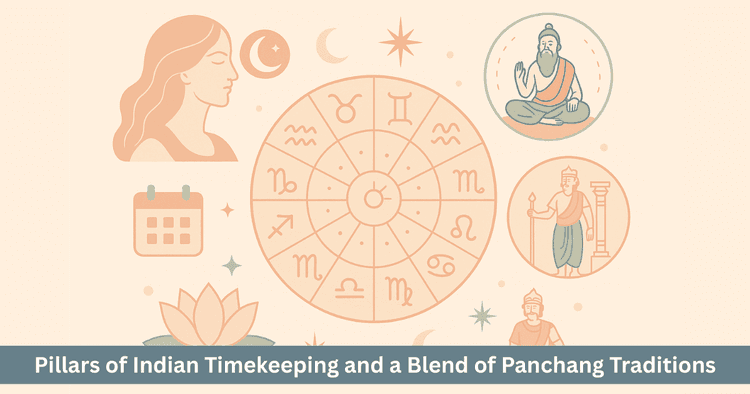
Table of Contents
The Indian subcontinent employs multiple calendar systems that reflect the rich diversity of Vedic timekeeping traditions. Among these, Vikram Samvat and Shaka Samvat stand as the two most prominent calendrical frameworks, each with distinct origins, regional prevalence and computational structures. Both these Samvats are deeply embedded in the religious and cultural life of India and form the backbone of Panchang calculations. While both Samvats are based on lunisolar principles, the fundamental differences between them lie in their starting years, month calculation methods and regional usage. Vikram Samvat is widely used in North and West India along with Nepal while Shaka Samvat is prevalent in the Deccan region and as India's national civil calendar.
Origin and Historical Foundation of Vikram Samvat
Vikram Samvat, also known as Vikrami or Bikrami calendar, is a lunisolar Hindu calendar historically used throughout the Indian subcontinent and still employed in several Indian states and Nepal. According to traditional accounts, King Vikramaditya of Ujjain established this calendar in 57 BCE to commemorate his victory over the Shaka rulers. The famous astronomer Varahamihira assisted King Vikramaditya in expanding the Vikram Samvatsara system.
The Jain text Kalakacharya Kathanaka provides a detailed legendary account stating that King Gandharvasena of Ujjain abducted a nun named Sarasvati, the sister of monk Kalakacharya. The monk sought help from the Shaka ruler King Sahi of Sistan, who defeated Gandharvasena. Later, Gandharvasena's son Vikramaditya invaded Ujjain, expelled the Shakas and initiated the Vikrama era around 58 to 56 BCE.
however modern scholarship reveals that the term Vikrama Samvat does not appear in historical records before the 9th century CE. Earlier inscriptions refer to the same calendar system as Krita meaning 343 and 371 CE, Kritaa meaning 404 CE, the era of the Malava tribe meaning 424 CE or simply Samvat. The earliest inscription calling the era Vikrama dates to 842 CE, while the first literary work associating it with King Vikramaditya is the Jain text Subhashita Ratna Sandoha meaning 993 to 994 CE by Amitagati.
Calendar Structure of Vikram Samvat
Vikram Samvat is a lunisolar calendar using twelve lunar months within each solar sidereal year. The year count is generally 57 years ahead of the Gregorian calendar, except during January to April when it is 56 years ahead. In common years, the calendar has 354 days, with an intercalary month known as Adhik Maas added approximately 7 times every 19 years following the Metonic cycle to ensure festivals align with appropriate seasons.
The Vikram Samvat operates in two systems. It began in 56 BCE in the southern Hindu calendar system known as Amanta and 57 to 56 BCE in the northern system known as Purnimanta. Each month consists of 30 tithis or lunar days that vary in length from 20 to 27 hours. The waxing phase known as Shukla Paksha begins after the new moon and is considered auspicious, while the waning phase known as Krishna Paksha is considered inauspicious.
Twelve Months of Vikram Samvat
| Vikram Samvat Month | Gregorian Months | Days |
|---|---|---|
| Baishakh | April to May | 30 or 31 |
| Jestha | May to June | 31 or 32 |
| Ashadh | June to July | 31 or 32 |
| Shrawan | July to August | 31 or 32 |
| Bhadra | August to September | 30, 31 or 32 |
| Ashwin | September to October | 30 or 31 |
| Kartik | October to November | 29 or 30 |
| Magshir | November to December | 29 or 30 |
| Poush | December to January | 29 or 30 |
| Magh | January to February | 29 or 30 |
| Falgun | February to March | 29 or 30 |
| Chaitra | March to April | 30 or 31 |
A significant feature of Vikram Samvat is that Chaitra, the first month of Shaka Samvat, is the last month of Vikram Samvat. This creates a significant structural difference between the two calendar systems.
New Year Traditions in Vikram Samvat
The Vikram Samvat recognizes multiple New Year traditions depending on region.
- Chaitra Navaratri: Marks the Hindu Lunar New Year, observed in the lunar month of Chaitra meaning March to April and considered the first day of the Hindu calendar.
- Vaisakhi: Marks the Hindu Solar New Year in Punjab and Northern, Eastern, North-eastern and Central India, usually celebrated on April 13 or 14.
- Bestu Varas: Celebrated in Gujarat as New Year on the first day of the bright fortnight of Kartika, following Diwali, symbolizing the beginning of the agricultural year.
Regional Usage of Vikram Samvat
Vikram Samvat is predominantly followed in western and northern India, including Gujarat, Rajasthan, Maharashtra, Uttar Pradesh, Bihar, Madhya Pradesh, Himachal Pradesh, Punjab and Haryana. It serves as the official calendar of Nepal, where it is used for everything from school sessions to legal contracts. The lunar year begins with the new moon of Chaitra month, though Nepal starts its year with Baisakh.
The Hindi version of India's Constitution presents the date of adoption meaning November 26, 1949 in Vikram Samvat as Margsheersh Shukla Saptami Samvat 2006. This demonstrates the historical and constitutional significance of Vikram Samvat.
Origin and Establishment of Shaka Samvat
The Shaka Samvat, also called Shalivahana Shaka era or simply Saka era, is based on the coronation of King Shalivahana of the Shatavahana dynasty in 78 CE. The era corresponds to Julian year 78; thus, adding 78 to any Shaka year yields the corresponding Gregorian year. According to the Kalakacharya Kathanaka, the Shaka era calendar was started in 78 CE at Pratishthana meaning modern Paithan in Maharashtra.
The Government of India adopted the Shaka Samvat as India's National Calendar on March 22, 1957, following recommendations from the Calendar Reform Committee appointed in 1952. The committee identified over 30 well-developed calendars in use across India and sought to create a unified calendrical system. Thus, Shaka Samvat was adopted as India's national civil calendar on Chaitra 1 meaning 1879 Saka.
Calendar Structure of Shaka Samvat
The Shaka calendar consists of 365 days divided into 12 months, structurally similar to the Gregorian calendar. The first month Chaitra begins on March 22 or March 21 during Gregorian leap years. The calendar follows a solar-based system with months aligned to Sankrantis meaning solar transitions.
Twelve Months of Shaka Samvat
| Shaka Samvat Month | Gregorian Months |
|---|---|
| Chaitra | March 21 to April 20 |
| Vaishakha | April 21 to May 21 |
| Jyeshtha | May 22 to June 21 |
| Ashadha | June 22 to July 22 |
| Shravana | July 23 to August 22 |
| Bhadra | August 22 to September 22 |
| Ashwin | September 23 to October 22 |
| Kartika | October 23 to November 21 |
| Agrahayana | November 22 to December 21 |
| Pausha | December 22 to January 20 |
| Magha | January 21 to February 19 |
| Phalguna | February 20 to March 20 or 21 |
The Shaka New Year begins with Gudi Padwa meaning Ugadi in March to April, marking Chaitra 1. This festival is widely celebrated in the Deccan region as the start of the new year.
Regional Usage of Shaka Samvat
Shaka Samvat is predominantly used in the Deccan states of southern and western India, including Maharashtra, Goa, Karnataka andhra Pradesh and Telangana. It serves as India's official civil calendar alongside the Gregorian calendar and is recognized as one of the national symbols of India.
Comparative Analysis of Vikram Samvat and Shaka Samvat
| Aspect | Vikram Samvat | Shaka Samvat |
|---|---|---|
| Starting Year | 57 BCE | 78 CE |
| Age Difference | 135 years older | 135 years younger |
| Calendar Type | Lunisolar meaning 354 days | Solar meaning 365 days |
| Named After | King Vikramaditya | King Shalivahana |
| Year Conversion | Gregorian Year = VS minus 57 | Gregorian Year = Saka plus 78 |
| New Year Start | Kartik meaning after Diwali or Chaitra or Vaisakhi | Chaitra 1 meaning March 22 or 21 |
| First Month | Baishakh meaning varies by region | Chaitra |
| Last Month | Chaitra | Phalguna |
| Regional Use | North & West India, Nepal | South & Central India meaning Deccan |
| Official Status | National Calendar of Nepal | National Calendar of India |
The fundamental difference lies in their month sequences. Chaitra, the first month of Shaka Samvat, is the last month of Vikram Samvat. This creates a significant structural difference in how the year unfolds in each calendar system.
Regional Calendar Synthesis
Beyond Vikram and Shaka Samvats, India employs numerous regional calendars that represent a synthesis of Vedic astronomical knowledge with local traditions.
Malayalam Calendar and Kollam Era
A sidereal solar calendar used in Kerala originating in 825 CE. The Kollam Era commemorates either the foundation of Kollam port after liberation from Chola rule or the memory of Adi Shankaracharya's physical departure in 820 CE. The calendar begins with Chingam meaning Leo sign from August to September rather than Medam. The new year starts with Simha Sankranti and months follow zodiac signs with Malayalam names like Chingam, Kanni, Tulam, Vrischikam, Dhanu, Makaram, Kumbham, Meenam, Medam, Idavam, Mithunam and Karkitakam.
Tamil Calendar
A solar sidereal calendar followed in Tamil Nadu where months are named after zodiac signs like Chithirai, Vaikasi, Aani, Aadi, Avani, Purattasi, Aippasi, Karthigai, Margazhi, Thai, Maasi and Panguni. Months begin on the same day as Sankranti if it occurs before sunset. The Tamil calendar follows the Kali Era and Southern Jovian cycle.
Bengali Calendar and Bengali San
A solar calendar used in West Bengal, Assam and Tripura, following the Bengali San era. Months begin the day after Sankranti if it occurs before midnight; otherwise, they start on the third day.
Odia Calendar and Odia Panji
Used in Odisha, following multiple eras including Bengali San, Saka, Vilayati and Amli. The month begins on the same day as the respective Sankranti.
Kashmiri Calendar and Saptarishi Era
Used by Kashmiri Pandits, following the Saptarishi era dating system.
Other Regional Variants
Additional calendars include the Punjabi calendar meaning Punjab, Gujarati Samvat meaning Gujarat, Sindhi calendar meaning Sindh, Telugu calendar meaning Andhra Pradesh and Telangana, Kannada calendar meaning Karnataka, Nepali calendar meaning Nepal and Sikkim, Maithili calendar, Meitei calendar meaning Manipur and Tibetan calendar meaning Tibet.
Purnimanta and Amanta Systems
A significant difference between Vikram and Shaka Samvats lies in the method of calculating the lunar month. In North India, the Purnimanta system is primarily followed where the month ends on the full moon day and begins with Krishna Paksha. In South India, the Amanta system prevails where the lunar month ends on the new moon day and begins with Shukla Paksha.
This difference can create confusion in festival dates because the same lunar phase may be assigned to different months in different systems. however the calculation of Tithi and Nakshatra remains the same, so the timing of religious rituals stays aligned in both systems.
Contemporary Usage and Practical Significance
Despite the adoption of Shaka Samvat as India's National Calendar in 1957, the Gregorian calendar remains dominant in administrative, educational and commercial spheres. The Vikram Samvat continues to hold symbolic importance for Hindus in northern, western and central India, primarily for determining religious festivals and auspicious occasions. however in Nepal, Vikram Samvat maintains practical significance for all official functions.
Adhik Maas and Lunisolar Adjustment
A significant feature of Vikram Samvat is the inclusion of Adhik Maas or intercalary month. Since the lunar year is approximately 11 days shorter than the solar year, an additional lunar month is added every two to three years. This adjustment ensures that festivals remain aligned with appropriate seasons. Adhik Maas follows the Metonic cycle, which adds approximately 7 intercalary months every 19 years. This month is generally considered inauspicious for religious rituals but auspicious for spiritual practice and charity.
Practical Application of Regional Synthesis in Panchang
In both Vikram and Shaka regions, the five limbs meaning Tithi, Nakshatra, Yoga, Karana and Vara are calculated from sidereal positions for Muhurta and festivals, so the core Vedic rules remain consistent even when the era or year label differs. Regional Panchangs synthesize era counting with local month systems. North and West often use Purnimanta and Vikram year labels while Deccan uses Shaka year labels with Amanta month reckoning, yet festival determinations remain aligned by Tithi rules.
Cultural and Religious Significance
Both Vikram Samvat and Shaka Samvat are deeply embedded in Indian culture and religion. Vikram Samvat is considered a symbol of King Vikramaditya's valor, who was emblematic of justice, wisdom and courage. Shaka Samvat represents the coronation of King Shalivahana and the rich heritage of the Deccan region.
Both Samvats are not merely time calculation systems but symbols of Indian identity, cultural pride and religious continuity. They are a testament to the mathematical and astronomical excellence of ancient Indian astronomers who developed sophisticated systems to harmonize lunar and solar cycles.
Future Relevance and Preservation
In the modern era when the Gregorian calendar has become the global standard, maintaining the relevance of Vikram Samvat and Shaka Samvat is crucial for cultural preservation. These calendars are not only essential for determining religious festivals but also preserve India's rich astronomical and mathematical heritage.
Educational institutions, government bodies and religious organizations should work together to raise awareness about these traditional calendar systems. Digital Panchangs and mobile applications can play a significant role in connecting the modern generation with these calendars.
Final Essence of Synthesis
Vikram Samvat and Shaka Samvat are the two pillars of Indian calendar tradition, reflecting regional diversity and cultural richness. The 135-year difference between them and the various calculation methods highlight the complexity and depth of Indian civilization. The regional synthesis that blends these two Samvats with local traditions forms the foundation of dozens of Panchangs across India. This synthesis is a unique blend of astronomical science and cultural practice, making India a true example of unity in diversity.
India does not have a single unified Hindu calendar. Instead, the Vikram and Shaka eras serve as foundational pillars upon which dozens of regional Panchangs are built. Each regional Panchang is a unique synthesis of astronomical science and local cultural practice, reflecting the cultural and religious plurality of India.
Frequently Asked Questions
What is the main difference between Vikram Samvat and Shaka Samvat?
Vikram Samvat began in 57 BCE and is a lunisolar calendar while Shaka Samvat began in 78 CE and is primarily a solar calendar. There is a difference of 135 years between them.
Why did India adopt Shaka Samvat as the National Calendar?
The Calendar Reform Committee of 1952 recommended Shaka Samvat to unify over 30 different calendars across India because it is solar-based and has a structure similar to the Gregorian calendar.
What is the difference between Purnimanta and Amanta systems?
In the Purnimanta system, the month ends on the full moon and begins with Krishna Paksha, while in the Amanta system, the month ends on the new moon and begins with Shukla Paksha.
What is Adhik Maas and why is it added?
Adhik Maas is an intercalary month added every two to three years to align the lunar year with the solar year so that festivals remain in appropriate seasons.
Which Samvat is official in Nepal?
Vikram Samvat is the official calendar in Nepal and is used for all governmental, educational and legal purposes.
Get your accurate Kundali
Generate KundaliDid you like it?
Author
Pt. Amitabh Sharma (56 Years)
Experience: 20
Consults About: Family Planning, Career
Clients In: Punjab, Haryana, Delhi
Share this article with friends and family
WELCOME TO
ZODIAQ
Right Decisions at the right time with ZODIAQ
