Ancient Indian Solar Instruments for Time Measurement: Bridging Astronomy, Mathematics and Spirituality
By Pt. Narendra Sharma
Scientific and Spiritual Journey of Time Measurement in Ancient India from Sanku-Yantra to Jantar Mantar
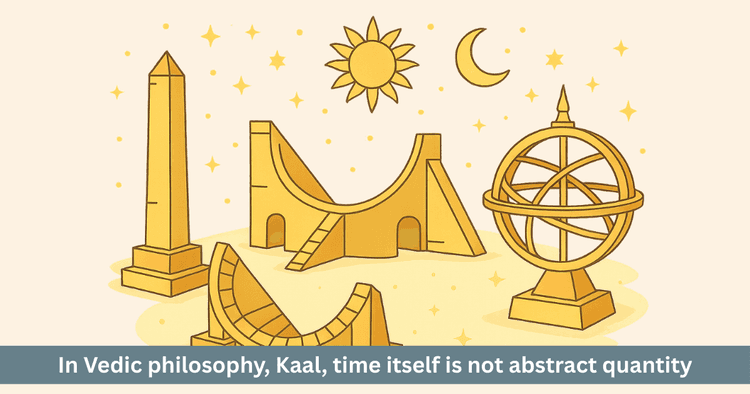
Table of Contents
Long before mechanical clocks ticked away the seconds, long before atomic oscillations defined precision, ancient Indian astronomers developed a sophisticated array of instruments to measure time with remarkable accuracy. These Yantras literally instruments or devices represented far more than technological achievements because they embodied a profound philosophical understanding that time itself constitutes sacred dimension connecting human consciousness with cosmic order.
The story of these instruments reveals an ancient civilization that integrated mathematical rigor, astronomical precision, practical engineering and spiritual wisdom into unified system for reading the universe's rhythm. From the simple shadow-casting gnomon to monumental stone sundials achieving two-second accuracy, these tools demonstrate that humanity's quest to measure time represents ultimately a quest to understand our place within infinite cosmos.
The Philosophical Foundation: Time as Divine Consciousness
Kaal: Time as Brahman
In Vedic philosophy, Kaal time itself is not an abstract quantity but a manifestation of Brahman, the ultimate divine principle underlying all existence. Time represents the mechanism through which infinite consciousness partitions itself into comprehensible segments for human understanding.
Key Philosophical Principles include Time Carries Cosmic Significance. Every moment possesses a distinct quality determined by celestial configurations. The position of the Sun, Moon, planets and stars at any given instant creates unique energetic signature. Actions aligned with these cosmic qualities receive universal support and actions opposing them face resistance. This principle undergirds entire Panchang system and Muhurta auspicious timing calculations.
Ritual Timing Reflects Divine Law. The Vedanga Jyotisha ancient treatise on Vedic timekeeping approximately one thousand BCE explicitly states that determining correct time for rituals represents the highest purpose of astronomical science. Precise timing enables human action to synchronize with cosmic consciousness transforming ritual from mere performance into communion with divine.
Time Embodies Divine Justice. In Hindu philosophy Kaal functions as ultimate arbiter of consequences. Every action planted in time eventually yields harvest and every intention manifested in aligned moment receives cosmic blessing. Time itself enforces universal law because consequences inevitably follow actions through inexorable passage of moments.
The Hierarchy of Vedic Time Units
From the Surya Siddhanta and Mahabharata ancient Indians systematized time into elaborate hierarchical framework reflecting both material precision and spiritual significance. Paramanu is twenty-six point three microseconds representing atomic vibration and ultimate divisibility of time spiritual significance. Truti is four hundred seventy-four microseconds representing blink of eye and moment of consciousness shift. Lav is zero point one second representing duration of basic ritual gesture.
Kashtha is six point four seconds representing duration of short ritual action. Laghu is one point six minutes representing small time interval. Ghatika or Nadika or Danda is twenty-four minutes representing day's sixtieth division and basic timekeeping unit. Muhurta is forty-eight minutes representing auspicious moment for action. Prahara is three hours representing day's eighth division and one-eighth of complete day-night. Ahoratra or Dina is twenty-four hours representing complete day-night cycle.
Mathematical Elegance shows this system demonstrates extraordinary sophistication. Each unit relates to others through consistent mathematical ratios. The fact that time begins with winks of the eye Truti derived from blink suggests ancient recognition that consciousness itself not mechanical process, represents time's ultimate measure.
The Primary Instruments: The Yantras
Sanku-Yantra: The Gnomon Shadow Stick
Description and Principle shows the Sanku-Yantra literally shadow stick instrument represents the most fundamental and widely-used ancient Indian solar instrument. It consists simply of a vertical pole or rod Sanku planted perpendicular into flat horizontal surface. Yet this simplicity conceals profound astronomical principle because as the Sun moves across the sky the shadow cast by the gnomon changes predictably in both length and direction revealing time, direction and seasonal position.
How It Works includes Daily Motion where as Sun moves from east to west throughout the day gnomon's shadow rotates clockwise in Northern Hemisphere. At noon when the Sun reaches its highest point the shadow points true North. At sunrise and sunset the shadow reaches maximum length. Seasonal Variation shows Summer where Sun reaches high altitude and shadow shortest. Winter where the Sun remains low and shadow longest. Equinoxes where shadow length equals gnomon height at specific hours.
Directional Information includes North-South line equals shadow at local noon. East-West line equals shadow at sunrise sunset. Mathematical Calculation uses basic trigonometry where ancient astronomers calculated solar altitude. Tan Solar Altitude equals Gnomon Height divided by Shadow Length. From solar altitude they could determine exact time of day, local latitude through seasonal shadow variations, cardinal directions and date within year through shadow length pattern.
Practical Applications include Temple Orientation where temples were constructed using Sanku-Yantra observations to ensure proper alignment with cardinal directions and solar positions at specific festival dates. Agricultural Timing where farmers used gnomon shadows to identify optimal planting times aligned with solar position in zodiac and seasonal indicators. Ritual Timing where priests consulted gnomon shadows to determine exact moments for Vedic rituals ensuring precise Muhurta auspicious timing.
Accuracy shows Sanku-Yantra could achieve plus minus fifteen to thirty minute accuracy sufficient for practical timekeeping and ritual purposes particularly when combined with other instruments for verification.
Ghatika-Yantra: The Water Clock
Description and Principle shows the Ghatika-Yantra water clock or clepsydra represented revolutionary innovation enabling time measurement independent of solar observation. It consisted of a hemispherical copper bowl with a precisely-drilled tiny hole at bottom. Mechanism shows the copper bowl was placed floating on larger water-filled basin. Gradual Filling where water slowly entered through a precisely-drilled hole at bottom. Controlled Flow where the hole's diameter was carefully calibrated to ensure water entered at precise rate. Complete Cycle where when bowl filled completely it sank beneath water surface with distinctive sound. Time Marker where one complete cycle equals exactly one Ghatika approximately twenty-four minutes. Day Division where entire day-night equals sixty Ghatikas equals twenty-four hours.
Calibration Process shows water clocks required meticulous calibration using solar observations. Measurements compared between water clock cycle and sundial observations during daylight. Hourly adjustments made to hole size until precision achieved. Cross-verification ensured consistency across different seasons.
Advantages Over Sundials include Nighttime Function where unlike sundials dependent on sunlight water clocks operated continuously through night enabling twenty-four hour timekeeping. Weather Independence where cloudy, rainy or overcast conditions didn't affect water clock whereas they rendered sundials useless. Uniform Timekeeping where water flowed at constant rate assuming constant water level providing more uniform time measurement than variable solar shadow movement. Portability where compact compared to large gnomon installations and could be relocated between locations.
Accuracy shows Ghatika-Yantra achieved plus minus two to five minute accuracy superior to most gnomon-based measurement particularly valuable for nighttime ceremonies.
Cultural Significance shows water clocks held sacred status in Indian royal courts and temples. A famous Mughal era miniature painting now at Boston Museum of Fine Arts depicts the birth of Emperor Jahangir with astrologers gathered around ornate water clock to record his exact birth time. The painting symbolizes that time itself measured by Ghatika-Yantra serves as witness to cosmic destiny and determines astrological chart.
Chakra-Yantra: The Circular Disk Sundial
Description shows the Chakra-Yantra circular disk sundial evolved from simple gnomon principle into more sophisticated instrument with multiple calibrations. Components include Circular Disk with metal or stone surface marked with radial lines, Central Gnomon with vertical rod or triangular structure at center, Hour Markings with radial divisions indicating time units typically twelve or twenty-four hours and Latitude Adjustments with curved hour lines accounting for latitude-specific Sun's altitude.
Advantages include Multi-Direction Reading visible from multiple angles, Enhanced Accuracy where curved rather than straight hour lines accounted for celestial mechanics and Seasonal Adjustments where design accommodated seasonal variation in Sun's path.
Dhanu-Yantra: The Semicircular Dial
Description shows the Dhanu-Yantra semicircular altitude instrument specialized in measuring Sun's altitude angle above horizon rather than merely casting shadows. Components include Semicircular Graduated Disk marked in degrees from zero degrees horizon to ninety degrees zenith, Plumb Bob with weight on string ensuring vertical alignment and Sight Lines aligned with Sun's position.
Function shows by measuring Sun's altitude at known times astronomers could determine exact local time, calculate latitude, verify seasonal position and cross-check Chakra-Yantra readings.
Armillary Sphere: The Gola-Yantra
Description shows the Gola-Yantra armillary sphere represented most sophisticated pre-Jantar Mantar instrument. It consisted of concentric metal rings representing celestial coordinate system. Components include Meridian Ring with fixed vertical ring representing North-South line through observer's location, Equatorial Ring with ring perpendicular to meridian representing celestial equator, Ecliptic Ring with ring tilted to represent Sun's annual path, Horizon Ring with ring representing observer's local horizon and Sighting Mechanisms aligned with celestial bodies.
Functions show this instrument enabled astronomers to determine positions of planets and stars, calculate precise time through celestial observations, measure declination angular distance from celestial equator, determine azimuth angle from true North and perform spherical trigonometric calculations.
Accuracy shows armillary spheres achieved plus minus ten to fifteen minute accuracy for time measurement through celestial observations.
The Monumental Achievement: Jantar Mantar
The pinnacle of ancient Indian solar instrument development emerged in the eighteenth century with construction of Jantar Mantar literally place of instruments. These astronomical observatories built by Maharaja Sawai Jai Singh II across India represent supreme achievements of integrating mathematical, engineering and astronomical knowledge.
Vrihat Samrat Yantra: The Great Sundial
Location shows Jantar Mantar Jaipur with principal instrument. Scale and Grandeur includes Height of twenty-seven meters eighty-eight feet, Material with stone construction with precisely graduated marble scales, Design with massive right-angled triangle with gnomon at right-angle apex and Shadow Paths with two quadrant-shaped graduated scales on either side.
Operational Principle shows the triangular structure creates perfect gnomon for its latitude Jaipur at approximately twenty-six point nine degrees North. Gnomon Angle of twenty-six point nine degrees tilted from horizontal matching Jaipur's latitude. Shadow Movement where as Sun moves shadow sweeps across graduated quadrant scales. Time Indication where shadow's position on scale directly indicates local solar time.
Extraordinary Accuracy shows the Vrihat Samrat Yantra achieves plus minus two second accuracy representing remarkable precision achieved purely through geometric design and stone construction without any mechanical components.
Accuracy Mechanisms include Curved Scales Not Straight where the hour divisions aren't evenly spaced straight lines but curved paths accounting for Earth's elliptical orbit varying orbital speed, Earth's axial tilt varying solar altitude and Equation of Time fifteen to thirty minute variation between apparent solar time and mean solar time.
Precise Scale Calibration shows each scale marking was calculated using advanced trigonometry and verified through years of astronomical observation before construction. Quality Stone Work shows the marble scales were cut and polished to accommodate shadows thin enough to register two-second variations representing an extraordinary achievement in stone work.
Practical Use shows the Vrihat Samrat Yantra served multiple purposes including Civil Timekeeping providing accurate local time for administrative purposes, Astrological Calculations determining Sun's exact position for birth chart calculations, Agricultural Timing verifying seasonal transitions for farming, Festival Dating confirming solar festivals like Makar Sankranti and Scientific Research recording long-term solar variations.
Modern Recognition shows UNESCO World Heritage Site designation recognizes Jantar Mantar's historical and scientific significance. The Vrihat Samrat Yantra continues functioning accurately even today where many mechanical clocks in the city remain synchronized with its shadow readings.
Other Jantar Mantar Instruments
Beyond the Vrihat Samrat Yantra Jantar Mantar complexes contained specialized instruments. Jai Prakash Yantra with inverted hemispherical bowl with gridlines enabled observation of entire sky vault from single location and calculated celestial coordinates and time simultaneously. Chakra Yantra with large circular disk for time measurement included horizontal and vertical versions for different observations. Dakshinottara Bhitti Yantra with North-South wall instrument measured Sun's declination throughout year. Digamsa Yantra with azimuth measuring instrument determined angles from true North.
The Process: How Ancient Indians Measured Time Daily
Step One: Sunrise-Sunrise Day Calculation
The fundamental principle of Vedic timekeeping begins with sunrise not midnight. Daily Cycle Division includes Daytime Sunrise to Sunset with fifteen Ghatika approximately twelve hours varying seasonally. Nighttime Sunset to Sunrise with fifteen Ghatika approximately twelve hours varying seasonally. Total of thirty Muhurtas equals twenty-four hours equals one complete day-night.
Seasonal Variation Recognition shows ancient astronomers explicitly recognized that daytime and nighttime hours varied seasonally. Summer where daytime hours exceeded nighttime hours. Winter where nighttime hours exceeded daytime hours. Equinoxes where daytime and nighttime approximately equal. This sophisticated understanding predates modern recognition of this phenomenon by centuries.
Step Two: Multi-Instrument Cross-Verification
Rather than relying on single instrument ancient astronomers employed redundancy principle. Daytime Protocol includes Primary with Sanku-Yantra gnomon shadow observations, Secondary with Chakra-Yantra readings for verification and Tertiary with Dhanu-Yantra altitude measurements. Nighttime Protocol includes Primary with Ghatika-Yantra water clock measurements, Secondary with Astronomical observations using Armillary Sphere and Tertiary with Lunar position observations using established lunar calculations.
Cloudy Weather Protocol includes Exclusive reliance on water clock, Astronomical observations if visible and Previous day's calculated projections. Critical Moments Protocol includes All available instruments employed, Multiple observers recording simultaneously and Cross-verification procedures ensuring accuracy.
Result shows this redundancy system ensured extraordinary reliability. If one instrument failed others provided confirmation. Systematic cross-verification caught errors before recording in official Panchang.
Step Three: Recording in the Panchang
Measured times were meticulously recorded in elaborately detailed Panchangs almanacs which included Tithi with lunar day calculated from measured lunar-solar angle, Nakshatra with lunar constellation Moon's position among twenty-seven nakshatras, Yoga with luni-solar combination quality of time, Karana with half-tithi karmic action potential, Vara with weekday solar day designation, Auspicious Muhurtas with specific time windows optimal for different activities and Inauspicious Periods with Rahu Kaal, Yamagandam, Gulika Kaal timing.
These Panchangs guided all religious, agricultural and social activities across entire population.
Step Four: Long-Term Verification
Annual cycles of observation enabled verification and refinement. Annual Equinox Verification where exact moment of equinox when day and night equal observed using instruments. Compared against calculated predictions. Discrepancies analyzed and formulas refined. Solstice Confirmation where longest day Summer Solstice observations verified Sun's maximum altitude. Shortest day Winter Solstice observations verified Sun's minimum altitude.
Multi-Year Trend Analysis where records spanning centuries accumulated. Patterns identified such as Equation of Time variations. Mathematical models continuously refined. This long-term systematic observation enabled ancient astronomers to identify subtle celestial phenomena and develop increasingly precise predictive models.
Mythological Integration: Time Measurement in Sacred Narrative
Surya Dev: The Divine Timekeeper
In Hindu mythology Surya Dev the Sun God embodies time itself through his daily journey across sky. Mythological Description shows Surya rides golden chariot pulled by seven horses each representing one of seven colors of visible light. This chariot travels from east Sunrise to west Sunset each day literally bringing day and marking passage of time.
Cosmic Significance includes Creator of Day-Night Cycle where Surya's movement defines day's beginning and ending. Measurer of Seasons where Surya's changing altitude throughout year marks seasonal progression. Divider of Year where Sun's entry into each zodiacal sign Sankranti marks solar month beginning. Establisher of Ayana where Sun's northward journey Uttarayana and southward journey Dakshinayana divide year into two six-month periods.
Philosophical Implication shows time is not abstract concept but physically embodied in Sun's observable movement. By measuring Sun's position ancient Indians believed they were literally reading the language of divine understanding God's will written in celestial geometry.
The Mahabharata on Time Measurement
The ancient epic provides explicit technical description of time divisions. The Rishis measuring time have given particular names to particular portions. Five and ten winks of the eye make what is called a Kashtha. Thirty Kashthas make what is called a Kala. Thirty Kalas with the tenth part of a Kala make a Muhurta. Thirty Muhurtas make up one day and night.
Profound Implication shows time begins with winks of the eye suggesting consciousness itself represents the fundamental measure. Even involuntary biological rhythms eye blinks mark time's passage indicating that time flows through all levels of existence from gross physical to subtle consciousness.
Cosmic Cycles in Mythology
Beyond daily timekeeping mythology describes vast cosmic time divisions. The Four Yugas show time unfolds in massive cycles representing gradual decline in dharma righteousness. Satya Yuga with one million seven hundred twenty-eight thousand years represents Golden Age and perfect dharma and no disease with dharma level one hundred percent. Treta Yuga with one million two hundred ninety-six thousand years represents Silver Age and dharma begins declining with dharma level seventy-five percent. Dvapara Yuga with eight hundred sixty-four thousand years represents Bronze Age and continued decline with dharma level fifty percent. Kali Yuga with four hundred thirty-two thousand years represents Iron Age and severe dharma decline current with dharma level twenty-five percent.
One Mahayuga equals complete cycle of four Yugas equals four million three hundred twenty thousand years. One Kalpa equals one day of Brahma equals one thousand Mahayugas equals four point three two billion years. Philosophical Teaching shows these vast cycles teach that all existence operates through patterns of creation, maintenance, decline and dissolution infinitely repeating at every scale from individual breaths to cosmic ages.
Technological Innovation: Ancient Sophistication
Analemma Correction
Ancient Indian astronomers developed understanding of Equation of Time representing the plus minus fifteen to thirty minute variation between apparent solar time and mean solar time. Modern recreation of an Analemma-Corrected Sundial now at VSSC Space Museum demonstrates ancient principles. Accounts for figure-eight pattern of Sun's apparent movement Analemma. Corrects for orbital and axial variations. Can display both local solar time AND standardized time. Ancient instruments likely incorporated these corrections empirically even if not formally documented.
Latitude-Specific Design
Rather than using fixed gnomons sophisticated instruments employed Adjustable Gnomons tilted at specific angles matching location's latitude. Seasonal Repositioning where gnomon height adjusted seasonally. Curved Hour Lines accounting for Earth's rotation speed variation at different latitudes. Graduated Scales calibrated specifically for instrument's location.
Combined Instrument Systems
By classical period advanced observatories integrated multiple instruments. Sundials for daytime measurement, Water clocks for nighttime measurement, Armillary spheres for celestial observation and Specialized instruments for specific calculations. This integration enabled cross-verification and provided redundancy ensuring reliability.
Conclusion: The Genius of Ancient Indian Timekeeping
The ancient Indian solar instruments represent revolutionary synthesis of multiple dimensions. Mathematical Precision shows using geometry and trigonometry ancient mathematicians calculated complex relationships between Sun's position and time with extraordinary accuracy. Astronomical Observation shows centuries of systematic observation identified patterns Equation of Time, precession orbital variations enabling refined predictions.
Practical Engineering shows creation of functional durable instruments using available materials demonstrated exceptional craftsmanship and problem-solving. Spiritual Philosophy shows integration of time measurement with ritual practice and cosmic consciousness recognized that accuracy serves not merely administrative convenience but spiritual purpose aligning human activity with divine order.
From simple shadow-casting gnomon to monumental stone sundials achieving two-second accuracy, from water clocks measuring nighttime to armillary spheres mapping celestial coordinates, ancient India developed comprehensive timekeeping system rivaling modern technology in precision while surpassing it in philosophical depth and integration with spiritual practice.
These instruments remind us that humanity's quest to measure time ultimately represents quest to understand ourselves to synchronize our brief existence with vast eternal rhythms of cosmos recognizing that in reading the Sun's journey we read the fundamental story of existence itself endless cycles of creation and dissolution, expansion and contraction, emergence and return eternally renewing through infinite time.
Get your accurate Kundali
Generate KundaliDid you like it?
Author

Pt. Narendra Sharma (63)
Experience: 20
Consults About: Family Planning, Career
Clients In: Punjab, Haryana, Delhi
Share this article with friends and family
WELCOME TO
ZODIAQ
Right Decisions at the right time with ZODIAQ
