Revival of Surya Siddhanta in Modern Education: Reconnecting Ancient Astronomical Wisdom with Contemporary Science
By Pt. Narendra Sharma
IIT Curriculum, Digital Panchang, Planetarium Exhibits and Indigenous Knowledge Systems Integration
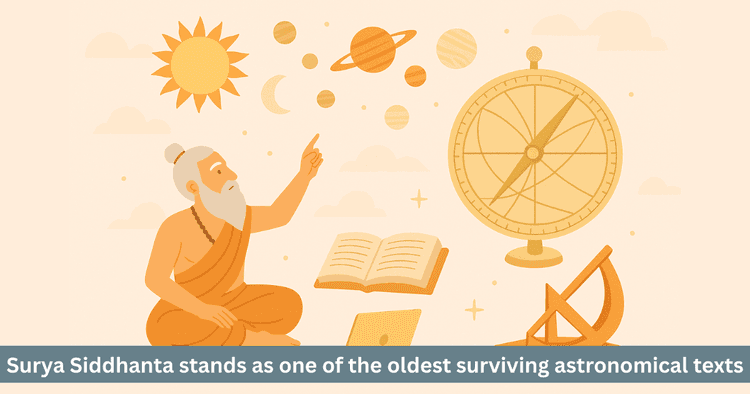
Table of Contents
For centuries the Surya Siddhanta India's ancient astronomical treatise guided calendar making eclipse prediction and timekeeping across the Indian subcontinent. Yet during colonial rule and the dominance of Western educational models this foundational text was marginalized relegated to specialized Sanskrit scholarship or dismissed as religious mythology rather than recognized as rigorous scientific work.
Today a remarkable renaissance is underway. From IITs integrating Vedic astronomy modules to planetariums showcasing ancient instruments from digital translation projects to curriculum reforms recognizing Indigenous Knowledge Systems the Surya Siddhanta is experiencing revival across multiple educational domains. This movement represents more than nostalgic cultural reclamation it constitutes serious effort to reconnect India's scientific heritage with contemporary STEM education demonstrating that astronomy is not foreign import but deeply rooted in India's own mathematical and observational traditions.
Understanding the Surya Siddhanta: India's Ancient Astronomical Masterwork
Historical Context and Significance
The Surya Siddhanta stands as one of the oldest surviving astronomical texts in world history. Though its exact dating remains debated among scholars most evidence suggests compositional period between five hundred BCE and five hundred CE with the current recension likely stabilizing around four hundred to five hundred CE during India's Gupta Golden Age.
Traditional attribution: According to legend the text was divinely revealed by Surya Dev meaning the Sun God to an asura meaning celestial being named Maya at the conclusion of Satya Yuga. This mythological framing far from diminishing scientific content reflects ancient Indian understanding that empirical observation and spiritual insight represent complementary paths to truth.
Core subject matter: The Surya Siddhanta provides comprehensive mathematical framework for solar and lunar motion calculating Sun and Moon's positions with remarkable precision. Planetary orbits determining positions of Mercury Venus Mars Jupiter and Saturn. Eclipse prediction forecasting solar and lunar eclipses decades in advance. Trigonometry and geometry introducing sine tables meaning jya and spherical trigonometry. Time measurement defining hierarchical time units from microseconds to cosmic ages. Calendar calculation establishing mathematical basis for Hindu Panchang system. Astronomical constants calculating Earth's diameter circumference and orbital parameters.
Scientific Achievements Attracting Modern Recognition
What distinguishes Surya Siddhanta from mere historical curiosity is its extraordinary mathematical precision.
| Astronomical Parameter | Surya Siddhanta Value | Modern Measurement | Error |
|---|---|---|---|
| Tropical Year | 365.2421756 days | 365.2421904 days | 1.4 seconds |
| Sidereal Day | 23h 56m 4.1s | 23h 56m 4.09s | Negligible |
| Earth's Diameter | 12,800 km | 12,756 km | Less than 1% |
| Earth's Circumference | Approximately 40,000 km | 40,075 km | Approximately 0.2% |
| Moon's Sidereal Period | 27.322 days | 27.32166 days | 0.002 days |
These measurements calculated fifteen hundred plus years ago through naked eye observation and geometric reasoning match modern values within fractions of percent testament to sophisticated methodology.
Trigonometric innovation: The Surya Siddhanta introduced sine tables meaning jya to mathematical astronomy approximately one thousand years before Western trigonometry emerged. These tables enabled precise calculation of celestial coordinates and eclipse geometry foundational contributions to global mathematical development.
Why Revival is Essential: Motivations and Rationale
Reclaiming India's Scientific Heritage
For centuries colonial educational systems promoted narrative that scientific advancement originated exclusively in Greece Arab lands and Europe. The marginalization of texts like Surya Siddhanta contributed to cultural disconnection generations of Indian students learned astronomy as Western import rather than recognizing indigenous roots.
Revival addresses this historical distortion by demonstrating that India possessed sophisticated astronomical traditions millennia before European Enlightenment. Mathematical innovations meaning sine functions decimal system algebraic concepts emerged independently in Indian context. Rigorous empirical observation undergirded ancient Indian astronomy not merely philosophical speculation.
Integrating Indigenous Knowledge Systems
The global movement toward recognizing Indigenous Knowledge Systems acknowledges that diverse civilizations developed sophisticated understandings of natural phenomena through unique methodological approaches. Rather than viewing Western science as sole valid framework integration recognizes multiple valid epistemologies different cultures developed distinct yet equally rigorous approaches to understanding cosmos. Contextual relevance indigenous systems often addressed local phenomena more effectively than imported frameworks. Holistic integration traditional systems integrated scientific observation with ethical spiritual and ecological dimensions anticipating modern calls for values in science.
For Indian education specifically Surya Siddhanta revival represents effort to reconnect scientific training with cultural identity demonstrating that rigorous STEM education need not require cultural alienation.
Fostering Critical Historical Analysis
Studying Surya Siddhanta cultivates sophisticated understanding of history and philosophy of science. Evolution of scientific models students examine how astronomical models developed were refined and occasionally corrected understanding science as iterative process rather than fixed body of facts. Cross cultural scientific exchange comparing Surya Siddhanta with Greek meaning Ptolemy Babylonian and Chinese astronomy reveals both independent innovation and trans civilizational dialogue. Contextual understanding recognizing why certain models made sense within their observational and technological constraints prevents presentist dismissal of historical science.
Practical Educational Benefits
Beyond cultural pride Surya Siddhanta offers concrete pedagogical advantages.
Making mathematics meaningful: Abstract trigonometric concepts become tangible when students calculate actual celestial positions using ancient sine tables connecting abstract formulas to observable phenomena.
Encouraging astronomical observation: Rather than merely memorizing planetary data students engage in direct sky observation using methods described in Surya Siddhanta fostering empirical scientific mindset.
Bridging disciplines: The text naturally integrates mathematics astronomy history philosophy and cultural studies modeling interdisciplinary approach increasingly valued in contemporary education.
Forms of Revival: How Modern Education Incorporates Surya Siddhanta
Curriculum Integration at National Level
National Education Policy two thousand twenty: India's NEP explicitly calls for integrating Indian Knowledge Systems across curriculum. The University Grants Commission has issued directives encouraging universities to develop modules on traditional Indian astronomy.
NCERT and CBSE initiatives: National textbooks now reference Indian astronomical heritage in science and mathematics chapters. Social science curricula include sections on history of Indian astronomy. Indian Knowledge Traditions introduced as component in various subjects.
Bharatiya Gyan Parampara programs: UGC's dedicated initiative promotes traditional knowledge systems through faculty development programs on Vedic sciences. Curriculum development workshops. Research funding for studying classical texts. Translation and digitization projects.
University Level Courses and Research Programs
IIT integration: Several Indian Institutes of Technology have introduced Surya Siddhanta content. IIT Kharagpur elective courses on Vedic Science and Technology include modules on astronomical texts. IIT Indore seminars and workshops on history of Indian mathematics and astronomy. IIT Bombay cultural activities and academic talks featuring traditional astronomical knowledge.
Specialized universities: Banaras Hindu University Department of Jyotir Vigyan meaning Astronomy and Astrology offers comprehensive programs integrating Surya Siddhanta. M.A. and Ph.D. programs in traditional astronomical systems. Research publications comparing ancient and modern calculations.
Rashtriya Sanskrit Sansthan M.A. in Siddhantic Jyotish meaning Astronomical Astrology. Detailed study of calculation methods from classical texts. Sanskrit instruction alongside mathematical analysis.
Chinmaya Vishwavidyapeeth and MIT ADT Pune interdisciplinary programs under Indian Knowledge Systems initiative. Integration of Sanskrit texts with contemporary space science. Collaborative research between Sanskrit scholars and astronomers.
Research Centers and Academic Publications
Indian Institute of Astrophysics and IUCAA: These premier research institutions collaborate with Sanskrit scholars on critical textual analysis and translation. Comparative studies between ancient parameters and modern measurements. Digital preservation of astronomical manuscripts.
Academic journals: Publications like Indian Journal of History of Science regularly feature comparative analyses of Surya Siddhanta calculations with NASA data. Historical studies tracing development of astronomical concepts. Cross cultural comparisons with Greek Arab and Chinese astronomy.
Research findings: Recent scholarship demonstrates that planetary mean motions in Surya Siddhanta differ by only one to two minutes per day from modern ephemerides. Eclipse prediction methods achieved accuracy sufficient for religious and agricultural timing. Trigonometric innovations influenced Arab astronomers who transmitted them to medieval Europe.
Planetariums and Interactive Science Centers
Vedic astronomy sections: Major Indian planetariums have established dedicated exhibits. Nehru Planetarium Delhi interactive displays showing ancient astronomical instruments. Demonstrations of Shanku Yantra meaning gnomon calculations. Workshops on calculating local solar time using traditional methods.
Ujjain Observatory Vedh Shala historic observatory at ancient Greenwich of India. Functioning instruments based on Surya Siddhanta principles. Educational programs for students calculating planetary positions.
Jantar Mantar Jaipur UNESCO World Heritage Site featuring monumental astronomical instruments. Guided tours explaining mathematical principles behind designs. Student workshops on using stone sundials achieving two second accuracy.
Interactive learning activities: These centers offer hands on instrument operation. Sky observation sessions comparing ancient predictions with actual positions. Computational workshops where students implement Surya Siddhanta algorithms. Cultural programs connecting astronomical knowledge with festivals and calendar.
Digital Revival and Open Access Learning
Online courses: SWAYAM Platform government initiative offering free courses on Vedic astronomy and mathematics. Coursera edX international platforms hosting courses on history of Indian astronomy. YouTube channels educational content explaining Surya Siddhanta concepts in accessible formats.
Digital resources: Digital Panchang Project open source implementation of Surya Siddhanta algorithms in Python. Enables students to generate traditional calendars using ancient methods. Compares traditional calculations with modern astronomical data.
Translation initiatives digitized Sanskrit manuscripts with parallel English translations. Annotated versions explaining technical terminology. Interactive commentaries linking ancient concepts to modern equivalents.
Augmented reality applications 3D visualizations of planetary orbits according to Surya Siddhanta. AR apps overlaying ancient star maps on actual night sky. Interactive models demonstrating eclipse geometry.
Teacher Training and Capacity Building
Faculty development programs: IITs and central universities offer specialized workshops training science teachers in history and philosophy of Indian astronomy. Methodologies for integrating traditional knowledge without compromising scientific rigor. Balancing cultural appreciation with critical historical analysis.
Pedagogical innovation: Teacher training emphasizes contextual teaching presenting Surya Siddhanta as sophisticated system within its historical context not as equivalent to modern physics. Comparative analysis encouraging students to identify both achievements and limitations. Critical thinking using ancient texts to develop scientific reasoning rather than uncritical acceptance.
Educational Benefits Across Disciplines
| Educational Domain | Specific Benefits |
|---|---|
| Mathematics | Trigonometry becomes tangible through celestial calculations introduces historical development of mathematical concepts |
| Astronomy | Encourages direct sky observation demonstrates evolution from geocentric to heliocentric models |
| History of Science | Reveals non Western contributions illustrates cross cultural scientific exchange |
| Philosophy | Explores relationships between observation theory and worldview examines concept of cosmic order Rita |
| Cultural Studies | Connects scientific traditions with festivals architecture and social practices |
| Environmental Science | Links solar motion with seasonal ecology and agricultural timing |
Challenges and Critical Perspectives
Scientific Accuracy Concerns
The challenge: While Surya Siddhanta achieved remarkable precision for its era some parameters and models differ from modern scientific understanding. Integrating it into education requires careful contextualization.
Educational response: Historical framing present text as sophisticated achievement within observational and theoretical constraints of its time. Comparative analysis explicitly compare ancient values with modern measurements discussing both successes and limitations. Evolutionary perspective show how models developed were refined and eventually superseded illustrating normal scientific progress.
Mythological Context
The challenge: Surya Siddhanta blends mathematical astronomy with mythological narratives meaning divine revelation cosmic ages celestial deities creating tension with secular educational approaches.
Educational response: Distinguish levels separate mathematical content meaning universally valid calculations from cosmological framing meaning cultural context. Cultural appreciation explain mythological elements as reflecting ancient Indian worldview without requiring literal belief. Comparative religion examine how different civilizations embedded scientific knowledge within religious frameworks.
Avoiding Romanticization
The challenge: Revival efforts sometimes romanticize ancient texts claiming they anticipated all modern discoveries or possessed lost advanced technology.
Educational response: Scholarly rigor emphasize what texts actually say based on careful translation not wishful interpretation. Acknowledge limitations discuss areas where ancient models proved inadequate such as geocentric assumptions inaccurate planetary distances. Celebrate real achievements focus on genuine innovations meaning sine tables accurate year length eclipse prediction rather than exaggerated claims.
Pedagogical Adaptation
The challenge: Ancient teaching methods meaning oral transmission memorized verses guru student relationships differ fundamentally from modern classroom approaches.
Educational response: Interactive learning transform memorization based content into hands on calculation and observation activities. Collaborative projects students work in teams to implement ancient algorithms or construct simple instruments. Technology integration use computational tools to make complex calculations accessible while preserving underlying principles.
Vision for the Future: Sustainable Integration
Balanced Curriculum Development
The goal is complementary integration rather than replacement. Modern physics and astronomy remain primary content. Surya Siddhanta serves as enrichment historical context and cultural connection. Students gain both contemporary scientific literacy and appreciation for intellectual heritage.
Research and Innovation
Continuing scholarship: Translation projects making classical texts accessible to non Sanskrit readers. Comparative studies examining transmission of astronomical knowledge across civilizations. Digital humanities approaches analyzing large scale patterns in astronomical literature.
Practical applications: AI based tools for translating and analyzing Sanskrit astronomical texts. Interactive simulations enabling students to test ancient models against observations. Citizen science projects where students contribute to digitizing and annotating manuscripts.
Global Recognition
International collaboration: Joint research projects with universities worldwide studying history of astronomy. Exchange programs bringing international students to study Indian astronomical heritage. Contributions to UNESCO programs on preserving scientific heritage.
Museum and exhibition development: World class museums dedicated to history of Indian astronomy. Traveling exhibitions bringing ancient instruments and concepts to global audiences. Virtual reality experiences allowing students worldwide to explore ancient observatories.
Conclusion: Reuniting Science with Culture
The revival of Surya Siddhanta in modern education represents profound recognition that scientific education need not require cultural alienation. For too long Indian students learned astronomy as European discipline with no connection to their own heritage. The current movement demonstrates that rigorous STEM education can simultaneously foster scientific literacy understanding modern astronomy mathematics and physics. Historical consciousness appreciating how knowledge developed across civilizations. Cultural pride recognizing indigenous contributions to human intellectual achievement. Critical thinking analyzing both strengths and limitations of different approaches.
As one scholar eloquently stated to study the Sun's path is to study the rhythm of life itself and Surya Siddhanta is that rhythm written in numbers.
By reconnecting with this ancient wisdom while maintaining commitment to contemporary scientific rigor Indian education charts path toward integration rather than compartmentalization honoring past while advancing future celebrating cultural identity while participating in global scientific community respecting tradition while embracing innovation.
The revival of Surya Siddhanta ultimately teaches that humanity's quest to understand cosmos transcends any single civilization that knowledge flows across cultures and epochs and that authentic education honors all contributions to our collective wisdom about the universe we inhabit.
Get your accurate Kundali
Generate KundaliDid you like it?
Author

Pt. Narendra Sharma (63)
Experience: 20
Consults About: Family Planning, Career
Clients In: Punjab, Haryana, Delhi
Share this article with friends and family
WELCOME TO
ZODIAQ
Right Decisions at the right time with ZODIAQ
