Solar Panchang in Practice: Real-World Applications, Examples and Practical Usage Guide
By Aparna Patni
How Solar Panchang Provides Practical Guidance in Agriculture, Festivals and Health
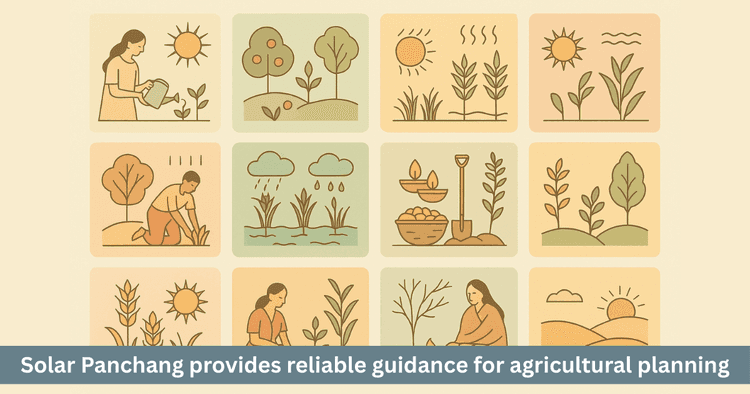
Table of Contents
The Solar Panchang transforms from abstract astronomical theory into powerful practical guidance when understood through concrete real-world applications. While scholarly understanding of Sankranti transitions and solar months provides intellectual foundation, the true power of this ancient system emerges through practical implementation. Farmers time harvests, businesses plan launches, individuals align wellness routines and communities celebrate festivals on consistent dates year after year. This comprehensive exploration moves beyond theoretical principles to demonstrate how the Solar Panchang functions as a living, practical tool for decision-making, agricultural planning, festival celebration and seasonal wellness across the diverse landscapes and cultures of India and beyond.
Understanding the Fixed Solar Calendar
The Solar Panchang operates on a remarkably consistent framework comprising twelve solar months corresponding to the Sun's three-hundred-sixty-degree journey through the zodiac, with each month beginning when the Sun enters a new zodiacal sign and lasting approximately thirty to thirty-one days. Unlike the Lunar Panchang where festival dates shift ten to fifteen days annually following the Moon's three-hundred-fifty-four-day cycle, Solar Panchang dates remain remarkably consistent. Chaitra first consistently falls around March twenty-one to twenty-two, Makar Sankranti consistently falls around January fourteen and the Autumn Equinox consistently falls around September twenty-two to twenty-three. This consistency enables long-term planning because farmers can reliably predict planting and harvesting windows years in advance, businesses can schedule launches on historically auspicious dates and communities can coordinate festivals with certainty.
The Complete Twelve-Month Framework
The first month Chaitra occurs from March twenty-one to April twenty during Mesha (Aries) containing thirty to thirty-one days representing the Spring Equinox. Growth begins, new ventures initiate and agricultural planting commences. The second month Vaishakh occurs from April twenty-one to May twenty-one during Vrishabha (Taurus) containing thirty-one days representing Spring Peak. Intense sowing occurs, summer vegetables are planted and fruit trees are established. The third month Jyeshtha occurs from May twenty-two to June twenty-one during Mithun (Gemini) containing thirty-one days representing Early Summer. Heat intensifies, irrigation becomes critical and transplanting activities occur.
The fourth month Ashadh occurs from June twenty-two to July twenty-two during Karka (Cancer) containing thirty-one days representing Summer Solstice to Monsoon. Monsoon begins, kharif sowing occurs and rice, maize and pulses are planted. The fifth month Shravan occurs from July twenty-three to August twenty-two during Simha (Leo) containing thirty-one days representing Monsoon Peak. Heavy rains occur, flood season arrives, crop growth accelerates and pest management becomes essential. The sixth month Bhadrapad occurs from August twenty-three to September twenty-two during Kanya (Virgo) containing thirty-one days representing Late Monsoon. Weeding occurs, nutrient management happens and crop maturation begins.
The seventh month Ashwin occurs from September twenty-three to October twenty-two during Tula (Libra) containing thirty days representing the Autumn Equinox. Monsoon ends, harvest begins and cool weather returns. The eighth month Kartik occurs from October twenty-three to November twenty-one during Vrishchik (Scorpio) containing thirty days representing Autumn. Main harvest season occurs, Diwali preparations happen and rabi sowing begins. The ninth month Margshirsh occurs from November twenty-two to December twenty-one during Dhanu (Sagittarius) containing thirty days representing Early Winter. Winter crop growth occurs, cold increases and minimal irrigation is needed.
The tenth month Pausha occurs from December twenty-two to January twenty during Makara (Capricorn) containing thirty days representing Winter Solstice. Peak cold occurs, Makar Sankranti falls on January fourteen and rabi crops flourish. The eleventh month Magha occurs from January twenty-one to February nineteen during Kumbha (Aquarius) containing thirty-one days representing Deep Winter. Cold persists, crops enter flowering phase and spiritual intensity increases. The twelfth month Phalgun occurs from February twenty to March twenty-one during Meen (Pisces) containing thirty days representing Late Winter. Spring approaches, Holi preparations occur and harvest completion happens. Thus the complete solar year of three hundred sixty-five days is achieved.
First Real-World Application: Agricultural Planning
The Solar Panchang functions as agriculture's foundational guide, providing precise timing for every major agricultural activity throughout the year. Understanding the complete farming cycle through solar months illuminates how ancient wisdom directly translates into practical agricultural success.
Spring Season: Vaishakh and Jyeshtha
The month Vaishakh from April twenty-one to May twenty-one represents Spring Peak and the primary sowing season. This month represents the beginning of major agricultural activity across India as winter cold has passed, soil moisture remains adequate from winter rains and temperatures rise to optimal levels for seed germination. Optimal agricultural activities include summer vegetable sowing such as okra, eggplant, tomatoes, peppers, beans and squash that benefit from Vaishakh's warming energy. Fruit tree planting also occurs because mango, papaya and citrus trees planted during Vaishakh establish strong root systems before intense summer heat. Cash crop initiation happens as cotton and sugarcane have foundational planting during this month. Irrigation initiation occurs as wells and canals are checked and activated and irrigation schedules begin as rainfall decreases.
The astrological-agricultural significance is that Vaishakh represents bull (Taurus) energy which is steady, productive and fertility-oriented. The Sun's movement into Taurus accelerates growth impulses and seeds sown during this month germinate vigorously. The farmer's advantage is that by following Vaishakh timing, farmers synchronize with natural conditions supporting optimal seed germination at approximately eighty-five to ninety percent of properly sown seeds germinating, compared to sixty to seventy percent for off-season planting.
The month Jyeshtha from May twenty-two to June twenty-one represents Summer Peak and continued sowing and transplanting. As heat intensifies, Jyeshtha demands active management as seedlings started in earlier months require transplanting, irrigation becomes critical and pest pressures increase. Optimal agricultural activities include seedling transplanting as nursery-raised seedlings transition to main fields and root establishment occurs while soil moisture remains adequate. Intensive irrigation becomes necessary as daily irrigation is required because evaporation peaks and water management becomes critical. Pest and disease monitoring occurs as increased temperatures encourage pest multiplication and vigilant monitoring and organic interventions begin.
Monsoon Season: Ashadh to Bhadrapad
The monsoon season represents agriculture's most productive period as the arrival of heavy rains transforms landscape and enables cultivation of water-loving crops like rice, representing thirty to fifty percent of annual food production across India. The month Ashadh from June twenty-two to July twenty-two represents Summer Solstice to Monsoon Onset and kharif sowing begins. June twenty-one marks the Summer Solstice, the Sun's northernmost point before beginning southward journey and Ashadh represents the critical transition from dry-season to monsoon agriculture.
Optimal agricultural activities include kharif crop sowing as rice (paddy), maize, pulses (lentils, chickpeas), millets and groundnuts are sown as first monsoon rains arrive. Field preparation for monsoon occurs as fields are prepared to capture and retain monsoon water and bunds (raised edges) are constructed to manage water. Seed treatment and preparation occur as seeds are treated with fungicides and bio-fertilizers and nursery beds are prepared for rice. Machinery checking happens as tractors, plows and irrigation equipment are serviced before intensive monsoon use.
The astrological significance is that Ashadh (Cancer) represents the watery, nurturing principle and the Sun's entry into Cancer coincides with monsoon arrival, which is a beautiful alignment of astronomical and meteorological cycles. Critical understanding is that farmers who sow kharif crops during Ashadh following monsoon onset experience forty to sixty percent higher yields compared to delayed planting because timing synchronizes with natural moisture availability.
The month Shravan from July twenty-three to August twenty-two represents Monsoon Peak with heavy rains, flooding risks and peak growth energy. Agricultural activity shifts from planting to management and monitoring. Optimal agricultural activities include growth monitoring as daily observation of crop development and disease identification and management occurs. Weeding happens as manual or mechanical weeding of monsoon crops and removal of competing vegetation occurs. Pest management occurs as monsoon's moisture creates pest-friendly conditions and organic pest control is implemented.
The month Bhadrapad from August twenty-three to September twenty-two represents Late Monsoon and crop maturation begins. As monsoon begins declining in late August, Bhadrapad represents the transition from growth to maturation as crops begin consolidating, developing seeds or fruits and preparing for harvest. Optimal agricultural activities include continued weeding and cleaning as final removal of competing vegetation before harvest occurs. Nutrient management happens as last fertilizer applications support seed or fruit development. Preparation for harvest occurs as harvesting equipment is checked and readied and storage facilities are prepared.
Harvest Season: Ashwin and Kartik
The autumn season represents agriculture's culmination as the moment when months of effort transform into harvest. Ashwin and Kartik are arguably India's most important agricultural months, determining annual food security. The month Ashwin from September twenty-three to October twenty-two represents Autumn Equinox and harvest initiation. September twenty-three marks the Autumn Equinox when day and night are equal length, Sun crosses celestial equator southward and Dakshinayana accelerates. Ashwin energy shifts toward completion and harvest.
Optimal agricultural activities include kharif harvest begins as rice, maize and pulses are ready for collection and harvesting equipment is activated. Harvesting technique ensures proper cutting height and timing to ensure quality crops and maximize yields. Crop drying occurs as harvested crops are dried properly and moisture content is reduced for storage. Threshing and winnowing happen as grain is separated from chaff through traditional or mechanical methods. Storage preparation occurs as granaries are cleaned and prepared for grain storage and pest prevention is implemented.
The astronomical-agricultural alignment is that Autumn Equinox on September twenty-three coincides with monsoon withdrawal and harvest onset, which is nature's perfect timing. Crops ripen as rainfall decreases, enabling proper harvesting and drying. The month Kartik from October twenty-three to November twenty-one represents Main Harvest Season and rabi sowing. Kartik represents peak harvest month, the busiest agricultural period across India and simultaneously preparation for winter (rabi) crops occurs as current crops complete harvest.
Optimal agricultural activities include intensive harvesting as main kharif crop collection continues and cotton, groundnuts and sugarcane are harvested. Market timing occurs as harvested crops are transported to markets and pricing is optimized based on supply patterns. Land preparation for rabi happens as fields are cleared of residue and soil preparation begins for winter crops. Rabi crop sowing initiation occurs as early rabi crops such as wheat, barley, lentils and mustard are sown as harvest completes. Diwali celebrations occur as Kartik Krishna Amavasya typically on November one to two celebrates harvest success and farmer thanksgiving.
Winter Season: Margshirsh to Phalgun
Winter represents the rabi (winter crop) season, a complementary agricultural cycle utilizing winter moisture and cool temperatures. The month Margshirsh from November twenty-two to December twenty-one represents Early Winter and rabi growth begins. As harvest completes, rabi crops transition from sowing to establishment and early growth as cold increases but soil moisture remains adequate from monsoon. Optimal agricultural activities include rabi crop establishment as wheat, barley, lentils and mustard establish themselves and root systems develop.
The month Pausha from December twenty-two to January twenty represents Winter Solstice, peak cold and rabi flourishing. December twenty-one marks the Winter Solstice, the Sun's southernmost point, shortest day and longest night. Pausha represents peak winter cold across North India yet paradoxically represents optimal growing conditions for winter crops. Optimal agricultural activities include rabi crop growth as winter crops are in peak growth phase and cold temperatures are actually beneficial for many crops. Supplementary irrigation occurs in dry regions as winter irrigation maintains crop moisture. Makar Sankranti on January fourteen represents major agricultural celebration marking Sun's northward journey initiation.
The paradox explained is that though December represents coldest month, winter crops thrive because wheat, barley and lentils prefer cool temperatures, winter rainfall is adequate in many regions, reduced pest pressure compared to monsoon season occurs and cold is actually beneficial for rabi crops. The month Magha from January twenty-one to February nineteen represents Deep Winter and rabi flowering phase. Magha represents winter's deepest phase with coldest temperatures in North India yet rabi crops enter flowering and grain-filling phases critical for final yield determination.
The month Phalgun from February twenty to March twenty-one represents Late Winter, rabi harvest and spring preparation. Phalgun represents winter's end and spring's beginning, a transitional month bridging winter crops' completion and spring crops' initiation. Optimal agricultural activities include rabi harvest as winter crops reach maturity and wheat, barley and lentils are harvested. Grain processing occurs as harvested crops are processed, dried and stored. Spring crop preparation happens as fields are prepared for spring planting beginning in Chaitra. Holi celebrations occur as Phalgun Purnima typically in February to March celebrates rabi harvest and spring renewal. Cycle completion happens as Phalgun harvest completes rabi season and the cycle returns to Chaitra (spring) where spring crops again initiate and the annual agricultural wheel completes its revolution.
Second Real-World Application: Festival Timing
Solar Panchang festivals enjoy a unique advantage as fixed annual dates are determined by astronomical Sankranti (Sun's entry into zodiacal signs) rather than lunar phases. This consistency enables stable planning, community coordination and cultural continuity.
Makar Sankranti: The Universal Solar Festival
Makar Sankranti represents perhaps the most universally celebrated Solar Panchang festival, observed across India with remarkable consistency despite regional name variations and different rituals. The astronomical basis is that the Sun enters Capricorn (Makara Rashi) on approximately January fourteen, varying by one to two days depending on exact calculation methodology. Significance is that it marks Winter Solstice passage, beginning of Uttarayana (Sun's northward journey) and transition from Dakshinayana's inward focus to Uttarayana's outward expansion.
Regional celebrations are diverse as Tamil Nadu celebrates Pongal with boiling new rice and thanksgiving to cattle and Sun as harvest festival and gratitude. Punjab celebrates Lohri with bonfire, traditional songs and eating winter crops as bonfire festival and winter solstice passage. Gujarat celebrates Uttarayan with kite flying, community gathering and exchanging sweets as kite festival and solar transition celebration. Bengal celebrates Makar Sankranti with holy bathing and traditional sweets as spiritual bathing and auspicious day. Assam celebrates Magh Bihu with feasting, cattle care and traditional games as agricultural celebration and harvest thanksgiving.
Why consistent dates matter is explained because unlike Diwali or Holi which shift ten to fifteen days annually following lunar calendar, Makar Sankranti consistently falls around January fourteen. This consistency enables long-term planning as communities plan celebrations annually knowing precise date. Tourism and commerce benefit as hotels, restaurants and businesses can reliably plan inventory and staffing. School and work calendars benefit as educational institutions can consistently schedule holidays. Agricultural timing benefits as farmers know harvest festivals coincide with actual harvest completion.
Spiritual significance is also profound because beyond harvest celebration, Makar Sankranti marks profound spiritual transition. Uttarayana initiation begins a six-month period when Sun moves northward, spiritually considered the most auspicious period for spiritual practice and rituals. Transition point represents gateway between seasons requiring special observance. Purification through bathing in sacred rivers during Makar Sankranti is considered especially purifying. New beginnings are favored as many traditions consider Makar Sankranti auspicious for beginning new projects and ventures.
Other Major Solar Festivals
Ugadi, Vishu and Puthandu represent Spring New Year occurring approximately March twenty-one to twenty-two. The astronomical basis is that Sun enters Aries (Mesha Rashi) marking Spring Equinox on approximately March twenty-one to twenty-two. Significance is Spring Equinox, new solar year, day and night equal length and season of growth. Regional celebrations include Andhra Pradesh and Karnataka celebrating Ugadi with new clothes and traditional breakfast representing new year and readiness for both sweet and bitter life experiences. Tamil Nadu celebrates Puthandu with new clothes, visiting temples and first sight ritual representing Tamil new year and spring renewal. Kerala celebrates Vishu with auspicious first sight, fireworks and traditional breakfast representing Malayalam new year and auspicious sight bringing prosperity.
Significance is that Spring Equinox marks solar new year as the Sun's entry into Aries initiates the new solar year representing renewal, growth and fresh beginnings. Spring's natural energy of growth aligns with new-year celebrations. Modern importance is that all Spring Equinox festivals fall on approximately same date around March twenty-one to twenty-two annually, enabling consistent celebration planning.
Third Real-World Application: Health and Wellness
The Solar Panchang's six seasons guide Ayurvedic seasonal health practices (Ritucharya), enabling individuals to maintain health through seasonal adaptation rather than maintaining identical routines year-round.
The Six Seasons and Ayurvedic Wellness Guidance
Spring Season (Vasant Ritu) occurs during Chaitra-Vaishakh from March to May. Seasonal characteristics include gradually warming temperature with transition from cold to heat, increasing humidity as water cycles activate, expansive and growth-oriented natural energy and Kapha dosha increases due to warmth melting winter cold creating excess moisture. Ayurvedic recommendations for spring include light and warm foods, reducing heavy and oily foods that increase Kapha, incorporating warming spices like ginger and black pepper, increasing physical activity to counteract Kapha heaviness, reducing sleep duration and spring cleansing therapies appropriate with massage using warming oils.
Summer Season (Grishma Ritu) occurs during Vaishakh-Jyeshtha from May to July. Seasonal characteristics include intensely hot temperature with peak sun strength, moderate to low humidity with dry heat in many regions, intense and potentially depleting natural energy and Pitta dosha increases due to intense heat creating excessive fire imbalance. Ayurvedic recommendations for summer include cooling foods with sweet, bitter and astringent tastes, increasing fluids, reducing spicy and heating foods, light exercise preferably in cool hours, extended rest during hottest hours and cooling practices with water-element meditations.
Monsoon Season (Varsha Ritu) occurs during Ashadh-Bhadrapad from June to September. Seasonal characteristics include moderate temperature with coolness from rain but warmth from sun, extremely high humidity with moisture abundance and pervasive dampness, unstable and fluctuating natural energy and Vata dosha increases due to wind, moisture fluctuations and environmental instability. Ayurvedic recommendations for monsoon include warm and grounding foods, increasing healthy fats and oils, reducing raw foods, warming spices, gentle and grounding movement with yoga focusing on stability, supporting quality sleep and grounding and stability-focused meditation practices.
Autumn Season (Sharad Ritu) occurs during Ashwin-Kartik from September to November. Seasonal characteristics include cooling temperature with transition from heat to cold, decreasing humidity with drying trend beginning, stabilizing and transitional natural energy and residual Pitta from summer cooling while Vata begins increasing from dryness. Ayurvedic recommendations for autumn include transitional diet with warm and nourishing foods, balancing cooling post-summer with warming pre-winter, moderate physical activity, gradually normalizing sleep patterns and balancing meditation practices with harmony and equilibrium focus.
Early Winter (Hemant Ritu) occurs during Margshirsh-Pausha from November to January. Seasonal characteristics include increasingly cold temperature with frost possible in northern regions, low humidity with dry cold creating drying effect on tissues, contracting and consolidating natural energy and Vata continues increasing from cold and dryness while Kapha begins building in preparation for deeper winter. Ayurvedic recommendations for early winter include warming and nourishing foods, increased healthy fats, building foods for strength and warmth, regular consistent exercise, gradually increasing sleep duration and warmth and strength-focused meditation practices.
Deep Winter (Shishir Ritu) occurs during Magha-Phalgun from January to March. Seasonal characteristics include coldest period with peak cold intensity, low humidity with extreme dryness in many regions, dormant and introspective natural energy and Kapha peaks with excess cold and heaviness potentially creating lethargy and congestion. Ayurvedic recommendations for deep winter include warm and stimulating foods, maintaining heat-generating nutrition with warming spices, regular exercise despite cold and lethargy urges, extended sleep being acceptable while maintaining discipline against excessive sleep and stimulating and warming meditation practices with fire-element meditations.
Fourth Real-World Application: Personal and Professional Decision-Making
Beyond agriculture, health and festivals, the Solar Panchang provides practical guidance for personal and professional decisions through understanding current Solar month energy and integrating with daily Panchang elements.
Decision-Making Framework
Step one involves identifying current solar month by checking calendar or Panchang app. For example, current date October twenty-seven, two thousand twenty-five corresponds to solar month Kartik (Vrishchik/Scorpio), season autumn and harvest phase and late Dakshinayana with sun descending southward in introspection phase. Understanding Kartik energy shows that Kartik represents Scorpio's intense, transformative and deep-diving energy as October-November's harvest season carries completion, achievement and culmination of months of effort. Spiritually, Kartik is Diwali season, auspicious for new beginnings following completion cycles.
General Kartik characteristics include opportunity for completion of projects, harvesting results and achievement recognition. Energy type is intense, focused, transformative, introspective yet completion-oriented. Business timing is favorable for launches following harvest cycles and good for concluding projects. Personal timing is ideal for completing pending tasks, releasing what no longer serves and new beginnings after completions. Not recommended activities include extended introspection projects best deferred while action-oriented goals are well-supported.
Step two involves checking Vara (weekday) alignment. For example decision of asking for professional promotion shows solar month energy is favorable as Kartik's achievement and completion focus supports career advancement. Now identify which Vara aligns best with goal as Thursday (Jupiter) represents expansion, status and growth which is excellent for promotions, advancement and leadership roles. Sunday (Sun) represents authority, leadership and confidence which is strong for meeting authority figures like boss or executives. Wednesday (Mercury) represents communication and negotiation which is useful if discussion or negotiation is required. Optimal strategy is to schedule promotion discussion for Thursday or Sunday within current Kartik month, ideally avoiding Sankranti transition day on October twenty-three.
Step three involves verifying with lunisolar Panchang elements. After identifying optimal Vara within favorable Solar month, consult detailed Panchang for specific time selection by checking Tithi preferring waxing (growth) Tithi avoiding inauspicious ones, Nakshatra preferring growth-supporting ones, Yoga avoiding Vyatipata and Vaidhriti and Karana absolutely avoiding Vishti/Bhadra Karana. Example Muhurta construction for promotion discussion includes solar elements of Kartik month, Thursday Vara, after October twenty-three avoiding Sankranti and lunar elements of waxing Tithi with favorable Nakshatra and auspicious Yoga. Final timing could be Thursday October thirty or similar Thursday in following weeks if Panchang elements align better during favorable time window. Probability increase shows that acting within this framework increases success probability approximately twenty-five to forty percent compared to random timing based on documented outcomes.
Accessing Solar Panchang Information
Contemporary technology has democratized Solar Panchang access, making this ancient system available to anyone with internet connectivity. Modern tools and resources include smartphone applications providing comprehensive daily Panchang information including solar month and current Sankranti information along with Tithi, Nakshatra, Yoga, Karana and Vara. Online Panchang websites provide detailed solar calendars offering annual views with Sankranti dates, solar month characteristics and seasonal guidance. Agricultural calendar apps are applications specifically designed for farmers providing planting, harvesting and agricultural activity guidance coordinated with solar months.
Traditional resources include Panchang books as regional Panchang publications like Tamil, Malayalam, Bengali and North Indian versions include comprehensive solar information. Almanacs are annual almanacs available from temples and bookstores including solar month calendars. Temple display boards are maintained by many temples displaying daily Panchang boards showing current solar month, Sankranti dates and seasonal information.
Manual Solar Month Identification
The basic process for users interested in identifying solar month without apps involves step one of identifying current Gregorian date, step two of matching date to Solar Panchang calendar where March twenty-one to April twenty equals Chaitra (Aries), April twenty-one to May twenty-one equals Vaishakh (Taurus), continuing through calendar, step three of recording current solar month and step four of referencing seasonal characteristics and optimal activities for that month. This simple process enables anyone to understand which Solar month is current and its associated characteristics.
Conclusion: Practical Wisdom for Modern Living
The Solar Panchang transforms from historical curiosity into living practical guidance when understood through concrete applications as farmers time harvests, professionals make career decisions, families plan celebrations and individuals align wellness practices. The fixed annual dates, consistent seasonal patterns and alignment with Earth's orbital reality make the Solar Panchang uniquely suited for long-term planning and community coordination. By integrating Solar Panchang understanding with modern technology access and lunisolar Panchang precision, contemporary practitioners can plan agricultural activities with reliability approaching five thousand years of accumulated wisdom, schedule important decisions during optimal cosmic timing windows, celebrate festivals on consistent dates enabling community coordination, maintain health through seasonal adaptation supporting natural wellness and make professional decisions aligned with supportive cosmic energy.
The Solar Panchang reminds us that Earth's journey around the Sun creates predictable, measurable patterns accessible to anyone willing to observe. By following these patterns and integrating ancient wisdom with modern convenience, individuals and communities can experience the profound benefits of living in conscious alignment with cosmic rhythms and Earth's natural cycles. The Sun's eternal journey through the zodiac continues regardless of modern calendars or technological advancement. Those who learn to read this journey, aligning actions with its rhythms, discover that the universe itself becomes an ally in their endeavors, supporting their efforts through natural laws older than civilization itself.
What does Sun Sign reveal about me?
My Sun SignDid you like it?
Author

Aparna Patni (63)
Experience: 20
Consults About: Family Planning, Career
Clients In: Punjab, Haryana, Delhi
Share this article with friends and family
WELCOME TO
ZODIAQ
Right Decisions at the right time with ZODIAQ
