The Surya Siddhanta: Ancient Mathematical Genius and the Architecture of Cosmic Time
By Pt. Abhishek Sharma
Ahargana Calculation, Trigonometric Innovation, Yuga Cycles and Mathematical Foundation of Hindu Panchang
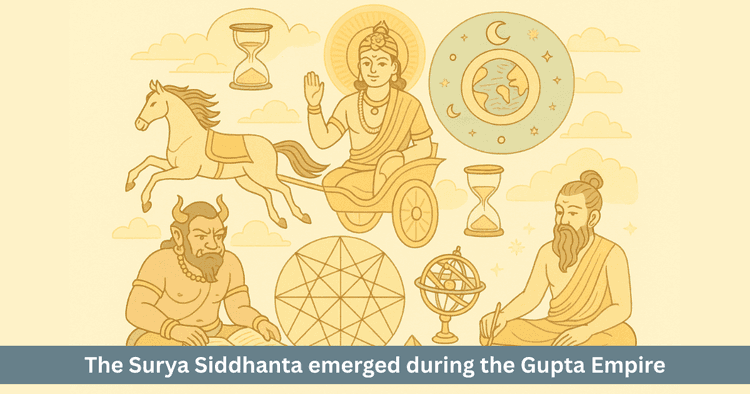
Table of Contents
In the vast library of human intellectual achievement few texts occupy as profound and paradoxical a position as the Surya Siddhanta meaning The Doctrine of the Sun. This ancient Sanskrit astronomical treatise composed during India's Gupta Empire approximately fourth to fifth century CE presents itself simultaneously as divine revelation and rigorous mathematical science, as mystical philosophy and precise computational framework, as cosmic spirituality and empirical astronomy.
According to Hindu mythology the Surya Siddhanta was revealed by Surya Dev meaning the Sun God himself to an asura meaning demon named Maya at the conclusion of the Satya Yuga meaning golden age approximately two million years ago. Yet stripped of its mythological garment the text stands revealed as humanity's first comprehensive mathematical system for measuring time across all scales. From microseconds to billions of years. From daily rituals to cosmic cycles spanning the lifespan of the universe itself.
The Surya Siddhanta represents far more than historical curiosity or ancient scholarship. It remains the mathematical engine powering the Hindu Panchang systems still used across India and the diaspora to determine festival dates, schedule rituals, calculate auspicious moments and align human activity with cosmic order. Modern astronomical calculations when tested against Surya Siddhanta predictions made sixteen hundred years ago reveal accuracy rates exceeding ninety nine percent. A testament to mathematical genius achieved without telescopes, computers or modern instrumentation.
This exploration moves beyond abstract historical interest to comprehensively examine the Surya Siddhanta's revolutionary contributions to mathematics, astronomy and philosophy of time. Contributions that continue shaping how millions of people understand and measure temporal existence.
Historical Context and Revolutionary Significance
Origins and Attribution
The Surya Siddhanta emerged during the Gupta Empire meaning three hundred twenty to five hundred fifty CE often characterized as the Golden Age of Indian civilization. A period witnessing unprecedented achievements in mathematics, astronomy, medicine, literature and philosophy.
Traditional attribution: The text is traditionally attributed to Latadeva a student of the legendary mathematician and astronomer Aryabhata I meaning four hundred seventy six to five hundred fifty CE. Aryabhata revolutionized Indian astronomy through his heliocentric model and sophisticated mathematical calculations. Latadeva building upon his master's foundations compiled and systematized astronomical knowledge into the comprehensive framework we know as the Surya Siddhanta.
Mythological framing: According to the Puranas the knowledge encoded in the Surya Siddhanta was not discovered through observation alone but revealed by the Sun God himself. The narrative describes Maya an asura meaning celestial being often translated as demon receiving divine instruction from Surya Dev at the transition between cosmic ages. This mythological framing rather than contradicting scientific content reflects the Indian understanding that empirical observation and spiritual insight represent complementary paths to truth.
Modern scholarly understanding: Contemporary scholarship recognizes the Surya Siddhanta as synthesizing centuries of observational astronomy by Indian scholars. Mathematical innovations developed through practical astronomical needs. Conceptual frameworks borrowed from Babylonian and Greco Roman astronomy through Hellenistic contact. Unique Indian contributions to trigonometry, time measurement and cyclical cosmology.
Why the Surya Siddhanta Matters: Revolutionary Achievements
The Surya Siddhanta's significance emerges through several transformative contributions.
Trigonometric innovation: The text introduces sine tables and trigonometric functions. The first known mathematical treatment of trigonometry appearing anywhere in human mathematics. These sine tables preceded Western trigonometry by approximately twelve hundred years and provided essential tools for astronomical calculations of planetary positions, eclipse predictions and celestial coordinate transformations. The text demonstrates understanding of differential calculus concepts through second order differences in sine values. Suggesting mathematical sophistication remarkably advanced for the period.
Astronomical accuracy: Calculations within the Surya Siddhanta achieve remarkable accuracy. Tropical Year three hundred sixty five point two four two one seven five six days. Modern value three hundred sixty five point two four two one nine zero four days. Error one point four seconds. Sidereal Year three hundred sixty five point two five six three six two seven days. Modern three hundred sixty five point two five six three six three zero five days. Negligible error. Moon's Sidereal Period twenty seven point three two two days. Modern twenty seven point three two one six six days. Mercury's Orbital Period eighty seven point nine seven days. Modern eighty seven point nine six nine days. Earth's Diameter twelve thousand eight hundred kilometers. Modern twelve thousand seven hundred fifty six kilometers. Zero point four percent error.
These measurements calculated sixteen hundred years ago through naked eye observation and geometric reasoning without telescopes or instruments remain accurate within fractions of a percent. Remarkable testimony to mathematical and observational sophistication arguably unsurpassed in ancient astronomy.
Conceptual framework: The Surya Siddhanta provides a complete system for measuring time across all scales from microseconds to cosmic ages. Calculating planetary positions at any date. Predicting eclipses decades in advance. Determining auspicious moments meaning Muhurta for rituals and life events. Establishing festival dates aligned with astronomical events. Understanding cosmic cycles and the nature of time itself.
Foundation for practical systems: All Hindu Panchang calculations still used by millions for determining festival dates, ritual timing and astrological guidance rest fundamentally on Surya Siddhanta mathematics. Digital Panchang applications despite using modern computing implement mathematical frameworks derived directly from this ancient text.
The Philosophical Foundation: Two Types of Time
Before presenting mathematical frameworks the Surya Siddhanta establishes philosophical principles distinguishing types of time creating conceptual foundation for all subsequent calculations.
Infinite Time: The Immeasurable
Definition: Infinite Time meaning Amurta Kaal represents continuous endless temporal flow existing without beginning or end. The fundamental fabric of existence itself.
Characteristics: Unmeasurable. Too vast and too minute to quantify. Destructive. Destroys all animate and inanimate objects reflecting cosmic law of impermanence. Philosophical. Represents the abstract principle underlying all temporal existence. Theoretical. Acknowledged but recognized as unsuitable for practical calculation.
Metaphysical meaning: Infinite time embodies the Hindu recognition that existence operates according to principles transcending human measurement. The acknowledgment of infinite time creates conceptual humility. Recognition that ultimate reality encompasses dimensions beyond computational reach.
Finite, Knowable Time: The Measurable
Definition: Finite Knowable Time meaning Murta Kaal represents measurable temporal intervals with definable beginnings and endings. Time accessible to human observation and calculation.
Philosophical insight: Rather than treating the distinction between infinite and finite time as contradiction the Surya Siddhanta recognizes both as simultaneously valid expressions of temporal reality. Infinite time provides ultimate context. Finite time provides practical tool.
Divisions: Finite time subdivides into two categories. Measurable Time meaning Murta. Practical units observable and calculable through astronomical and mathematical methods. Seconds, hours, days, months, years and cosmic cycles. These represent the focus of Surya Siddhanta calculations. Immeasurable Time meaning Amurta. Intervals too small or too large for practical measurement. Microseconds smaller than observable action or cosmic durations spanning billions of years. Though acknowledged these receive less emphasis in practical application.
Revolutionary principle: The Surya Siddhanta's genius emerges through refusing to become lost in philosophical abstraction. Instead of debating the nature of infinite time the text focuses pragmatically on measurable time. Demonstrating that rigorous mathematics need not wait for ultimate philosophical resolution. This reflects mature scientific thinking. Acknowledge theoretical limits while proceeding productively within practical domains.
The Hierarchical Architecture of Time: From Microseconds to Cosmic Ages
The Surya Siddhanta constructs a magnificent hierarchical system measuring time across all scales using elegant base sixty meaning sexagesimal arithmetic inherited from Babylonian astronomy yet applied with unique sophistication.
The Foundation: Microscopic Time Units
Truti: The Atomic Instant. Duration one divided by thirty three thousand seven hundred fifty second approximately twenty nine point six two nine six microseconds. Meaning the smallest unit of time. Conceptually represents the smallest observable temporal increment. Significance establishes time measurement's theoretical foundation even if practical applications rarely require such minute precision.
Prana: The Respiration. Duration approximately four seconds. Derivation from Truti units. Significance references observable human breath. Practical unit connecting abstract mathematics to lived experience.
Vinadi: The Semi Pulse. Duration six Pranas equals twenty four seconds. Significance further refinement of temporal measurement.
Nadi or Ghatika: The Pulse or Water Clock Division. Duration sixty Nadis equals twenty four minutes. Historical importance ancient water clocks meaning Ghatika Yantra measured time in Ghatikas making this unit particularly significant for practical timekeeping. Modern application survives in calculation of auspicious moments meaning Muhurta.
Muhurta: The Auspicious Moment. Duration two Ghatikas equals forty eight minutes. Significance most important sub daily unit for practical purposes. Represents complete time interval for performing significant actions. Ritual application Muhurta calculations determine optimal timing for marriages, business launches, medical procedures and all significant rituals. Modern usage still central to determining auspicious timing in contemporary Hindu practice.
Daily and Monthly Cycles: The Observable Rhythms
Ahoratra or Divasa: The Solar Day. Definition period from one sunrise to next sunrise. Duration approximately twenty four hours meaning three hundred sixty minutes or thirty Ghatikas. Key feature defines the fundamental solar day. Slight variation occurs across year due to Earth's elliptical orbit and axial tilt. Significance the most commonly observed temporal unit in human life.
Vara: The Weekday. Definition solar day named after ruling planet Sunday through Saturday. Planetary association. Sunday Sun meaning Surya. Monday Moon meaning Chandra. Tuesday Mars meaning Mangala. Wednesday Mercury meaning Budha. Thursday Jupiter meaning Guru. Friday Venus meaning Shukra. Saturday Saturn meaning Shani. Significance each Vara carries distinct planetary energy influencing activities essential for Muhurta calculations.
Tithi: The Lunar Day. Definition time required for Moon to move exactly twelve degrees ahead of Sun. Duration variable ranging from nineteen to twenty six hours depending on lunar speed. Calculation Tithi equals Moon Longitude minus Sun Longitude divided by twelve degrees. Monthly cycle thirty Tithis per lunar month meaning fifteen waxing fifteen waning. Significance core unit for Lunar Panchang. Determines festival dates and ritual timing.
Special Tithis Amavasya meaning New Moon thirtieth Tithi. Darkest night. Ancestor rituals. Purnima meaning Full Moon fifteenth Tithi. Brightest night. Completion energy. Ekadashi meaning eleventh Tithi. Most spiritually significant. Fasting day.
Nakshatra Day: The Stellar Division. Definition time Moon spends in one Nakshatra meaning stellar mansion thirteen degrees twenty minutes of arc. Duration average twenty three point five hours variable like Tithi. Significance determines character and energy quality. Twenty seven Nakshatras correspond to twenty seven constellations.
Masa: The Month. Two primary definitions. Chandra Masa meaning Lunar Month. Duration from one New Moon meaning Amavasya to next New Moon. Approximate duration twenty nine point five three days. Contains thirty Tithis. Usage basis for festival dating and ritual timing. Saura Masa meaning Solar Month. Duration time Sun occupies one Rashi meaning zodiacal sign. Approximate duration thirty point four four days varies due to Earth's elliptical orbit. Contains fixed thirty degrees of zodiacal arc. Usage basis for solar calendars in South India meaning Tamil Telugu Kannada Malayalam calendars.
Paksha: The Fortnight. Duration fifteen days meaning half lunar month. Division Shukla Paksha waxing moon fifteen days from New Moon to Full Moon. Krishna Paksha waning moon fifteen days from Full Moon to New Moon. Significance each Paksha carries opposite energetic qualities affects ritualistic and practical timing.
Seasonal Divisions: The Ritu Cycle
Ayana: The Half Year. Duration six months. Division Uttarayana Sun's northward journey approximately December twenty one to June twenty one. Spiritual significance most auspicious period associated with day of gods. Physical effect increasing daylight hours ascending solar energy. Dakshinayana Sun's southward journey approximately June twenty one to December twenty one. Spiritual significance associated with night of gods introspection period. Physical effect decreasing daylight hours descending solar energy.
Ritu: The Season. Duration each Ritu spans two solar months equals approximately sixty to sixty one days. Six Seasons in Complete Year. Vasant meaning Spring Chaitra to Vaishakh. Grishma meaning Summer Jyeshtha to Ashadh. Varsha meaning Monsoon Shravan to Bhadrapad. Sharad meaning Autumn Ashwin to Kartik. Hemant meaning Early Winter Margshirsh to Pausha. Shishir meaning Deep Winter Magha to Phalgun.
Varsha: The Year. Two primary definitions. Saura Varsha meaning Solar Year. Duration time for Sun to complete three hundred sixty degree journey through zodiac. Approximate duration three hundred sixty five point two five six three six two seven days. Definition called Sidereal Year measures against fixed stars. Accuracy modern value three hundred sixty five point two five six three six three zero five days. Surya Siddhanta error negligible. Chandra Varsha meaning Lunar Year. Duration twelve lunar months. Approximate duration three hundred fifty four point three six days. Problem falls eleven days short of solar year. Solution Adhika Maas meaning intercalary month added every two to three years to maintain alignment.
Cosmic Cycles: The Yugas and Mahayugas
The Surya Siddhanta transcends daily and annual timekeeping to model cosmic cycles spanning billions of years. A conception of time truly vast and revolutionary.
The Four Yugas: Cosmic Ages
Hindu cosmology divides cosmic time into four ages meaning Yugas characterized by declining righteousness meaning Dharma.
| Yuga | Duration | Dharma | Divine Years | Characteristics |
|---|---|---|---|---|
| Satya Yuga Golden Age | One million seven hundred twenty eight thousand years | One hundred percent | Four thousand eight hundred | Perfect righteousness no disease death or suffering complete truth |
| Treta Yuga Silver Age | One million two hundred ninety six thousand years | Seventy five percent | Three thousand six hundred | Three quarters dharma remain beginning of decline some disease and evil emerge |
| Dvapara Yuga Bronze Age | Eight hundred sixty four thousand years | Fifty percent | Two thousand four hundred | Dharma reduced to half increased chaos and moral ambiguity |
| Kali Yuga Iron Age | Four hundred thirty two thousand years | Twenty five percent | One thousand two hundred | Quarter dharma remains age of conflict confusion and spiritual darkness current age |
Mathematical elegance: Notice the elegant proportional ratios four colon three colon two colon one. Each yuga's duration decreases as righteousness declines reflecting philosophical principle that moral decay accelerates as ages progress.
One Mahayuga: The Complete Cosmic Cycle
One Mahayuga equals Satya plus Treta plus Dvapara plus Kali. Equals one million seven hundred twenty eight thousand plus one million two hundred ninety six thousand plus eight hundred sixty four thousand plus four hundred thirty two thousand. Equals four million three hundred twenty thousand solar years.
This number four million three hundred twenty thousand becomes the cornerstone of all Surya Siddhanta calculations. Planetary revolution counts are calculated per Mahayuga enabling computation of positions at any historical moment.
Larger Cosmic Containers
Kalpa: One Day of Brahma. Duration one thousand Mahayugas equals four point three two billion years. Metaphysical meaning represents single day in the lifespan of Brahma meaning cosmic creator deity. Following Kalpa Pralaya meaning cosmic night of equal duration representing dissolution before next creation. Infinite cycle Brahma's lifespan extends one hundred Brahma years after which entire universe dissolves and recreates.
Brahma's Lifespan: Duration one hundred Brahma years. Calculation one hundred times two times one thousand Mahayugas times three hundred sixty five point two five days approximately equals three hundred eleven point zero four trillion years. Philosophical significance even cosmic creator's lifespan reaches finite end. All created things return to unmanifest state before new creation.
Practical Verification: Accuracy Comparison
Comparing Surya Siddhanta calculations with modern measurements demonstrates extraordinary precision.
| Parameter | Surya Siddhanta | Modern Value | Error |
|---|---|---|---|
| Tropical Year | 365.2421756 days | 365.2421904 days | 1.4 seconds |
| Sidereal Year | 365.2563627 days | 365.25636305 days | Negligible |
| Moon's Sidereal Period | 27.322 days | 27.32166 days | 0.002 days |
| Mercury's Period | 87.97 days | 87.969 days | 0.001 days |
| Earth's Diameter | 12,800 km | 12,756 km | 0.4% |
| Venus's Period | 224.7 days | 224.701 days | Negligible |
Remarkable achievement: These measurements achieved through naked eye observation and geometric reasoning without telescopes or instruments demonstrate mathematical and observational sophistication arguably unsurpassed in ancient astronomy. Modern astronomy has refined these values primarily through technological advancement rather than conceptual revolution.
The Central Mathematical Concept: Ahargana
To calculate planetary positions at any moment the Surya Siddhanta introduces Ahargana literally the count of days. The fundamental unit enabling all planetary calculations.
How Ahargana Works
Conceptual principle: Rather than calculating planetary positions through continuous observation the Surya Siddhanta uses elegant mathematical principle. If we know total days elapsed from fixed reference point. Number of revolutions each planet completes in one Mahayuga. Days in one Mahayuga. Then we can calculate any planet's current position through simple proportion.
Reference point: Kali Yuga Epoch. Date February eighteen three thousand one hundred two BCE in Gregorian calendar. Significance marks beginning of current Kali Yuga meaning Iron Age. Astronomical alignment represents moment of unique astronomical configuration used as reference for all calculations. Usage all Ahargana counts measure from this fixed point.
Calculation Steps
Step one: Calculate total days since Kali Yuga Epoch. For any given date calculate Ahargana by counting days from February eighteen three thousand one hundred two BCE to target date. Example January twenty nineteen eighty five. Days from Kali Yuga epoch to January twenty nineteen eighty five approximately one million five hundred eighty nine thousand days.
Step two: Reference planetary revolution data meaning Bhagana. The Surya Siddhanta specifies number of times each planet revolves during one Mahayuga.
| Planet | Revolutions per Mahayuga | Daily Motion approx |
|---|---|---|
| Sun Surya | 4,320,000 | 0.9856 degrees per day |
| Moon Chandra | 57,753,336 | 13.19 degrees per day |
| Mercury Budha | 17,937,060 | 4.09 degrees per day |
| Venus Shukra | 7,022,376 | 1.60 degrees per day |
| Mars Mangala | 2,296,824 | 0.52 degrees per day |
| Jupiter Guru | 364,224 | 0.083 degrees per day |
| Saturn Shani | 146,564 | 0.033 degrees per day |
Step three: Apply planetary position formula. Planet's Mean Longitude equals Total Days times Planet's Revolutions per Mahayuga divided by Days in Mahayuga times three hundred sixty degrees modulo three hundred sixty degrees.
Example calculation: Jupiter's position on January twenty nineteen eighty five. Ahargana one million five hundred eighty nine thousand days. Days in Mahayuga four million three hundred twenty thousand times three hundred sixty five point two five equals one billion five hundred seventy seven million nine hundred seventeen thousand five hundred days. Jupiter's revolutions per Mahayuga three hundred sixty four thousand two hundred twenty four. Jupiter's Position equals one million five hundred eighty nine thousand times three hundred sixty four thousand two hundred twenty four divided by one billion five hundred seventy seven million nine hundred seventeen thousand five hundred times three hundred sixty degrees. Equals approximately one hundred thirty one point nine degrees approximately eleven degrees fifty minutes Libra meaning Tula.
Interpretation: This calculation reveals Jupiter's mean position meaning average position assuming uniform circular motion at given moment. The fractional result's decimal portion can be converted to minutes and seconds for precise positioning.
Mean versus true position: The mean position calculated above assumes uniform circular orbital motion. True position accounts for orbital irregularities through correction factors called Equations of the Center meaning Manda correction adjusted through additional calculations involving sine functions from the Surya Siddhanta's trigonometric tables.
The Revolutionary Contribution: The Sine Table and Early Trigonometry
Among the Surya Siddhanta's most innovative contributions stands its trigonometric sine table. The first known mathematical treatment of trigonometry appearing in any human civilization.
Historical Significance
Timeline achievement: Surya Siddhanta Date approximately four hundred CE. Western Trigonometry developed by seventeenth century CE. Precedence Indian sine tables precede Western trigonometry by over twelve hundred years.
Revolutionary aspect: Before the Surya Siddhanta mathematics possessed no systematic treatment of trigonometric functions. The text's introduction of sine tables transformed astronomical and geometric calculations enabling precise computation of celestial phenomena.
The Sine Table Structure
Construction method: The Surya Siddhanta divides a right angle quadrant meaning ninety degrees into twenty four equal segments of three point seven five degrees each. For each segment it calculates the sine value using circle radius of three thousand four hundred thirty eight minutes approximately fifty seven point three degrees the radian measure.
Table format:
| Angle | Sine Value | First Difference | Second Difference |
|---|---|---|---|
| 0° | 0 | , | , |
| 3.75° | 225 | 225 | 1 |
| 7.5° | 449 | 224 | 2 |
| 11.25° | 671 | 222 | 3 |
| ... | ... | ... | ... |
| 90° | 3,438 | 7 | 15 |
Mathematical innovation: The second order differences demonstrate sophisticated understanding of mathematical relationships. The pattern in second differences suggests early recognition of concepts later formalized as differential calculus. Newton and Leibniz wouldn't develop calculus for another twelve hundred years.
Application: Sine values enable calculation of planetary latitudes meaning north south deviations from ecliptic. Eclipse shadow geometry and magnitude. Apparent sizes of celestial bodies. Atmospheric refraction corrections. Coordinate transformations between different celestial reference systems.
Practical Application: Calculating Birth Charts Using Surya Siddhanta
The Surya Siddhanta's mathematical framework though ancient remains practical for calculating astrological birth charts meaning Janam Kundli. Still used by millions for determining personality characteristics timing and life guidance.
Step by Step Process
Step one: Obtain the Ahargana. Determine total days from Kali Yuga epoch to birth date. Example birth date January twenty nineteen eighty five. Ahargana one million five hundred eighty nine thousand days approximately.
Step two: Calculate mean planetary positions. Apply the planetary position formula for each of the seven classical planets. Using the calculation method detailed earlier. Sun position approximately three hundred degrees meaning Sagittarius Dhanu. Moon position approximately forty five degrees meaning Taurus Vrishabha. Mars position approximately one hundred twenty degrees meaning Leo Simha. Mercury position approximately three hundred ten degrees meaning Sagittarius Dhanu. Jupiter position approximately two hundred twenty five degrees meaning Scorpio Vrishchik. Venus position approximately three hundred forty degrees meaning Pisces Meen. Saturn position approximately eighty five degrees meaning Cancer Karka.
Step three: Calculate birth time corrections. Adjust positions based on exact birth time meaning hour minute second using daily motion rates. Position at Birth Time equals Mean Position plus Daily Motion times Birth Hour Fraction.
Step four: Determine Tithi and Nakshatra. Calculate Moon's position relative to Sun. Tithi equals Moon Longitude minus Sun Longitude divided by twelve degrees. Example if Moon at forty five degrees and Sun at three hundred degrees. Difference forty five plus three hundred sixty minus three hundred equals one hundred five degrees. Tithi one hundred five degrees divided by twelve degrees equals eight point seven five. So ninth Tithi meaning Navami Shukla Paksha.
Calculate Nakshatra from Moon's absolute position. Nakshatra equals Moon Longitude divided by thirteen degrees twenty minutes. Example forty five degrees divided by thirteen point three three degrees equals three point three seven five. So fourth Nakshatra meaning Rohini.
Step five: Generate complete birth chart. Compile all calculated data into complete birth chart showing seven planetary positions in degrees minutes seconds. Twelve house positions meaning Bhavas. Tithi Nakshatra Yoga Karana. Dasha periods and subperiods. Astrological interpretations.
Result: A comprehensive birth chart accurately calculated using the same mathematical principles contained in the Surya Siddhanta sixteen hundred years ago.
Core Principles for Understanding Surya Siddhanta
Principle One: Base Sixty Sexagesimal Mathematics
The Surya Siddhanta employs sexagesimal meaning base sixty arithmetic throughout inherited from Babylonian astronomy but applied with unique sophistication. Sixty seconds equals one minute. Sixty minutes equals one hour. Sixty Nadis equals one day. Sixty degree divisions equals circular measurements.
Advantage: Base sixty provides advantages for astronomical calculation. Sixty divides evenly by two three four five six ten twelve fifteen twenty thirty. Facilitates creation of fractional subdivisions. Makes complex calculations manageable through elegant proportions.
Principle Two: Cyclical Rather Than Linear Time
The Surya Siddhanta fundamentally rejects linear time conception. Instead time operates in endless cycles. Yugas repeat infinitely. Mahayugas recycle eternally. Each cycle identical. When one Mahayuga concludes the next begins with identical conditions and events. Cosmic recursion. Brahma's days and nights repeat. Universes arise persist dissolve and reemerge.
Philosophical consequence: History represents eternal recurrence. Cosmic principles transcend individual incarnations. Modern relevance this cyclical conception resonates with contemporary physics recognition of cyclic cosmological models and challenges linear progress narratives.
Principle Three: Mathematical Precision Coupled with Humility
Despite achieving extraordinary precision the Surya Siddhanta maintains philosophical humility. Acknowledges limits recognizes infinite time beyond measurement. Focuses practically rather than becoming lost in theoretical impossibilities concentrates on measurable calculable domains. Respects mystery accepts that ultimate cosmic principles exceed human comprehension while proceeding productively within accessible domains.
This reflects mature scientific thinking. Uncertainty about ultimate reality need not paralyze useful investigation within definable domains.
Principle Four: Hierarchical Scaling
Time scales elegantly from microseconds to cosmic ages each level building on previous. Truti arrow Prana arrow Vinadi arrow Nadi arrow Muhurta arrow Ahoratra arrow Masa arrow Varsha arrow Yuga arrow Kalpa. Each step multiplies by consistent factors creating mathematically coherent system spanning incomprehensible range.
Principle Five: Unity of Science and Spirituality
The Surya Siddhanta refuses false dichotomy between scientific calculation and spiritual meaning. Numbers carry meaning precise measurements simultaneously reveal cosmic order meaning Rita and divine intelligence. Astronomy as spirituality understanding celestial mechanics becomes path to enlightenment. Timing as sacred calculating auspicious moments aligns human action with cosmic consciousness.
Bridging Ancient and Modern: Continuing Accuracy and Relevance
Over sixteen hundred years after its composition the Surya Siddhanta maintains practical relevance and demonstrates continued accuracy.
Modern Panchang Applications
Contemporary Panchang calculations whether using traditional methods or digital applications still implement mathematical frameworks derived directly from Surya Siddhanta principles. Traditional calculation process calculate Ahargana meaning days since Kali Yuga epoch. Determine planetary positions using Surya Siddhanta formulas. Calculate Tithi Nakshatra Yoga Karana Vara. Identify auspicious moments meaning Muhurta for planned activities.
Digital implementation modern Panchang apps automate these same calculations using NASA ephemeris data to verify calculations. Computer programming to implement Surya Siddhanta formulas. Database storage for rapid calculation access. The underlying mathematics remains unchanged. Only computational method has evolved.
Accuracy in Contemporary Context
When Surya Siddhanta predictions are tested against modern astronomical observations. Eclipse predictions calculations sixteen hundred years old match modern predictions to within minutes. Festival dates Solar Panchang festivals meaning Makar Sankranti Ugadi etc aligned with astronomical events maintain consistency. Planetary positions mean positions calculated via Surya Siddhanta formulas require only minor correction for refined orbital elements.
Scientific achievement: This accuracy without telescopes computers or modern physics represents intellectual achievement arguably unsurpassed in ancient astronomy.
Learning Pathways: Approaches for Contemporary Students
For modern individuals interested in understanding the Surya Siddhanta progression through complexity proves effective.
Stage one: Conceptual foundation meaning weeks one to two. Focus understanding fundamental concepts without complex mathematics. Learning activities study basic time units meaning Truti through Muhurta. Understand Tithi Nakshatra Vara concepts. Grasp Yuga and Mahayuga cycles. Review astronomical basics meaning zodiac ecliptic celestial coordinates. Resources simplified English translations and summaries. Visual aids showing celestial mechanics. Planisphere or planetarium software showing zodiacal positions. Outcome comfortable understanding of Surya Siddhanta's conceptual framework.
Stage two: Mathematical basics meaning weeks three to four. Focus learning practical Surya Siddhanta calculations. Learning activities practice Tithi calculations meaning Moon Sun angle divided by twelve degrees. Calculate Nakshatra positions meaning Moon position divided by thirteen degrees twenty minutes. Understand Ahargana counting method. Study basic planetary motion concepts. Resources Surya Siddhanta English translations. Mathematical tables for historical dates. Modern Panchang apps for comparison verification. Outcome ability to manually calculate basic Panchang elements.
Stage three: Advanced calculations meaning weeks five to eight. Focus learning complete planetary position calculations. Learning activities master mean longitude calculations for all planets. Apply correction factors for true positions. Use sine tables for atmospheric corrections. Calculate complete birth charts. Resources complete Surya Siddhanta Sanskrit text with English commentary. Advanced mathematical references. Astronomical software for verification. Outcome ability to generate complete astrological birth charts using Surya Siddhanta methods.
Stage four: Integration and application meaning ongoing. Focus applying knowledge to practical decision making. Learning activities calculate personal Panchang for daily guidance. Time important decisions using Muhurta calculations. Observe how historical events align with calculated timing. Contribute to Surya Siddhanta research and verification. Resources personal Panchang apps and calculators. Decision making frameworks using astrological timing. Community of practitioners and scholars.
Inner Wisdom Behind the Mathematics
Beyond mathematical precision the Surya Siddhanta encodes philosophical principles about time's ultimate nature.
Time as teacher: In Vedic philosophy Kala meaning time functions as cosmic educator. Destroyer of illusions time reveals truth hidden by attachment. Revealer of law time demonstrates cosmic principles through observable consequences. Transformer time never permits stagnation. Constant transformation represents universal law.
Time as sacred: Precise measurement of time represents spiritual practice. Ritual timing calculating auspicious moments aligns human will with cosmic intelligence. Synchronization timing actions with supportive cosmic energy amplifies effectiveness. Humility recognition that certain moments possess natural power beyond human preference.
Cyclical perspective's wisdom: The cyclical time model offers modern psychological and philosophical relevance. Release from linear progress anxiety not all time moves forward. Cycles include return renewal dissolution. Eternal return history's patterns repeat. Principles transcend individual incarnations. Cosmic justice time eventually reveals consequences. Nothing permanently hidden. Hope in darkness even Kali Yuga meaning iron age represents phase within larger cycle. Decline eventually yields to renewal.
Conclusion: Ancient Wisdom for Contemporary Understanding
The Surya Siddhanta stands as towering achievement of human intellectual capability demonstrating that rigorous mathematics practical astronomy and profound philosophy need not represent separate domains but can unite in integrated understanding of cosmic reality.
Composed sixteen hundred years ago without modern instrumentation the text achieves accuracy rates modern observers can barely improve. Yet its significance transcends mathematical precision to encompass philosophical vision. Time operates according to principles both calculable and sacred both mathematical and meaningful both practical and spiritual.
For contemporary practitioners engagement with the Surya Siddhanta offers multiple benefits. Practical access to accurate methods for calculating auspicious timing. Intellectual engagement with sophisticated mathematical and astronomical thinking. Cultural connection with profound achievements of Indian intellectual tradition. Spiritual recognition that precise calculation and cosmic consciousness represent complementary rather than contradictory paths.
The Surya Siddhanta ultimately teaches that authentic understanding requires honoring time's multidimensional nature. Recognizing it simultaneously as physical phenomenon measurable through mathematics, as sacred dimension aligned with ritual practices and as philosophical principle illuminating existence's deepest mysteries.
In a contemporary world often treating time as mere commodity to be optimized and consumed the Surya Siddhanta offers radical alternative. Time as teacher. As sacred. As gateway to understanding ourselves and universe. By recovering this ancient wisdom integrating it thoughtfully with modern knowledge we recover holistic relationship with temporal existence itself.
What does Sun Sign reveal about me?
My Sun SignDid you like it?
Author

Pt. Abhishek Sharma (63)
Experience: 20
Consults About: Family Planning, Career
Clients In: Punjab, Haryana, Delhi
Share this article with friends and family
WELCOME TO
ZODIAQ
Right Decisions at the right time with ZODIAQ
