Vedic Solar Time vs Modern Clock Time: Bridging Cosmic Rhythm and Human Convenience
By Pt. Nilesh Sharma
Fundamental Differences Between Surya Kala and Clock Time and Importance of Local Mean Time in Astrology
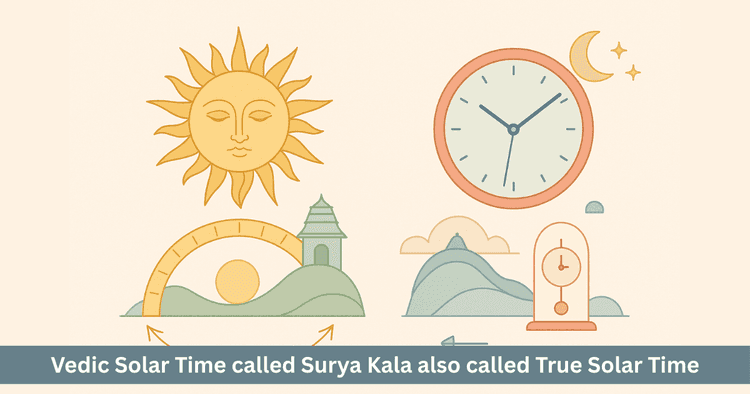
Table of Contents
Throughout human history, two fundamentally different approaches to measuring and conceptualizing time have shaped how civilizations organize life representing Vedic Solar Time rooted in ancient astronomical observation and spiritual principle and Modern Clock Time representing a standardized mechanical system enabling global coordination. These represent not merely different computational methods but profoundly divergent philosophies regarding time's nature and purpose.
For practitioners of Vedic astrology understanding this distinction proves essential because the difference between these two systems can shift planetary positions by degrees, fundamentally altering astrological interpretation and timing of important life decisions. Yet even beyond astrology, recovering understanding of Vedic timekeeping offers contemporary individuals a path toward greater alignment with natural rhythms and cosmic consciousness.
The Fundamental Divide: Two Conceptualizations of Time
Vedic Solar Time: The Sun's Actual Journey
Vedic Solar Time called Surya Kala also called True Solar Time or Apparent Solar Time represents time measured by the Sun's actual movement across the sky as observed from a specific geographic location. Rather than treating time as an abstract mechanical quantity Vedic philosophy recognizes time as a living rhythmic pulse of the universe representing a cosmic principle carrying distinct qualities and spiritual significance at each moment.
The core principles show that the day in Vedic timekeeping begins not at arbitrary midnight but at sunrise representing the natural moment when solar energy returns, consciousness awakens and the day recommences. The day concludes at the next sunrise completing one full solar-lunar cycle. This means a Vedic day is not uniformly twenty-four hours. It varies slightly based on geographic latitude where days are longer near equator in summer and shorter in winter, seasonal variation where summer days are longer and winter days are shorter and local sunrise sunset timing.
Measurement units show that Vedic timekeeping employs hierarchical measurement systems reflecting natural celestial rhythms. Nimisha is approximately zero point two one three seconds derived from the blink of an eye. Kshana is approximately ten seconds representing forty-five Nimishas. Pala is approximately twenty-four seconds where sixty Palas equal one Ghatika. Ghatika or Danda is approximately twenty-four minutes where sixty Ghatikas equal one day. Muhurta is approximately forty-eight minutes representing two Ghatikas and thirty Muhurtas per day.
Prahara is approximately three hours representing eight Praharas per day. Tithi is variable approximately twenty-four hours representing lunar day at twelve degree Sun-Moon separation. Divasa or Dina is sunrise to sunrise representing one complete solar day.
Philosophical significance shows that each unit carries spiritual meaning beyond mere measurement. Nimisha blink reflects momentary consciousness shifts. Muhurta auspicious moment represents cosmic window for action. Tithi lunar day reflects Moon's psychological influence. Divasa day represents complete cycle of manifestation and return.
Modern Clock Time: Mechanical Standardization
Modern Clock Time also called Mean Solar Time, Standard Time or Civil Time represents a standardized uniform measurement applying identically across entire geographic regions regardless of actual Sun position. Rather than tracking cosmic reality modern timekeeping prioritizes human convenience and global coordination.
The core principles show that the day in modern timekeeping begins at arbitrary midnight zero zero zero zero and concludes at the next midnight twenty-four zero zero. This moment holds no astronomical significance because midnight represents neither sunrise, sunset nor any observable celestial phenomenon. This means a modern day is precisely twenty-four hours always. It remains constant regardless of geographic latitude, season where summer and winter days are identical duration and local sunrise sunset timing.
Measurement units show that modern timekeeping employs a uniform decimal sexagesimal system. Second is one second representing SI units from atomic vibration. Minute is sixty seconds representing conventional division. Hour is sixty minutes representing traditional division. Day is twenty-four hours fixed and constant. Week is seven days representing the conventional cycle. Month is twenty-eight to thirty-one days representing historical convention. Year is three hundred sixty-five or three hundred sixty-six days representing Earth's orbital period averaged.
Philosophical significance shows that modern time represents mechanical precision replacing natural rhythm with mathematical uniformity. Universal standardization means same time worldwide within zones enabling coordination. Linear progression means time moves forward uniformly ignoring cycles. Quantification emphasizes how much time passes, not what kind of time it is.
The Practical Divergence: The Equation of Time
While Vedic and modern timekeeping systems diverge philosophically the most practically significant difference emerges through Equation of Time representing the mathematical variance between actual Sun position and average clock time.
Why the Divergence Exists
Cause One is Earth's Elliptical Orbit. Earth does not orbit the Sun in a perfect circle but in an ellipse with Sun at one focus. This creates variable speed. Perihelion closest to Sun approximately January three means Earth moves fastest and days are slightly shorter. Aphelion farthest from Sun approximately July four means Earth moves slowest and days are slightly longer. This orbital variation creates daily solar time fluctuations of approximately plus minus thirty seconds.
Cause Two is Earth's Axial Tilt. Earth's rotational axis tilts twenty-three point five degrees relative to orbital plane creating seasonal variations in the Sun's apparent path across the sky. Summer Solstice June twenty-one means the Sun reaches the northernmost point and longest day. Winter Solstice December twenty-one means Sun reaches southernmost point and shortest day. Equinoxes March twenty-one and September twenty-three mean Sun crosses celestial equator and day-night are equal. The tilted axis causes Sun's path to follow figure-eight pattern called Analemma across sky when observed at same local time throughout year.
Mathematical expression shows that Equation of Time Formula equals Apparent Solar Time minus Mean Solar Time. Annual Variation shows range from minus fourteen minutes to plus sixteen minutes representing approximately thirty minute total swing.
Real Example for October twenty-seven two thousand twenty-five shows Modern Clock Time IST at twelve zero zero PM noon sharp. Actual Solar Noon is approximately eleven thirty-eight AM representing twenty-two minutes earlier. Difference shows Sun is twenty-two minutes ahead of the clock today. This twenty-two minute variance seemingly trivial for daily life becomes critical for Vedic astrology where four minutes can shift the Ascendant Lagna by approximately one degree potentially changing entire astrological interpretation.
Local Mean Time: The Bridge Between Systems
To reconcile Vedic Solar Time with Modern Clock Time for astrological purposes practitioners employ Local Mean Time representing the average solar time specific to a birth location.
Understanding LMT
Definition shows that Local Mean Time represents the mean average solar time for your specific geographic longitude adjusted from standardized zone time like IST. Why It's Necessary shows that India operates on Indian Standard Time IST at eighty-two point five degrees East longitude passing through Mirzapur Uttar Pradesh. However India spans approximately twenty-eight degrees of longitude from sixty-eight degrees East in Gujarat to ninety-seven degrees East in Arunachal Pradesh.
This means someone in Mumbai seventy-two point eight degrees East experiences sunrise approximately thirty-nine minutes later than clock time suggests. Someone in Kolkata eighty-eight point four degrees East experiences sunrise approximately twenty-five minutes earlier than clock time suggests.
LMT Conversion Formula shows Standard Formula as LMT equals IST plus or minus Birth Longitude minus eighty-two point five degrees East multiplied by four minutes per degree. Directional Rule states if birth location is WEST of eighty-two point five degrees East then ADD the calculated minutes to IST. If birth location is EAST of eighty-two point five degrees East then SUBTRACT the calculated minutes from IST.
Practical Example Birth in Mumbai shows Scenario of child born at three zero zero PM IST in Mumbai on October twenty-seven two thousand twenty-five. Step One identifies Mumbai's Longitude at approximately seventy-two point eight degrees East. Step Two calculates Difference from Reference at eighty-two point five minus seventy-two point eight equals nine point seven degrees where Mumbai is WEST of reference. Step Three converts to Time at nine point seven degrees multiplied by four minutes per degree equals thirty-eight point eight minutes approximately thirty-nine minutes. Step Four calculates LMT where Mumbai is west of reference so ADD to IST. LMT equals three zero zero PM IST plus thirty-nine minutes equals three thirty-nine PM LMT.
Why This Matters shows that using three zero zero PM IST directly versus three thirty-nine PM LMT creates significant astrological difference. Thirty-nine minute variation equals approximately nine point seven five degrees of zodiacal shift. Lagna changes approximately fifteen degrees per hour equals one degree every four minutes. This thirty-nine minute variance equals approximately nine to ten degree Lagna shift potentially different zodiacal sign entirely.
Another Example Birth in Kolkata shows Scenario of child born at three zero zero PM IST in Kolkata. Step One identifies Kolkata's Longitude at approximately eighty-eight point four degrees East. Step Two calculates Difference from Reference at eighty-eight point four minus eighty-two point five equals five point nine degrees where Kolkata is EAST of reference. Step Three converts to Time at five point nine degrees multiplied by four minutes per degree equals twenty-three point six minutes approximately twenty-four minutes. Step Four calculates LMT where Kolkata is east of reference so SUBTRACT from IST. LMT equals three zero zero PM IST minus twenty-four minutes equals two thirty-six PM LMT.
Why This Distinction Matters for Vedic Astrology
The Lagna's Extreme Sensitivity
The Lagna Ascendant or Rising sign represents the most sensitive element in Vedic birth chart analysis. It determines Primary Life Theme representing overall life direction and karma. House Divisions where all twelve houses depend on accurate Lagna positioning. Dasha Periods representing planetary timing cycles calculated from Lagna. Predictions representing accuracy of major life event predictions.
Lagna Movement Rate shows Lagna Changes equal three hundred sixty degrees zodiac divided by twenty-four hours equals fifteen degrees per hour equals one degree every four minutes. Critical Sensitivity shows a mere four minute error in birth time creates one degree Lagna shift potentially changing the zodiacal sign itself shifting from Aries to Taurus for example, house placements of all planets, Dasha sequence and timing and life predictions and guidance.
Concrete Example of Lagna Shift
Scenario shows two siblings born four minutes apart in different cities. Sister A born at two fifty-eight PM IST in Delhi where Delhi is approximately seventy-seven point two degrees East. LMT Adjustment equals eighty-two point five degrees minus seventy-seven point two degrees multiplied by four equals twenty-one point two minutes add. Actual Birth Time LMT equals two fifty-eight PM plus twenty-one minutes equals three nineteen PM LMT. Calculated Lagna equals Aries twenty-eight degrees.
Sister B born at three zero two PM IST in Delhi four minutes later. Same city so same LMT adjustment. Actual Birth Time LMT equals three zero two PM plus twenty-one minutes equals three twenty-three PM LMT. Calculated Lagna equals Taurus two degrees.
Consequence shows that despite being born only four minutes apart the sisters have Different Rising Signs Aries versus Taurus, Different life themes according to Vedic astrology, Different Dasha sequences and timings and Potentially contradictory life predictions. This exemplifies why precise birth time recording and LMT conversion prove absolutely essential for accurate Vedic astrology.
Comparative Framework: Complete Overview
The key differences between Vedic Solar Time and Modern Clock Time are as follows. Basis shows Vedic uses Sun's actual position in sky while Modern uses Average standardized time. Day Start shows Vedic uses Sunrise varies daily while Modern uses Midnight fixed. Day Duration shows Vedic is Variable with seasonal variation while Modern is Fixed twenty-four hours always. Primary Unit shows Vedic uses Muhurta approximately forty-eight minutes and Ghatika approximately twenty-four minutes while Modern uses Hour, Minute and Second.
Calculation shows Vedic depends on actual sunrise at location while Modern is Identical across entire time zone. Annual Equation shows Vedic varies minus fourteen to plus sixteen minutes while Modern has No variation within zone. Application shows Vedic is for Rituals, auspicious timing and astrology while Modern is for Civil administration and coordination. Philosophy shows Vedic is Spiritual, cyclic and quality-focused while Modern is Mechanical, linear and quantity-focused.
Standardization shows Vedic is Localized with individual sunrise times while Modern is Standardized by longitude zones. Historical Use shows Vedic has five thousand plus years in Vedic tradition while Modern has been Since eighteen eighties modern era. Current Status in India shows Vedic is Used for astrology only while Modern is Official for all purposes IST. Lagna Accuracy shows Vedic is Essential for birth chart precision while Modern Must convert to LMT for accuracy.
Practical Guidance for Fresh Astrology Users
Five Essential Steps for Accurate Birth Chart Calculation
Step One Gather Precise Birth Information includes Date with full date day month year, Time exact to the minute if possible with seconds ideal, Location with city, state and preferably latitude longitude and Source with hospital birth record most reliable, doctor's estimate or family memory. Why this matters is because birth time accuracy directly affects Lagna Ascendant accuracy determining entire chart interpretation.
Step Two Never Use IST Directly for Chart Calculation means Do NOT enter IST clock time directly into astrological calculator. Instead convert IST to Local Mean Time LMT using formula or automatic calculator. Why this matters is because IST represents standardized zone time and your location's actual solar time may differ by ten to forty minutes.
Step Three Use Reliable Astrological Calculators includes Recommended Free Online Tools. What These Tools Do is automatically convert IST to LMT based on birth location, calculate accurate Lagna to arc-second precision, generate complete birth chart with all planetary positions and calculate Vimshottari Dasha periods most important for predictions.
Step Four Verify Your Lagna Makes Sense means after generating birth chart verify Lagna Rising sign against life experience. Check Against physical appearance and body type where does zodiacal element match, public personality where how others perceive you and does Lagna archetype fit, early childhood environment and family dynamics and overall life themes and patterns. If Lagna Feels Wrong then birth time may need rectification adjustment through experience-matching, consult experienced astrologer for time verification and don't ignore intuition because your Lagna should feel authentic.
Step Five Understand How Time Variation Affects Predictions means recognize that even small birth time uncertainties create Lagna uncertainty. Plus minus two minutes uncertainty equals plus minus zero point five degrees Lagna uncertainty. Plus minus five minutes uncertainty equals plus minus one point two five degrees Lagna uncertainty. Plus minus ten minutes uncertainty equals plus minus two point five degrees Lagna uncertainty. This can potentially shift zodiacal sign, alter house placements and affect Dasha timing.
The Profound Wisdom: Why Ancient Vedic Astronomers Were Geniuses
The sophistication of ancient Vedic timekeeping reveals remarkable scientific understanding. Standardization Without Uniformity shows Modern Western astronomy uses Greenwich Mean Time as global reference similar to Vedic use of Ujjain Mean Time. However while Western approach sacrificed local solar accuracy for standardization, Vedic system maintained BOTH with Ujjain as reference point like Greenwich and LMT conversion for local accuracy though not formalized until recently.
Mathematical Precision shows Surya Siddhanta calculations made sixteen hundred years ago without telescopes calculated Tropical year at three hundred sixty-five point two four two one seven five six days where modern is three hundred sixty-five point two four two one nine zero four with error of one point four seconds. Solar orbital variations accounting for Equation of Time. Precise time divisions from microseconds to cosmic ages.
Integration of Time Systems shows rather than choosing between solar seasonal and lunar consciousness time, Vedic system integrated both into unified Lunisolar Panchang combining solar months with lunar ritual timing through Adhika Maas intercalary month adjustment.
Conclusion: Bridging Two Worlds
For the contemporary practitioner of Vedic astrology understanding the distinction between Vedic Solar Time and Modern Clock Time proves transformative. This knowledge reveals that Vedic Solar Time teaches time is not abstract quantity but living cosmic principle carrying distinct qualities and spiritual significance at each moment. Aligning with solar rhythm through sunrise practice, Muhurta timing and seasonal adjustment reconnects consciousness with natural order.
Modern Clock Time teaches human coordination requires standardized systems transcending individual variation. Global civilization depends on universal time standards enabling commerce, communication and cooperation.
Integration principle shows the wisdom lies not in choosing one over the other but in honoring both. Use Modern Clock Time for practical scheduling, work commitments and social coordination. Use Vedic Solar Time via LMT for astrological precision, ritual timing and personal rhythm alignment. Recognize Local Mean Time as bridge enabling accurate astrological calculation within modern timekeeping framework.
By recovering understanding of Vedic Solar Time while navigating modern temporal reality contemporary practitioners access both ancient wisdom and modern convenience living simultaneously in cosmic rhythm and human coordination honoring both celestial truth and social order.
Get your accurate Kundali
Generate KundaliDid you like it?
Author

Pt. Nilesh Sharma (63)
Experience: 20
Consults About: Family Planning, Career
Clients In: Punjab, Haryana, Delhi
Share this article with friends and family
WELCOME TO
ZODIAQ
Right Decisions at the right time with ZODIAQ
