Vedic Versus Western Astronomy: Two Mirrors Reflecting Cosmic Truth
By Pt. Amitabh Sharma
Comprehensive Comparison of Fundamental Differences and Complementary Strengths Between Sidereal and Tropical Zodiacs
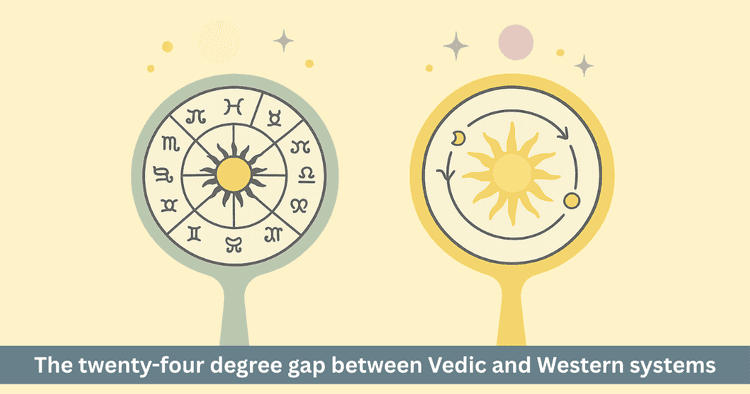
Table of Contents
Throughout human history, two fundamental approaches to understanding celestial mechanics and measuring time have evolved representing the Vedic Indian system and the Western system. These represent not merely different computational methods but fundamentally divergent philosophical frameworks for interpreting humanity's relationship with the cosmos. While both systems emerge from careful observation of celestial phenomena and employ sophisticated mathematics, they prioritize different aspects of cosmic reality, anchor their measurements to different reference points and ultimately serve different purposes. The Vedic system prioritizes astronomical accuracy relative to fixed stars combined with spiritual significance, while the Western system prioritizes seasonal alignment coupled with mathematical regularity.
Understanding these systems' similarities, differences and complementary strengths reveals how two approaches to identical celestial phenomena can reach divergent conclusions and why both offer valid insights into time's nature.
The Historical Divergence: When Two Paths Parted
The Perfect Alignment of 285 CE
Remarkably, the Vedic Sidereal and Western Tropical zodiacs were perfectly aligned approximately 285 CE. At this historical moment, both systems identified zodiacal boundaries identically as the starting point of Aries coincided in both systems, as did all subsequent zodiacal divisions. This alignment point represents a critical historical reference because the Western Tropical zodiac became crystallized at this moment, anchored to the Vernal Equinox position of 285 CE. The Vedic system, by contrast, continued adjusting for astronomical precession, maintaining alignment with actual stellar positions.
The Accumulating Gap: Precession's Relentless Drift
Earth's rotational axis is not perfectly stable. Like a spinning top gradually losing gyroscopic precision, Earth's axis undergoes a slow wobble called precession of the equinoxes. This wobble completes one full rotation approximately every twenty-six thousand years. The drift rate calculation shows that annual drift equals three hundred sixty degrees divided by twenty-six thousand years approximately equals zero point zero one three nine degrees per year or one degree every seventy-two years. Over approximately seventeen hundred forty years since 285 CE to present day, seventeen hundred forty years multiplied by zero point zero one three nine degrees per year approximately equals twenty-four point one six degrees. The current gap is approximately twenty-three degrees and fifty-one minutes. This represents nearly a complete zodiacal sign representing the difference between a Vedic Pisces Sun and a Western Aries Sun for the same birth date.
The Fundamental Divide: Two Zodiacal Approaches
The Sidereal Zodiac: Vedic Astronomy's Star-Based Framework
The Sidereal Zodiac measures zodiacal positions relative to actual fixed stellar constellations observable in the night sky. The term sidereal derives from Latin sidereus meaning of the stars. Rather than using seasonal markers, the Sidereal system anchors itself to specific fixed stars. Traditional reference includes the star Spica often associated with Chitra Nakshatra positioned at zero degrees Libra in the sidereal zodiac. The Sidereal system incorporates Ayanamsha the arc of difference representing precession. This adjustment is applied annually ensuring zodiacal positions continue matching actual stellar positions despite Earth's axial wobble.
When viewing the night sky through telescopes or astronomy applications, the actual stellar positions match the Vedic Sidereal zodiac. The constellation Scorpius actually occupies the zodiacal space the Vedic system labels as Scorpio and Pisces actually occupies the space labeled Pisces Rashi. The key advantage is that the Sidereal system maintains astronomical accuracy. What practitioners calculate corresponds to what observers actually see in the night sky.
The Tropical Zodiac: Western Astronomy's Season-Based Framework
The Tropical Zodiac measures zodiacal positions relative to Earth's seasonal cycle. The term tropical derives from tropic referring to the Tropic of Cancer and Tropic of Capricorn representing the extreme points of the Sun's seasonal journey. Rather than fixed stars, the Tropical system anchors to the Vernal Equinox representing the precise moment when the Sun crosses the celestial equator moving northward marking spring's astronomical beginning. This moment is designated zero degrees Aries annually.
Unlike the Sidereal system's dynamic adjustments, the Tropical zodiac remains constant to calendar dates. Aries always occurs March twenty-one to April nineteen, Libra always occurs September twenty-three to October twenty-two and Capricorn always occurs December twenty-one to January nineteen. These dates have remained unchanged for approximately two thousand years despite Earth's precession causing actual stellar positions to shift continuously.
Western astrology determines birth charts by consulting calendar dates rather than observing actual stellar positions. An individual born April first receives a Sun sign of Aries in Western astrology regardless of where the actual Sun appears in the night sky. The key advantage is that the Tropical system maintains seasonal alignment. Aries consistently corresponds to spring in the Northern Hemisphere and Capricorn to winter creating psychologically and agriculturally relevant associations.
The Twenty-Four Degree Gap: Real-World Implications
Concrete Example: October 27, 2025
To illustrate the practical consequences of this twenty-four degree divergence, the Vedic Sidereal assessment using actual astronomical observation via telescope or modern astronomy applications shows Sun's actual position at approximately four degrees Scorpio Vrishchik Rashi and Moon's actual position at approximately ten degrees Scorpio. The interpretation represents autumn harvest season, introspection phase and Kartik month energy. The Western Tropical assessment using calendar-based tropical zodiac shows Sun's position at approximately three degrees Scorpio Tropical. The interpretation represents Scorpio season, emotional intensity and personal power themes.
The discrepancy is that while both systems label the Sun as Scorpio, they reference different regions of the sky. The Vedic system describes where the Sun actually appears while the Western system describes the seasonal period regardless of actual stellar position.
Birth Chart Divergence: April 1, 1985
To illustrate consequences for astrological interpretation, an individual born April first nineteen eighty-five has different readings. In Western Astrology the Sun Sign is Aries occurring March twenty-one to April nineteen tropical dates with characteristics of pioneering, courageous and direct action-oriented. The ruling planet is Mars and the element is Fire. In Vedic Astrology the Sun Sign Surya Rashi is Pisces at approximately six to seven degrees Pisces sidereal with characteristics of intuitive, compassionate, spiritual and imaginative. The ruling planet is Jupiter and the element is Water.
The astrological consequence is that these represent fundamentally different personality interpretations. An individual considered Aries in Western astrology would be considered Pisces in Vedic astrology creating opposite archetypal associations and significantly different life guidance.
Comparative Framework: Side-by-Side Analysis
The key differences between Vedic Sidereal and Western Tropical systems are as follows. In zodiac type, Vedic uses Sidereal fixed stars while Western uses Tropical seasons. In reference point, Vedic uses fixed star Spica at zero degrees Libra while Western uses Vernal Equinox at zero degrees Aries. In current difference, Vedic is twenty-three degrees fifty-one minutes behind Western while Western is twenty-three degrees fifty-one minutes ahead of Sidereal.
In precession handling, Vedic is dynamic and adjusts every seventy-two years via Ayanamsha while Western is static and ignores precession entirely. In astronomical accuracy, Vedic matches actual sky positions while Western is two thousand years off from actual stellar positions. In origin and age, Vedic is five thousand plus years old from Vedas and Rigveda period while Western is approximately two thousand years old from Babylon and Greece origin.
In primary timing focus, Vedic uses Moon Sign Janma Rashi for personality and destiny while Western uses Sun Sign for personality and identity. In calendar type, Vedic is lunisolar integrating Moon and Sun while Western is solar using only Sun-based system. In house system, Vedic uses Whole Sign and Bhava Chalit while Western uses Placidus, Koch and Equal House.
In planets included, Vedic uses seven visible planets from Sun through Saturn while Western uses ten including Uranus, Neptune and Pluto. In prediction system, Vedic uses Dasha-Bhukti representing one hundred twenty year cycles and precise timing while Western uses Transits and Progressions representing general trends. In accuracy rate, Vedic achieves eighty-five to ninety percent for major events while Western achieves sixty to seventy percent for trends.
In philosophy, Vedic represents Karma and Dharma focusing on spiritual evolution and duty while Western represents Psychology and Personality focusing on self-understanding. In remedial measures, Vedic provides Mantras, gemstones, yagyas, charity and fasting while Western is limited including crystals, meditation and affirmations. In festival approach, Vedic uses dates calculated fresh annually from sky observation while Western uses fixed calendar dates.
In view of time, Vedic is cyclical representing Yugas, Kalpas and eternal recurrence while Western is linear representing progressive history and sequential time.
Calendrical System Implications
The Lunisolar Versus Solar Divide
The Vedic Calendar represents lunisolar integration. The Vedic Panchang integrates both lunar and solar cycles into unified framework. Moon's role is primary for determining daily time quality Tithi, personality characteristics Nakshatra and festival dates. Sun's role provides yearly framework solar year and defines solar months Saura Masa. The integration mechanism is Adhika Maas intercalary month added approximately every three years to prevent lunar calendar from drifting through seasons.
The philosophical basis is that Moon represents mind, emotion and consciousness fluctuation. Tracking the Moon provides precise guidance for rituals and personal timing. The Sun provides seasonal and yearly structure. Together they create calendar reflecting both psychological reality Moon and physical reality Sun.
The Western Calendar represents solar priority. The Western Gregorian calendar prioritizes the Sun's annual cycle. Moon's role is secondary and acknowledged through weeks approximately quarter-month lunar phases and specific religious calculations like Easter but not integrated into primary calendar structure. Sun's role is primary and determines year length and seasonal alignment. The correction mechanism is Leap Day February twenty-nine added approximately every four years to prevent calendar from drifting relative to seasons.
The philosophical basis is that the solar year provides measurable predictable framework for civil administration and agriculture. Month lengths twenty-eight to thirty-one days represent historical conventions from Roman times not astronomical precision.
Time Unit Definitions: Structural Differences
Vedic time units begin with the smallest time unit Truti at approximately zero point zero three three milliseconds. Prana is the respiration unit at approximately four seconds. Nadi or Ghatika is water clock division at twenty-four minutes. Muhurta is auspicious moment at forty-eight minutes. Tithi is lunar day at twelve degree separation and approximately twenty-four hours variable. Nakshatra Day is Moon in one constellation at approximately twenty-three point five hours.
Paksha is fortnight of fifteen Tithis at approximately fifteen days. Masa is month lunar or solar at twenty-nine point five three days lunar or thirty point four days solar. Ritu is season of two months at approximately sixty days. Varsha is year at three hundred sixty-five point two five six days sidereal. Yuga is cosmic age at millions of years. Mahayuga is complete cosmic cycle at four million three hundred twenty thousand years.
Western time units include Second as SI unit at one second. Minute is sixty seconds at one minute. Hour is sixty minutes at one hour. Day is Earth rotation at twenty-four hours midnight to midnight. Week is seven days. Month is approximately one lunar cycle at twenty-eight to thirty-one days conventional. Year is Earth's orbit at three hundred sixty-five point two four two days tropical.
The key difference is that Vedic units reflect astronomical observations where Tithi is based on actual Sun-Moon angle and Nakshatra is based on Moon's actual stellar position. Western units employ conventional divisions where months have varying lengths inherited from Roman times and day starts at midnight by convention.
Correction Mechanisms
Vedic System: Adhika Maas Intercalary Month
The problem is that the lunar year of twelve lunar months equals approximately three hundred fifty-four point three six days while the solar year equals approximately three hundred sixty-five point two five six days. This eleven day annual discrepancy causes lunar calendar to drift through seasons approximately one month every three years. The solution is Adhika Maas. Approximately every two to three years specifically every thirty-two to thirty-three months on average an extra lunar month is inserted. This intercalary month Adhika Maas is identical to the preceding lunar month but marked as extra for calendrical purposes.
The mathematical basis shows that Adhika Maas insertion rate equals Solar Year minus Lunar Year divided by Average Lunar Month equals ten point eight eight days divided by twenty-nine point five three days approximately equals zero point three six eight times annually. This means Adhika Maas is added seven times every nineteen years maintaining long-term alignment. The outcome is that the lunar festival calendar though following lunar cycles drifts only gradually through seasons over centuries remaining broadly synchronized with agricultural and seasonal realities.
For example Diwali celebrates Krishna Amavasya New Moon of Kartik month. While Diwali's date shifts typically in November one to fifteen range, it consistently occurs during autumn harvest season never drifting into winter or summer.
Western System: Leap Day Julian Gregorian Correction
The problem is that the tropical year equals approximately three hundred sixty-five point two four two days. If calendar years were always three hundred sixty-five days the calendar would lose approximately zero point two four two days annually causing it to drift relative to seasons approximately one day every four years. The solution is Leap Day. Every four years approximately February twenty-nine is added to create a three hundred sixty-six day year. However this correction overshoots slightly requiring additional refinement. The Gregorian Rule states leap years occur every four years EXCEPT century years like seventeen hundred, eighteen hundred, nineteen hundred unless divisible by four hundred.
The mathematical basis shows that Leap Day frequency equals zero point two four two days divided by one day approximately equals one day every four point one two five years. Gregorian calendar achieves this through complex rule structure maintaining average year length at three hundred sixty-five point two four two five days extremely close to actual tropical year. The outcome is that the Western calendar maintains seasonal dates with remarkable consistency. The Vernal Equinox consistently occurs March twenty to twenty-one and Winter Solstice occurs December twenty-one to twenty-two across centuries.
Astronomical Accuracy: Verification Against Modern Measurements
Modern astronomy through telescopes and satellite observations provides precise reference points for verifying which system maintains accuracy.
Sidereal Accuracy Verification
The method involves using modern astronomy software to observe actual Sun and Moon positions in night sky and compare to Vedic calculations. Vedic System Verification shows that when Vedic Panchang indicates Sun at four degrees Scorpio Sidereal, actual sky observation shows Sun actually appears in Scorpius constellation region approximately matching calculation. The result is that Vedic calculations match observable reality.
Example dates include October twenty-seven two thousand twenty-five where Vedic system indicates Sun at approximately four degrees Scorpio Sidereal matching actual night sky observation. January fourteen two thousand twenty-six where Vedic system indicates Sun entering Capricorn Makar Sankranti matching actual Sun's position relative to Capricornus constellation.
Tropical Accuracy Verification
The method involves comparing Western tropical zodiac to actual stellar positions. Western System Verification shows that when Western astrology indicates Sun in Scorpio Tropical from October twenty-three to November twenty-one, actual sky observation shows Sun actually appears approximately twenty-four degrees BEFORE Scorpius constellation in the sky. The difference is that Tropical Scorpio encompasses sky region that is actually sidereal Libra region. The result is that Western tropical positions are twenty-four degrees offset from actual stellar positions.
The practical consequence is that for an individual born October twenty-five nineteen ninety-five, Western Astrology states Sun in Scorpio and you are intense, secretive and transformative. Actual Sky shows Sun actually in Libra constellation. Vedic Astrology states Sun in Libra with different personality interpretation. The astronomical verdict is that the Vedic Sidereal system maintains astronomical accuracy because calculations match what observers actually see in the night sky. The Western Tropical system maintains seasonal consistency but sacrifices astronomical accuracy for calendrical simplicity.
Philosophical and Practical Frameworks
Vedic Philosophy: Karma, Dharma and Cosmic Order
The core principle is that Vedic astronomy functions as Daiva Vidya divine knowledge integrating astronomy with spiritual philosophy. Celestial movements reflect cosmic principles governing existence. Key philosophical concepts include Rita cosmic order where the universe operates according to Rita divine law maintaining cosmic harmony. Celestial movements express Rita and human actions aligned with Rita receive cosmic support.
Karma action and consequence means past actions ripple into present as Karma. Planetary positions represent karmic patterns ripening. Vedic astrology interprets planetary placement as manifestation of past karma. Dharma righteous duty represents individual's highest duty aligned with cosmic order. Vedic astrology identifies dharmic path through natal chart interpretation.
Muhurta auspicious timing means by timing actions during Muhurta auspicious moments practitioners align will with cosmic support vastly increasing success probability. Dasha System predictive precision means the Dasha system planetary period cycles provides extraordinary predictive precision at eighty-five to ninety percent accuracy for major events enabling practitioners to anticipate life phases with remarkable accuracy.
The spiritual goal is that Vedic astronomy ultimately serves liberation Moksha representing freedom from karmic cycles through aligning with cosmic consciousness.
Western Framework: Psychology, Science and Personal Empowerment
The core principle is that Western astrology functions as psychological tool for self-understanding and personal growth independent of spiritual or karmic frameworks. Key philosophical concepts include archetypal psychology where zodiac signs represent archetypal psychological patterns. Aries embodies pioneering warrior archetype and Pisces embodies mystical dreamer archetype. Birth chart reveals psychological blueprint.
Personality and identity means planetary positions reflect psychological drives and behavioral tendencies. Sun represents core identity, Moon represents emotional nature and Rising sign represents personality projection. Personal agency emphasizes free will and personal empowerment. Astrology provides insights but individuals retain complete freedom to choose response and shape destiny.
Transpersonal growth means beyond personality understanding transpersonal astrology explores consciousness development, spiritual emergence and higher self actualization. Outer planet symbolism means inclusion of Uranus revolution and innovation, Neptune transcendence and dissolution and Pluto transformation and death rebirth reflects modern psychological understanding of consciousness dimensions.
Therapeutic application means Western astrology increasingly integrates with therapy providing framework for understanding psychological patterns and facilitating healing. The personal goal is that Western astrology ultimately serves self-actualization and personal transformation through understanding oneself more deeply and aligning with authentic self-expression.
Which System Should Practitioners Choose
Choosing Vedic Sidereal Astrology
Optimal if you prioritize astronomical accuracy wanting calculations matching actual sky positions, predictive precision desiring specific timing for life events at eighty-five to ninety percent accuracy via Dasha system, karmic understanding interested in spiritual evolution and karmic learning, daily guidance wanting detailed Panchang-based recommendations for optimal timing, spiritual practice seeking to align life with dharma and cosmic order, long-term forecasting needing decade-ahead life planning with reliability and cultural connection desiring engagement with five thousand plus year tradition.
Best application areas include ritual timing and festival dating, business timing and venture launches, marriage and relationship timing, medical procedure scheduling, spiritual practice initiation and career transitions and major decisions.
Choosing Western Tropical Astrology
Optimal if you prioritize psychological insight wanting deep self-understanding through archetypal symbolism, seasonal relevance preferring zodiac connected to actual Earth seasons, personality focus interested in psychological patterns and traits, creative interpretation enjoying symbolic and metaphorical understanding without requiring astronomical precision, Western cultural context seeking alignment with Western astrological tradition, personal empowerment emphasizing free will and individual agency and consistent dates preferring stable zodiac dates year to year.
Best application areas include personality analysis and self-understanding, relationship compatibility assessment, psychological therapy integration, creative and artistic expression, personal growth and self-actualization and horoscope reading for entertainment and insight.
Integration: Complementary Strengths
Rather than viewing these systems as contradictory competitors, integration reveals complementary strengths. The Vedic System excels at astronomical accuracy, predictive precision, daily life optimization, karmic understanding and spiritual advancement. The Western System excels at psychological depth, seasonal relevance, personal empowerment, archetypal symbolism and therapeutic application.
An integrated approach means a sophisticated practitioner might use Vedic system for timing decisions when to act, use Western system for psychological understanding who you are and combine both for holistic wisdom integrating cosmic timing with personal psychology.
Example Integrated Application
Considering marriage, Vedic Analysis calculates optimal Muhurta auspicious moment for ceremony, examines Dasha periods for relationship timing and assesses birth chart compatibility. Western Analysis examines natal charts for psychological compatibility, explores relationship themes in synastry and understands personal growth potential. Integration means marry at auspicious Vedic time with partner of psychological compatibility identified through Western analysis combining cosmic timing with personal harmony.
Conclusion: Two Valid Perspectives on Cosmic Truth
The divergence between Vedic and Western astronomy represents not error on either side but fundamentally different choices about what aspects of cosmic reality to prioritize. Vedic Astronomy teaches that the universe operates according to cosmic principles accessible through mathematical observation and spiritual insight. By aligning with these principles through precise timing and karmic awareness human beings can navigate life with intelligence and purpose. Western Astronomy teaches that the universe operates according to mechanical principles discoverable through observation and analysis. By understanding these principles and recognizing our own psychological nature human beings can create meaningful lives through conscious choice.
Both approaches offer profound wisdom. The Vedic system provides precision and cosmic synchronization while the Western system provides psychological insight and personal empowerment. Neither is definitively correct rather each emphasizes different aspects of a multidimensional reality.
For the contemporary seeker the greatest wisdom may emerge through appreciating both systems' contributions by honoring the Vedic recognition that precise cosmic timing matters while simultaneously embracing the Western recognition that personal psychology and conscious choice fundamentally shape lived experience.
In the end understanding both systems reveals that humans inhabit multiple dimensions simultaneously living within both cosmic rhythms and personal consciousness, both universal patterns and individual choice. The most complete understanding emerges through engaging both mirrors recognizing that the cosmos reflects infinite depths revealed only through multiple perspectives.
What does moon sign reveal about me?
My Moon SignDid you like it?
Author

Pt. Amitabh Sharma (56 Years)
Experience: 20
Consults About: Family Planning, Career
Clients In: Punjab, Haryana, Delhi
Share this article with friends and family
WELCOME TO
ZODIAQ
Right Decisions at the right time with ZODIAQ
