Calculating Vimshottari Dasha: The 120-Year Roadmap of Your Life
By Pt. Abhishek Sharma
From Nakshatra to Complete Life Prediction
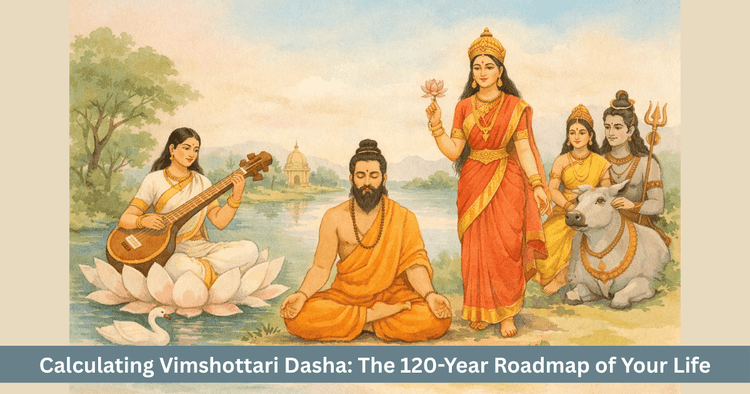
Table of Contents
This article is based on the Moon sign. To find your Moon sign, prepare a birth chart using your date, time and place of birth your Moon sign is the zodiac the Moon occupies at birth.
Vimshottari Dasha is the most widely used and revered predictive timing system in Vedic astrology, offering a 120-year roadmap that outlines the major planetary periods influencing an individual's life. Praised by Maharishi Parashar as the most suitable dasha system for the current era, it is calculated based on the position of the Moon in a specific nakshatra (lunar mansion) at the time of birth. This system provides a framework for understanding when the karma associated with each planet will manifest, shaping the events and experiences of a person's life journey.
The Core Principle: The Moon's Nakshatra
The entire calculation of Vimshottari Dasha hinges on one critical piece of information: the nakshatra where the Moon was placed at the moment of birth. The zodiac is divided into 27 nakshatras and each one is ruled by one of the nine grahas (planets) in a fixed sequence. The ruling planet of the Moon's birth nakshatra determines the first major planetary period or Mahadasha, that a person will experience.
The 120-Year Cycle and Planetary Rulerships
The Vimshottari Dasha system is based on a total cycle of 120 years, which was considered the ideal human lifespan in the Kali Yuga. This 120-year period is divided among the nine planets, with each planet ruling for a specific number of years.
Planetary Periods and Sequence
| Planet (Graha) | Dasha Duration | Ruling Nakshatras | Sequence Position |
|---|---|---|---|
| Ketu (South Node) | 7 Years | Ashwini, Magha, Moola | 1st |
| Venus (Shukra) | 20 Years | Bharani, Purva Phalguni, Purvashadha | 2nd |
| Sun (Surya) | 6 Years | Krittika, Uttara Phalguni, Uttarashadha | 3rd |
| Moon (Chandra) | 10 Years | Rohini, Hasta, Shravana | 4th |
| Mars (Mangal) | 7 Years | Mrigashira, Chitra, Dhanishta | 5th |
| Rahu (North Node) | 18 Years | Ardra, Swati, Shatabhisha | 6th |
| Jupiter (Guru) | 16 Years | Punarvasu, Vishakha, Purva Bhadrapada | 7th |
| Saturn (Shani) | 19 Years | Pushya, Anuradha, Uttara Bhadrapada | 8th |
| Mercury (Budha) | 17 Years | Ashlesha, Jyeshtha, Revati | 9th |
| Total | 120 Years | 27 Nakshatras | Cyclic |
Fixed Cyclic Order: The sequence never changes after Mercury's 17 years, the cycle returns to Ketu (if the person lives beyond 120 years). The planet ruling at birth depends solely on the Moon's Nakshatra position.
Step-by-Step Calculation Method
Step 1: Determine Moon's Nakshatra at Birth
Input Requirements:
- Date of birth
- Exact time of birth (precision is critical)
- Place of birth (latitude/longitude for astronomical calculations)
Calculation Process:
Using astronomical tables or software, determine the Moon's precise zodiacal position at birth moment. Convert this position to identify which of the 27 Nakshatras the Moon occupies.
Example: Birth on January 15, 1970, 4:30 AM in Delhi shows Moon at Aries 9°36'. Since Ashwini Nakshatra spans 0° to 13°20' Aries, the Moon is in Ashwini.
Step 2: Identify the Mahadasha Lord
Rule: The Nakshatra occupied by the Moon at birth determines which planet's Mahadasha operates at birth.
From the table above: Ashwini is ruled by Ketu, therefore the person is born during Ketu Mahadasha.
Important Note: This means the native will experience Ketu's influence first, followed by Venus, Sun, Moon, Mars, Rahu, Jupiter, Saturn and Mercury in strict sequence.
Step 3: Calculate the Balance of Dasha at Birth
Critical Concept: The Moon rarely enters a Nakshatra exactly at the moment of someone's birth. Usually, the Moon has already traveled some portion through the Nakshatra, meaning part of that planet's Mahadasha has already elapsed before birth.
The Balance Formula:
Each Nakshatra spans exactly 13°20' = 800 arc minutes.
Balance Calculation:
- Determine Moon's exact degree within its Nakshatra
- Calculate how many arc minutes remain until Nakshatra completion
- Apply proportional formula to determine remaining years
Mathematical Formula:
Balance (in days) = [(800 - Moon's position in Nakshatra in arc minutes) × 360 × Planet's total years] ÷ 800
Then convert days to years, months and days.
Detailed Example Using Our Birth Chart
Birth data: January 15, 1970, 4:30 AM, Delhi
Moon position: Aries 9°36' = within Ashwini Nakshatra
Ashwini range: 0° Aries to 13°20' Aries
Moon has traveled: 9°36' = 576 arc minutes
Remaining distance: 13°20' - 9°36' = 3°44' = 224 arc minutes
Calculation:
Ketu's full period = 7 years
Proportion remaining = 224 ÷ 800 = 0.28
Balance of Ketu Dasha = 7 × 0.28 = 1.96 years ≈ 1 year, 11 months, 15 days
Interpretation: This native will experience only the final 1 year 11 months of Ketu's 7-year Mahadasha, then enter Venus Mahadasha for its full 20 years, followed by Sun's full 6 years and so on.
Step 4: Create the Dasha Timeline
Once the balance is calculated, construct the complete lifetime Dasha sequence:
| Mahadasha | Start Date | End Date | Duration |
|---|---|---|---|
| Ketu (balance) | Jan 15, 1970 | Dec 30, 1971 | 1 yr 11 mo 15 days |
| Venus (full) | Dec 31, 1971 | Dec 30, 1991 | 20 years |
| Sun (full) | Dec 31, 1991 | Dec 30, 1997 | 6 years |
| Moon (full) | Dec 31, 1997 | Dec 30, 2007 | 10 years |
| Mars (full) | Dec 31, 2007 | Dec 30, 2014 | 7 years |
| Rahu (full) | Dec 31, 2014 | Dec 30, 2032 | 18 years |
| Jupiter (full) | Dec 31, 2032 | Dec 30, 2048 | 16 years |
| Saturn (full) | Dec 31, 2048 | Dec 30, 2067 | 19 years |
| Mercury (full) | Dec 31, 2067 | Dec 30, 2084 | 17 years |
This creates a complete 120-year roadmap showing which planetary energy dominates each life phase.
Hierarchical Sub-Periods: Antardashas and Beyond
The Five Nested Levels
Vimshottari Dasha operates through five hierarchical time divisions, each providing progressively finer timing precision:
- Mahadasha (Major Period): The primary planetary ruler (years)
- Antardasha/Bhukti (Sub-Period): Nine sub-divisions within each Mahadasha (months)
- Pratyantardasha (Sub-Sub-Period): Finer divisions within Antardashas (days)
- Sookshma Dasha (Micro-Period): Even finer timing (hours/days)
- Prana Dasha (Life-Breath Period): Finest division (minutes/hours)
Calculating Antardashas (Sub-Periods)
Within each Mahadasha, all nine planets operate as Antardasha lords in the same fixed sequence.
Antardasha Duration Formula:
Antardasha (in months) = (Mahadasha planet's years × Antardasha planet's years) ÷ 10
Remainder × 3 = additional days
Example: Venus Mahadasha (20 years) Antardashas:
| Antardasha Lord | Duration Calculation | Months | Days |
|---|---|---|---|
| Venus-Venus | (20 × 20) ÷ 10 | 40 months | 0 days |
| Venus-Sun | (20 × 6) ÷ 10 | 12 months | 0 days |
| Venus-Moon | (20 × 10) ÷ 10 | 20 months | 0 days |
| Venus-Mars | (20 × 7) ÷ 10 | 14 months | 0 days |
| Venus-Rahu | (20 × 18) ÷ 10 | 36 months | 0 days |
| Venus-Jupiter | (20 × 16) ÷ 10 | 32 months | 0 days |
| Venus-Saturn | (20 × 19) ÷ 10 | 38 months | 0 days |
| Venus-Mercury | (20 × 17) ÷ 10 | 34 months | 0 days |
| Venus-Ketu | (20 × 7) ÷ 10 | 14 months | 0 days |
| Total | 240 months | = 20 years |
Key Principle: The Antardashas always begin with the Mahadasha planet itself (Venus-Venus in this case), then proceed through the fixed sequence.
Practical Interpretation Guidelines
Understanding Dasha Results
Planetary Nature + Chart Placement = Results
The Dasha planet's results depend on:
- Natural benefic/malefic nature (Jupiter benefic, Saturn malefic, etc.)
- House rulership (which houses the planet owns in the chart)
- House placement (where the planet sits in the natal chart)
- Aspects received (influences from other planets)
- Dignity (exalted, debilitated, own sign, etc.)
- Functional nature (benefic/malefic for that specific ascendant)
Example: Jupiter Mahadasha could bring:
- Positive results if Jupiter is well-placed, exalted or ruling beneficial houses
- Challenging results if Jupiter is debilitated, afflicted or ruling difficult houses
- Mixed results requiring nuanced analysis of all factors
Dashas Are Unique, Transits Repeat
Critical Distinction: Unlike planetary transits (which repeat every planetary cycle), each person experiences each Mahadasha only once in their lifetime. This makes Dasha periods fundamentally transformative rather than cyclical the lessons and events of Saturn Mahadasha, for instance, occur once in a specific 19-year window and never repeat.
Combining Mahadasha and Antardasha for Events
Event Timing Principle: Major life events typically require alignment between Mahadasha and Antardasha lords both indicating similar outcomes.
Marriage Example:
If Mahadasha lord rules the 7th house (marriage) AND
Antardasha lord also connects to 7th house/Venus/relationships
Then marriage probability increases dramatically during that combined period.
Contradictory Periods: When Mahadasha indicates one thing but Antardasha contradicts, results become mixed or delayed, requiring deeper chart analysis.
Modern Calculation Tools
Software vs. Manual Calculation
Contemporary Practice: While traditional astrologers mastered manual calculations using nakshatra tables and mathematical formulas, modern practitioners primarily use Vimshottari Dasha calculator software enabling instant, accurate computation.
Available Tools:
- AstroSage Dasha Calculator
- Applied Jyotish Vimshottari Calculator
- JHora Software
- Parashara's Light
- Numerous mobile applications
Input Requirements: All calculators require:
- Date of birth
- Exact time of birth
- Place of birth
Output Provided:
- Current Mahadasha and balance
- All Antardashas with start/end dates
- Often Pratyantardasha and finer divisions
- Predictive interpretations based on planetary combinations
Common Pitfalls and Corrections
Birth Time Accuracy
Critical Factor: Even a 4-minute error in birth time can change the Moon's Nakshatra, completely altering the Dasha sequence. Birth time rectification becomes essential when recorded times prove unreliable.
Ayanamsha Selection
Different ayanamsha systems (Lahiri, Raman, KP) can slightly shift planetary positions, potentially affecting Nakshatra placement in borderline cases. Professional consultation should clarify which ayanamsha the astrologer employs.
Never Simplify Mid-Calculation
Important Warning: When performing manual calculations, NEVER simplify fractions before completing all multiplications. Complete all multiplication operations first, then divide premature simplification introduces rounding errors destroying accuracy.
Frequently Asked Questions
How accurate is Vimshottari Dasha?
It is considered the most accurate predictive system in Vedic astrology, especially with precise birth time.
Will I experience all nine Mahadashas?
Typically not. Most people experience 5-6 Mahadashas in a lifetime but will experience all nine planets' Antardashas within the Mahadashas they live through.
What happens during Dasha transitions?
Dasha transitions are often associated with significant life shifts or new beginnings.
Can a Dasha be negative?
Yes, if the Mahadasha planet is debilitated, afflicted or rules difficult houses, that period can present challenges.
How can I know my exact Dasha?
Consult a professional astrologer or use online Dasha calculators, providing accurate birth time and place.
Get your accurate Kundali
Generate KundaliDid you like it?
Author

Pt. Abhishek Sharma (63)
Experience: 20
Consults About: Family Planning, Career
Clients In: Punjab, Haryana, Delhi
Share this article with friends and family
WELCOME TO
ZODIAQ
Right Decisions at the right time with ZODIAQ
