Calculating Yogini Dasha The 36-Year Karmic Cycle
By Pt. Amitabh Sharma
Nakshatra to Yogini Determination and Balance Calculation
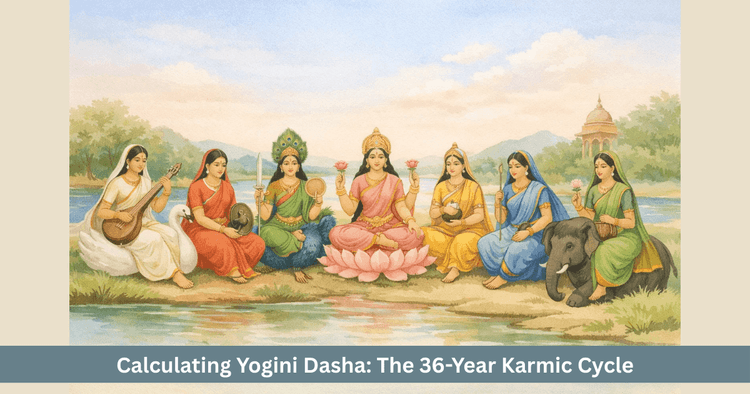
Table of Contents
This article is based on your Moon sign. To find your Moon sign, check the position of the Moon at your birth time. The zodiac sign where the Moon was placed in your birth chart is your Moon sign. This may differ from your Ascendant sign.
Yogini Dasha represents a thirty-six-year planetary period system encompassing eight divine feminine energies (Yoginis) that successively govern life periods of increasing duration. Unlike Vimshottari's nine planets operating for fixed durations, Yogini's eight Yoginis follow a progressive mathematical pattern: one, two, three, four, five, six, seven, eight years, creating an elegant framework that specifically addresses Kaliyuga (current age) dynamics.
The Kaliyuga Endorsement
According to the Rudrayamal text revealed by Lord Shiva himself, Yogini Dasha provides superior results specifically for Kaliyuga, making it particularly relevant despite its contemporary underutilization in practice. The system's mathematical elegance combined with its explicit Kaliyuga designation positions it as a powerful complementary framework to Vimshottari.
The Eight Yoginis: Divine Energies and Their Characteristics
| Yogini Number | Yogini Name | Ruling Planet | Period Years | Character |
|---|---|---|---|---|
| 1 | Mangala | Moon | 1 year | Energy warrior spirit initial vigor |
| 2 | Pingala | Sun | 2 years | Heat intensity leadership power |
| 3 | Dhanya | Jupiter | 3 years | Abundance fortune wisdom expansion |
| 4 | Bhramari | Mars | 4 years | Action courage conflict aggression |
| 5 | Bhadrika | Mercury | 5 years | Communication intellect commerce dexterity |
| 6 | Ulka | Saturn | 6 years | Limitation discipline duty hardship |
| 7 | Siddha | Venus | 7 years | Perfection fulfillment pleasure success |
| 8 | Sankata | Rahu | 8 years | Confusion illusion crisis obsession |
| Total | 36 years | One complete cycle |
Mathematical Elegance: One plus two plus three plus four plus five plus six plus seven plus eight equals thirty-six, creating a perfect triangular number progression reflecting cosmic design principles.
Benefic-Malefic Distribution: Across the thirty-six-year cycle, sixteen years operate under benefic planets (Moon, Jupiter, Mercury, Venus) and twenty years under malefic planets (Sun, Mars, Saturn, Rahu), ensuring realistic life experience combining challenges with opportunities.
Step-by-Step Calculation Method
Step 1: Determine Moon's Nakshatra at Birth
Required Information:
Accurate date of birth
Precise birth time (to the minute)
Birth location coordinates
Calculation Process: Using birth chart calculations, determine the Moon's exact zodiacal position and identify which of the twenty-seven nakshatras contains the Moon.
Example: Birth on July twenty-second, nineteen eighty-five, ten fifteen AM in Mumbai shows Moon at Cancer fifteen degrees twenty-four minutes. Since Pushya nakshatra spans thirteen degrees twenty minutes to twenty-six degrees forty minutes Cancer, the Moon is in Pushya nakshatra (Nakshatra number eight).
Step 2: Apply the Yogini Formula
The Master Formula:
(Moon's Nakshatra Number plus three) divided by eight equals Quotient (ignored) plus Remainder (shows operative Yogini)
Critical Process:
Add three to the Nakshatra number
Divide the result by eight
Ignore the quotient entirely
The remainder identifies the operative Yogini
Remainder Correspondence:
Remainder one equals Mangala Yogini Remainder two equals Pingala Yogini Remainder three equals Dhanya Yogini Remainder four equals Bhramari Yogini Remainder five equals Bhadrika Yogini Remainder six equals Ulka Yogini Remainder seven equals Siddha Yogini Remainder zero or eight equals Sankata Yogini
Step 3: Calculate Using the Example
Our Example: Moon in Pushya (Nakshatra number eight)
Calculation:
Moon's Nakshatra number equals eight
Add three: eight plus three equals eleven
Divide by eight: eleven divided by eight equals one quotient, three remainder
Remainder three equals Dhanya Yogini (ruled by Jupiter)
Result: This person is born during Dhanya Yogini with a three-year period operating at birth.
Step 4: Calculate the Balance of Yogini at Birth
Conceptual Principle: Similar to Vimshottari, the Moon rarely enters a Nakshatra at the exact birth moment. Part of that Yogini's period has already elapsed before birth, requiring calculation of the remaining balance.
Balance Calculation Formula:
Each Nakshatra spans thirteen degrees twenty minutes equals eight hundred arc minutes.
Balance (in days) equals [(eight hundred minus Moon's position within Nakshatra in arc minutes) multiplied by three hundred sixty-five multiplied by Yogini's years] divided by eight hundred.
Then convert days to years, months and days.
Extended Example with Balance Calculation:
Moon in Pushya equals Cancer fifteen degrees twenty-four minutes
Pushya starts at Cancer thirteen degrees twenty minutes
Moon's position within Pushya equals fifteen degrees twenty-four minutes minus thirteen degrees twenty minutes equals two degrees four minutes equals one hundred twenty-four arc minutes
Remaining distance in Pushya equals thirteen degrees twenty minutes minus two degrees four minutes equals eleven degrees sixteen minutes equals six hundred seventy-six arc minutes
Balance Calculation:
Dhanya Yogini's full period equals three years
Proportion remaining equals six hundred seventy-six divided by eight hundred equals zero point eight forty-five
Balance equals three multiplied by zero point eight forty-five equals two point five thirty-five years equals approximately two years, six months, thirteen days
Interpretation: This native will experience only the final two years six months of Dhanya Yogini's three-year period, then transition to Bhadrika Yogini (Mercury) for its full five years, followed by Ulka (Saturn) for six years and so on.
Step 5: Construct the Complete 36-Year Yogini Timeline
Using the calculated balance, create the lifetime sequence:
| Yogini | Start Date | End Date | Duration | Ruling Planet |
|---|---|---|---|---|
| Dhanya (balance) | July 22, 1985 | January 31, 1988 | 2 yr 6 mo 13 days | Jupiter |
| Bhadrika (full) | February 1, 1988 | January 31, 1993 | 5 years | Mercury |
| Ulka (full) | February 1, 1993 | January 31, 1999 | 6 years | Saturn |
| Siddha (full) | February 1, 1999 | January 31, 2006 | 7 years | Venus |
| Sankata (full) | February 1, 2006 | January 31, 2014 | 8 years | Rahu |
| Mangala (full) | February 1, 2014 | January 31, 2015 | 1 year | Moon |
| Pingala (full) | February 1, 2015 | January 31, 2017 | 2 years | Sun |
| Dhanya (full) | February 1, 2017 | January 31, 2020 | 3 years | Jupiter |
| Remaining 10 years | (Continues beyond example) |
This creates a thirty-six-year Yogini cycle roadmap beginning from the calculated starting point, then cycling through all eight Yoginis in sequence.
Mathematical Elegance and Verification
The Triangular Progression Advantage
Unlike Vimshottari's varied durations (six, seven, ten, sixteen, seventeen, eighteen, nineteen, twenty years), Yogini's progressive durations (one, two, three, four, five, six, seven, eight years) create several advantages:
Predictability: Each Yogini's duration is immediately identifiable from its numerical position, enabling rapid mental calculation without tables.
Cycle Completion: With precise thirty-six-year cycles, a person experiences exactly three point thirty-three complete Yogini cycles in a one-hundred-twenty-year lifespan, contrasting with Vimshottari's single one-hundred-twenty-year sequence.
Mathematical Verification: Total always equals thirty-six: (one plus two plus three plus four plus five plus six plus seven plus eight) equals thirty-six. Any calculation deviating from this total indicates error requiring recalculation.
Sub-Periods Within Yogini Dasha: Antardashas and Beyond
Calculating Sub-Periods (Antardashas)
Within each Yogini period, all eight Yoginis operate in sequence as sub-periods, with five hierarchical divisions providing progressive timing refinement.
Antardasha Duration Formula:
Antardasha (in months) equals (Mahadasha Yogini's years multiplied by Antardasha Yogini's years) divided by four.
Example: Dhanya Yogini (three years) Antardashas:
| Antardasha Yogini | Duration Calculation | Months | Years Months |
|---|---|---|---|
| Dhanya-Mangala | (3 × 1) ÷ 4 | 0.75 | 22.5 days |
| Dhanya-Pingala | (3 × 2) ÷ 4 | 1.5 | 1.5 months |
| Dhanya-Dhanya | (3 × 3) ÷ 4 | 2.25 | 2.25 months |
| Dhanya-Bhramari | (3 × 4) ÷ 4 | 3 | 3 months |
| Dhanya-Bhadrika | (3 × 5) ÷ 4 | 3.75 | 3.75 months |
| Dhanya-Ulka | (3 × 6) ÷ 4 | 4.5 | 4.5 months |
| Dhanya-Siddha | (3 × 7) ÷ 4 | 5.25 | 5.25 months |
| Dhanya-Sankata | (3 × 8) ÷ 4 | 6 | 6 months |
| Total | 27 months | 3 years |
Key Principle: Sub-periods always begin with the Mahadasha Yogini itself (Dhanya-Dhanya), then progress through the fixed eight-Yogini sequence.
Practical Interpretation: Reading Life Through 36-Year Cycles
Phase-by-Phase Life Mapping
First thirty-six years (Cycle 1):
Combines all eight Yogini energies in their first expression
Foundational life experiences, education, initial career direction
Childhood and youth developmental phases
Second thirty-six years (Cycle 2):
Repeats eight Yoginis with mature understanding
Mid-life responsibilities, established career, family commitments
Repetition with deeper complexity
Third thirty-six years (Cycle 3):
Final thirty-six-year expression (if lifespan exceeds one hundred eight years)
Culmination phases, wisdom integration, legacy completion
Benefic and Malefic Yogini Expectations
Benefic Yogini Periods (Moon, Jupiter, Mercury, Venus): Expect:
Relative ease and positive developments
Natural momentum supporting goals
Fewer obstacles and challenges
Success in undertakings
Malefic Yogini Periods (Sun, Mars, Saturn, Rahu): Expect:
Greater challenges and difficulties
Need for heightened effort and discipline
Potential for crisis but also karmic resolution
Spiritual growth through adversity
Yogini versus Vimshottari: Complementary Calculation
Simultaneous Calculation Strategy
Professional astrologers increasingly calculate both Yogini and Vimshottari simultaneously, treating them as complementary validation frameworks:
Calculate Vimshottari using the one-hundred-twenty-year framework
Calculate Yogini using the thirty-six-year framework
When both systems indicate similar results, prediction confidence rises substantially
When they conflict, deeper chart analysis becomes essential
Kaliyuga validation: Yogini's explicit endorsement for Kaliyuga adds weight to its concurrent predictions
Common Calculation Errors and Corrections
Birth Time Precision: Even two-minute errors can shift the Moon's Nakshatra, completely altering the Yogini sequence.
Ayanamsha Selection: Different ayanamsha systems can slightly affect Nakshatra placement in borderline cases, potentially changing the operative Yogini.
Never Prematurely Simplify: During manual calculations, complete all multiplications before dividing premature simplification introduces rounding errors destroying accuracy.
Frequently Asked Questions
What is the difference between Yogini Dasha and Vimshottari?
Vimshottari is a one-hundred-twenty-year cycle while Yogini is a thirty-six-year cycle. Yogini is specifically designed for Kaliyuga and shows faster effects and more immediate timing indicators.
Is Yogini Dasha calculation complicated?
No, the formula is straightforward: add three to the nakshatra number, divide by eight and the remainder shows the Yogini. The main complexity is calculating the balance using proportional mathematics.
Can I use only Yogini Dasha without Vimshottari?
Yes but using both simultaneously produces more powerful results. Yogini is better for short-term timing while Vimshottari is superior for longer-term trends.
Do all Yogini periods show the same effects?
No, the effectiveness of a Yogini period depends on the strength of the ruling planet in your chart. A weak Venus can make even the Siddha Yogini less pleasant.
How accurate is Yogini Dasha prediction?
When calculated precisely with correct birth time and using consistent ayanamsha, Yogini Dasha shows remarkable accuracy. It provides faster, more specific timing indicators than most other Vedic dasha systems.
Get your accurate Kundali
Generate KundaliDid you like it?
Author

Pt. Amitabh Sharma (56 Years)
Experience: 20
Consults About: Family Planning, Career
Clients In: Punjab, Haryana, Delhi
Share this article with friends and family
WELCOME TO
ZODIAQ
Right Decisions at the right time with ZODIAQ
