Ketu, Karma And Mahasamadhi
By Pt. Abhishek Sharma
A deep astrological exploration of Ketu, Saturn, Rahu, the twelfth house and muhurta in relation to mahasamadhi, moksha tendencies and karmic completion
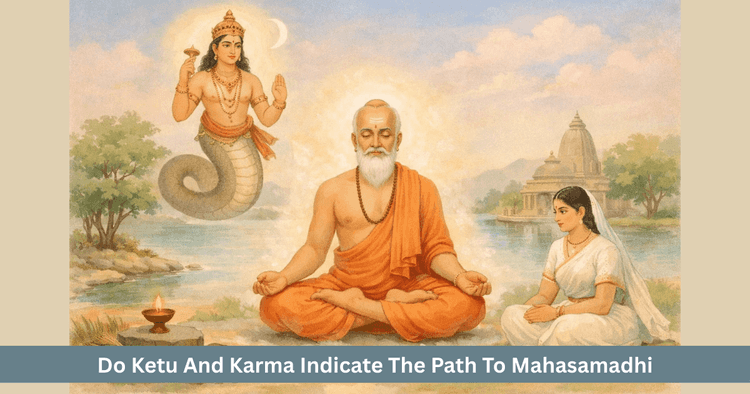
Table of Contents
What Makes Mahasamadhi Different From Ordinary Death
In Indian spiritual traditions mahāsamādhi refers to a very rare state. It is used for that moment when a fully awakened master leaves the body in complete awareness and inner freedom. Ordinary death is usually governed by the natural exhaustion of prarabdha karma. Mahasamadhi is described as a conscious exit where the realised being withdraws from the body like a yogi ending a deep meditation.
Astrology does not claim to “predict” such an event. It is not a formula that can be applied to any birth chart. At most, when disciples look back at the horoscopes of saints and accomplished yogis, they notice certain repeating patterns. These are read as symbols of detachment, karmic completion and spiritual ripening rather than promises that a particular soul will attain mahasamadhi.
Why A Mahasamadhi Chart Is Not Just A Death Chart
In normal chart analysis, indications of death relate to
- longevity
- illnesses or accidents
- and the physical end of the current incarnation
These are studied through the eighth house, its lord, maraka houses and running dashas.
Mahasamadhi belongs to another dimension.
- the focus is not on how long the body lasts
- it is on how deep the inner awakening has become
In such lives astrologers look for
- sustained detachment from worldly claims
- intense sadhana over decades
- and a mind already free from fear of death
Even if a chart shows strong spiritual yogas, without practice, humility and real purification, such an end is not expected. Traditions are very clear that planetary indications alone are never enough.
Ketu As Indicator Of Moksha And Karmic Completion
In Vedic astrology Ketu is known as a moksha karaka, an indicator of liberation.
- it cuts attachments
- it dissolves false identities
- and it brings back deep tendencies from past lives
In discussions of mahasamadhi astrologers often see
- how strongly Ketu influences the chart
- especially whether it touches the eighth or twelfth houses or their lords
Ketu With The Eighth House
The eighth house rules
- transformation
- hidden practices
- occult knowledge
- and the passage from life to death
If
- Ketu sits in the eighth house
- or has a strong link with the eighth lord
it can show repeated inner crises that push the person toward self inquiry.
- old karmas surface
- illusions are stripped away
- and interest in deeper truths can grow
This is not a guarantee of mahasamadhi. It is more like a potential for intense inner change.
Ketu With The Twelfth House
The twelfth house connects with
- renunciation
- solitude
- ashrams and retreat spaces
- and final release into the Absolute
When Ketu influences the twelfth house strongly,
- the native may feel naturally drawn toward meditation
- comforts and status lose their grip faster
- a quieter, simpler life style may appeal to the heart
If such tendencies are supported by practice, guidance and grace, some traditions say the soul is moving closer to freedom from repeated birth.
Saturn As The Keeper Of Karma And Maturity
Saturn is often feared as the planet of hardship, yet it is equally the planet of discipline, responsibility and maturity.
- it slows impulsive desires
- confronts us with our unfinished duties
- and demands consistency over many years
In charts of advanced beings one often finds
- strong Saturn connected with key spiritual houses
- links between Saturn, Ketu, the eighth and twelfth lords
This suggests that
- karmic debts have been faced rather than avoided
- the person has learned to accept tests with patience
- structure, restraint and humility are well developed
In that sense Saturn acts less as a punisher and more as the guardian of completion. Only when duty has been honoured can true inner freedom unfold.
Why A Quiet Rahu Matters On The Path To Mahasamadhi
Rahu represents
- craving
- ambition
- fascination
- and the hunger for new experiences
In most charts a strong Rahu pulls the person outward into
- status
- novelty
- and intense worldly pursuits
In lives moving toward mahasamadhi astrologers often observe that
- Rahu is less dominant
- or its impulses are balanced by Saturn, Ketu and Jupiter
This quieter Rahu reflects
- a decline in ego driven goals
- reduced dependence on praise or recognition
- greater obedience to inner truth than to social success
It indicates that the fire of desire has been steadily transformed into the glow of clarity. The outer story may still be active but the inner centre is no longer owned by Rahu’s restless hunger.
Twelfth House, Renunciation And Union With The Infinite
The twelfth house is sometimes simplified as loss or expenditure. In a spiritual chart its deeper meaning becomes central. It is connected with
- retreat from noise
- contemplation
- sleep and samadhi
- and merging into the Divine
In mahasamadhi discussions astrologers ask
- is the twelfth house strong and dignified
- does it receive the influence of Jupiter, Ketu or Saturn
The Role Of Jupiter
Jupiter brings
- wisdom
- benevolence
- and a sense of sacred guidance
When Jupiter connects with the eighth or twelfth houses
- detachment is joined by understanding
- austerity is softened by compassion
Such combinations suggest a seeker who does not merely escape the world but learns to see the Divine within it. If life is then lived in service, truthfulness and devotion, the chart begins to resemble those honoured in spiritual histories.
Can Muhurta Support A Conscious Exit
Muhurta means the art of choosing the right time. Tradition uses it for
- marriages
- journeys
- ceremonies
- and important new beginnings
In lore about great saints one often reads that
- some left the body on Amavasya
- some during eclipses
- others under powerful nakshatras or yogas
The idea is that at such times
- the subtle and gross worlds are more closely aligned
- spiritual practice bears intensified fruit
For an ordinary person these timings are not invitations to attempt anything drastic. For a realised being whose life has already ripened, such windows may simply harmonise with their inner readiness. Muhurta here is like the final gentle breeze that carries a ripe fruit from branch to ground.
Table: Key Astrological Themes Associated With Mahasamadhi (Conceptual Only)
| Indication | Deeper meaning |
|---|---|
| Strong Ketu with 8th or 12th house | deep detachment, movement toward liberation |
| Well placed yet testing Saturn | steady karmic completion, discipline and endurance |
| Relatively subdued Rahu | freedom from obsessive ambition and ego hunger |
| Powerful 12th house with benefic links | genuine pull toward renunciation and inner union |
| Jupiter tied to 8th or 12th houses | wisdom and grace guiding detachment |
This table is meant for contemplation, not for stamping any chart as “destined for mahasamadhi.”
Mahasamadhi As Fulfilment, Not As Fate
From an astrological and spiritual view, mahasamadhi is not seen as a prize randomly given by destiny. It is the flowering of
- long standing sadhana
- purification of karma
- and a life lived in alignment with dharma
Ketu can cut attachments, yet without guidance it can also cause confusion. Saturn can mature the soul, yet without insight it can harden the heart. Rahu can tempt or teach depending on how consciously its lessons are lived.
So the most practical teaching for seekers is this
- instead of searching charts for promises of mahasamadhi
- use these symbols to understand your own tendencies
- then choose practices that bring balance, humility and love
Even if mahasamadhi remains far beyond the horizon, such a life prepares the mind to meet death with more peace and less fear. In that sense every honest step toward clarity honours the same principle that shines at the heart of mahasamadhi.
Frequently Asked Questions
1. Does a strong Ketu automatically mean a person will attain mahasamadhi
No. A strong Ketu only points to powerful detachment tendencies. Without ethics, compassion and steady practice, it can also manifest as imbalance. Mahasamadhi belongs to souls who have refined these tendencies through a lifetime of conscious living.
2. Is it useful for ordinary people to look for mahasamadhi yogas in their charts
Constantly hunting for such yogas can distract from real practice and may inflate ego. It is more helpful to see how your chart supports meditation, service and inner growth. The goal is not a grand exit but a meaningful life.
3. Are strong Saturn and Ketu always positive in spiritual charts
They can indicate great potential for austerity and awakening, yet the experience may be intense. If the person has guidance and a sincere heart, these forces can deepen insight. Without that, they may bring loneliness or rigidity. Context matters.
4. Can the exact timing of mahasamadhi be chosen through astrology
Stories of realised masters choosing their moment exist but this is beyond normal predictive astrology. For most people, muhurta is best used for starting wholesome activities. Mahasamadhi is spoken of as grace meeting lifelong preparation.
5. How can knowledge of Ketu, Saturn and the twelfth house help simple daily practice
It can show where you are naturally inclined toward retreat, discipline or escapism. By honouring the healthy side of these tendencies through meditation, honest work and compassion, you align with their higher expression instead of their destabilising side.
Get your accurate Kundali
Generate KundaliDid you like it?
Author

Pt. Abhishek Sharma (63)
Experience: 20
Consults About: Family Planning, Career
Clients In: Punjab, Haryana, Delhi
Share this article with friends and family
About ZODIAQ
ZODIAQ is an online Vedic Astrology platform. It connects clients seeking astrological advice to experienced astrologers with deep knowledge. Our users also generate kundali and perform kundali milan for free. ZODIAQ also offers services to the Astrologers. Astrologers utilize various offerings by ZODIAQ to serve their clients effectively.
If you are a User
Consult with experienced astrologers and seek their guidance. You can also order handwritten Janm Patrika report with life prediction prepared by experienced astrologers. Generate accurate Kundali, perform Kundali Matching and check horoscope and muhurat. Utilize our online library for all the necessary astrological and spiritual information.
If you are an Astrologer
Create accurate kundali for your clients and perform Kundali Matching for up to 5 people at a time. Write comprehensive Janm Patrika report for your clients with ZODIAQ. Check client details anytime by saving it in client directory. Become more productive by tracking how many clients you guide every day.
WELCOME TO
ZODIAQ
Right Decisions at the right time with ZODIAQ
