5 Lessons From Shiva on Overcoming Fear and Doubt
By Pt. Nilesh Sharma
The God of Transformation Teaches the Art of Facing Fear
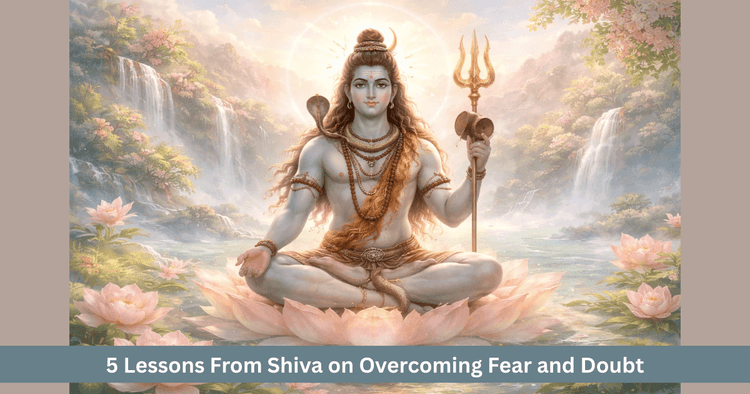
Table of Contents
Om Tryambakam Yajamahe Sugandhim Pushtivardhanam Urvarukamiva Bandhanan Mrityor Mukshiya Mamritat. We worship the three-eyed Lord Shiva, the fragrant one who nourishes all beings. May He free us from the bonds of fear and death and grant us the nectar of immortality and true peace.
The God of Transformation Teaches the Art of Facing Fear. In the pantheon of Hindu deities, few figures are as paradoxical, as simultaneously terrifying and deeply comforting, as Shiva, the lord of transformation, the god of destruction, the eternal meditator draped in ash and adorned with snakes. His very appearance unsettles the conventional mind. He sits in serene meditation yet dances the cosmos into being and unmaking. He is ascetic and otherworldly yet a devoted family man. He is ferocious beyond measure yet possesses infinite compassion.
Yet this paradox is precisely what makes Shiva the supreme teacher for those wrestling with fear and doubt. He does not offer false certainty or easy answers. Instead, he models something far more valuable: how to face uncertainty with clarity, how to embrace contradiction with wisdom, how to transform what terrifies us into the very source of our strength. In a world that teaches us to escape discomfort, to chase certainty, to avoid difficulty, Shiva's life teaches a radically different path. Move toward what frightens you, sit with what confuses you and discover that the gateway to freedom lies not in avoidance but in direct encounter with the sources of our fear.
Lesson One Sit in Silence and Meet Your Fears
The Power of Stillness and Shiva's Meditation
Shiva's entire existence is a study in the transformative power of silence and solitude. High on Mount Kailash, in caves and remote places, Shiva sits in meditation, not hiding from the world but engaging with its deepest reality through consciousness itself. This is not escapism but the most profound form of engagement. His meditation is not sleep or unconsciousness. Rather, it is heightened awareness, a state where consciousness turns completely inward to perceive the nature of existence itself. This is Shiva's first teaching. The first step to mastering fear is to stop running from it. This means creating space for silence. Meditation, contemplation or simply sitting without distraction creates the mental space necessary for wisdom to emerge.
Fear in the Absence of Quiet
Consider what happens in our lives when silence is absent. Constant noise exists. We live in unprecedented noise, externally through technology, media and constant connectivity and internally through racing thoughts, anxiety and mental chatter. Fear amplification occurs. In this noise, fear grows disproportionately. Without quiet to examine it, fear becomes imaginary, self-perpetuating, unexamined and controlling.
Loss of perspective happens. When the mind never quiets, we lose the ability to step back and see our fears in proper perspective. They feel absolute, overwhelming and inescapable. Shiva teaches that the first step to overcoming fear is to stop running from it. This means creating space for silence and observing rather than reacting.
The Discipline of Sitting With Fear
In silence, you can observe your fears without being swept away by them. You notice which fears are based on real and present danger, which are projections, imaginations or habitual patterns, which fears have power only because you have not examined them and how fear actually feels in the body and mind.
Silence reveals patterns. Do you fear failure? Perhaps you have internalized messages about self-worth. Do you fear judgment? Perhaps you have learned to define yourself through others' opinions. Do you fear loss? Perhaps you are clinging to things as sources of identity. Do you fear death? Perhaps you have not clarified what you truly value.
| Type of Fear | Underlying Cause | Shiva's Teaching |
|---|---|---|
| Fear of failure | Misunderstanding of self-worth | Value comes from effort not outcome |
| Fear of judgment | Dependence on others | Self-acceptance is sufficient |
| Fear of loss | Attachment to temporary | Everything is impermanent |
| Fear of death | Confusion about identity | The soul is immortal |
| Fear of change | Need for control | Change is life's rhythm |
The practice is simple. Choose a time and place where you can be undisturbed. Sit quietly and allow your mind to settle. Observe your thoughts without judgment or reaction. Notice which fears arise and how they manifest. Return to your breath, using it as anchor to the present moment. Sustained over time, this practice reveals that fears lose their charge when examined directly. They transform from controlling forces into observable phenomena, still present but no longer dominating consciousness.
Lesson Two Face Negativity Instead of Avoiding It
The Poison That Saves
Among Shiva's most famous exploits is a moment that perfectly illustrates his teaching on facing negativity: the drinking of poison during Samudra Manthan, the churning of the cosmic ocean. During this cosmic operation, when gods and demons worked together to extract the nectar of immortality, something unexpected emerged: Halahala, a deadly poison so toxic that its mere presence threatened to destroy all creation.
Every being fled in terror. No one would even touch it. But Shiva stepped forward, picked up the poison without hesitation and drank it. This act contains multiple layers of profound teaching. No avoidance. Shiva did not hope someone else would handle it. He did not negotiate or delegate. He saw what needed to be done and acted without delay or resistance.
No judgment. The poison was not good or bad but simply was. Shiva accepted it as part of reality, not something he had to wish away or deny. Transformation. By drinking the poison with full consciousness, Shiva transformed it. His throat turned blue, Neelkantha and rather than destroying him, the poison became part of his power. No self-pity. There is no record of Shiva complaining about the bitter taste, the danger or the sacrifice. He acted with complete acceptance of what was required.
How This Applies to Our Fears
Life's poison. Like Halahala, life offers us what we might consider poisons: challenges, failures, losses, difficult emotions, uncomfortable truths. The avoidance trap. Most people's strategy is Shiva's opposite: denial that the problem does not exist, running to distraction, substances or new situations, hoping someone else will solve it, focusing on how unfair it is or becoming stuck in indecision.
The Shiva path. To face what frightens us: acknowledge reality by simply admitting what is true, not how we wish it were but what it actually is. Accept what is required. Sometimes difficult action is necessary. Sometimes we must have difficult conversations, face hard truths, make painful choices or release things we treasure.
Move toward, not away. Rather than retreating from negativity, move directly into it with consciousness. This does not mean becoming masochistic but rather meeting challenges with awareness rather than panic. Transform through engagement. The remarkable truth is that direct engagement with what we fear often transforms it. The feared conversation, the painful truth, the difficult choice when actually faced often proves less overwhelming than the imagined version we have been dreading.
Practical application. Consider a fear you carry. Now ask: What am I avoiding, the real situation or my emotional reaction to it? What would happen if I faced it directly? Often the reality is less catastrophic than the fear. What small step could I take today? Not necessarily solving it completely but engaging with it consciously. What support do I need? We do not have to face everything alone.
Shiva's lesson is not that facing difficulty is easy but that it is possible, that it transforms us and that the alternative, endless avoidance, is far more exhausting than the direct encounter.
Lesson Three Accept Change as Part of Life's Rhythm
The Destroyer Who Creates
Shiva is called the Destroyer, Mahadeva, yet this title profoundly misrepresents his role. He does not destroy randomly or maliciously. Rather, he destroys in service of creation, clearing away the old so that the new can emerge, dissolving form so that new forms can manifest.
This is embodied in the Tandava, the cosmic dance that Shiva performs. This is not a gentle or balanced dance but fierce, wild and powerful. Yet this dance represents the rhythm of creation and dissolution, demonstrates that endings and beginnings are inseparable, shows that what appears as destruction is part of a larger creative cycle and teaches that movement and change are fundamental to existence.
The Nature of Impermanence
Hindu philosophy teaches impermanence as a fundamental truth: all forms are temporary, all situations change and clinging to permanence is a source of suffering. Yet most of us live as though stability is the natural state and change is the aberration. We fear losing what we have, resist transitions and endings, cling to identities, relationships and situations and experience grief or anxiety when facing change. This resistance to change is the root of much of our suffering.
The Teaching of the Tandava
Shiva's dance teaches that change is natural, not exceptional. Transformation is not something that occasionally disrupts a stable world but is the fundamental nature of reality itself. Destruction serves creation. When Shiva destroys, he is not being cruel or capricious. He is making space for what wants to emerge. The forest fire that seems destructive actually fertilizes the soil for new growth. The illness that seems disastrous often catalyzes necessary change in how we live. The ending of a relationship, though painful, often opens doors to new possibilities.
We are always dying and being born. Each moment, cells die and are born. Each year brings changes to our bodies, relationships and circumstances. Each phase of life, childhood, adolescence, adulthood, aging, involves death of one form and birth of another. To dance with life is to accept its rhythm. Rather than resisting change, Shiva models moving with it, dancing with it, expressing creativity through it.
Overcoming Fear of Change
The fear of change often stems from loss of identity, uncertainty about what comes next, attachment to what we have invested in and the illusion of control. Shiva's teaching addresses each: Your identity is not defined by circumstances but by your essential nature. Uncertainty is normal; attempting to eliminate it is futile. Attachment creates suffering; freedom comes through releasing it. You cannot control change; you can only control your response to it.
Practice. Accept one change. This week, notice one change you are resisting: a transition you are afraid of, a loss you have not accepted or a new situation you are not adjusting to. Now ask: What am I afraid will be lost? What might emerge if I accept this change? How have I adapted to changes in the past? What would it feel like to dance with this change rather than fight it?
Shiva teaches that when we stop fighting change and instead align with it, anxiety diminishes and creative energy becomes available.
Lesson Four Focus on Action Not Outcome
The Karma Yoga of Shiva
One of Shiva's most distinctive characteristics is his complete non-attachment to outcomes. He sits in meditation without seeking particular results, saves the universe by drinking poison without expecting gratitude or recognition, performs the Tandava as an expression of his nature not to achieve anything and acts in cosmic drama with complete dedication and zero attachment to how it turns out. This is a perfect embodiment of Karma Yoga as described in the Bhagavad Gita, the path of acting without attachment to results.
The Outcome Trap
Most of us operate under outcome-based motivation. Fear of negative outcomes: What if I fail? What if they judge me? What if I make a mistake? What if I lose? These fears paralyze action as we hesitate, delay or avoid. They contaminate present moments as we become anxious about hypothetical futures. They create suffering as we already experience the loss we fear. They reduce effectiveness as anxiety undermines the very performance we are worried about.
The Shiva Approach Action Without Attachment
Shiva teaches that true courage emerges when you focus on right action rather than feared outcomes. Define your integrity, not your results. Ask not what do I need to do to succeed but what is the right action regardless of outcome. Release the need to control. You cannot guarantee outcomes. You can only do your best, maintain your ethics, act with clear intention and accept the results as they unfold.
Focus on process, not destination. In meditation, focus on the practice, not on achieving enlightenment. In work, focus on doing it well, not on getting the promotion. In relationships, focus on being loving and present, not on being appreciated. In creativity, focus on authentic expression, not on being recognized.
Accept what unfolds. When outcomes do not match what you hoped for, Shiva's example teaches: This too is part of the dance. The universe is unfolding as it needs to. Your job is to respond with wisdom and grace. The failure may contain seeds you cannot yet see.
The paradox. Here is the remarkable paradox: by releasing attachment to outcomes, you often achieve better outcomes. This is because anxiety undermines performance; releasing it allows excellence. Desperation repels opportunity; releasing it attracts possibility. Forcing creates resistance; allowing creates flow. Ego-based action attracts opposition; selfless action attracts support.
Practice. Choose one area where you are anxious about outcomes: a project you are worried about, a conversation you are afraid to have, a goal you are desperate to achieve or a situation where you fear judgment. Now ask: What is the right action, regardless of outcome? What would I do if I did not care about the result? Where am I trying to control what I cannot? What would happen if I released my attachment?
Then act with complete dedication to the right action while remaining completely indifferent to the results. This is the heart of Shiva's teaching.
Lesson Five Embrace Life's Contradictions
The Lord of Paradox
Perhaps Shiva's greatest teaching comes through his very embodiment of contradiction. He is utterly ascetic yet a devoted family man married to Parvati. He is peaceful in meditation yet dances the world into and out of existence. He wears ashes yet adorns himself with serpents and moon. He is mild-mannered yet possesses the power to destroy universes. He lives in solitude on a mountain yet is intimately involved in cosmic drama. He is the destroyer yet essential to creation. He appears wild and unkempt yet is the supreme embodiment of discipline and wisdom.
This is not confusion or inconsistency but wholeness. Shiva is not trying to be consistent or simple. He is simply fully himself, containing multitudes.
Fear Thrives on Simplicity
Much of our fear comes from demanding that life and ourselves be simple, consistent and predictable. The need for certainty makes us want clear answers, black-and-white choices and guaranteed outcomes. The demand for consistency makes us want others to be predictable, situations to follow patterns and ourselves to be reliable and unchanging. The desire for simplicity makes us want complex situations to have simple solutions and ambiguous choices to be clearly right or wrong. The illusion of safety makes us believe that if we can just reduce complexity, we can achieve safety and control.
The Reality of Contradiction
Yet life is fundamentally paradoxical and ambiguous. We must be both strong and vulnerable. We need both solitude and connection. We must be both disciplined and spontaneous. We contain both light and shadow. We face choices that are genuinely ambiguous with no clear right answer. Suffering comes not from the contradictions themselves but from our demand that they resolve into simplicity.
Embracing Paradox as Power
Shiva teaches that strength comes from accepting contradictions, from being able to hold opposing truths simultaneously, adapt to different situations appropriately, contain multitudes without fragmenting, remain centered while expressing diversity and be comfortable with mystery and ambiguity.
When you embrace paradox, fear loses power as it often depends on false certainty. Flexibility increases as you are not locked into one way of being. Wisdom grows as you can see situations from multiple perspectives. Resilience develops as you can adapt to contradictory demands. Authenticity emerges as you stop trying to be simple and become fully yourself.
The Contradictions Within You
Consider the contradictions you contain. You want security yet crave adventure. You desire independence yet need connection. You value honesty yet sometimes protect others with discretion. You pursue success yet fear its responsibilities. You want to help others yet need to care for yourself.
Rather than seeing these as problems to solve, Shiva teaches that these are the richness of being human. Practice. Make a list of contradictions you are carrying: within yourself, in your relationships, in your values and in your life situation. Now, for each contradiction, ask: How can both truths coexist? What becomes possible when I stop trying to resolve this? Where might my greatest strength lie in this paradox? What would Shiva do with this contradiction? Transform it into creative expression.
Rather than resolving contradictions, learn to dance with them, as Shiva dances with destruction and creation, asceticism and family, power and peace.
Conclusion Fear as the Gateway to Transformation
The Unified Teaching
These five lessons from Shiva cohere around a single revolutionary teaching: Fear is not something to be eliminated but to be understood, faced and ultimately transformed. Fear is the gateway, not the obstacle. It marks the boundary of your current comfort and points toward the next stage of your growth. What you fear most, silence, truth, change, purposeless action, paradox, often contains exactly what you need most.
The Invitation and the Deeper Truth
Shiva invites you to stop running. Sit in silence and examine what frightens you. Most fears lose power when examined directly. Stop avoiding. Face the negativity, difficulty or truth you have been resisting. You are stronger than you know. Stop resisting. Accept that life is change. Learn to dance with transformation rather than fighting it. Stop controlling. Release attachment to outcomes. Focus on right action and accept what unfolds. Stop simplifying. Embrace the contradictions within yourself and life. Your wholeness contains paradox.
In Hindu philosophy, Shiva is also called Mahakal, the Great Time, the one who transcends time. Fear is fundamentally fear of time: fear of the future, regret about the past, anxiety about change. When you align with Shiva's consciousness beyond time, beyond outcome, present in each moment, fear dissolves. Not because the challenges disappear but because you are no longer identified with a small, separate self struggling to maintain its existence. You recognize yourself as part of something larger, eternal, indestructible.
The final image. Picture Shiva on Mount Kailash, utterly at peace, perfectly alert, completely unafraid. Not because his life is free from challenges as he faces cosmic difficulties constantly but because he has no investment in particular outcomes. He does not fear loss because he does not cling to possession. He does not fear the future because he is not identified with a small self.
This is the freedom Shiva offers: not escape from fear but transformation of the consciousness that creates fear. When you can sit in silence like Shiva meditates, face difficulty like he drank the poison, accept change like he dances, act without attachment like he saves the world and embrace contradiction like he contains all paradoxes, then fear becomes not an obstacle but a teacher, pointing you always toward your own deepest strength.
The three-eyed god sees past, present and future simultaneously. He shows us that when we stop being trapped in time and fear, we gain the clarity to see what is truly happening and the wisdom to respond with grace.
Frequently Asked Questions
Why is Shiva the best teacher for overcoming fear?
Shiva is the ideal teacher for overcoming fear because he himself embodies paradox. He is simultaneously terrifying and peaceful, destroyer and creator, ascetic and family man. This shows that strength comes not from resolving contradictions but from embracing them. Shiva does not offer false certainty or easy answers. Instead, he teaches how to face uncertainty with clarity, how to confront truth directly and how to accept change. He shows us that rather than running from fear, we should look at it directly and understand it as a gateway to transformation. His life teaches that real power comes not from avoidance but from direct encounter.
What does Shiva drinking poison during Samudra Manthan teach us about fear?
When Shiva drank the Halahala poison during the churning of the cosmic ocean, he taught a profound truth about facing negativity. Everyone fled from the poison but Shiva picked it up without hesitation and drank it. This teaches that rather than running from difficulties in life, we should face them directly. Shiva did not call the poison good or bad but accepted it as part of reality. By drinking it with full consciousness, he transformed it. His throat turned blue and the poison became part of his power instead of destroying him. This teaches us that when we directly face what we fear, it often transforms. The feared conversation, painful truth or difficult choice when actually faced often proves less overwhelming than the imagined version we have been dreading.
What does the Tandava dance teach about change?
Shiva's Tandava dance teaches that change is a natural part of life's rhythm, not an aberration. This fierce, powerful dance represents the eternal cycle of creation and dissolution. When Shiva dances, he is simultaneously destroying and creating because both are inseparable. The Tandava teaches that change is not exceptional but the fundamental nature of existence. What we call destruction is actually clearing the old to make space for the new. The forest fire that seems destructive fertilizes the soil. The ending of a relationship, though painful, opens doors to new possibilities. We are constantly dying and being reborn. Each moment cells die and are born. Resisting change is the source of suffering. The Tandava teaches us to dance with change rather than fight it, to flow with its rhythm and to express creativity through it.
How does focusing on action rather than outcomes reduce fear?
When you focus on right action rather than outcomes, fear's power dramatically decreases. Most fear is related to future outcomes: What if I fail, what if they judge me, what if I lose. These are all outcome-based fears. Shiva teaches that you cannot control outcomes. You can only control your actions. When you ask what is the right action regardless of outcome, your focus shifts to the present moment and your integrity rather than an imagined future. This immediately reduces anxiety because anxiety is about the future, not the present. Paradoxically, releasing outcomes often leads to better outcomes because anxiety undermines performance while calm focus allows excellence. This is the essence of Karma Yoga in the Bhagavad Gita: Act with complete dedication but do not desire the fruit.
What do Shiva teach us about embracing contradiction?
Shiva is himself a living contradiction, so he is ideally positioned to teach us about embracing paradox. He is simultaneously ascetic and family man, peaceful meditator and fierce dancer, destroyer and creator. This shows that wholeness includes contradiction. We are all filled with contradictions. We want both security and adventure, independence and connection. We contain both light and shadow. Most people try to resolve these contradictions but this creates suffering. Shiva teaches that instead, embrace contradictions. Accept that you are complex, multidimensional and do not fit simple definitions. When you embrace paradox, flexibility increases, wisdom deepens and authenticity emerges. You stop trying to be simple and become fully yourself. This is real power.
What does Nakshatra reveal about me?
My NakshatraDid you like it?
Author

Pt. Nilesh Sharma (63)
Experience: 20
Consults About: Family Planning, Career
Clients In: Punjab, Haryana, Delhi
Share this article with friends and family
About ZODIAQ
ZODIAQ is an online Vedic Astrology platform. It connects clients seeking astrological advice to experienced astrologers with deep knowledge. Our users also generate kundali and perform kundali milan for free. ZODIAQ also offers services to the Astrologers. Astrologers utilize various offerings by ZODIAQ to serve their clients effectively.
If you are a User
Consult with experienced astrologers and seek their guidance. You can also order handwritten Janm Patrika report with life prediction prepared by experienced astrologers. Generate accurate Kundali, perform Kundali Matching and check horoscope and muhurat. Utilize our online library for all the necessary astrological and spiritual information.
If you are an Astrologer
Create accurate kundali for your clients and perform Kundali Matching for up to 5 people at a time. Write comprehensive Janm Patrika report for your clients with ZODIAQ. Check client details anytime by saving it in client directory. Become more productive by tracking how many clients you guide every day.
WELCOME TO
ZODIAQ
Right Decisions at the right time with ZODIAQ
