7 Vedic Stories That Sound Like 21st Century Inventions
By Aparna Patni
7 Lesser-Known Indian Myths That Predicted Our Tech-Obsessed Future
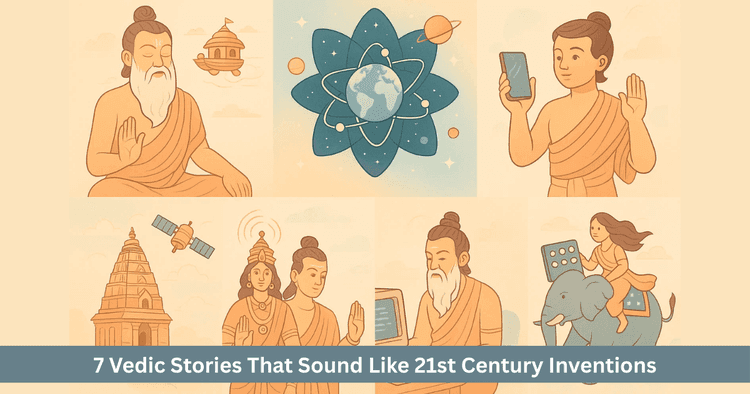
Table of Contents
7 Lesser-Known Indian Myths That Predicted Our Tech-Obsessed Future
India stands at a fascinating crossroads where ancient wisdom and cutting-edge technology coexist in an almost surreal dance. Towering skyscrapers cast shadows on centuries-old temples. Startups innovate with the same intensity that sages once contemplated cosmic truths. Yet within this juxtaposition lies something profoundly intriguing: the ancient scriptures of India contain descriptions that sound unnervingly similar to the technological innovations we're only now beginning to realize.
This is not to claim that our ancestors possessed literal flying machines or broadcast satellites-though some traditions have made such claims. Rather, it is to recognize that Hindu mythology operated on multiple levels simultaneously: as spiritual allegory, as encoded wisdom about consciousness and cosmology and sometimes as astonishingly prescient descriptions of possibilities that would not manifest physically for thousands of years.
The question becomes not "Did the ancients have this technology?" but rather "How did minds without computers conceptualize systems and technologies that would require computers to fully explain?" The answer may lie in a deeper understanding of how myth functions as a language for transmitting complex truths across time and how human consciousness, when sufficiently awakened, can perceive patterns and possibilities beyond its era.
Let us explore seven lesser-known Vedic stories that, when examined closely, sound disturbingly like specifications for technologies we are only now developing.
1. Vimanas: The Ancient Flying Machines of the Skies
The Scriptural Foundations
Among all the technological marvels described in Hindu scriptures, Vimanas are perhaps the most extensively documented. References appear not merely in poetic epics but in technical treatises. The Vaimanika Shastra, a Sanskrit text attributed to the sage Maharishi Bharadvaja, dedicates itself entirely to the design, construction and operation of flying vehicles. The text details aeronautical principles governing flight, materials suitable for aircraft construction, propulsion systems using various fuels and engines, navigation techniques for different altitudes and speeds and maintenance protocols for long-term functionality.
The Mahabharata and Ramayana contain vivid descriptions of Vimanas used in battle and travel. The Pushpaka Vimana could expand and contract. War chariots flew through multiple dimensions. Underwater vessels could submerge and navigate ocean depths. Craft could travel to distant stars and return unharmed.
The Technical Descriptions
What makes these descriptions remarkable is their specificity bordering on engineering manuals. Propulsion systems describe engines powered by mercury vapor or liquid mercury used in rotational mechanisms. Modern aeronautical engineers have noted that mercury, with its unique density and flow properties, could theoretically power certain types of engines. Control systems mention control panels with multiple switches and levers, suggesting sophisticated mechanical systems. Navigation describes navigation by stars, by internal instruments pointing toward specific directions and by "knowledge of currents in the sky." Speed and altitude descriptions mention Vimanas traveling "faster than birds" and reaching altitudes where "the air becomes thin and stars become visible."
The Eerie Parallels
The uncanny aspect is not that Vimanas exist but that their descriptions anticipate problems that only emerged once humans actually built aircraft: structural integrity, fuel efficiency, pilot training requirements and safety systems including fail-safes and emergency procedures. These are not problems one would naturally anticipate without actually attempting to fly-yet they appear in texts predating powered flight by millennia.
Modern Parallel: Space travel, drones, stealth aircraft, aerial warfare
2. Sanjaya's Remote Vision: The First Televised War?
The Setup: A Blind King's Dilemma
The Mahabharata opens with a unique narrative device. King Dhritarashtra, who is blind, desperately wants to know every detail of the Kurukshetra war happening miles away. His solution: Sanjaya, his advisor and charioteer, equipped with "divya drishti" (divine sight), narrates real-time events from the battlefield. But here's the extraordinary aspect: Sanjaya is not physically present at the war. He remains in the palace with the king, yet he provides continuous, detailed, real-time narration of events as they occur.
The Technical Marvel
The Mahabharata describes how "By the power of meditation granted by the sage Vyasa, Sanjaya could see all that occurred on the battlefield, as if standing directly there. He perceived every warrior, every chariot, every arrow released, transmitting this knowledge through his words to the blind king."
The implications are staggering: remote perception where information is gathered at a distant location and transmitted instantaneously, real-time broadcasting as events happen, selective detail where Sanjaya edits vast complexity into coherent narrative and accuracy despite distance sufficient for strategic decisions.
The 21st Century Parallel
Sanjaya's feat parallels live satellite feeds from war zones, drone surveillance gathering and transmitting real-time information, augmented reality technology and emerging neural interfaces promising direct transmission of sensory information.
Modern Parallel: Live satellite feeds, drone surveillance, augmented reality, neural interfaces
3. The Brahmastra: Precision-Guided Weapons of the Gods
The Ultimate Weapon
In Hindu mythology, Brahmastra represents the most devastating weapon ever created-a celestial missile that could annihilate entire armies, cities or cosmic regions. Yet what distinguishes Brahmastra is its technological specificity. It was summoned through intense mental concentration and specific verbal formulas. Once summoned and aimed, it never missed its intended target, could track moving targets and adjust for distance and wind. Interestingly, it could only be used once in a lifetime by each wielder. Some texts describe how its destructive radius could be modulated.
The Technical Sophistication
Modern weapons engineers would identify these features:
| Brahmastra Feature | Modern Weapon Parallel |
|---|---|
| Summoning through intention | Voice-activated or biometric-triggered systems |
| Mantric formula for activation | Encrypted launch codes or biometric authentication |
| Never misses target | Guided missile systems with lock-on capability |
| Adjusts for movement | Active targeting systems tracking moving objects |
| Scalable destructive radius | Modular warhead systems with adjustable yields |
| One-use limitation | Non-reusable ordnance systems |
The Ethical Dimension
Remarkably, Brahmastra descriptions include ethical constraints: it could only be used against worthy opponents not innocents, using it unjustly created karmic consequences for the wielder, it could be recalled if conditions changed and misusing it resulted in cosmic punishment exceeding the original transgression.
Modern Parallel: Precision-guided missiles, nuclear warheads, autonomous weapons systems
4. The Pushpaka Vimana: Personal Flying Transport
The Luxury Vehicle
The Pushpaka Vimana occupied a unique category-a personal luxury flying palace initially belonging to Kubera and later used by Ravana and Lord Rama. Its description reads like a specification sheet for a premium aircraft with size adaptability (could expand or contract), comfort features (luxurious seating, climate control), speed and efficiency (traveling vast distances rapidly), autonomous operation (self-propelling, responding to mental intention) and durability (never aged, never required maintenance).
Modern Parallel: Flying taxis, modular aircraft, autonomous vehicles, sustainable aviation
5. The Chakravyuh: Data Encryption and Cybersecurity
The Labyrinthine Strategy
One of the most famous episodes in the Mahabharata involves the Chakravyuh-a sophisticated military formation so complex that only specially trained warriors could navigate it. The structure had concentric circular layers, each representing a different challenge. To penetrate it, one needed to know the correct sequence of entry points, understand the pattern of rotation, have the skill to defeat guardian warriors and know the exit strategy or risk becoming trapped forever.
Young Abhimanyu learned the entry strategy but not the exit. He penetrated the formation but became trapped and was ultimately killed-demonstrating how incomplete knowledge of complex systems can be fatal.
The Cybersecurity Parallel
The Chakravyuh maps remarkably onto modern cybersecurity concepts:
| Chakravyuh Element | Cybersecurity Parallel |
|---|---|
| Multiple concentric layers | Network firewalls and security layers |
| Authorized entry points | Secure gateways and authentication ports |
| Changing patterns | Dynamic security protocols |
| Guardian warriors | Security software and intrusion detection |
| Specific knowledge required | Encryption keys and access credentials |
| Exit strategy | Logout protocols and secure disconnection |
| Trap for unauthorized entry | Lockdown of breached systems |
Modern Parallel: Encrypted data systems, network firewalls, biometric authentication, zero-trust security
6. Narada's Cosmic Network: The First Interstellar Messenger
The Cosmic Traveler
Sage Narada is one of Hindu mythology's most enigmatic figures-a divine being described as having the ability to traverse all dimensions of reality instantaneously. He appears in multiple places simultaneously, communicates between gods and humans and serves as a kind of cosmic news network with instant transportation, information access, cross-dimensional communication and neutrality with omniscience.
The Cosmic Internet
Consider how Narada's role parallels modern internet infrastructure: global connectivity, information transmission, instantaneous communication, network neutrality and real-time updates. Hindu philosophy suggests that consciousness operating at certain frequencies can transcend space-time, perceive multiple timelines, operate as a transmitter and navigate between dimensions.
Modern Parallel: The Internet, satellite communication, quantum communication, the Cloud, neural networks
7. The Hiranyagarbha: The Big Bang Theory in Vedic Garb
The Golden Womb of Creation
The Rigveda contains hymns describing the universe's origin through Hiranyagarbha-literally "the golden womb" or "the golden egg." The description: "In the beginning, there was neither being nor non-being. There was neither sky nor earth, neither light nor darkness. From the golden womb emerged all creation."
The concept envisions a primordial singularity, golden radiance (intense energy and light), infinite potential from a single point and self-generating expansion.
The Big Bang Parallel
Modern astrophysics describes the Big Bang as a singularity with explosive expansion, intense radiation and universal origin. The remarkable similarities include:
| Vedic Concept | Big Bang Theory |
|---|---|
| Singularity (Hiranyagarbha) | Cosmic singularity |
| Golden radiance | Intense electromagnetic radiation |
| Infinite potential in one point | Infinite density and temperature |
| Emanation outward | Cosmic inflation and expansion |
| Self-generating | No external cause required |
| Universe from one source | All observable universe from single event |
Modern Parallel: Big Bang cosmology, cosmic inflation theory, quantum field theory, string theory
Bridging Myth and Machine: Coincidence or Intuition?
The Structure of These Stories
What makes these parallels particularly striking is not just individual similarities but the coherent structure of these ancient descriptions with technical specificity, problem anticipation, ethical framework and scalability and adaptation.
The Interpretation Question
Examining these parallels, thoughtful observers face several possible interpretations: literal prophecy (the ancients literally possessed this technology), metaphorical brilliance (elaborate poetic descriptions of spiritual concepts), intuitive perception (consciousness perceiving technological possibilities not yet manifested), collective unconscious prophecy or evolutionary memory.
The Question Worth Asking
Rather than definitively proving any single interpretation, perhaps the more profound question is: How did minds without computers, without modern physics, without calculus or engineering training, manage to imagine these technologies with such specificity that they correlate to actual technologies developed thousands of years later?
Why These Myths Still Matter
In an Age of Disruption
We live in an era of unprecedented technological disruption. In such a time, why return to ancient myths?
They Stimulate Imagination
The myths of ancient India demonstrate that human imagination has always reached beyond immediate reality toward possibilities not yet manifest. This imagination is not mere fantasy but the first step in innovation.
They Blur Necessary Boundaries
Modern civilization has created an artificial dichotomy: science versus spirituality, fact versus metaphor, material versus mystical. Yet these myths suggest that such boundaries are artificial abstractions. Ancient myths operated in a space before these boundaries hardened-exploring consciousness, technology, ethics and spirituality simultaneously.
They Provide Cultural Grounding
There is a particular significance to recognizing that ancient Indian thinkers were visionaries, engineers and philosophers of the first order. This recognition grounds contemporary Indian scientists in a heritage of technological thinking, challenges Western narratives and enriches the global conversation about what technology should be.
Conclusion: Reading the Ancient Code for the Future
The Mythical Blueprint
Whether viewed as literal descriptions, profound metaphors or intuitive perceptions of future possibilities, the myths of ancient India contain something crucial: a template for how technology can be developed within an ethical and spiritual framework rather than as mere instrumental power.
Modern technology tends toward rapid development without ethical consideration, disconnection from spiritual implications, fragmentation and externalization of costs. Ancient Indian myths, by contrast, suggest that technology should be ethically considered from inception, spiritually grounded, systemically integrated and responsible and restrained.
The Invitation
In an era where machines outthink men, where data flows faster than wisdom, where technology advances faster than ethics can follow, perhaps it is time to reread our ancient scriptures not as beautiful poetry to preserve in museums but as active guides for navigating the future we are creating.
The Final Reflection
Perhaps what makes these ancient myths most relevant to our current moment is not whether they predicted specific technologies but whether they predicted the spiritual crisis that accompanies unguided technological development. The myths consistently teach that power without wisdom leads to tragedy, that technology without ethics becomes destructive and that genuine progress integrates material advancement with spiritual maturation.
As we stand on the threshold of transformative technologies-artificial intelligence, genetic engineering, quantum computing, neural interfaces-we face a choice. We can continue on our current trajectory, developing technology and then scrambling to manage consequences or we can recover the ancient wisdom that technology and spirituality, innovation and ethics, human ambition and cosmic law are not opposed but intimately interconnected.
The question is not whether our ancestors invented these technologies. The question is: In our rush toward the future, are we forgetting the wisdom our ancestors preserved about how to develop power responsibly, how to use knowledge ethically and how to ensure that technology serves genuine human liberation rather than merely creating new forms of bondage?
That conversation, recorded in myths that "sound like 21st-century inventions," remains profoundly urgent. The future we build will be determined not by the sophistication of our technology but by the wisdom with which we deploy it. And that wisdom, it seems, was available all along-encoded in stories passed down through millennia, waiting for a moment when we finally had the technology to recognize their truth.
Frequently Asked Questions
Did ancient India really have flying technology like Vimanas?
This is a complex question with three interpretations. Literal interpretation suggests some researchers argue that ancient India actually possessed flying technology that was later lost. Metaphorical interpretation suggests that Vimanas represent spiritual vehicles and technical details are metaphors for yogic processes. Intuitive prophecy interpretation holds that these descriptions represent human consciousness intuitively perceiving technological possibilities through deep meditation, expressed in available metaphors. What's most significant is that the descriptions anticipate engineering problems that only emerged with actual flight attempts, suggesting remarkable foresight or knowledge.
How does Sanjaya's remote vision compare to modern broadcasting?
Sanjaya's ability bears remarkable similarities to modern live broadcasting technology. He gathered real-time information from distant locations and transmitted it instantaneously, much like satellite feeds or drone surveillance. He selected significant events and edited them into coherent narrative, like modern news broadcasts. The difference is that Sanjaya used consciousness technology rather than electronic equipment. Hindu philosophy suggests that consciousness itself can transcend distance when properly developed. This provides an intriguing parallel to emerging neural interface technology that attempts to directly connect brains to information sources.
What are the similarities between Brahmastra and modern precision weapons?
The parallels between Brahmastra and modern guided missiles are striking. Both require specific codes or formulas for activation-mantras for Brahmastra, encrypted launch codes for modern weapons. Both have target tracking capabilities-Brahmastra never misses, modern missiles have lock-on systems. Both have scalable destructive power. Significantly, Brahmastra descriptions include ethical constraints: use only against worthy opponents, one-use limitations to prevent unauthorized use and karmic consequences for misuse. This suggests ancient thinkers understood that powerful weapons require ethical frameworks, which modern weapons development often ignores.
How does the Chakravyuh relate to cybersecurity concepts?
The Chakravyuh is a remarkable ancient parallel to modern cybersecurity principles. Its multiple concentric layers mirror modern firewalls and multi-layered security systems. The requirement for authorized entry points is like secure gateways and authentication protocols. Periodically changing patterns are similar to dynamic security protocols that update regularly. Abhimanyu's tragedy-knowing entry but not exit-mirrors modern cybersecurity warnings that incomplete knowledge is dangerous. It teaches that navigating complex systems requires complete understanding or risks failure, which echoes in modern principles of zero-trust security and comprehensive cybersecurity training.
How does the Hiranyagarbha concept compare to Big Bang theory?
The parallels between Hiranyagarbha and Big Bang theory are remarkable. Both describe a singularity where all matter and energy were compressed into an infinitely dense point. Hiranyagarbha's golden radiance description matches the intense electromagnetic radiation of the early universe. Both describe expansion from a single point from which all diversity emerges. The Vedic concept goes further, suggesting that consciousness (Brahman) is the primary reality from which physical existence emanates, which some modern physicists have explored through the participatory anthropic principle. The Vedas also describe cyclical time-creation and dissolution in yugas-which echoes modern theoretical concepts of oscillating universes. Significantly, these descriptions predate modern scientific understanding by thousands of years.
Are these parallels just coincidence or something deeper?
This question continues to spark debate among scholars and thinkers. Several factors suggest something beyond coincidence. First, the technical specificity of descriptions that goes beyond vague metaphors. Second, problem anticipation where ancient texts address challenges that only became apparent during actual technological development. Third, the coherent ethical framework across multiple stories that modern technology often ignores. Fourth, the scalability and adaptability of principles. While definitive answers remain elusive, the most likely explanation is that human consciousness, when sufficiently developed through deep meditation and philosophical inquiry, can intuitively perceive possibilities and patterns not yet physically manifested. These ancient visionaries were expressing their insights in the language and metaphors of their time, which have manifested as technological realities in our age.
Get your accurate Kundali
Generate KundaliDid you like it?
Author

Aparna Patni (63)
Experience: 20
Consults About: Family Planning, Career
Clients In: Punjab, Haryana, Delhi
Share this article with friends and family
About ZODIAQ
ZODIAQ is an online Vedic Astrology platform. It connects clients seeking astrological advice to experienced astrologers with deep knowledge. Our users also generate kundali and perform kundali milan for free. ZODIAQ also offers services to the Astrologers. Astrologers utilize various offerings by ZODIAQ to serve their clients effectively.
If you are a User
Consult with experienced astrologers and seek their guidance. You can also order handwritten Janm Patrika report with life prediction prepared by experienced astrologers. Generate accurate Kundali, perform Kundali Matching and check horoscope and muhurat. Utilize our online library for all the necessary astrological and spiritual information.
If you are an Astrologer
Create accurate kundali for your clients and perform Kundali Matching for up to 5 people at a time. Write comprehensive Janm Patrika report for your clients with ZODIAQ. Check client details anytime by saving it in client directory. Become more productive by tracking how many clients you guide every day.
WELCOME TO
ZODIAQ
Right Decisions at the right time with ZODIAQ
