Bhima And Hanuman Hidden Lessons
By Pt. Amitabh Sharma
The unique story of Bhima and Hanuman across strength, pride and devotion
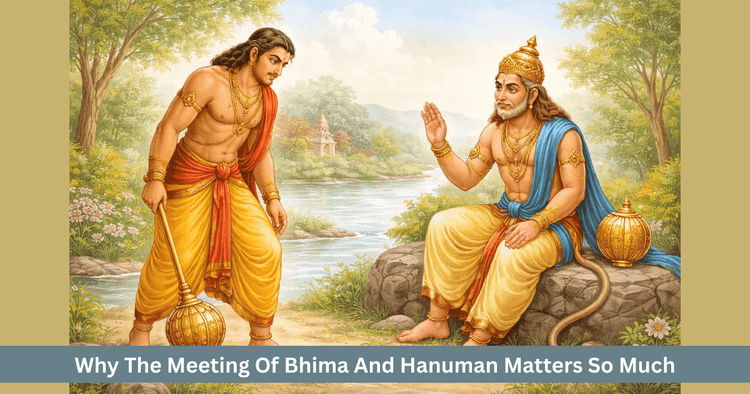
Table of Contents
Why The Meeting Of Bhima And Hanuman Matters So Much
In the Mahabharata, Bhima is remembered as the unmatched master of physical strength and courage. His image with the mace in hand, standing firm against injustice, has shaped how generations see him. In the Ramayana tradition, Hanuman stands as the symbol of devotion, service and incredible power. Few people pause to notice that these two figures are linked through a deep and revealing encounter.
Both are associated with Vayu, the god of wind and life breath. On one side stands Bhima, the warrior of the age of the Mahabharata. On the other side stands Hanuman, the great devotee from the time of Rama. When these two meet, the story that unfolds is not just a test of strength. It becomes a teaching on what true power really is and how pride can quietly weaken even the strongest hero.
How Did Bhima’s Search For More Strength Reach Hanuman
During the exile of the Pandavas, Bhima often moved through forests and mountains. His nature drew him towards challenge. Whenever a chance appeared to prove his power over a demon, wild beast or harsh terrain, he accepted it readily. This was courage and it was also a wish to test his own limits again and again.
At one point, while walking along a narrow path, Bhima saw an old monkey lying across the way. The monkey’s body and tail spread out in such a way that it blocked the entire passage. Bhima wanted to move ahead quickly and for him this looked like a very small obstacle. In his mind, such a thing could be cleared with little effort.
Can Every Obstacle Be Removed By Force Alone
Bhima asked the old monkey to move aside. The monkey replied gently that he was too old and tired to get up and requested Bhima to shift his tail a little so that the path might open. To a warrior like Bhima this sounded almost amusing.
He decided to move the tail with casual ease. First he tried with one hand. The tail did not move. Then he used more strength. Still no movement. After that he gathered his full force and tried with all seriousness. To his surprise, the tail remained exactly in its place.
This was the same Bhima who had defeated many powerful enemies and broken iron like straw. Now the tail of an old monkey refused to shift even a little. A question arose in his mind. Who was this being who looked so ordinary yet carried such unshakeable weight.
When Did The Monkey Reveal His True Identity
Repeated attempts brought no result. Along with physical strain, a new feeling entered Bhima’s heart. He understood that this was no ordinary monkey. The mind that had been full of pride now began to turn towards respect and inquiry. Bhima folded his hands and asked with sincerity who the monkey really was.
The monkey then revealed his true form. He was Hanuman, the mighty servant of Rama. The same Hanuman whose leap to Lanka, strength in battle and single pointed devotion are central to the Ramayana. The same Hanuman whose name Bhima had heard since childhood.
Hanuman also reminded Bhima that both of them are linked through the grace of Vayu. This creates a bond like that of elder and younger brother. Hanuman’s gaze carried affection rather than rebuke. It became clear that this meeting had been arranged not to insult Bhima but to reshape his understanding from within.
The Shared Lineage Of The Sons Of Vayu
In Indian thought, lineage is not only a matter of physical blood. It also reflects the movement of divine forces.
In the case of Bhima and Hanuman the tradition says
- Bhima’s strength is supported by the blessing of Vayu
- Hanuman is known as Vayuputra, son of the wind god, protected and strengthened by that same force
This creates a spiritual brotherhood between the two. It also hints at an important idea. The same elemental power can express itself in two different ways
- one that focuses mainly on outer victory and physical challenge
- another that channels power into service, humility and devotion
Through this meeting Hanuman shows Bhima that raw strength without right direction can easily harden into pride. Strength guided by devotion becomes a tool for protection and upliftment.
How Did Bhima Learn The Depth Of Humility
Once Bhima accepted that he could not even move the tail, something inside him softened. The pride which had been taken for granted began to melt. Hanuman explained that muscles alone do not define true power.
He pointed to three important elements of real strength
- humility, which accepts that not everything is under personal control
- restraint, which decides when and where strength should be used
- devotion, which frees power from the grip of ego and offers it to a higher purpose
Hanuman made it clear that he could have used force in many ways, yet his nature was not to display power for its own sake. His nature was to protect, to serve and to act only when it helped dharma. He helped Bhima see that on the battlefield of Kurukshetra, physical energy would not be enough. Inner steadiness and faith would be just as important.
What Did Hanuman’s Blessing Change In Bhima’s Life
Pleased by Bhima’s sincerity, Hanuman gave him a blessing. He promised that during the war of Kurukshetra he would be present on the flag of Arjun’s chariot. This promise had several layers of meaning.
- Bhima’s strength would now stand under the protective gaze of Hanuman
- the image of Hanuman on the flag would constantly remind the warriors that devotion must travel with courage
When one imagines the chariot of Arjun rolling into battle with Hanuman’s image high above, it becomes clear that the Pandavas were not supported by human force alone. A living connection to devotion and dharma also moved with them.
What Is The Symbolism Hidden In This Story
If this event is seen only as a contest of strength, its value becomes small. Its real worth lies in the symbols that touch deeper understanding.
What Does The Unmoving Tail Represent
The inability to move Hanuman’s tail shows that
- attempts driven by pride have a natural limit
- some aspects of reality are not meant to bend before physical force
Many teachers have pointed out that the tail can be seen as a symbol of ego. As long as a person secretly believes that “I can do everything by my own power”, progress remains shallow. The moment one recognises the presence of a power beyond the individual, a doorway to deeper growth opens.
What Does The Lineage Of Vayu Suggest
In the natural world Vayu gives movement and carries prana. It energises yet remains invisible. Bhima and Hanuman both carry immense pranic strength. The difference is in how they hold it.
- Bhima leans more towards action and visible achievement
- Hanuman joins the same flowing energy with awareness, discipline and surrender
For any seeker, this is a strong reminder that inner energy must be guided by clear vision. Without that, speed can turn into restlessness.
Comparison Table Of Bhima And Hanuman
| Aspect | Bhima | Hanuman |
|---|---|---|
| Lineage | Supported by Vayu among the Pandavas | Vayuputra, servant of Rama |
| Primary image | Mace warrior, physical power and courage | Devotee, servant, wise and powerful |
| Initial focus | Trust in outer strength and victory | Trust in surrender and service |
| Main lesson | Strength completes itself through humility | Power exists to protect and to serve |
| Role in war | Visible fighter at Kurukshetra | Presence on the flag as subtle support |
How Is This Story Relevant For Life Today
Even today people often measure strength in outer terms.
- income
- influence
- physical fitness
- social status
These may be useful, yet by themselves they do not guarantee balance or peace. The meeting of Bhima and Hanuman offers another measure.
Power has two layers
- the layer of capacity, which includes skill and energy
- the layer of character, which includes values and self control
If capacity grows and character does not, then inner imbalance appears. Anger and arrogance gain room. When humility and faith grow along with ability, strength becomes a blessing instead of a burden. This story gives a living picture of that balance.
United Message Of Hanuman’s Devotion And Bhima’s Valour
When Hanuman stands on the flag and Bhima stands on the ground, one sees a union of two important qualities.
- inside, the heart of Hanuman with its devotion and humility
- outside, the readiness of Bhima to act with courage
Only devotion without action can leave work unfinished. Only action without devotion can become harsh and self centred. The ideal that emerges from this story suggests that a complete human life carries both. The courage to face the world and the softness to bow within.
Through this meeting the streams of the Ramayana and the Mahabharata touch each other. The devotee of Rama and the warrior with Krishna both point to the same truth. Real victory belongs to those whose strength is guided by a higher trust, not by pride alone.
Frequently Asked Questions
1. Are Bhima and Hanuman really considered brothers
Tradition describes both as connected to Vayu. Because of this they are often spoken of as elder and younger brothers. This bond explains the affection with which Hanuman guides Bhima instead of only testing him.
2. Why did Hanuman hide his identity at first
If he had shown his full form at once, Bhima’s pride might not have broken. The slow realisation that he could not move the tail prepared Bhima to listen. Only after that did Hanuman reveal who he was and share deeper teaching.
3. What is the spiritual meaning of Hanuman appearing on the chariot flag
Hanuman on the flag shows that when a person fights for dharma, the force of devotion stands above as protection. It reminds every seeker that human effort must go forward, yet trust in the divine should remain constant.
4. What was the single most important lesson for Bhima from this encounter
The most important lesson was that power without humility is incomplete. After this meeting, Bhima still remained strong and confident, yet his sharp sense of pride was softened. He became more aware of the need for guidance and grace.
5. What practical insight can a modern person take from this story
The practical insight is simple. No matter how capable one becomes, it is wise to remember the limits of individual power. Seeking guidance, staying humble and keeping one’s strength aligned with a higher purpose makes success more stable and meaningful.
Get your accurate Kundali
Generate KundaliDid you like it?
Author
Pt. Amitabh Sharma (56 Years)
Experience: 20
Consults About: Family Planning, Career
Clients In: Punjab, Haryana, Delhi
Share this article with friends and family
About ZODIAQ
ZODIAQ is an online Vedic Astrology platform. It connects clients seeking astrological advice to experienced astrologers with deep knowledge. Our users also generate kundali and perform kundali milan for free. ZODIAQ also offers services to the Astrologers. Astrologers utilize various offerings by ZODIAQ to serve their clients effectively.
If you are a User
Consult with experienced astrologers and seek their guidance. You can also order handwritten Janm Patrika report with life prediction prepared by experienced astrologers. Generate accurate Kundali, perform Kundali Matching and check horoscope and muhurat. Utilize our online library for all the necessary astrological and spiritual information.
If you are an Astrologer
Create accurate kundali for your clients and perform Kundali Matching for up to 5 people at a time. Write comprehensive Janm Patrika report for your clients with ZODIAQ. Check client details anytime by saving it in client directory. Become more productive by tracking how many clients you guide every day.
WELCOME TO
ZODIAQ
Right Decisions at the right time with ZODIAQ
