Did Lord Hanuman Really Write the First Ramayana
By Pt. Amitabh Sharma
The Hidden Legend of Hanumad Ramayana and Its Spiritual Message
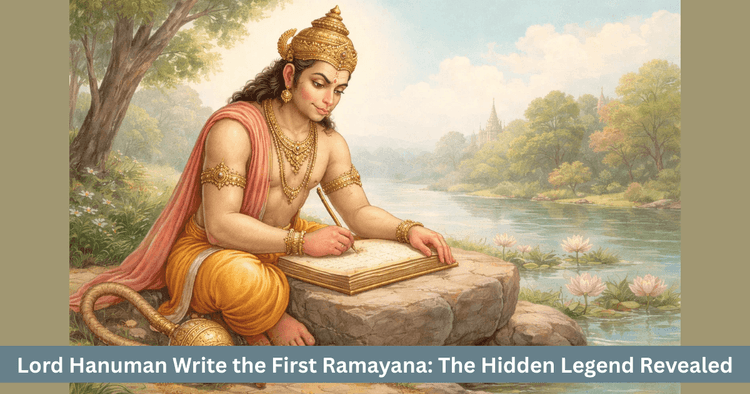
Table of Contents
When most people think of the Ramayana, they picture Sage Valmiki sitting in deep contemplation, transforming divine vision into poetry. He is rightly honoured as the Adi Kavi, the first poet and the author of the epic we know and love. Yet, there is a quieter legend, passed more by whispers than by written proof, that suggests another possibility. Long before Valmiki’s verses spread across the world, Lord Hanuman may have already written his own Ramayana.
This version, known in folklore as the Hanumad Ramayana, is described as so beautiful that even great sages felt humbled before it. Strangely, almost nothing of it survives. Why would a work of such power vanish and what does this story really want to teach us.
A Devotee Who Turned His Devotion into Scripture
According to the legend, sometime after the great events of the Ramayana, Hanuman retreated into the peace of the mountains. Imagine him there - not as the mighty warrior leaping across oceans but as a quiet devotee, heart still full of Rama’s name, with no desire for acclaim, only an overflowing love seeking expression.
Moved by this inner tide, Hanuman began to write. Some versions say he used banana leaves. Others describe him carving verses into stone with his nails on Himalayan rocks. Whatever the medium, the intent was the same. This was not meant as a public masterpiece. It was a private offering. A personal love-letter to his Lord, written not for the world’s eyes but for the joy of praising Rama.
In a way, Hanuman did what many of us secretly wish to do - he took his deepest feeling and turned it into creation, without worrying about audience, image or outcome.
When Valmiki Saw Hanuman’s Ramayana
The legend continues. One day, Sage Valmiki came across Hanuman’s Ramayana. He began to read. With every verse, his amazement grew. The narrative, the devotion, the poetic flow, the subtlety - everything felt perfect, effortless and divinely alive.
As a poet who had himself received inspiration from the divine, Valmiki knew greatness when he saw it. Yet, in that recognition, a human emotion arose. Compared to Hanuman’s version, his own Ramayana seemed small. Not because it lacked depth but because Hanuman wrote from a space very few can ever reach - sheer, ego-less devotion.
The story does not paint Valmiki as jealous, only honest. Sometimes, even the noblest heart can feel overshadowed in front of another’s brilliance.
Hanuman’s Response: Humility Greater Than Genius
What happened next is what makes this story unforgettable. When Hanuman realised how Valmiki felt, he did not say, “Let the world decide whose work is superior.” He did not argue, did not defend, did not cling.
Instead, the legend says, he quietly destroyed his own work.
If it was on banana leaves, he is said to have torn them and cast them away. If it was inscribed on rocks, he erased the verses. He chose to let Valmiki’s Ramayana stand as the version humanity would know, study and recite for ages.
Think about this for a moment in today’s language. It is like a creator willingly deleting a far superior project so that another meaningful work can shine, simply because that is what serves the larger good. No competition. No bitterness. Only clarity about what truly matters.
Hanuman was not insecure about his greatness. That is precisely why he did not need to prove it.
Did Anything of Hanuman’s Ramayana Survive
Folklore sometimes adds a gentle footnote to this story. It says that the Hanumad Ramayana did not disappear entirely. A few traces, a verse here, a fragment there, may have survived in subtle ways. Some traditions claim that a single stanza from Hanuman’s Ramayana was once seen by a great poet like Kalidasa, who marvelled at its depth and admitted he could never match it.
Whether this particular detail is fact or symbol is less important than what it suggests. True spiritual work rarely dies. Even when the physical form is lost, its fragrance lives on. It may inspire future writers, saints, musicians and seekers in ways they themselves cannot fully trace.
That is how real devotion works. It does not insist on being seen, yet it quietly colours the world.
What This Legend Really Teaches: Beyond Fame and Credit
For someone building a career, nurturing a marriage or trying to create something meaningful in life, Hanuman’s lost Ramayana offers profound lessons.
- Not Every masterpiece is meant to be public
- Not Every contribution needs a name stamped on it
- Not Every great act must be visible to be valuable
Hanuman’s act says:
- Devotion is its own reward, even if no one claps
- Skills and genius are complete only when they are free of the hunger for comparison
- The highest spiritual maturity sometimes appears as the willingness to step back, so that the right work reaches the right people in the right way
In a world obsessed with visibility and validation, this story asks us a quiet question. “If no one saw what you did, would you still do it with the same sincerity.”
Myth or History: Does It Matter
Historically, there is no surviving text we can point to and say, “This is Hanuman’s original Ramayana.” As far as research goes, this legend remains a part of oral tradition and devotional storytelling.
Yet, spiritual stories often carry two layers - outer event and inner meaning. The outer event may or may not be historically provable. The inner meaning speaks directly to the heart:
- Who am I serving through my work - my ego or something higher
- Would I still create if applause was removed from the equation
- Can I honour someone else’s contribution even if it outshines my own
From that angle, whether Hanuman literally wrote and destroyed a Ramayana matters less than what his character is teaching: Love that wants nothing in return is the highest form of power.
The Epic That Was Never Seen, Yet Never Lost
Valmiki’s Ramayana continues to live as a guiding light for millions. It shapes values, inspires devotion and offers a map for ethical living. Hanuman’s Ramayana, if it ever fully existed in written form, no longer does. But its legend lives as a deeper commentary on creativity, devotion and ego.
Some epics are meant to be read by the world.
Some are meant to be written only for God.
Hanuman’s hidden masterpiece seems to belong to the second kind. And perhaps that is why, even without a single page in front of us, it still leaves us thinking, feeling and quietly re-examining the reason we do what we do.
Frequently Asked Questions
1. Is there any actual manuscript of Hanuman’s Ramayana available today
No. There is no known surviving manuscript. The Hanumad Ramayana is preserved as a devotional legend, not as an accessible text.
2. Does this story mean Valmiki’s Ramayana is inferior to Hanuman’s
No. The legend does not diminish Valmiki. If anything, it honours his role by showing how even a divine being like Hanuman chose to support his contribution for the benefit of humanity.
3. Why would Hanuman destroy something so beautiful
Because in the spiritual view, purpose is higher than personal pride. Hanuman valued the impact of Valmiki’s Ramayana on the world more than the glory of his own writing.
4. How is this legend relevant for modern professionals and creators
It reminds us that while recognition is pleasant, it cannot be the sole reason for our work. Integrity, intention and inner alignment matter more than outer noise.
5. If Hanuman’s Ramayana cannot be read, what is its real gift to us
Its real gift is the mirror it holds up. It invites us to look at our own ambition, our need for credit and our capacity for selfless contribution and gently asks, “What would you choose if no one was watching.”
Get your accurate Kundali
Generate KundaliDid you like it?
Author

Pt. Amitabh Sharma (56 Years)
Experience: 20
Consults About: Family Planning, Career
Clients In: Punjab, Haryana, Delhi
Share this article with friends and family
About ZODIAQ
ZODIAQ is an online Vedic Astrology platform. It connects clients seeking astrological advice to experienced astrologers with deep knowledge. Our users also generate kundali and perform kundali milan for free. ZODIAQ also offers services to the Astrologers. Astrologers utilize various offerings by ZODIAQ to serve their clients effectively.
If you are a User
Consult with experienced astrologers and seek their guidance. You can also order handwritten Janm Patrika report with life prediction prepared by experienced astrologers. Generate accurate Kundali, perform Kundali Matching and check horoscope and muhurat. Utilize our online library for all the necessary astrological and spiritual information.
If you are an Astrologer
Create accurate kundali for your clients and perform Kundali Matching for up to 5 people at a time. Write comprehensive Janm Patrika report for your clients with ZODIAQ. Check client details anytime by saving it in client directory. Become more productive by tracking how many clients you guide every day.
WELCOME TO
ZODIAQ
Right Decisions at the right time with ZODIAQ
