Did Lord Rama's Sin Cause Lord Krishna's Death?
By Pt. Amitabh Sharma
The Forgotten Karmic Connection Between Two Avatars
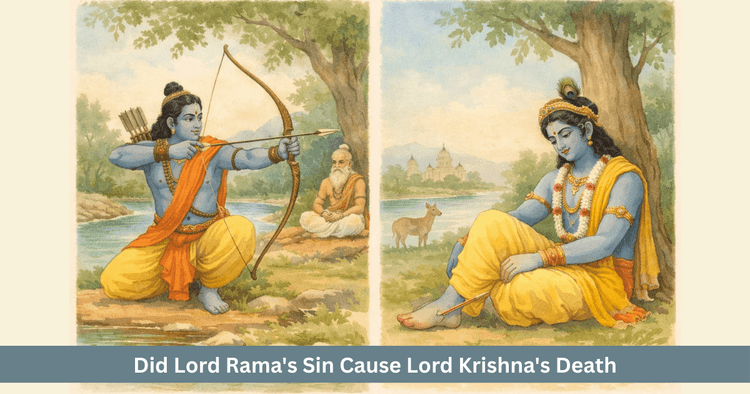
Table of Contents
In Hindu mythology, every action, even by the gods, carries the weight of karma. Lord Rama and Lord Krishna, two avatars of Lord Vishnu, are separated by ages but connected by an unseen thread of destiny. Though both descended on Earth to restore dharma, a single event from Lord Rama's life set the stage for Lord Krishna's death many centuries later. This lesser-known connection between the two divine incarnations shows how the cosmic law of cause and effect spares no one, not even the gods themselves.
The Divine Purpose Behind Two Avatars
Lord Vishnu incarnates whenever the balance between good and evil tips dangerously toward darkness. In Treta Yuga, He appeared as Lord Rama to defeat Ravana and establish righteousness. In Dwapara Yuga, He was born as Lord Krishna to guide humanity through wisdom and compassion. Both roles served the same divine mission, yet their stories were destined to complete one another through karma.
The Significance of Vishnu's Avatars
Among Lord Vishnu's ten primary avatars, Rama and Krishna hold special places. Rama is called Maryada Purushottam, one who maintains propriety in every circumstance while following dharma. Krishna is considered the complete avatar, possessing all sixteen kalas or divine attributes, while Rama possessed twelve. Rama taught dharma through his example, while Krishna imparted knowledge through the Bhagavad Gita. Both avatars aimed to restore dharma on Earth but their methods differed significantly.
The Transition of Ages
Rama's avatar occurred at the end of Treta Yuga when dharma existed at three-quarters strength. Krishna's avatar occurred at the end of Dwapara Yuga when dharma was reduced to half. With Krishna's death, Kali Yuga began, when dharma remained only one-quarter. This transition was part of the cosmic plan and both avatars played crucial roles in this divine scheme.
The Controversial Death of Vali in the Ramayana
During his exile, Lord Rama formed an alliance with Sugriva, who had been dethroned by his brother, Vali, the powerful monkey king. To help Sugriva reclaim his kingdom, Rama shot Vali from behind a tree. Though Rama's act was justified as punishment for Vali's moral transgressions taking his brother's wife and kingdom it sparked debate about fairness and dharma.
Vali's Questions to Rama
When Rama's arrow struck Vali, Vali questioned Rama extensively. He said that as a Kshatriya, Rama should not have shot an arrow from hiding. Vali asked what crime he had committed to deserve such treatment. He also stated that he was neither an enemy of Rama's kingdom nor had he ever committed any offense against Rama. Vali's questions highlighted the complexity of dharma.
Rama's Response
Rama explained to Vali that he had violated dharma by keeping his younger brother Sugriva's wife Ruma. This was a great sin according to the moral code. Rama said that as a prince of the Ikshvaku dynasty, it was his duty to protect dharma. Vali eventually accepted his fate, acknowledging Rama's divine purpose. Yet, his soul carried the echo of that moment into his next birth.
The Complexity of Dharma
The incident of Vali's death demonstrated the complexity of dharma. On one hand, Rama killed Vali to protect dharma because he had taken his brother's wife. On the other hand, shooting an arrow from hiding is considered against Kshatriya dharma. This incident shows that sometimes rules must be broken to protect greater dharma. Rama broke a smaller rule to protect the larger principle of righteousness.
The Rebirth of Vali as Jara the Hunter
Many centuries later, the cycle of karma turned once more. In Dwapara Yuga, Vali was reborn as Jara, a humble hunter living in the forest. Unaware of his divine connection to Krishna, Jara would soon play a vital role in fulfilling the balance of karma set in motion ages ago.
Jara's Background
Jara was an ordinary hunter who lived by hunting in the forest. He was a righteous person but knew nothing about his previous birth. He did not know that in his previous life, he was the monkey king Vali and how he was connected to Lord Rama. This ignorance itself was to make him an instrument of the cosmic plan.
The Law of Karma
In Hindu philosophy, the law of karma is immutable. Every action has consequences, whether in this life or the next. Vali had met his death at Rama's hands in his previous birth. Although Rama performed this act to protect dharma, the balance of karma was still necessary. Vali's rebirth as Jara was part of this balance.
The Divine Plan
It is important to understand that this incident did not occur out of vengeance but to maintain cosmic balance. Vali had accepted Rama's divine purpose and had not cursed him. Yet the law of karma demands that every action has a reaction. Jara became the medium for this reaction.
The Arrow That Ended Krishna's Mortal Life
As Krishna's earthly mission neared completion, He withdrew into solitude, meditating under a peepal tree. From a distance, Jara mistook Krishna's shining foot for the eye of a deer and shot his arrow. The arrow struck the Lord's foot, the same way Rama's arrow had once struck Vali. The karmic circle was complete.
The Destruction of the Yadava Clan
Before Krishna's death, the Yadava clan was destroyed. After the Kurukshetra war, Gandhari cursed Krishna that just as her hundred sons died, Krishna would also witness the destruction of his entire clan. This curse came true when internal strife erupted among the Yadavas and they began killing each other. Krishna witnessed the destruction of his entire lineage.
Krishna's Solitude
After the destruction of the Yadava clan, Krishna retreated to the forest. He sat in meditation under a peepal tree near Prabhas Tirtha. The sole of his foot was shining. This solitude was his preparation for the completion of his earthly play. He knew his time had come and he was ready to return to the divine abode.
Jara's Arrow
Approaching from a distance, the hunter Jara mistook the sole of Krishna's foot for a deer's eye and shot an arrow. The arrow struck Krishna's foot directly. It is said that this arrow was made from the same metal that remained from the time of Krishna's son Pradyumna's death. This was part of the divine plan. Even after being struck by the arrow, Krishna remained calm.
The Moment of Death
When Jara realized his mistake, he ran to Krishna. He was terrified and began begging for forgiveness. But Krishna smiled gently and consoled him. He said that all this was predestined and that Jara was merely an instrument of divine justice. Krishna blessed Jara and departed to his divine abode.
Krishna's Forgiveness and the Lesson of Karma
Realizing his mistake, Jara rushed to Krishna, trembling with guilt. But Krishna smiled gently and consoled him, saying that their meeting was destined and that Jara had merely been an instrument of divine justice. By forgiving Jara, Krishna reminded the world that even divine beings honor the cosmic law of karma, where every action finds its rightful resolution.
The Importance of Forgiveness
Krishna's forgiveness demonstrates that he knew Jara was merely a medium. Jara had no personal fault. This was part of the cosmic plan. Krishna not only forgave Jara but also blessed him. He said that Jara would not incur any sin because all this was predestined. This demonstrates the greatness of forgiveness.
The Resolution of Karma
With Krishna's death, the karma that began in Treta Yuga with Rama's killing of Vali was completed. This shows that the account of karma is always settled, no matter how long it takes. Rama killed Vali to protect dharma and Krishna accepted the balance of that karma. In both events, the divine plan is clear.
Divine Beings' Adherence to Karma
This incident also shows that divine beings are also bound by the law of karma. Despite being avatars of Lord Vishnu, both Rama and Krishna followed the law of karma. This demonstrates the depth of Hindu philosophy where no one is above the law of karma. Even God bears the fruits of his actions.
The Eternal Balance of Dharma
The connection between Rama and Krishna teaches a timeless truth: no deed vanishes in the universe. The same divine hand that gives life also ensures balance. Through this story, Hindu philosophy beautifully illustrates that karma transcends lifetimes and dharma, once disturbed, will always find its way back to harmony.
The Universal Law of Karma
The principle of karma is central to Hindu philosophy. It teaches that every action has consequences. Good actions bring good results and bad actions bring bad results. But karma is not just that. It also maintains cosmic balance. When an action occurs, there must also be a reaction. The story of Rama and Krishna demonstrates this balance.
The Triumph of Dharma
Ultimately, this story is about the triumph of dharma. Rama killed Vali to protect dharma. Krishna accepted the balance of karma. Both actions were for the establishment of dharma. Dharma is never destroyed; it only changes form. Through Rama and Krishna, dharma manifested itself.
The Cycle of Life and Death
This story also demonstrates that life and death are a cycle. Vali's death and rebirth as Jara, then his role in Krishna's death all this is part of this cycle. Death is not the end but a new beginning. The soul is immortal and bodies keep changing.
Different Perspectives and Interpretations
Scriptural Perspective
The Mahabharata and various Puranas describe Krishna's death in different ways. Some cite Gandhari's curse as the primary cause. Some mention the destruction of the Yadava clan. Some reference the change of ages. The connection between Vali and Jara is mainly found in folk tales. It is presented as an example to explain the principle of karma.
Philosophical Interpretation
From a philosophical perspective, this story demonstrates the universal law of karma. It teaches that no one can escape karma, not even God. It underlines the importance of karma in human life. It also shows that every action has consequences, no matter how long it takes.
Spiritual Message
Spiritually, this story conveys the message that we should be aware of our actions. Every action should be done thoughtfully because we have to bear its consequences. Also, it demonstrates the importance of forgiveness. Krishna forgave Jara, which teaches us that forgiveness is a great virtue.
Frequently Asked Questions
Did Vali actually take rebirth as Jara?
This is mainly found in folk tales and later literature. The original Mahabharata does not explicitly mention it. however it is a powerful example to explain the principle of karma.
Did Rama commit a sin?
In Hindu philosophy, Rama killed Vali to protect dharma. This was not a sin but an adherence to dharma. however every action has consequences and the balance of karma is necessary.
Why did Krishna accept his death?
Krishna knew this was part of the cosmic plan. He had completed his earthly play and it was time to return to the divine abode. He accepted the law of karma.
What does this story teach us?
This story teaches us that karma is universal; no one can escape it. Every action has consequences. Protecting dharma is important. Forgiveness is a great virtue.
Is this story authentic?
This story is part of Hindu tradition. It is mainly found in folk tales. It should be viewed as a philosophical example to explain the principle of karma.
Get your accurate Kundali
Generate KundaliDid you like it?
Author
Pt. Amitabh Sharma (56 Years)
Experience: 20
Consults About: Family Planning, Career
Clients In: Punjab, Haryana, Delhi
Share this article with friends and family
About ZODIAQ
ZODIAQ is an online Vedic Astrology platform. It connects clients seeking astrological advice to experienced astrologers with deep knowledge. Our users also generate kundali and perform kundali milan for free. ZODIAQ also offers services to the Astrologers. Astrologers utilize various offerings by ZODIAQ to serve their clients effectively.
If you are a User
Consult with experienced astrologers and seek their guidance. You can also order handwritten Janm Patrika report with life prediction prepared by experienced astrologers. Generate accurate Kundali, perform Kundali Matching and check horoscope and muhurat. Utilize our online library for all the necessary astrological and spiritual information.
If you are an Astrologer
Create accurate kundali for your clients and perform Kundali Matching for up to 5 people at a time. Write comprehensive Janm Patrika report for your clients with ZODIAQ. Check client details anytime by saving it in client directory. Become more productive by tracking how many clients you guide every day.
WELCOME TO
ZODIAQ
Right Decisions at the right time with ZODIAQ
