Distinct Spiritual Paths in Hinduism: Rishi, Sadhu, Saint, Muni, Sannyasi and Bhakti Yogi
By Pt. Sanjeev Sharma
Diverse Spiritual Lifestyles and Practices Leading toward Moksha and Self-Realization
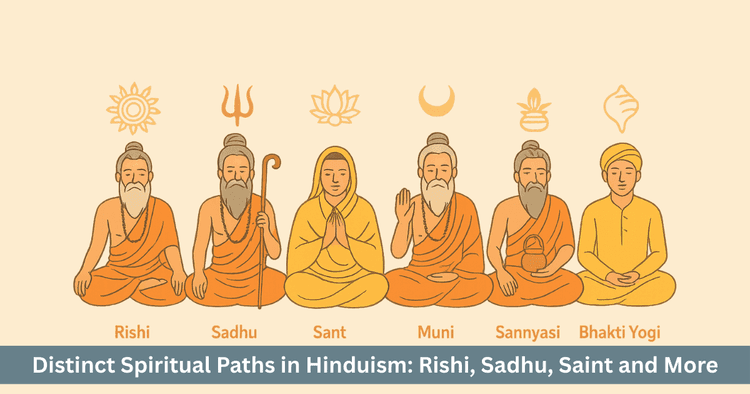
Table of Contents
Diverse Avenues toward Spiritual Attainment
Hindu spirituality unfolds through various sacred paths, each characterized by unique lifestyles, philosophies and practices. These paths are exemplified by the revered figures known as the Rishi, Sadhu, Saint, Muni, Sannyasi and Bhakti Yogi. While their approaches differ markedly, all share a unified and profound quest: the realization of the Self (Atman) and liberation (Moksha) from the cycles of birth and death (Samsara). This diversity highlights the inclusiveness of Hinduism, which honors multiple valid routes to spiritual fulfillment.
Rishi: The Visionary Sages of Vedic Wisdom
Rishis are the ancient seers who perceived and recorded the deepest truths contained in the Vedas, conveying these insights through sacred hymns meant to uplift humanity. Far more than mere poets, they were custodians and pioneers of spiritual sciences, establishing foundational knowledge in disciplines like Yoga, Ayurveda and Tantra. Renowned sages such as Vashistha, Vishwamitra and Agastya stand as pillars of this tradition, shaping not only spiritual practice but also early scientific thought in India.
These sages gained profound cosmic insights through intense meditation and spiritual discipline, described in scriptures as 'seeing' the ultimate reality. Their contributions form the bedrock for much of Hindu philosophical and spiritual knowledge.
| Type of Rishi | Distinctive Features | Examples |
|---|---|---|
| Maharshi | Supreme spiritual realization and authoritative insight | Vashistha, Agastya |
| Rajarshi | Combines regal leadership with spiritual wisdom | Vishwamitra |
| Devarshi | Divine celestial sages and heavenly messengers | Narada |
| Brahmarshi | Attainers of complete realization of Brahman | Markandeya |
Rishis are often described as ancient spiritual scientists who formulated methods such as Kundalini awakening and meditative mental control, unveiling profound secrets of the cosmos and human consciousness through their disciplined vision.
Sadhu: The Ascetic Renunciate
Sadhus are spiritual aspirants who renounce worldly attachments and comforts to fully engage in austerity, devotion and service. Typically dwelling in isolated forests, mountains, holy cities or ashrams, they live simple and disciplined lives devoted to meditation and self-purification. The term "Sadhu" denotes a person of noble character, one who embodies righteousness, humility and steadfast dedication to spiritual goals.
With detachment from material possessions, Sadhus commit their energy towards spiritual evolution, often serving as guides and mentors to others, while embracing poverty and austerity to deepen their own soul’s journey toward liberation.
Saint (Sant): Embodiments of Devotion and Moral Excellence
Saints (Sants) are enlightened personalities whose lives exemplify unwavering devotion (Bhakti), compassion and ethical integrity. Through their poetry, mystical songs, teachings and conduct, saints like Tulsidas, Surdas and Mirabai have inspired countless devotees to cultivate intense love and surrender towards the Divine.
Saints achieve their spiritual stature through rigorous penance and introspection, transforming not only themselves but also communities by spreading values of universal love, kindness and divine service. Their lives serve as luminous beacons for collective spiritual awakening and social harmony.
Muni: The Silent Contemplative Sage
Munis are sages deeply immersed in silence, reflection and mental discipline. Derived from the Sanskrit root 'manan' meaning ‘to think,’ a Muni engages in profound introspection while maintaining rigorous control over speech and mind to avoid distractions.
The Bhagavad Gita (2.56) particularly highlights a Muni’s capacity to keep a tranquil and discerning mind that can explore various thoughts without losing focus or being entangled. The Muni’s adherence to silence (Mauna) is regarded as a crucial spiritual vow that fosters clarity, concentration and inner purity essential for realizing higher truths.
Sannyasi: The Total Renouncer
A Sannyasi undertakes the highest form of renunciation, formally relinquishing all personal attachments, possessions and worldly roles to devote their entire existence to spiritual pursuit and God-realization. Their life is marked by celibacy, simplicity, ethical discipline and unshakable devotion.
Figures like Adi Shankaracharya and Swami Vivekananda embody this ideal, serving as spiritual teachers and reformers who journey across lands to disseminate sacred knowledge and awaken spiritual consciousness in society. Sannyasis emphasize liberation (moksha) as the supreme goal beyond all worldly endeavors.
Bhakti Yogi: The Devotee of Divine Love
A Bhakti Yogi follows the path of loving devotion, surrendering every thought, word and action as a sacred offering to the Divine. This path transcends intellectual knowledge or ritualistic practices, focusing instead on cultivating heartfelt love and constant remembrance of God.
Bhakti Yogis manifest compassion, selfless service and joyous surrender, seeing unity with the beloved personal deity as the pinnacle of spiritual realization. Their devotion is pure, unconditional and serves as a living force stirring the soul toward union with the divine.
A Unified Destination Through Varied Means
Despite their varied external practices and temperaments, all these spiritual roles, Rishi, Sadhu, Saint, Muni, Sannyasi and Bhakti Yogi, share profound unity in purpose. They guide aspirants to transcend ignorance, dissolve ego and awaken to the eternal Self. This pluralistic embrace within Hinduism allows seekers to find a spiritual method aligned with their nature while affirming the singular goal of liberation and spiritual enlightenment.
This rich diversity exemplifies Hinduism’s vast and accommodating nature, celebrating the myriad ways the soul can navigate the sacred journey toward ultimate freedom.
Would you like a comparative table detailing these roles’ key features and spiritual emphases for clearer understanding?
Frequently Asked Questions
Q1: What is the difference between a Rishi and a Muni?
Answer: A Rishi is a seer and transmitter of Vedic knowledge, possessing divine insight into cosmic mysteries. A Muni is a silent contemplative, who attains self-knowledge through deep meditation and mental discipline.
Q2: How do Sadhu and Sannyasi compare and differ?
Answer: Both renounce worldly attachments and practice austerity but Sadhus often live ascetic lives while Sannyasis completely relinquish all worldly duties dedicating themselves solely to liberation.
Q3: What role do Saints play in society?
Answer: Saints propagate love, devotion and moral values, inspiring spiritual awakening and devotional living in society.
Q4: What path does a Bhakti Yogi follow?
Answer: The Bhakti Yogi follows the path of loving devotion and surrender, where unwavering service and faith in God is paramount.
Q5: How do these diverse spiritual roles complement each other in Hinduism?
Answer: These roles represent different spiritual methods suited to various temperaments, yet all aim at self-realization and liberation, reflecting Hinduism’s rich pluralistic tradition.
Get your accurate Kundali
Generate KundaliDid you like it?
Author

Pt. Sanjeev Sharma (63)
Experience: 20
Consults About: Family Planning, Career
Clients In: Punjab, Haryana, Delhi
Share this article with friends and family
About ZODIAQ
ZODIAQ is an online Vedic Astrology platform. It connects clients seeking astrological advice to experienced astrologers with deep knowledge. Our users also generate kundali and perform kundali milan for free. ZODIAQ also offers services to the Astrologers. Astrologers utilize various offerings by ZODIAQ to serve their clients effectively.
If you are a User
Consult with experienced astrologers and seek their guidance. You can also order handwritten Janm Patrika report with life prediction prepared by experienced astrologers. Generate accurate Kundali, perform Kundali Matching and check horoscope and muhurat. Utilize our online library for all the necessary astrological and spiritual information.
If you are an Astrologer
Create accurate kundali for your clients and perform Kundali Matching for up to 5 people at a time. Write comprehensive Janm Patrika report for your clients with ZODIAQ. Check client details anytime by saving it in client directory. Become more productive by tracking how many clients you guide every day.
WELCOME TO
ZODIAQ
Right Decisions at the right time with ZODIAQ
