Forgotten Gods of India That Once Had Millions of Followers
By Pt. Sanjeev Sharma
The Echoes of Vanished Worship and the Fragility of the Sacred
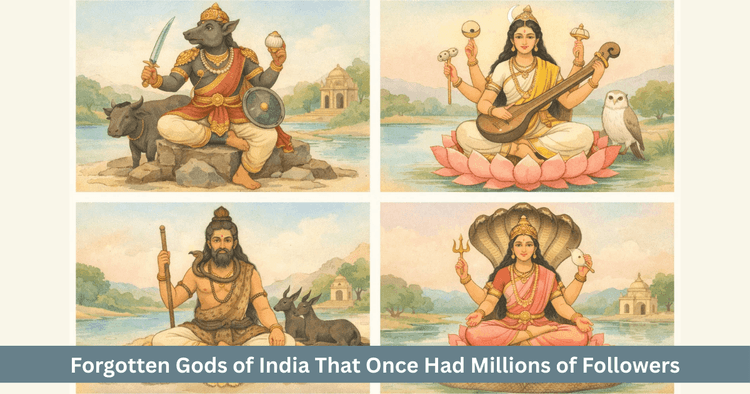
Table of Contents
The Echoes of Vanished Worship
In the vastness of Hindu mythology and Indian spirituality, certain images dominate the contemporary consciousness. Shiva meditating on Mount Kailash. Krishna playing his flute in Vrindavan. Durga riding her lion into battle. Ganesha blessing new beginnings. These deities remain vivid, their temples crowded, their stories retold with undiminished energy.
Yet behind these enduring figures lurks a more unsettling reality. Across the Indian subcontinent, in temples now crumbling, in sculptures now gathering dust in museums, in rituals now performed by fewer and fewer hands, lie the remains of divine cults that once commanded millions of devotees. These are the gods who were worshipped with fervor in one era, honored as supreme protectors or beloved companions, only to be gradually eclipsed, absorbed or simply forgotten as the currents of history shifted.
The story of India's forgotten gods is not merely a tale of religious evolution but a profound meditation on how divinity itself or more precisely how human devotion to divinity, transforms across time. It suggests that gods are not eternal abstractions but living presences within the collective consciousness of a people, responsive to their needs, shaped by their contexts and vulnerable to the same forces of change and erasure that affect all human institutions.
To study these forgotten deities is to discover a parallel history of India, one where the sacred landscape was far more diverse, the spiritual options far more varied and the relationship between humans and the divine far more fluid than contemporary monotheistic or hegemonically focused frameworks suggest.
One Revanta The Warrior Son Left Behind
The Guardian of Warriors and Hunters
Revanta, son of Surya the Sun God and chief of the Guhyakas, occupied a position of singular importance during the early medieval period in India. He was not a minor deity relegated to local worship but a major god venerated across northern and eastern India, particularly in Bihar, Bengal and Odisha.
The Iconography of Excellence
Revanta was depicted with characteristic elegance. A handsome prince on horseback suggesting both nobility and mobility. Armed with bow and sword marking him as the divine warrior. Accompanied by attendants and celestial beings indicating his exalted status. Surrounded by symbols of nobility and martial prowess associating him with the ideals of the warrior class.
His imagery was not confined to temples but appeared on coins, seals and sculptures, suggesting that his cult was sufficiently widespread to attract royal patronage and popular support.
The Lost Legacy
What is remarkable about Revanta is not his ancient importance but his near-complete disappearance from contemporary Hindu consciousness. Several factors contributed to this eclipse. Theological realignment. As the solar tradition absorbed diverse solar deities, Revanta's distinctness was diluted into the broader Surya tradition. Rather than maintaining an independent cult, he became merely one of Surya's aspects.
Shift in military patronage. Warrior deities required active patronage from the kshatriya warrior class. As political structures changed and patronage shifted toward other deities, Revanta's temples received less funding and attention. Literary marginalization. Unlike Shiva or Vishnu who feature prominently in major Sanskrit texts, Revanta's stories became increasingly sidelined in the theological literature that shaped subsequent religious practice.
Geographic concentration. His worship was concentrated in specific regions. When these regions experienced political upheaval or religious transitions, his following dispersed or assimilated into other cults.
The Lesson
Revanta's fade from prominence teaches that even significant deities with widespread worship, royal patronage and developed mythologies can disappear within a few centuries. His story suggests that religious prominence is not inevitable but contingent, dependent on ongoing patronage, literary transmission and alignment with prevailing theological currents.
Two Yaksha and Yakshini Deities The Spirits Before the Gods
The Earlier Divine Hierarchy
Before the complex theological systems of classical Hinduism emerged, before Shiva and Vishnu achieved their cosmic supremacy, the Indian subcontinent was populated by a diverse array of nature spirits and local deities. Among the most significant were Yakshas male spirits and Yakshinis female spirits, beings associated with guardianship of treasures and wealth, fertility of land and prosperity of agriculture, protection of forests and natural spaces and channels for divine blessing and material abundance.
The Mauryan Veneration
The Mauryan period three twenty-two to one eighty-five BCE provides us with remarkable evidence of how central Yaksha worship was to the religious life of the time. Archaeological finds include the famous Didarganj Yakshi sculpture from Pataliputra, a masterpiece of ancient Indian art depicting a female spirit of extraordinary grace and power. Multiple Yaksha statues and inscriptions across the subcontinent suggest their widespread veneration. Dedicatory inscriptions from merchants, rulers and common people indicate worship across social classes.
The Sacred Function
Yakshas and Yakshinis were not merely mythological beings but living presences in the spiritual life of communities. Yaksha worship provided access to material blessing without requiring complex theological understanding. Their worship was inclusive, attracting both commoners and royalty. They embodied the sacred within nature itself, making forests, groves and water sources into temples. Their rituals were practical, directly addressing concerns for prosperity, fertility and protection.
The Absorption and Disappearance
As organized religions became institutionalized, Yakshas underwent a peculiar transformation. Theological reframing. Rather than remaining as independent divine beings, Yakshas were reinterpreted as attendants or servants of major deities. Yakshinis became companions of goddesses. Yakshas became guardians in temples dedicated to Shiva or Vishnu.
Institutional marginalization. With the rise of temple-based Hinduism organized around major deities, Yaksha worship required separate priesthoods and ritual systems, a luxury institutions preferred not to maintain. Literacy shift. The literary traditions that shaped subsequent religious practice emphasized Puranic deities. Yakshas, lacking sophisticated mythological narratives in the canonical texts, gradually faded from the literature that shaped successive generations' understanding of the sacred.
Archaeological disconnection. The physical remains, statues and inscriptions, became museum pieces rather than living objects of worship. Without continuous ritual attention, they ceased to be perceived as sacred and became historical artifacts.
The Contemporary Trace
Today, Yakshas survive primarily as background figures in temple iconography, attendants rather than principal deities. Museum exhibits studied by archaeologists but not worshipped by living communities. Remnants in folk traditions where localized nature spirits persist under different names. Aesthetic subjects admired for their artistic excellence but divorced from active devotion.
The Didarganj Yakshi stands in a museum, her serene grace preserved in stone but no one performs rituals before her. She has become a historical artifact, her original sacred function dissolved by time and changing religious structures.
Three Khandoba The Fierce Guardian of the Deccan
A Regional Power
Khandoba, a fierce and powerful local deity, once commanded a vast following in the Deccan region, particularly in Maharashtra, Karnataka and Telangana. Unlike the pan-Indian deities whose worship spread through theological literature and merchant networks, Khandoba was rooted in regional specificity, yet within his region, he was extraordinarily significant.
The Nature of His Worship
Khandoba was venerated as a guardian warrior god, protector against all threats. An incarnation of Shiva, though with a distinct and independent cult. A patron deity of farmers and shepherds, addressing the concerns of rural communities. A figure who transcended religious boundaries with both Hindu and Muslim devotees making offerings at his shrines.
This last point is particularly significant. Khandoba's cult was syncretic, attracting worshippers across religious boundaries. His fierce protective nature made him relevant regardless of theological affiliation.
The Physical Presence
Khandoba had dedicated temples, most notably in Jejuri Maharashtra which became a major pilgrimage site. Distinct rituals and ceremonies different from the standard Hindu puja. His own mythology recorded in regional texts and oral traditions. Active priesthoods maintaining his worship with dedicated fervor.
The Contemporary Decline
Despite this robust tradition, Khandoba's following has dramatically contracted. Today his temples, though still functioning, attract fewer devotees compared to mainstream Hindu temples. His mythology is less known outside the Deccan region. Regional distinctiveness, once a source of strength, has become a limitation as pan-Indian deities absorb worship. Urban migration and modernization have weakened the rural base of his devotion. His Jejuri temple remains significant but lacks the resources and prominence of major pilgrimage sites.
The Reason for Decline
Several factors contributed. Religious standardization. The pan-Indian Hindu movements, Brahmo Samaj, Arya Samaj, modern Hindu nationalism, promoted standardized text-based Hinduism that marginalized regional deities. Urbanization. As people migrated from rural areas to cities, the connection to local deities weakened. New urban temples followed standardized models worshipping major pan-Indian deities.
Theological hierarchy. Khandoba was claimed as an incarnation of Shiva but this very assimilation meant he was subordinated to Shiva. Why worship the incarnation when you can worship the original? Accessibility. Shiva is worshipped everywhere. Khandoba requires pilgrimage to specific sites. Convenience favored the pan-Indian option.
The Lesson
Khandoba teaches that regional strength is vulnerable in the face of pan-Indian standardization. His fierce independence and regional specificity, which once made him a powerful force, eventually became limitations in a religious landscape increasingly dominated by centralized, text-based, pan-Indian systems.
Four Brahma The Creator Now Nearly Forgotten
The Cosmic Irony
Perhaps no deity better exemplifies the volatility of divine prominence than Brahma, who stands as the supreme irony in Hindu mythology. The creator of the universe, one of the three principal deities in the Trimurti Trinity of Hinduism, now has virtually no temples dedicated to him and receives minimal worship.
The Ancient Prominence
In the ancient Vedas and early Puranas, Brahma occupied a position of extraordinary importance. He was the creator, the first manifestation of Brahman. He was worshipped extensively across India with multiple temples and rituals. He was one of the three supreme deities alongside Vishnu and Shiva. He received royal patronage and popular devotion.
The Theological Decline
What caused Brahma's remarkable eclipse? The factors are complex. The mythology of his flaw. The Shiva Purana and other texts contain stories portraying Brahma as arrogant, claiming his creative power equals or exceeds that of Shiva. Lustful, developing inappropriate desires for his own daughter Saraswati. Unreliable, bound by his own curses or rendered ineffective by his nature. These narratives, while containing philosophical teachings, established a theological narrative in which Brahma was flawed or limited compared to Shiva.
The problem of redundancy. Creation is a one-time event in a given cosmic cycle. Once the universe is created, Brahma has little ongoing function. In contrast, Vishnu must continuously preserve creation and Shiva must continuously maintain the cycle of dissolution and recreation. Brahma's role is essentially complete.
The theological shift. As Puranic Hinduism evolved, theological emphasis shifted toward Vishnu as supreme in Vaishnava traditions and Shiva as supreme in Shaiva traditions. Both were more useful theologically than Brahma who represented a completed function. The curse against worship. Perhaps most remarkably, multiple texts contain explicit statements that Brahma will not be worshipped, suggesting that theological justification was provided for the abandonment of his cult.
The Surviving Remnant
Today, Brahma worship survives primarily in one place: the Brahma Temple in Pushkar, Rajasthan. This temple remains one of the few temples with Brahma as the principal deity. Continues to attract pilgrims during specific festivals. Preserves the remnants of what was once a widespread cult. Stands as a relic of a past religious landscape.
The Broader Implications
Brahma's near-disappearance teaches several profound lessons. Theological narrative shapes worship. The stories told about a deity, whether they portray the deity as flawed or powerful, directly influence whether people will worship that deity. Functionality determines prominence. Deities with ongoing cosmic functions, Vishnu preserving, Shiva destroying, retain significance. Those with one-time functions, Brahma creating, lose relevance.
Centralization creates hierarchies. The standardization of pan-Indian Hinduism through texts like the Puranas effectively demoted regional and functional deities in favor of those presented as supreme. Even cosmic importance is contingent. Being the creator of the universe proved insufficient to preserve Brahma's worship. This suggests that nothing, not even cosmic status, guarantees religious prominence.
Five Rishabhanatha The Jain Pioneer Beyond Jainism
The Uncommon Knowledge
Rishabhanatha, also called Adinath the first lord, holds a unique position in Indian religious history. He is recognized within Jainism as the first Tirthankara, the first in the current cycle of spiritual leaders who attained enlightenment and taught the path to liberation. Yet his significance extended far beyond Jainism into broader Indian religious culture.
The Ancient Pan Indian Presence
Scholars of ancient India have noted that Rishabhanatha was worshipped in early Vaishnava and Shaiva communities, not just Jain circles. Ancient inscriptions and sculptures dedicated to him appear across north and central India. Early texts suggest theological borrowing with some Vaishnava traditions incorporating elements from Rishabhanatha's teachings. His cult had sufficient prominence to attract royal patronage and temple construction.
The Historical Integration
Over centuries, Rishabhanatha was increasingly confined to Jain tradition. As Vaishnava and Shaiva Hinduism solidified, their theological systems no longer required incorporation of his teachings. Jain communities, strengthening their own institutions, began to emphasize exclusively Jain identity. The broader Hindu tradition moved away from Rishabhanatha, focusing instead on Shiva, Vishnu and their avatars. Textual traditions shifted and Rishabhanatha's stories appeared primarily in Jain scriptures rather than mainstream Hindu texts.
The Contemporary Confinement
Today, Rishabhanatha is deeply respected within Jain communities where he remains a central figure. Virtually unknown outside Jain circles, even among educated Hindus. A historical figure of scholarly interest, studied by academics of ancient Indian religion. Preserved in ancient statuary with impressive sculptures surviving in various museums and temples.
The Broader Pattern
Rishabhanatha's trajectory illustrates a recurring pattern among India's forgotten gods. Figures of pan-regional or pan-Indian significance become confined to single traditions as religious boundaries harden. What was once a shared spiritual heritage becomes proprietary, preserved by one community rather than celebrated across many.
Six Murugan in North India The Southern God Who Left the North
The Cosmic General
Murugan, also called Kartikeya or Skanda, is the god of war, victory and divine masculine power. Today, he is primarily known as a Tamil god with his most important temples and most fervent worship concentrated in Tamil Nadu, where he remains one of the most beloved and widely worshipped deities. Yet this was not always the case.
The Gupta Period Glory
During the Gupta period, roughly fourth to sixth centuries CE, Murugan worship spread across north India. Temples dedicated to Murugan stood in Kashmir, Rajasthan and throughout the Gangetic plains. Sculptures and inscriptions testify to his worship across diverse regions. Royal patronage supported his cults in various northern kingdoms. He was central to religious imagination, worshipped as the supreme deity by many devotees.
The Northern Decline Southern Flourishing
What is remarkable is that Murugan's worship contracted in the north while intensifying in the south. Today Tamil Nadu is the epicenter of Murugan devotion with the famous Arupadai Veedu temples, six principal Murugan temples, drawing millions of pilgrims. Murugan is nearly absent from north Indian temples and religious consciousness. The northern cult has virtually vanished leaving minimal traces.
The Reasons for North South Divergence
Several factors explain this geographical reversal. Political fragmentation. As north India experienced political transitions and invasions, the patronage networks supporting Murugan temples fragmented. Meanwhile, southern kingdoms maintained more continuous political structures allowing for sustained religious patronage.
The rise of Shaivism and Vaishnavism. North India witnessed the spectacular rise of pan-Indian Shaivism and Vaishnavism, movements sponsored by powerful rulers. Murugan, while important, was subordinated within these broader traditions, understood as a son of Shiva in Shaivism.
Regional identity crystallization. Tamil identity became increasingly associated with Tamil language, Tamil literature and Tamil deities. Murugan, as a prominent Tamil deity, became part of Tamil cultural identity. Meanwhile, north Indian religious identity crystallized around pan-Indian rather than regional deities.
The Brahmin migration. The complex movements of Brahmin communities and changing patronage networks in north India favored certain deities and traditions over others. Cultural flourishing in the south. While north India experienced greater disruption, Tamil Nadu experienced a remarkable cultural and religious flourishing, including the Tamil Bhakti movement, which reinforced devotion to regional deities like Murugan.
The Consequence
Today, Murugan represents a stark example of how a pan-Indian deity can become regionally confined. His worship did not disappear but relocated to its current stronghold in the south. His northern presence is now primarily a matter of historical record rather than living religious practice.
Seven Indra The Fallen King of Gods
The Supreme Vedic Deity
Indra occupies a remarkable position in Indian religious history. He was the most important deity in the Rigveda, the supreme god of the Vedic religion. He was the king of the gods, Devraj. The god of thunder, rain and war. The wielder of the thunderbolt, Vajra. The central figure of countless Vedic hymns and rituals. The primary recipient of sacrifices in Vedic religion.
The Vedic Centrality
The Rigveda contains more hymns dedicated to Indra than to any other deity. He was not merely one god among many but the supreme deity. Central to the cosmological narrative with extensive creation myths centered on Indra's deeds. The focus of ritual attention with elaborate sacrifices performed to win his favor. The model of divine power and action, celebrated for his victories over demons.
The Puranic Diminishment
As Puranic Hinduism emerged and evolved, Indra's position changed dramatically. Theological reframing. Rather than being the supreme deity, Indra was reinterpreted as one of many gods and specifically as a minor functionary responsible for rain and heaven. He was subordinated to Shiva and Vishnu who were presented as supreme.
Character degradation. Puranic texts portrayed Indra increasingly as arrogant, requiring correction from superior deities. Lustful, often tempted by divine women. Weak, easily defeated or humiliated. Secondary, lacking the cosmic significance of Shiva or Vishnu.
Functional limitation. While Vedic Indra was multifunction, creator, warrior, king, storm god, Puranic Indra was increasingly defined only by rain and heaven, limited domains.
The Contemporary Status
Today, Indra is rarely worshipped directly, appearing primarily as a background character in Hindu mythology. Important functionally in rituals as Indra is still invoked for rain but not as a principal deity. Depicted iconographically as an older, sometimes comic or weakened figure. Studied historically for his significance in Vedic religion but not the subject of active devotion.
The Precipitous Fall
What makes Indra's case particularly striking is the speed and totality of his decline. He did not gradually fade over millennia. Rather, within a few centuries of the rise of Puranic Hinduism, he went from supreme deity to secondary figure. This suggests that religious prominence is remarkably unstable, dependent on theological narratives rather than inherent divine status.
Eight The Chausath Yoginis The Tantric Sisterhood
The Occult Tradition
Chausath Yoginis refers to the sixty-four female deities in a tantric tradition that, at its height, commanded significant following and sophisticated ritual systems. These were not merely goddess figures but tantric deities associated with occult knowledge, magical power and liberation through esoteric means.
The Temple Evidence
The remains of this tradition are preserved primarily in distinctive circular open-air temples built to house the sixty-four Yoginis, with each deity positioned at a specific location. Major temples survive in Odisha, with the Chausath Yogini Temple in Bhubaneswar being the most famous surviving example. Madhya Pradesh, with several temples in different states preserving the tradition. Uttar Pradesh, with additional temples testifying to the tradition's widespread presence.
These temples are architectural marvels demonstrating the sophistication and resources devoted to this cult.
The Ritual Function
Worshippers would circumambulate the temple, visiting each Yogini in sequence. Perform specific rituals addressing each deity's particular powers. Seek protection, fertility and occult knowledge. Engage in tantric practices including mantras and meditation techniques.
The Reasons for Disappearance
The cult faded due to multiple factors. Theological marginalization. As mainstream Hinduism increasingly questioned tantric practices, viewing them as heterodox or dangerous, the Yogini tradition was pushed to the margins.
Institutional challenge. Tantric traditions required specialized priesthoods and initiation, making them difficult to maintain within institutionalizing religious structures. It was easier to standardize worship of major deities like Shiva and Durga.
Brahminization resistance. The brahminization of Hinduism, the increasing dominance of Brahmin ritual specialists and values, marginalized non-brahminical traditions like the Yogini cults, which often involved practitioners of various castes and sometimes women in leadership roles.
Missionary competition. Colonial-era missionary activity and subsequent modernization undermined folk and tantric traditions which lacked the institutional infrastructure to resist these pressures.
The Contemporary Trace
Today, the Yogini temples stand as mysterious archaeological sites, attracting tourists and scholars but rarely active worshippers. Are preserved as heritage monuments rather than living places of worship. Represent a lost spiritual technology, documented in architectural form but no longer practiced. Remind us of Hindu traditions now marginalized or nearly extinct.
Nine Soparaya Yaksha The Maritime Guardian
The Coastal Deity
In the coastal regions of western India, particularly in Sopara, modern Nala Sopara near Mumbai, ancient texts and inscriptions reference Soparaya, a Yaksha deity venerated as guardian of maritime trade and commerce. Protector of merchants and coastal communities. Controller of oceanic fortune, blessing traders with favorable conditions.
The Merchant Veneration
References in Buddhist texts and merchant guild inscriptions indicate that merchant guilds made formal offerings to Soparaya seeking blessings for trade. Coastal communities performed rituals ensuring safe passage and profitable commerce. His worship was integrated into the mercantile calendar and activities.
The Lost Worship
Soparaya's worship disappeared due to colonial disruption. The British colonial period disrupted traditional merchant networks and religious practices and introduced new forms of economic organization that made traditional merchant worship obsolete.
Coastal urbanization. As Sopara underwent modernization and urban development, the physical and social spaces necessary for his worship vanished or were transformed. Religious standardization. The shift toward pan-Indian deities meant that local maritime deities like Soparaya were no longer maintained by institutional religion.
Documentation loss. Unlike major deities with extensive textual records, Soparaya's worship was preserved primarily through oral tradition and localized practice. When these were disrupted, there was nothing to fall back on.
The Contemporary Absence
Today, Soparaya exists primarily as a historical reference in academic texts on ancient Indian religion. An archaeological footnote in studies of coastal trade. A memory, if that, among descendants of merchant families. No active worship or temples remain.
The Broader Pattern What We Learn From Forgotten Gods
The Contingency of Divine Prominence
The most profound teaching from studying forgotten gods is that religious prominence is contingent, not inevitable. Even creators of universes like Brahma can be abandoned. Kings of gods like Indra can be demoted. Widespread pan-Indian deities like Murugan in the north can vanish from entire regions. Sophisticated philosophical systems like the Yoginis can be marginalized into extinction.
This suggests that divinity itself is a social construction or more precisely, that how divinity is manifest and worshipped is shaped by social, political and institutional factors.
The Role of Institutional Power
Religious prominence correlates strongly with patronage networks, wealthy rulers supporting temples and priesthoods. Textual preservation, being featured prominently in literature that shapes subsequent generations. Institutional structures organized priesthoods capable of maintaining worship. Theological alignment, fitting within the dominant theological framework of the era. When these support structures change, even major deities can fade.
The Vulnerability of Minority Traditions
Regional and specialized cults are particularly vulnerable because they lack the resources of pan-Indian traditions. Depend on specific communities whose fortunes may change. Cannot be standardized in the same way as major deities. Are easily absorbed or superseded by larger traditions.
The Role of Political Change
Religious change typically follows political transitions. When patronage shifts from one ruler to another, associated cults may fade. When political borders change, cults confined to specific regions may lose institutional support. When colonial powers arrive, they disrupt traditional patronage networks that sustained specialized deities. When new nations form, religious identity often shifts from local to national, favoring pan-national deities.
The Power of Narrative
Remarkably, theological narratives shape religious prominence. Stories portraying a deity as flawed reduce worship. Narratives emphasizing supremacy increase devotion. Myths that explain why a deity should not be worshipped can effectively end worship. Textual presence in major literature determines long-term remembrance.
Conclusion The Fragility of the Sacred
What Disappearing Deities Teach
The study of forgotten gods reveals something uncomfortable. Nothing about a deity's original importance, cosmic significance or theological depth guarantees long-term survival in human devotion. Instead, survival depends on continuous institutional support. Narrative reinforcement through literature. Patronage networks that maintain temples and priesthoods. Cultural identification that makes worship feel essential. All of these are contingent and changeable.
The Ongoing Fluidity
Indian religion is often presented as ancient and unchanging, yet the forgotten gods reveal a fundamentally fluid reality. Religions are not monuments but living processes, constantly evolving, with deities rising and falling, cults flourishing and fading and the landscape of worship shifting with each generation.
The Invitation to Reflection
The forgotten gods invite us to reflect on what determines what we remember and what we forget. How do power structures shape what is considered sacred? What would happen to the deities we worship today if patronage patterns changed? How much of religion is about transcendent truth versus social construction?
The Haunting Question
Most profoundly, the forgotten gods haunt us with a single question. Are they truly forgotten? Or do they persist, invisible, in the collective memory of the earth, waiting for some future moment when the conditions for their resurrection might align?
Some Hindus believe that forgotten deities can be reawakened through sincere devotion. Others suggest that they persist in subtle realms, influencing the world even without formal worship. Still others maintain that they truly have faded, their power spent, their time ended.
What seems certain is this. The gods of India's forgotten past remind us that the present religious landscape is not inevitable, that future generations may wonder what happened to the deities we worship today and that nothing, not even cosmic significance, guarantees permanence in human memory and devotion.
In the echoing silence where temples once stood full of devotees, where rituals once structured the sacred calendar, where deities once moved through the imagination of millions, in that silence we hear the voice of the forgotten gods teaching the ultimate lesson. Everything changes. Even the divine can disappear.
Frequently Asked Questions
Why have so many gods been forgotten in India?
Gods have been forgotten in India because religious prominence depends on political patronage, literary preservation, institutional support and cultural identification. When these change, deities can fade. For example, Revanta's cult disappeared when the solar tradition absorbed him and military patronage changed. Yaksha and Yakshini deities were marginalized by institutional Hinduism which focused on major deities like Shiva and Vishnu. Brahma's worship nearly ended because Puranic narratives portrayed him as flawed and his function of one-time creation was complete. Religious evolution is ongoing and deities once central can disappear when power structures, religious narratives and cultural priorities change.
Why is Brahma, despite being the creator, the most significant forgotten deity?
Brahma's near-total disappearance demonstrates the volatility of religious prominence. Though he is the creator of the universe and one of three supreme deities in the Trimurti, he now has virtually no temples. This occurred due to several factors. Puranic texts portrayed Brahma as arrogant and flawed, diminishing his theological status. Creation is a one-time event, so Brahma's function is complete, while Vishnu must continuously preserve and Shiva must continuously dissolve and recreate. Puranic Hinduism elevated Vishnu and Shiva as supreme, subordinating Brahma. Even texts contain curses stating that Brahma will not be worshipped. This teaches that even cosmic importance does not guarantee worship if religious narratives and functional relevance change.
How did Indra fall so quickly from being the supreme Vedic deity?
Indra's rapid fall demonstrates the power of religious narratives. In the Rigveda, Indra was the supreme deity with more hymns dedicated to him than any other. Yet within a few centuries of Puranic Hinduism's rise, he was demoted to a minor functionary. Puranic texts portrayed Indra as arrogant, lustful, weak and secondary, lacking the cosmic importance of Shiva and Vishnu. While Vedic Indra was multifunctional, creator, warrior, king, Puranic Indra was limited to rain and heaven only. Religious focus shifted to Shiva as supreme in Shaiva traditions and Vishnu as supreme in Vaishnava traditions. Today Indra is rarely worshipped directly, appearing only as a background character. This shows that religious prominence depends on theological narratives rather than inherent divine status.
Can forgotten deities be revived?
Some Hindus believe forgotten deities can be reawakened through sincere devotion and renewed patronage. however this would be difficult because religious prominence depends on institutional support, literary presence, patronage networks and cultural identification. Reviving a deity would require rebuilding temples, training dedicated priests, revitalizing religious literature and creating a cultural movement. Some regional deities like Khandoba survive in the Deccan in smaller numbers, suggesting partial revival is possible. Yet in the modern world, pan-Indian deities like Shiva, Vishnu and Durga dominate, making it difficult for local or forgotten deities to re-emerge. The fluidity is that Indian religion is constantly evolving, so future circumstances might allow some deities to re-emerge while others worshipped today may fade.
What do forgotten gods teach about modern Hinduism?
Forgotten gods teach that Hinduism is not a static monument but a living, fluid process. Religion constantly evolves with deities rising and falling, cults flourishing and fading. Religious prominence depends on political patronage, literary preservation and cultural identification rather than inherent divine status. Even cosmically important deities like Brahma the creator and Indra the Vedic supreme god can disappear if religious narratives change. The present religious landscape is not inevitable. Future generations may wonder what happened to the deities we worship today. Forgotten gods remind us that religion is alive, breathing, changeable and that nothing, not even cosmic importance, guarantees permanence. This encourages humility and appreciation for the vast diversity of Hinduism.
Get your accurate Kundali
Generate KundaliDid you like it?
Author

Pt. Sanjeev Sharma (63)
Experience: 20
Consults About: Family Planning, Career
Clients In: Punjab, Haryana, Delhi
Share this article with friends and family
About ZODIAQ
ZODIAQ is an online Vedic Astrology platform. It connects clients seeking astrological advice to experienced astrologers with deep knowledge. Our users also generate kundali and perform kundali milan for free. ZODIAQ also offers services to the Astrologers. Astrologers utilize various offerings by ZODIAQ to serve their clients effectively.
If you are a User
Consult with experienced astrologers and seek their guidance. You can also order handwritten Janm Patrika report with life prediction prepared by experienced astrologers. Generate accurate Kundali, perform Kundali Matching and check horoscope and muhurat. Utilize our online library for all the necessary astrological and spiritual information.
If you are an Astrologer
Create accurate kundali for your clients and perform Kundali Matching for up to 5 people at a time. Write comprehensive Janm Patrika report for your clients with ZODIAQ. Check client details anytime by saving it in client directory. Become more productive by tracking how many clients you guide every day.
WELCOME TO
ZODIAQ
Right Decisions at the right time with ZODIAQ
