From Rudra to Bholenath: Shiva’s Remarkable Journey and the Story of Balanced Generosity
By Pt. Abhishek Sharma
Explore Shiva’s Evolution from Fierce Rudra to the Gentle Bholenath and Lessons in Generosity
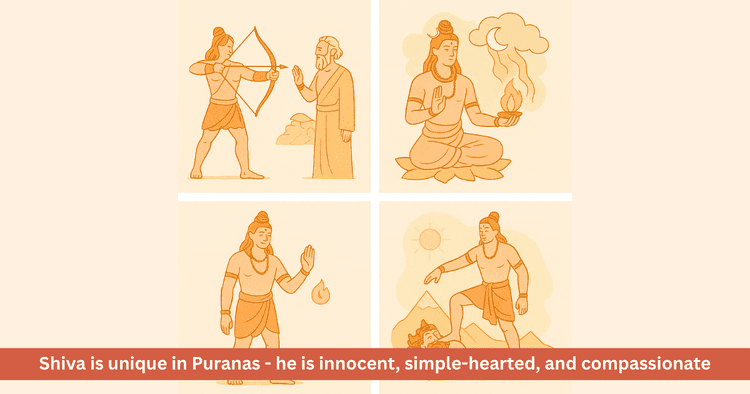
Table of Contents
Shiva is one of the most dynamic and evolving divine forms in Indian sacred tradition. The Rudra of the Vedas and the Shiva of the Puranas represent two very different expressions of the same cosmic force. Rudra appears fierce, unpredictable and destructive, while the Puranic Shiva is serene, compassionate and adored as Bholenath. This transformation reflects the philosophical evolution of Indian culture.
The Ancient Rudra and Historical Traces
In the Vedas, Rudra holds a bow rather than a trident. He destroys sacrifices when he is not invited and receives only leftover offerings.
The Ramayana introduces the story of Shiva capturing the descending Ganga in his matted locks.
The Gudimallam Linga shows a wild haired figure holding a goat, possibly an early form of Shiva.
Two thousand years ago, the form of the Shiva Linga became prominent. Initially formless or single faced, later four faced lingas appeared.
Shiva’s imagery spread to Vietnam, Java and Thailand around a thousand years ago.
The Brihadeeswara Temple built by the Cholas celebrates Shiva’s majestic and tantric presence.
The Puranic Bholenath
In the Puranas, Shiva appears gentle, innocent and approachable.
The story of Bhasmasura reveals how Shiva gives a boon without foreseeing its consequences.
He is known as Ashutosh, one who is easily pleased and quickly grants wishes.
His simplicity makes him appear unaware of worldly cunning, yet his innocence is a conscious detachment.
Generosity and its Consequences
Shiva’s stories teach that generosity is divine but requires discernment.
Ravana once demanded many boons and even requested Mount Kailash.
Shiva gently pressed Kailash with his finger and trapped Ravana. When Ravana pleaded, Shiva forgave him immediately.
This shows that Shiva grants without hesitation because he is free from attachment. He knows that deceit ultimately falls before time, and he himself is Time.
Philosophical Message of Shiva
Shiva represents balance, introspection and conscious generosity.
Unrestrained giving without responsibility can cause disorder.
His stories teach that compassion must be paired with wisdom.
Bholenath inspires humanity to cultivate humility, clarity and emotional stability.
Essence of Shiva’s Generosity (Table)
| Episode | Teaching |
|---|---|
| Boon to Bhasmasura | Thoughtless generosity brings danger |
| Granting Kailash to Ravana | Boundaries in generosity are important |
| Equal regard for all | Ideal of neutrality and fairness |
| Quick forgiveness | Power of compassion |
| Detachment and contentment | Freedom from fear and bondage |
FAQ
1. What is the difference between Vedic Rudra and Puranic Shiva
Rudra is fierce and destructive while Puranic Shiva is calm, compassionate and meditative.
2. Why is Shiva called Bholenath
Because he grants boons readily with pure intent and without deceit.
3. What does the Bhasmasura story teach
That granting without contemplation can lead to destructive outcomes.
4. Is Shiva’s generosity a weakness
No. It reflects his detachment and inner fullness. Deceit ultimately destroys itself.
5. How is Shiva’s philosophy relevant today
It teaches mindful generosity, emotional balance and responsible decision making.
Get your accurate Kundali
Generate KundaliDid you like it?
Author

Pt. Abhishek Sharma (63)
Experience: 20
Consults About: Family Planning, Career
Clients In: Punjab, Haryana, Delhi
Share this article with friends and family
About ZODIAQ
ZODIAQ is an online Vedic Astrology platform. It connects clients seeking astrological advice to experienced astrologers with deep knowledge. Our users also generate kundali and perform kundali milan for free. ZODIAQ also offers services to the Astrologers. Astrologers utilize various offerings by ZODIAQ to serve their clients effectively.
If you are a User
Consult with experienced astrologers and seek their guidance. You can also order handwritten Janm Patrika report with life prediction prepared by experienced astrologers. Generate accurate Kundali, perform Kundali Matching and check horoscope and muhurat. Utilize our online library for all the necessary astrological and spiritual information.
If you are an Astrologer
Create accurate kundali for your clients and perform Kundali Matching for up to 5 people at a time. Write comprehensive Janm Patrika report for your clients with ZODIAQ. Check client details anytime by saving it in client directory. Become more productive by tracking how many clients you guide every day.
WELCOME TO
ZODIAQ
Right Decisions at the right time with ZODIAQ
