Bhima and Hanuman Meeting in the Mahabharata
By Pt. Narendra Sharma
Why Lord Hanuman met Bhima in the forest and taught him humility and dharma
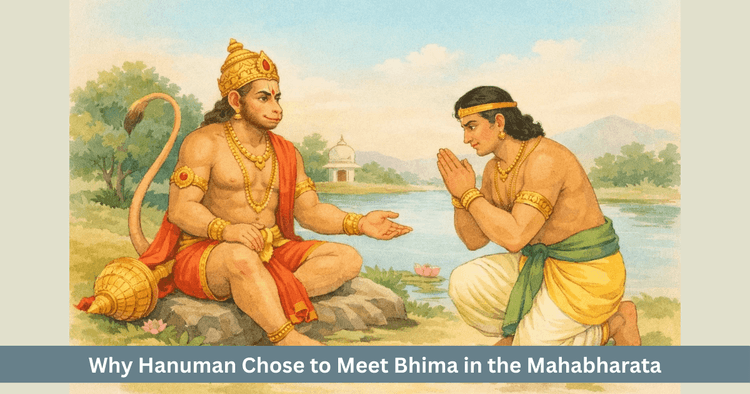
Table of Contents
There is a moment in the Mahabharata that reveals the deep connection between strength, humility and dharma in a very simple way. This is the episode in which Bhima meets an old monkey on a forest path and that monkey is none other than Lord Hanuman.
“Na hi balam balinam shreshtham vinayena vinakritam
Vinayena vihinam tu balam cha bhavati durbalam”
The meaning of this shloka is that strength without humility has no real value and power that is empty of humility finally becomes weak. The meeting of Bhima and Hanuman brings this truth alive, where outer power bows before inner humility.
When and in what context did Bhima and Hanuman meet
During the exile of the Pandavas, there came a time when Bhima went deep into the forest to collect fragrant celestial lotuses for Draupadi. While walking through the dense forest, he saw an old monkey lying on the path, whose large tail was stretched across the way. From this simple scene, a divine encounter begins.
Bhima is known as the son of Vayu. Lord Hanuman is also the son of Vayu, therefore a subtle spiritual relationship already existed between them. Yet destiny placed them in different ages, with Hanuman as a hero of the Treta Yuga and Bhima as a central warrior of the Dvapara Yuga. Their meeting became a meeting of two ages and two expressions of the same divine element.
Vayu element, Hanuman and Bhima
The element of air represents speed, life force and enthusiasm. Both Hanuman and Bhima stand as expressions of this pranic energy. When the air element is balanced, it becomes life giving prana that supports yoga, service and devotion. When it is disturbed, it can appear as restlessness, anger or uncontrolled impulse.
In Bhima, there was immense heroism, yet at times a trace of harshness and agitation could also be seen. Hanuman stands for the same energy refined through devotion, discipline and humility. In this sense, their meeting is not only between two heroes but also between two levels of the same principle.
Bhima’s might and Hanuman’s humility
The strength of Bhima is described in the Mahabharata as awe inspiring. He defeats powerful demons and mighty warriors with his mace. Yet the nature of strength is such that when it sees continuous victory, pride may quietly arise.
When Bhima saw the old monkey, he naturally expected that the animal should move aside. The monkey replied calmly that he was too tired to move and requested Bhima to kindly shift the tail and go forward. For Bhima this was a small matter but when he tried with all his force and still could not move the tail even slightly, he realised that his own power had limits. At that very moment a seed of humility took root in his heart.
Why did Hanuman teach Bhima the grace of humility
The power of Bhima was necessary for the protection of dharma in the future war. If that same strength had become clouded by arrogance, it could have turned destructive. By means of the tail, Hanuman offered not a mere test but a deep lesson that the beauty of strength is revealed only through humility and restraint.
When Bhima finally bowed and asked who this extraordinary being was, Hanuman revealed his true identity. He told Bhima that he was the same devotee of Rama who had crossed the ocean, entered Lanka and dedicated his life to service. In that moment Bhima understood that real greatness does not lie in display of strength but in service, devotion and humility.
Was Hanuman’s appearance a coincidence
A natural question arises. Why did Hanuman meet Bhima at that particular time in that vast forest. The answer is that this encounter was an expression of destiny. The life of the Pandavas was standing at a turning point. The Kurukshetra war was to come in the near future and Bhima would have to face many difficult decisions.
Hanuman’s arrival became a subtle preparation for the coming war. On one side he taught Bhima humility, on the other he gave assurance that Bhima’s power would not stand alone. The message was that as long as strength remains aligned with dharma, divine support will also remain present.
Reminder of Bhima’s duty towards dharma
The Mahabharata is not only a story of war. It is a story of choices. Again and again every character is asked on which side they will stand and for what purpose their abilities will be used.
Hanuman reminded Bhima that his strength was not meant for personal pride. It was granted as an instrument to protect dharma. He indicated that the very day strength is used only for ego, it will cease to be protective and will become destructive. This understanding needed to be firmly established in Bhima’s mind and the encounter served that purpose.
Blessing Bhima with inner strength and protection
Hanuman is not just a warrior. He is also a yogi whose power arises from unwavering devotion. When he blessed Bhima and declared that he would be present on the flag of Arjuna’s chariot in the Kurukshetra war, he actually offered a protective shield to the Pandavas.
Hanuman on Arjuna’s flag was far more than an ornament. It was a sign that in the most difficult moments of the war, the presence and roar of Hanuman would uphold the courage of the Pandavas. For Bhima this assurance was very deep, because he now knew that his family would not stand alone. The son of Vayu, Hanuman, would stand with them as guardian.
Revelation of the bond between two divine brothers
Many readers forget that Bhima and Hanuman share the same divine father, Vayu. When Hanuman revealed this fact, their meeting transformed from being a meeting of god and human into a heartfelt meeting of brothers.
Hanuman accepted Bhima not only as an heir of physical might. He accepted him as a carrier of the tradition of service, humility and devotion. He indicated that the real glory of the lineage of Vayu lies not only in power but in using that power in the service of dharma and compassion.
Relationship between Hanuman and Bhima
| Aspect | Hanuman | Bhima |
|---|---|---|
| Divine origin | Son of Vayu | Son of Vayu |
| Central qualities | Devotion, humility, unfailing valour | Physical might, courage, mastery of the mace |
| Age | Treta Yuga, story of Rama | Dvapara Yuga, story of the Mahabharata |
| Main purpose | Service of Rama, protection of dharma | Protection of the Pandavas, struggle against injustice |
This table makes it clear that the source is the same, while the expression differs. The visit of Hanuman reminded Bhima that to be a son of Vayu does not mean to be powerful alone, it also means to be compassionate and devoted.
Limits of physical power and the strength of awareness
When Bhima tried with full force to lift Hanuman’s tail and could not succeed, his pride began to dissolve. He understood that in any age there will always be someone greater.
Hanuman showed that true power lies not only in muscles but in awakened awareness. Without control, restraint and surrender to the divine, strength remains incomplete. Many episodes of the Mahabharata carry this message that inner maturity is more important than external force. Through this experience Hanuman prepared Bhima for the demands of the future.
Preparation for the Kurukshetra war
In the coming days Bhima had to face fierce battles. Victory would depend not only on the power of his mace but also on endurance, patience and clarity of mind. Through this meeting Hanuman introduced him to controlled anger, disciplined strength and dharmic decision.
Once Bhima felt assured that Hanuman would be present on Arjuna’s banner, his fear reduced. Such inner steadiness becomes the foundation of victory, whether outer or inner.
A bridge between the Ramayana and the Mahabharata
Another important question arises. Why does a hero of the Ramayana appear suddenly in the Mahabharata. The deeper answer is that dharma is not bound to a single story or an age.
The meeting of Hanuman and Bhima works as a bridge between the Ramayana and the Mahabharata. In one narrative Lord Rama appears as the embodiment of discipline, in the other Lord Krishna appears as the guide of wisdom and compassion. Hanuman connects these two streams and shows that wherever dharma is upheld, his presence, protection and blessing are available.
Message of this story for present life
The story of Bhima and Hanuman is not merely an ancient episode. It can serve as a mirror for present life also. Every human being has some form of strength. Sometimes it is wealth, sometimes knowledge, sometimes position, sometimes influence.
The question is whether humility walks with that strength or not. If power is separated from humility and dharma, it can become a source of suffering for oneself and for others. The teaching of Hanuman is that the highest use of strength lies in the direction of service, compassion and protection of righteousness.
A person who recognises the pride within, as Bhima did and places it before an ideal like Hanuman, becomes ready for the great battles of life. Such a person does not gain only outer success but also inner peace.
A refined inspiration for seekers
After meeting Hanuman, Bhima remained the same warrior outwardly. His physical power and his mace did not change. What changed was his vision. Strength now walked together with humility and awareness. His might became an instrument for the protection of dharma, not a tool of personal anger.
For every seeker, this story suggests that whenever inner arrogance, impatience or uncontrolled strength is felt, it is wise to remember the example of Hanuman. The same power that can become a cause of downfall can also become a divine force when it turns towards dharma and surrender. In that state strength does not merely belong to the individual, it becomes blessed and luminous.
Get your accurate Kundali
Generate KundaliDid you like it?
Author

Pt. Narendra Sharma (63)
Experience: 20
Consults About: Family Planning, Career
Clients In: Punjab, Haryana, Delhi
Share this article with friends and family
About ZODIAQ
ZODIAQ is an online Vedic Astrology platform. It connects clients seeking astrological advice to experienced astrologers with deep knowledge. Our users also generate kundali and perform kundali milan for free. ZODIAQ also offers services to the Astrologers. Astrologers utilize various offerings by ZODIAQ to serve their clients effectively.
If you are a User
Consult with experienced astrologers and seek their guidance. You can also order handwritten Janm Patrika report with life prediction prepared by experienced astrologers. Generate accurate Kundali, perform Kundali Matching and check horoscope and muhurat. Utilize our online library for all the necessary astrological and spiritual information.
If you are an Astrologer
Create accurate kundali for your clients and perform Kundali Matching for up to 5 people at a time. Write comprehensive Janm Patrika report for your clients with ZODIAQ. Check client details anytime by saving it in client directory. Become more productive by tracking how many clients you guide every day.
WELCOME TO
ZODIAQ
Right Decisions at the right time with ZODIAQ
