Hanuman: The Only God Who Still Walks the Earth
By Pt. Nilesh Sharma
The Mystery of Rama’s Blessing and Eternal Devotion
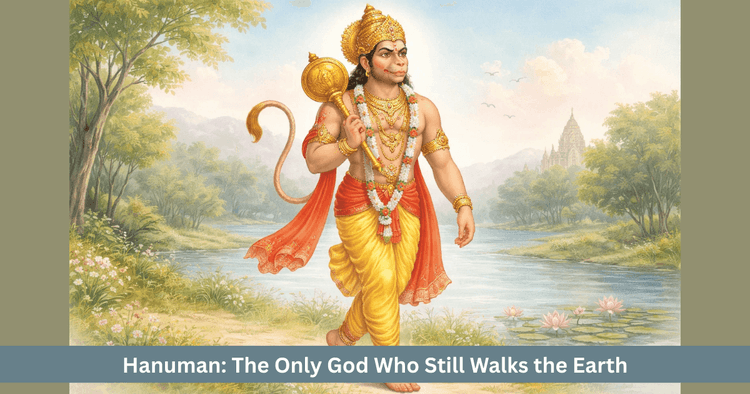
Table of Contents
"As long as the Earth shall endure, Hanuman, you shall endure. Wherever my story is told, there shall you be present."
When Rama departed from the earthly realm at the conclusion of the Treta Yuga, he left behind a blessing that defied cosmic law itself. Not a blessing of wealth, not a blessing of power, not a blessing of territorial dominion but a blessing of eternal presence and purposeful existence. This blessing transformed one devoted being into an unprecedented phenomenon: an immortal who actively walks the earth, accessible to sincere seekers, responsive to genuine devotion, present wherever the divine name is remembered with authentic heart. This being is Hanuman.
The Paradox of the Eternal Devotee: When Gods Depart, One Remains
Within Hindu theology and spiritual philosophy exists a profound paradox that challenges conventional understanding of divinity and mortality. Across different cosmic ages, Vishnu descended in multiple incarnate forms. In the Treta Yuga, he manifested as Rama. In the Dvapara Yuga, as Krishna. In each age, after fulfilling divine missions and restoring dharma to the three worlds, these avatars returned to their celestial abode in Vaikuntha, the eternal realm of unending peace. Each departure represented a withdrawal of direct divine presence from earthly existence. Yet one being, a non-avatar, a devoted follower, refused to follow this pattern. He remained. He continues to remain even now.
This is not mythology preserved in ancient texts, nor an abstract spiritual principle floating in theoretical consciousness. According to millions of sincere practitioners, established scholars and recognized saints, Hanuman constitutes a genuine living presence, a tangible reality within physical existence, appearing wherever the Lord's name is invoked with true devotion, manifesting through direct intervention when the occasion demands it.
This extraordinary assertion, that a divine being from epic antiquity literally continues to exist in the contemporary world, is not dismissed as superstition by serious practitioners and recognized authorities. Rather, it is understood as a profound teaching about the essential nature of devotion itself. It demonstrates that perfect love of the divine transcends the boundaries that contain all other beings, creating a presence that endures beyond temporal limitation, beyond physical death, beyond the very cosmic cycles that govern ordinary existence.
But how did this unprecedented occurrence manifest? What cosmic principle permits one being to remain immortal while avatars themselves depart? What truth underlies this legend of perpetual presence and unceasing service? The complete answer requires understanding the unique blessing Rama conferred, the philosophical principles that enable such immortality, the sacred purpose Hanuman continues to fulfill through Kali Yuga and beyond and the transformation within his own consciousness that made eternal service possible.
The Blessing That Defied the Cosmic Order: An Eternal Covenant
The Moment That Transformed Infinity
After the monumental war in Lanka concluded, after Ravana's defeat and Sita's liberation, after the victory that restored dharma to all three realms, Rama prepared for his triumphant return to Ayodhya. The divine prince, having completed his earthly incarnation and accomplished his cosmic mission, began conferring appropriate blessings upon those who had faithfully served him.
To each devoted follower, Rama offered gifts matched to their nature and service. Sugriva received the kingdom of the monkeys, eternal prosperity and everlasting dominion. Angada was granted valor, courage and the capacity to inspire fearlessness in others. Vibhishana obtained the throne of Lanka and a place among the Chiranjivis, the seven immortals who would survive until the world's end. Jambavan received extended lifespan and perpetual youth. Yet when Hanuman approached the divine prince, Rama recognized immediately that no conventional blessing could adequately honor the incomparable service rendered.
What had Hanuman accomplished that transcended ordinary heroism? He had:
- Crossed an impossible ocean without hesitation when others had surrendered to despair
- Confronted Ravana's entire celestial court with fearless humility and perfect composure
- Endured torture and being set aflame without surrendering his devotion even for an instant
- Carried an entire mountain through the sky to preserve a life
- Searched unceasingly for Sita with unwavering dedication and perfect focus
- Never once requested reward or recognition, serving purely from the ineffable joy of service itself
Understanding this unprecedented devotion, Rama bestowed upon Hanuman a blessing of an entirely different character. It was not a boon designed to glorify or elevate. Rather, it was a sacred covenant establishing an eternal purpose:
"As long as my name endures upon this Earth, you shall remain my most beloved. Wherever my story is sung and celebrated, there shall you be worshipped and served."
The Profound Theology Within the Blessing
This blessing was neither arbitrary nor emotionally sentimental. Rather, it encoded eternal cosmic truths regarding the nature of devotion and its transformative relationship to immortality:
Devotion Creates Transcendent Connection: By binding Hanuman's eternal continuity to the remembrance of his name and story, Rama established that perfect devotion creates an unbreakable connection transcending all ordinary boundaries. As long as a single heart maintains love for Rama, Hanuman must exist. This is not mechanical law but the intrinsic nature of authentic love.
Service Constitutes True Immortality: Unlike other immortals granted extended existence as reward or punishment, Hanuman's immortality serves a function that transcends his individual benefit. He lives not for personal glory or the alleviation of his own desire but to remain perpetually available for divine service, to manifest whenever that service is genuinely required.
Presence Supersedes Power: The blessing specified that Hanuman would exist "wherever my story is told." This means his presence is activated by remembrance, made manifest through sincere devotion. He does not remain as a distant immortal somewhere awaiting death but actively participates in the spiritual life and struggles of contemporary devotees through their authentic faith.
Essence of the Divine Transferred: Through this unprecedented blessing, Rama transferred something essential of his own eternal nature to Hanuman. Since Rama represents Vishnu incarnate and Vishnu constitutes the eternal principle itself, Hanuman's intimate connection to this eternal essence renders him equally perpetual and indestructible.
Hanuman Among All Beings: A Unique Position Among the Immortals
The Seven Chiranjivis and Hanuman's Singular Distinction
Hindu spiritual tradition recognizes seven immortal beings destined to survive the entire duration of the present cosmic cycle until the final dissolution of existence:
"Ashwatthama, Bali, Vyasa, Hanuman, Vibhishana, Kripa and Parashurama, these seven shall endure through all the ages."
Yet among these seven immortals, Hanuman occupies a distinctly active, purposeful and accessible position that sets him fundamentally apart from all others:
| Immortal Being | Nature of Immortality | Designated Purpose | Mode of Existence |
|---|---|---|---|
| Ashwatthama | Cursed to wander eternally | Suffers punishment for transgressions | Passive endurance of suffering |
| Bali | Blessed with special status | Waits in the subterranean realm of Sutala | Existence in other dimensions |
| Vyasa | Knowledge-earned immortality | Preserves and transmits the Vedas | Scholarly preservation and teaching |
| Vibhishana | Blessed by Rama for virtue | Governs the kingdom of Lanka | Worldly administrative engagement |
| Kripa | Transcendence through virtue | Awaits future teachings and revelations | Ascetic withdrawal from engagement |
| Parashurama | Avatar's inherent nature | Trains warriors in martial dharma | Selective temporal engagement |
| Hanuman | Devoted service transcendence | Serves all avatars; guides all sincere devotees | Omnipresent, eternally active |
Hanuman stands apart because his immortality is fundamentally different in character. It is:
Active rather than passive: He does not merely exist in some distant realm but actively manifests and continuously serves across all dimensions of existence.
Devotionally responsive: His presence becomes activated by sincere worship and remembrance, responding directly to the spiritual needs of those who call upon him.
Universally and immediately accessible: Unlike other immortals confined to distant celestial realms or other-worldly dimensions, Hanuman is believed to remain present among ordinary people, accessible to sincere seekers regardless of their social position, education or material circumstance.
Purpose-driven and focused: His continued existence serves dharma itself and actively guides sincere seekers in real time, in immediate circumstances, in the lived experience of contemporary spiritual aspirants.
The Philosophy of Ego-Transcendence: Why Hanuman Uniquely Qualified
The deeper reason Hanuman alone qualified for this unprecedented eternal presence lies in understanding a profound spiritual principle often misunderstood in modern spiritual discourse:
The Universal Paradox of Immortality: Generally, immortality becomes a burden that traps the ego in endless continuation. Immortal beings cling desperately to life, constantly fearing cessation and loss, perpetuating the very ignorance and attachment that constitute the root of suffering. Most immortals, therefore struggle intensely with the psychological and spiritual burden of endless existence.
Hanuman's Transcendent Exception: Because Hanuman's ego had completely transcended itself through perfect devotion, had metaphorically and spiritually died while his body continued to function, immortality did not bind him to suffering but liberated him into eternal service. He does not struggle against death because the individual sense of "I" that fears death has already been completely surrendered and dissolved. In this state, immortality is not a cage but a natural expression of realized consciousness.
The Spiritual Teaching Encoded Within: In Hindu philosophical understanding, ego constitutes the fundamental mechanism through which time operates, through which change and decay manifest. When ego persists in an individual, that person remains subject to time's corrosion, aging, weakening, eventual biological death. This is the natural law. But when ego dissolves completely through perfect devotion and surrender, individual consciousness merges into infinite consciousness, becoming functionally immune to time's destructive effects.
Hanuman achieved this ego-death while remaining fully embodied, fully active, fully engaged. therefore his immortality is not experienced as burden but as the natural consequence of his perfect realization. He remains not despite the passage of centuries but because time no longer possesses power over him. He exists in the eternal present moment, untouched by the temporal cycles that govern ordinary beings.
This is why among all beings, only Hanuman could bear the blessing of endless existence without being gradually corrupted or destroyed by it, as happens to other immortals who retain ego-consciousness.
The Active Mission: Hanuman's Essential Role in Kali Yuga
Understanding the Age of Decline: The Characteristics of Kali Yuga
Kali Yuga, the age in which humanity currently exists, is characterized by unique spiritual challenges and profound dangers to dharmic existence that make the continued presence of an illumined guardian absolutely essential. The Hindu understanding recognizes a progression through four cosmic ages, each representing a diminishment in spiritual consciousness and moral capacity:
The Sequence of Ages and Their Characteristics:
Satya Yuga, the age of truth, existed when dharma stood completely whole upon all four legs. Righteousness pervaded all existence. Truth reigned universally. Suffering was virtually unknown. The lifespan of humans extended to one hundred thousand years. The fabric of existence remained undamaged by untruth or malice.
Treta Yuga, the silver age, followed when dharma appeared diminished to three complete legs. Untruth began to emerge, though truth remained predominant. The lifespans of humans decreased to approximately ten thousand years. Spiritual knowledge began to fragment. The divine incarnated as Rama during this age to restore dharma threatened by emerging adharma.
Dvapara Yuga, the bronze age, witnessed further decline as dharma reduced to two legs, meaning truth and untruth existed in equal measure. Spiritual knowledge became increasingly difficult to comprehend. The human lifespan decreased to approximately one thousand years. The divine incarnated as Krishna during this period to restore balance through teachings transmitted in the Bhagavad Gita.
Kali Yuga, the current iron age, represents the nadir of spiritual consciousness. Dharma now stands precariously upon a single leg. Untruth has become overwhelmingly dominant. The average human lifespan has diminished to approximately one hundred years or less. This age exhibits specific characteristics that create unprecedented spiritual dangers:
- Righteousness and dharmic understanding have become nearly extinct
- Greed, materialism and unbridled desire dominate human motivation
- Truth hides beneath countless layers of deliberate falsehood
- Spiritual knowledge exists fragmented, diluted and often distorted
- Direct access to divine grace has become progressively more difficult
- Mental disturbance, anxiety and existential confusion pervade consciousness
- Natural disasters and collective suffering are rapidly increasing
- Violence and brutality have become normalized
The Spiritual Crisis: Why Traditional Paths Have Become Ineffective
The crisis of Kali Yuga extends far beyond material suffering. Traditional spiritual paths have become functionally ineffective for the vast majority of humanity. The path of Vedic ritual, once available to all serious practitioners, now demands enormous resources, extended periods of leisure and a degree of environmental purity virtually impossible to maintain in contemporary society. The path of yoga, historically practiced in isolated ashrams with complete dedication, requires withdrawal from ordinary responsibilities and relationships, an impracticality for most contemporary householders navigating complex urban existence. The path of meditation demands profound mental stability and freedom from distraction, qualities increasingly rare in a civilization characterized by constant stimulation and psychological fragmentation. The path of intellectual knowledge has become disconnected from lived reality, remaining trapped within academic discourse rather than transforming actual consciousness.
Hanuman's Specific Role as Kali Yuga Guardian
Into this unprecedented darkness and spiritual crisis, Hanuman's continued active presence serves highly specific and essential functions:
Active and Vigilant Protection: Hanuman functions as an actively engaged protector defending sincere devotees from demonic influences, psychological torment, spiritual obstacles and the negative forces that proliferate during Kali Yuga. Temples depicting Hanuman facing south (toward the realm of death and dissolution) symbolize his perpetual vigilant guardianship against mortality, negativity and the forces of dissolution.
Accessibility During Maximum Decline: While other celestial beings seem progressively more distant and inaccessible as Kali Yuga deepens, Hanuman is understood to remain remarkably close and responsive to sincere supplication. The Hanuman Chalisa, a forty-verse devotional composition encoding hidden spiritual truths, explicitly addresses this principle:
"Wherever Rama's name is sung and celebrated, there Hanuman bows with folded hands, with eyes overflowing with tears of pure devotion, honoring the destroyer of all demonic forces."
This ancient verse does not merely describe historical events from distant ages. It establishes a contemporary principle: Hanuman's presence remains active and responsive, manifesting simultaneously wherever sincere devotion to Rama occurs, in every moment, in every location where the divine name is genuinely remembered.
Preservation of Dharma: Hanuman's continued mission maintains the continuity of dharmic understanding and practice. As long as even a solitary being remembers Rama and sincerely practices devotion, Hanuman's sacred purpose continues: to preserve dharma, guide those committed to spiritual truth and prevent the absolute annihilation of righteousness during the darkest cosmic age.
Bridge Across Ages: Most profoundly, Hanuman's perpetual presence ensures that when the new Satya Yuga eventually arrives and the cosmic cycle begins anew, the spiritual knowledge and devotional transmission of previous ages will not be completely obliterated. He functions as the eternal carrier of the torch of bhakti, devotional love, across all ages, maintaining the continuity of spiritual consciousness even through periods of maximum darkness and ignorance.
The Nature of His Presence: Vyapak (All-Pervading Consciousness)
Transcending Physical Embodiment: The Vyapak Understanding
One of the most frequent misunderstandings regarding Hanuman's immortality concerns the precise nature of his presence. He is not conceived as a single physical body remaining hidden somewhere in distant mountains or remote forests. Rather, he is described through the Sanskrit term vyapak (व्यापक), which means all-pervading, omnipresent, everywhere simultaneously.
The Vedantic Philosophical Framework: In Advaita Vedanta philosophy, Brahman, ultimate reality itself, is described as vyapak, meaning everywhere simultaneously, permeating all existence, the fundamental ground of being present in all forms. Similarly, Hanuman's consciousness is understood to permeate the entire universe, operating through multiple dimensions and frequencies of existence simultaneously.
Multi-Dimensional Manifestation: This understanding means Hanuman can demonstrate the following capacities:
- Manifest in countless distinct forms at the same instant
- Exist in multiple separate geographical locations without internal contradiction
- Move freely between physical and subtle dimensions
- Appear as inner strength and courage within sincere devotees
- Remain completely invisible while maintaining active presence
- Respond to multiple sincere calls simultaneously
- Be everywhere the divine name is remembered with authenticity
The Wind Analogy: As Vayuputra (वायुपुत्र), literally "Son of the Wind," Hanuman inherits the essential nature of Vayu, the cosmic principle of air and movement. Wind possesses remarkable characteristics:
Wind exists formless, yet its effects remain tangibly evident and undeniable. Wind fills every available space yet belongs to no single location or boundary. Wind sustains all life continuously, yet typically goes unnoticed in ordinary awareness. Wind demonstrates tremendous power, yet remains essentially invisible. Wind never truly ceases to exist; it merely transforms continuously, moving from one location to another, perpetually flowing onward.
Hanuman's mode of existence mirrors this perfectly. He is powerful and evident in his effects, yet subtle and often unseen in his presence. He is everywhere simultaneously, yet confined to no fixed location. He is eternal, yet transcends the concept of fixed spatial form.
How Contemporary Devotees Experience His Living Presence
While Hanuman's literal physical manifestation may be understood as subtle or energetic rather than material in the conventional sense, devotees across centuries and continuing into contemporary times report experiencing his presence directly and unmistakably:
As Inner Strength and Courage: When facing seemingly impossible challenges and overwhelming obstacles, devotees consistently report experiencing sudden and inexplicable courage, mental clarity and unwavering resolve appearing spontaneously when they invoke Hanuman's name or memory. This is not understood merely as psychological self-suggestion or internal motivation. Rather, it is experienced as Hanuman's actual intervention operating directly within consciousness itself.
As External Mysterious Presence: Saints and recognized yogis frequently recount encounters with mysterious sadhus (renunciate holy persons), typically appearing as elderly monks or simple ascetics, who manifest exactly when immediate assistance becomes necessary, offer perfectly timed guidance or practical help and then vanish mysteriously, leaving no physical trace. Many experienced practitioners attribute these encounters to direct manifestations of Hanuman, appearing to test the sincerity of seekers or to provide crucial guidance during spiritual crises.
As Collective Spiritual Presence: During organized group worship, communal chanting or collective meditation focused on Hanuman or Rama, practitioners consistently report perceiving a distinct palpable presence, a specific warmth, protective field or concentrated energy that transcends what could be generated by the group alone. This experience is understood not as group psychology or shared delusion but as Hanuman's direct presence manifesting and intensifying through collective sincere devotion.
As Spontaneous Inner Guidance: Devotees describe receiving sudden profound insights, protective intuitions or unmistakable inner guidance appearing in moments of sincere prayer or invocation of Hanuman. This guidance consistently manifests in perfect alignment with dharmic principles and often proves prophetic, demonstrating knowledge of future events before they occur. The consistency of this guidance suggests actual presence rather than coincidental mental processes.
These experiences remain not confined to ancient antiquity or to remote ashram settings. Contemporary reports continue proliferating in the modern world, suggesting that Hanuman's responsive presence continues actively manifest in contemporary circumstances, remaining fully engaged with the spiritual struggles and genuine aspirations of modern seekers.
The Scriptural Evidence: Multiple Traditions Affirm Living Presence
Explicit Statements in Ancient Texts Confirming Immortality
The belief in Hanuman's continued active existence finds substantial foundation not merely in devotional sentiment but in explicit textual statements appearing across multiple ancient scriptural traditions:
The Ramayana: The foundational epic text of Hindu civilization contains numerous references to Hanuman's essential nature and eternal status:
He is described as Vira Hanuman Mahabali, the mighty heroic Hanuman, the one of extraordinary power and valor. He is called Sarvajna, all-knowing, possessing complete knowledge. He is explicitly identified as Amar, immortal, deathless, eternal. The text unambiguously states his immortality as the direct consequence of Rama's blessing of eternal presence.
The Mahabharata: Within the Adi Parva (the Book of Origins), historical records describe Bhima, Hanuman's half-brother, encountering Hanuman and conversing extensively with him. Critically, this encounter occurs centuries after the Rama story concludes, establishing temporal continuity. This encounter proves that Hanuman remained alive throughout the entire Treta Yuga and continued into the Dvapara Yuga. During their meeting, Hanuman explicitly explains his continued existence:
"I have become immortal through my unwavering devotion to Rama's service and my complete surrender to his divine purpose."
The Brahma Vaivarta Purana: This sacred text contains unambiguous statements regarding Hanuman's specific role during Kali Yuga:
"Hanuman will protect the Earth and all sincere devotees until the very end of Kali Yuga."
This statement establishes both the fact of his continued presence and the specific temporal scope of his mission.
The Ananda Ramayana: This text describes Hanuman as perpetually young, eternally devoted, eternally appearing wherever Rama's sacred name is chanted or his story is told:
"Wherever Rama's story is told, there Hanuman remains present. Wherever devotion to Rama awakens within a heart, there Hanuman manifests."
The Skanda Purana: This significant Purana contains the remarkable statement:
"Hanuman resides in the home where the Ramayana is read. He inhabits every space where Rama's story is celebrated and remembered."
The Padma Purana: This text affirms that Hanuman will remain present, visible or invisible, active or dormant according to circumstances but never truly absent as long as sincere devotion to Rama persists within the world.
The Remarkable Consistency Across Diverse Texts
What strikes any sincere scholar as remarkable is that despite being composed in different historical periods, by different textual authors, in different regional contexts and reflecting different schools of thought, all these authoritative texts consistently affirm several interconnected truths:
- Hanuman's immortality constitutes an established fact, not speculation
- His continued presence manifests on Earth itself (not confined to distant heavenly dimensions)
- His responsiveness to sincere devotion operates as an active principle
- His essential role functions as protector and guide specifically during Kali Yuga
- His activity persists until the conclusion of the present cosmic cycle
This consistency cannot reasonably be attributed to later textual interpolations or to mythological elaboration across centuries. Rather, it reflects a unified understanding of spiritual reality present from the Ramayana onward, an understanding that Hanuman's immortality functions as a theological principle of lasting significance, not merely as a literary convention or poetic embellishment used in ancient narratives.
The Perfect Balance: Strength and Humility as the Secret of Endurance
The Divine Paradox: Power Without Corruption
One of the most striking and distinctive aspects of Hanuman's character is the perfect balance maintained between his extraordinary cosmic power and his genuine spiritual humility. These two seemingly contradictory qualities are not in tension within his consciousness but exist in seamless integration. This balance proves essential to understanding why he alone can bear the weight of immortality:
His Extraordinary Power: Hanuman possesses abilities that transcend ordinary comprehension:
He can expand his physical form to cosmic proportions or contract to microscopic dimensions according to will. He can traverse vast oceans and soar above the highest mountains. He can cross the entire world in a single magnificent leap. He moves with the speed of thought itself. He remains invulnerable to physical injury or harm. He possesses superhuman strength that can move mountains. He carries within himself access to all Vedic knowledge and cosmic understanding. He can exist partially in multiple dimensions simultaneously while maintaining full consciousness in each.
His Profound Humility: Yet despite possessing this unprecedented cosmic power, Hanuman demonstrates characteristic humility:
He never sought recognition or worship from anyone. He consistently considered himself merely Rama's humble servant, nothing more significant. He invariably acted for Rama's benefit alone, never advancing personal ambition or gain. He remained completely free from boasting about his accomplishments or abilities. He continued serving faithfully even when his efforts went unappreciated or unacknowledged. He treated all beings with equal respect and genuine compassion. He viewed his formidable strength exclusively as an instrument of divine will, never as personal possession or grounds for pride.
The Spiritual Teaching: How Humility Enables Immortality
This unprecedented combination teaches a truth that transforms understanding of both power and immortality. In spiritual philosophy, ego constitutes the essential mechanism through which time operates. The ego:
- Constantly fears loss and dissolution (driving desperate search for permanence)
- Desires endless expansion (creating perpetual dissatisfaction)
- Experiences time as existential threat (aging, decay, approaching death)
When ego completely dissolves, time loses its fundamental grip. Consciousness transcends the ordinary cycles that govern limited individual awareness.
Hanuman achieved this total ego-transcendence while remaining fully embodied and actively engaged. This achievement stands unprecedented in spiritual history. Most beings who transcend ego either:
- Merge into formless Absolute (no longer maintain earthly presence)
- Become psychologically withdrawn or passive
- Lose active engagement with the world and its concerns
Hanuman alone achieves the integration of:
- Complete ego-transcendence
- Full embodied presence and physical functionality
- Active engagement with the world and its suffering beings
- Unwavering focus on divine service
This unique combination makes him optimally suited for immortality while remaining protected from the corruption and degradation that affects other immortals. His humility ensures that endless existence does not breed arrogance, increasing attachment or the desire for final rest that leads to withdrawal from the world.
The Universal Principle: True Power Through Surrender
Hanuman's perfect balance of strength and humility encodes a universal principle applicable to all spiritual seekers. The beings who endure through time are not those who desperately cling to existence with ego-driven grasping but those who completely release ego-attachment while maintaining engaged presence. The power that actually lasts is not that which grasps and possesses but that which flows freely in service to something transcendent.
For contemporary spiritual aspirants, Hanuman's example teaches that authentic power originates in genuine humility, that real strength emerges through ego-transcendence and that the divine accomplishes its purposes through those who have completely surrendered personal will and individual agenda.
Why Hanuman Chose to Remain: The Bridge Between Divine and Human
The Cosmic Necessity: The Problem Hanuman Solved
When Rama returned to Vaikuntha at the conclusion of the Treta Yuga, the direct presence of an incarnate avatar withdrew from earthly existence. The world transitioned into Dvapara Yuga, a progressively darker age, bereft of the immediate living guidance of a divine incarnation walking among humans.
For humanity, this represented an unprecedented spiritual emergency. How could sincere seekers maintain authentic connection to the divine without a living embodied avatar to guide them? How could genuine devotion be transmitted faithfully across generations without a direct living exemplar? How could dharmic principles be preserved when their living embodiment had physically departed? How could grace remain accessible when its source had withdrawn?
Hanuman's Solution: The Living Bridge
Hanuman's continued presence solved this multifaceted crisis completely. By remaining actively engaged on Earth, Hanuman became the indispensable bridge, ensuring that:
Continuity of Dharma: The values that Rama embodied, truth, righteousness, devotion, sacrifice, would not fade from human memory and consciousness but would be actively preserved and transmitted across generations. Dharmic understanding would remain living, not merely textual.
Accessibility of Divine Grace: While avatars inevitably come and depart according to cosmic cycles, Hanuman's continued active presence ensures that divine grace remains continuously accessible to sincere seekers between successive avatars. He does not replace the avatar's irreplaceable role but he extends the blessing and protective grace beyond the temporal boundaries of any single avatar's earthly sojourn.
The Living Example: More than theoretical texts or abstract philosophical concepts, Hanuman's actual existence proves that divine consciousness can authentically embody itself in tangible living form that remains responsive and accessible. This living proof keeps alive for every generation the possibility of genuine direct spiritual connection, preventing the descent into purely intellectual or ritualistic spirituality disconnected from lived transformation.
Gateway to Infinite Possibility: Hanuman's living example illuminates the pathway of devotion for all seekers. It demonstrates that through perfect love of the divine, the finite genuinely becomes eternal, the human authentically becomes divine, the mortal authentically becomes immortal. This is not poetic metaphor but actual spiritual reality.
Hanuman's Unique Position in the Divine Hierarchy
Hanuman occupies a position in the cosmic hierarchy that remains genuinely unprecedented and unrepeated:
Not a Human Saint Attaining Liberation: Unlike human seekers who achieve realization through disciplined practice and then subsequently leave their physical bodies at death, Hanuman remains divinely born (the literal son of Vayu) and continues his bodily incarnate activity throughout endless ages.
Not a Distant God Demanding Elaborate Worship: Unlike major deities who receive complex, expensive and formally elaborate worship rituals requiring specialized priests and extensive preparation, Hanuman remains remarkably approachable and genuinely humble, appearing to those who call him with simple sincere supplication.
Not Remote and Completely Abstract: Unlike philosophical concepts of the divine, Hanuman is experienced as tangible and immediately responsive, believed by countless practitioners to appear directly when sincere need calls him.
Not a Cosmic Impersonal Force: Unlike universal principles or impersonal forces, Hanuman possesses distinct personality, emotional depth, individual consciousness and genuine capacity for choice, making him profoundly relatable to human experience and struggle.
This unprecedented and unrepeated combination makes Hanuman the perfect intermediary between infinite divine and finite humanity. He remains neither so transcendent and distant as to be spiritually unreachable, nor so limited and human as to lack genuine divine authority.
The Expansion of Presence: Growing Stronger Rather Than Fading
The Counterintuitive Truth: Ancients Growing More Powerful
Logic from ordinary experience would suggest that as time passes and centuries accumulate, ancient beings naturally fade into insignificance. Yet the reverse appears true for Hanuman. His presence seems to grow progressively stronger, increasingly visible, more responsive, precisely because sincere devotion directed toward him has continued to deepen and expand rather than diminish.
The Scriptural Promise: The Vayu Purana states explicitly:
"Wherever Hanuman is worshipped with sincere heart, there Rama's divine grace manifests and becomes active. Wherever Rama's sacred name is sung and celebrated, there Hanuman remains present and actively engaged."
Proliferation of Sacred Spaces: Across India and increasingly throughout the world, temples dedicated to Hanuman continue proliferating at accelerating rates. Each newly established temple is understood not merely as historical monument or architectural landmark but as an activation point for Hanuman's presence, a consecrated location where his concentrated energy becomes particularly accessible and responsive.
The Expanding Contemporary Following: Modern India has witnessed unprecedented growth in sincere devotion to Hanuman. This expansion crosses all demographic boundaries, spanning all ages, all educational classes, from rural villages to international urban centers. Rather than ancient devotion gradually fading into historical memory, it continues deepening and expanding with each generation.
The Intensified Contemporary Presence: Many recognized spiritual teachers and experienced practitioners report that Hanuman's presence feels more palpable, more actively engaged, more immediately accessible than ever recorded in previous centuries. This is not mere nostalgia for ancient times or romantic idealization of the past. Rather, practitioners describe this as a current, immediate, lived spiritual reality.
The Principle of Intensifying Manifestation
This apparent defiance of ordinary decay and fading follows a specific principle deeply rooted in Hindu philosophy: the frequency of sincere remembrance increases and intensifies presence.
When millions of devotees chant the Hanuman Chalisa daily with genuine heart, sing devotional songs to Hanuman throughout each week, visit Hanuman temples regularly with sincere supplication and invoke his name in moments of genuine spiritual need, this vast collective remembrance creates a field of consciousness that:
- Strengthens Hanuman's presence within collective human awareness
- Makes his individual manifestations progressively more frequent and immediately accessible
- Intensifies his protective and guiding activities across multiple dimensions
- Expands his influence and reach across different levels of existence
- Amplifies his response to sincere calls for assistance
Rather than weakening with the passage of centuries, Hanuman grows progressively stronger as sincere devotion deepens and expands, precisely as a musical note becomes louder and more resonant as increasing numbers of voices join in singing it together.
The Eternal Mystery: The Deepest Question of Devotion
The Question That Transcends Rational Logic
Given that Hanuman possessed the genuine freedom to retire to Vaikuntha with Rama, could have entered samadhi (meditative absorption into the divine), could have withdrawn completely from the world's pain, confusion and suffering, why does he choose to remain in this imperfect world? Why does he select continued active engagement with human struggle rather than permanent rest in unending bliss?
The answer points to the deepest mystery of divine love itself:
Love Does Not Calculate or Reason: Hanuman did not remain because he rationally calculated that devotees would need his assistance (though they desperately do). He remains because authentic love of Rama made his continued presence inevitable and necessary. When you experience complete love for someone, you cannot remain separated from them. Separation becomes impossible, not by time, space, death or even the transformation of universes themselves.
Service as Essential Nature: For Hanuman, rendered service is not an external choice or imposed obligation. Service constitutes his fundamental nature. Just as fire possesses heat as its essential quality, just as water naturally flows downward according to its nature, Hanuman naturally serves. He does not perform service as separate from himself; he is service itself.
The Eternal Present Moment: While ordinary beings remain trapped in time, the past pulling them backward with regret, the future generating anxiety and dread, death approaching inevitably, Hanuman exists in the eternal now. For him, there exists no "after" when his service concludes, because he has transcended the linear experience of time. He dwells in a dimension where service never terminates, where devotion remains eternally fresh and unfinished.
The Spiritual Teaching for Every Sincere Seeker
Hanuman's continued presence teaches each sincere seeker several essential truths about spiritual reality:
You Need Not Abandon the World: The spiritual path does not demand escape from the world. Rather, it requires fundamental transformation of your relationship to worldly existence. Through perfect devotion and ego-transcendence, you can remain actively engaged with life while simultaneously transcending its limitations and sufferings.
Service Constitutes Immortality: The greatest powers, genuine immortality, divine protection, guidance, grace, do not come through directly seeking them. They arrive naturally through complete dedication to something beyond the individual self. Service is not merely a path to achieve power; it is the power itself.
Love Transcends All Separation: When your love for the divine becomes complete and perfectly authentic, death cannot separate you from the beloved. Hanuman and Rama remain eternally together, not despite Rama's departure to Vaikuntha but precisely because their love created bonds that completely transcend ordinary separation.
The Eternal Guardian: Living Proof That Divine Love Never Fades
As human civilization advances, as technology progressively transforms human existence, as the modern world becomes increasingly disconnected from traditional spiritual understanding, Hanuman continues his eternal walk across the Earth. He is not bound to historical antiquity or confined to remote mountain caves. He is not restricted to temple sanctuaries or preserved only within scriptural texts. He remains present wherever sincere devotion genuinely awakens, accessible to anyone who calls with an authentic heart, actively engaged in the lives of countless beings who experience his protection, guidance and transformative grace.
The story of Hanuman's immortality is not ancient mythology to be outgrown or historical narrative to be forgotten as civilization progresses. It constitutes a present living reality, a contemporary spiritual truth, an active relationship available immediately to anyone who genuinely opens their heart to receive it.
Why does Hanuman continue to walk the Earth?
Because authentic love never fades or diminishes. Because service proves eternal in its nature. Because sincere devotion creates bonds infinitely stronger than physical death. Because even when the divine departs in human form, those who love with perfect authenticity remain as living reminders that the divine connection never truly ends.
In a world growing progressively darker, more confused, more desperate for genuine meaning and purpose, Hanuman's continued presence stands as living, active proof that:
- Divine grace has not abandoned the world
- Spiritual power remains accessible to sincere seekers
- Faith can still move mountains (literally)
- Humility and genuine courage coexist perfectly
- Perfect love of the divine can render even an individual immortal
When you sincerely chant his name, understand that this is not mere tradition or hopeful fantasy. Somewhere within dimensions accessible to sincere devotion, Hanuman hears your call, recognizes your genuine need and responds directly.
For as long as Earth continues to endure, as long as even one heart remembers Rama, as long as sincere devotion stirs within any being, Hanuman will remain, the eternal servant, the timeless guardian, the living proof that authentic love never dies, true service never ends and the divine never truly abandons those who have learned to love with perfect devotion.
Jay Shri Ram. Jay Hanuman.
Victory to Rama. Victory to Hanuman.
He walks the Earth still. And eternally will.
Frequently Asked Questions
Question 1: Does Hanuman Actually Exist Today, Walking the Earth?
Answer: Yes, according to millions of sincere practitioners and established scriptural authority, Hanuman remains actively present on Earth in the contemporary world. This belief is not founded merely upon devotional sentiment but rests upon explicit textual evidence from ancient authoritative sources. The Brahma Vaivarta Purana states unambiguously that "Hanuman will protect the Earth until the end of Kali Yuga," indicating his current active engagement. The Mahabharata describes Bhima encountering Hanuman centuries after the Rama narrative concludes, establishing temporal continuity across ages. The Ananda Ramayana declares that "wherever Rama's story is told, there Hanuman remains present." This presence is not physical in the conventional human sense but rather all-pervading and multidimensional. When sincere devotees invoke Hanuman with authentic heart, his presence manifests and responds; when his purpose is fulfilled, he withdraws from perceptible awareness. Countless contemporary practitioners report experiencing his direct intervention in their lives, providing protection, guidance and spiritual transformation.
Question 2: Why Did Rama Bestow This Blessing of Immortality Upon Hanuman?
Answer: Rama granted Hanuman the unprecedented blessing of eternal presence because his devotional service transcended all ordinary standards of faithfulness and sacrifice. Hanuman crossed an impossibly vast ocean without hesitation when all others despaired. He confronted Ravana's entire celestial court single-handedly with fearless humility. He endured torture and being set ablaze without abandoning his devotion even momentarily. He carried mountains through the sky to preserve lives. Most significantly, Hanuman never requested reward or recognition; he served purely from the ineffable joy of service itself. His devotion was so complete and authentic that his individual ego had entirely dissolved. Rama recognized that such transcendent service demanded acknowledgment beyond ordinary blessings. however this immortality was not merely reward but also responsibility. Hanuman was assigned to remain on Earth safeguarding dharma, guiding sincere seekers, ensuring that divine grace remained accessible between successive avatars and serving as the eternal bridge between infinite divine and finite humanity.
Question 3: Is Hanuman's Presence Purely Spiritual or Does It Possess Material Dimension?
Answer: Hanuman's presence operates simultaneously across multiple dimensions, both spiritual and material, though not in the conventional physical form of embodied humans. He is described as vyapak, meaning all-pervading, similar to how wind exists everywhere without visible physical form yet produces tangible effects. His presence manifests internally within sincere devotees' consciousness as sudden courage, clarity, protective instinct and spiritual guidance. Saints and recognized yogis throughout history have reported encountering mysterious sadhus (renunciate holy persons) appearing in moments of genuine crisis, offering perfectly timed assistance and vanishing mysteriously, these encounters are understood as Hanuman's external manifestations. During collective worship and sincere group chanting, practitioners consistently report experiencing a distinct concentrated presence, a protective field or powerful energy transcending what the group could generate alone. This presence represents Hanuman's direct intervention. Thus Hanuman's existence operates multidimensionally, manifesting in various forms according to circumstance and genuine spiritual need, simultaneously internal and external, subtle and concentrated, transcendent yet responsive.
Question 4: What Is Hanuman's Specific Role and Purpose During Kali Yuga?
Answer: Kali Yuga represents the darkest cosmic age when dharma has diminished to a single leg, untruth has become overwhelmingly predominant, spiritual knowledge exists fragmented and distorted and accessible pathways to enlightenment have become increasingly difficult. The Brahma Vaivarta Purana explicitly identifies Hanuman as Kali Yuga's primary protector and guardian. His role encompasses multiple interconnected functions. First, he actively defends sincere devotees from demonic influences, psychological turmoil and spiritual obstacles that proliferate during this age of darkness. Second, he remains remarkably accessible and responsive to sincere invocation, whereas other celestial beings appear increasingly distant and inaccessible. Third, he preserves and actively maintains dharmic principles, ensuring that righteousness does not completely disappear from human consciousness during maximum decline. Fourth, he functions as an eternal bridge between ages, carrying the torch of bhakti (devotional love) across epochs so that when the new Satya Yuga eventually arrives, spiritual knowledge and transformative devotion will not be completely lost. The Hanuman Chalisa encodes this principle: "Wherever Rama's name is sung, there Hanuman bows with tears," establishing that his presence activates wherever sincere devotion awakens in contemporary circumstances.
Question 5: How Does Hanuman Differ Fundamentally From Other Immortals Among the Seven Chiranjivis?
Answer: Hindu tradition recognizes seven immortals destined to survive until the world's end, Ashwatthama, Bali, Vyasa, Hanuman, Vibhishana, Kripa and Parashurama. Yet Hanuman's immortality possesses entirely different character and function. Ashwatthama exists under curse, wandering eternally in punishment and suffering passively. Bali remains confined to subterranean realms, existing in other dimensions. Vyasa preserves Vedic knowledge in scholarly isolation. Vibhishana governs Lanka within territorial limitations. Kripa awaits future teachings in ascetic withdrawal. Parashurama engages selectively in training warriors. Hanuman alone maintains active, continuous, universally accessible, purpose-driven immortality. His presence is perpetually engaged rather than passive, responds directly to sincere devotion, remains immediately accessible to ordinary practitioners regardless of circumstance and serves dharma itself. This unprecedented distinction emerges from Hanuman's complete ego-transcendence achieved through perfect devotion while remaining fully embodied and actively engaged. His perfect balance of extraordinary cosmic power with genuine spiritual humility made him uniquely suited to bear immortality without corruption. Unlike other immortals who struggle with the burden of endless existence, Hanuman experienced ego-death while living, rendering immortality not a cage but a natural expression of realized consciousness.
Get your accurate Kundali
Generate KundaliDid you like it?
Author

Pt. Nilesh Sharma (63)
Experience: 20
Consults About: Family Planning, Career
Clients In: Punjab, Haryana, Delhi
Share this article with friends and family
About ZODIAQ
ZODIAQ is an online Vedic Astrology platform. It connects clients seeking astrological advice to experienced astrologers with deep knowledge. Our users also generate kundali and perform kundali milan for free. ZODIAQ also offers services to the Astrologers. Astrologers utilize various offerings by ZODIAQ to serve their clients effectively.
If you are a User
Consult with experienced astrologers and seek their guidance. You can also order handwritten Janm Patrika report with life prediction prepared by experienced astrologers. Generate accurate Kundali, perform Kundali Matching and check horoscope and muhurat. Utilize our online library for all the necessary astrological and spiritual information.
If you are an Astrologer
Create accurate kundali for your clients and perform Kundali Matching for up to 5 people at a time. Write comprehensive Janm Patrika report for your clients with ZODIAQ. Check client details anytime by saving it in client directory. Become more productive by tracking how many clients you guide every day.
WELCOME TO
ZODIAQ
Right Decisions at the right time with ZODIAQ
