Hanuman: The Only Witness to Vishnu’s Final Avatar, Kalki
By Pt. Sanjeev Sharma
The Eternal Witness to All Cosmic Cycles and the Final Avatar
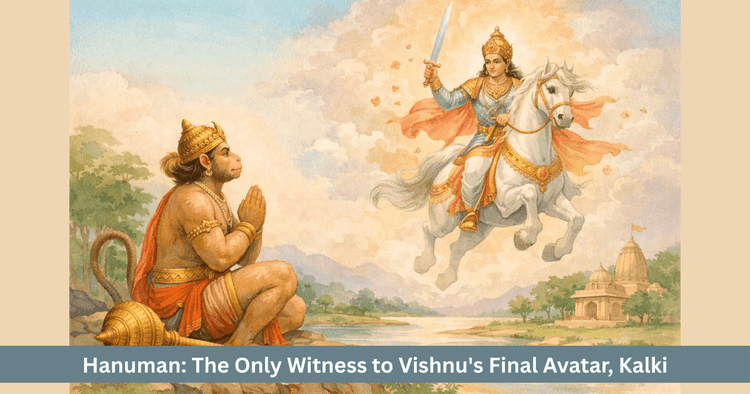
Table of Contents
Imagine standing at the precipice of eternity itself, watching as the cosmic cycle moves through its predetermined transformations. Every age brings crisis; every crisis brings divine response. From the first interventions in ages past to the ultimate restoration approaching, one eternal witness remains constant: Hanuman, the eternal devotee, positioned to see what no other being can witness, the descent of Kalki, Vishnu's final incarnation in this cosmic cycle, the avatar who will complete the wheel of ages and restore dharma for a new beginning.
This is not merely legend or religious speculation. It represents the fulfillment of cosmic design, the completion of a pattern established from the beginning and a profound teaching about the nature of devotion, service and the eternal connection between the divine and those who love purely.
The Seven Chiranjivis: Why Hanuman Stands Apart in Sacred Destiny
The Tradition of Immortals Across Ages
Hindu spiritual tradition recognizes seven immortal beings, Chiranjivis, destined to survive until the very end of the present cosmic cycle. An ancient verse identifies them:
"Ashwatthama, Bali, Vyasa, Hanuman, Vibhishana, Kripa and Parashurama, these seven shall endure through all the ages."
Each achieved immortality through distinct means and for specific purposes:
Ashwatthama: Cursed to wander eternally with untreatable wounds as punishment for transgressions committed during the Mahabharata war, passive suffering immortality.
Bali: The righteous demon king granted immortality by the Vamana avatar as acknowledgment of his dharmic adherence, dimensional immortality in other realms.
Vyasa: The sage-compiler of the Vedas and author of the Mahabharata, blessed to preserve knowledge and spiritual wisdom across ages, scholarly preservation immortality.
Vibhishana: Ravana's righteous brother, blessed by Rama to rule Lanka eternally, territorial and administrative immortality.
Kripa: The honored teacher granted immortality as a boon, ascetic immortality in withdrawal.
Parashurama: Vishnu's avatar himself, remaining to train warriors in dharmic combat, selective engagement immortality.
Hanuman's Unprecedented Position
Yet among these seven, Hanuman possesses a unique destiny that distinguishes him fundamentally from all others: he alone is destined to witness all of Vishnu's major avatars, from Rama through Krishna and ultimately to Kalki. The reasons are multiple and spiritually profound:
Active Devotional Service: While others exist through obligation, curse, dimensional necessity or territorial responsibility, Hanuman exists through pure devotional purpose. His immortality directly serves the divine will and the spiritual awakening of devotees.
Avatar Continuity Across Ages: Parashurama is himself an avatar, not a witness to avatars. The others served individual incarnations but were not cosmically assigned to recognize and serve all avatars. Hanuman's sacred role transcends individual manifestations.
Embodied Prana: As Vayuputra (Son of the Wind), Hanuman represents the fundamental life force permeating all existence. Wind cannot be destroyed; it transforms and continues eternally.
Devotional Perfection Achieving Transcendence: Hanuman accomplished through perfect love of God what most beings can only aspire toward: complete ego-death while maintaining full embodied consciousness and active engagement. This rare combination renders him uniquely suited to recognize all divine manifestations.
The Blessed Covenant: When Divine Recognition Transcends Time
The Ultimate Promise on Victory's Shore
After the monumental war in Lanka concluded, after Ravana's destruction and Sita's rescue, after dharma had been restored to the three worlds, Rama prepared to return to Ayodhya. Before his departure, he offered blessings to all who had served him faithfully in that cosmic battle.
To his allies, Sugriva, Vibhishana, Angada, Rama granted appropriate kingdoms, prosperity and eternal governance. But when Hanuman approached, Rama recognized that this divine being's service transcended all ordinary measures. Hanuman had:
- Crossed the impossibly vast ocean when others had surrendered to despair
- Confronted Ravana's entire celestial court single-handedly with fearless humility
- Endured torture and immolation without abandoning his devotion for an instant
- Carried an entire cosmic mountain through the sky to preserve a single life
- Searched unceasingly for Sita with perfect dedication
- Never once requested recognition or personal reward, serving purely from the transcendent joy of service itself
Rama's blessing to Hanuman was therefore unprecedented:
"As long as my name is remembered and chanted on this Earth, as long as my story is told, as long as even a single being loves me with authentic devotion, you shall live. You shall remain wherever sincere remembrance of me exists."
The Theological Significance of This Covenant
This blessing transcended mere emotional sentiment or personal reward. It encoded profound cosmic truths about devotion and immortality:
Immortality Connected to Divine Memory: Hanuman's eternal existence became intrinsically bound to the presence of bhakti (genuine devotion) on Earth. As long as even one sincere heart maintains love for Rama, Hanuman continues living.
Active Responsive Presence: The blessing specified that Hanuman would manifest wherever Rama's name is remembered or story told. This renders his immortality participatory and responsive, not passive or withdrawn, he actively appears and serves.
Transcendent Connection: By binding Hanuman's life to the remembrance of his name, Rama essentially declared: "You and I are inseparable. Through your eternal presence, my connection to Earth remains unbroken."
Essence Transfer: Rama transferred something of his own eternal divine nature to Hanuman. Since Rama represents Vishnu incarnate and Vishnu constitutes the eternal principle itself, Hanuman now shares in that eternal essence.
The Ramcharitmanas beautifully captures this relationship when Rama declares to Hanuman:
"You are as dear to me as my own brother Bharata. There is no one more beloved to me than you."
This represents not mere affection but ontological unity, Hanuman's consciousness became merged with Rama's will, rendering his existence eternal because divine will itself transcends time.
From Rama to Krishna: Recognizing the Divine Across Forms
The Historic Encounter in Dvapara Yuga
After Treta Yuga concluded and Rama returned to Vaikuntha, cosmic time moved forward. The wheel of ages rotated from Treta to Dvapara Yuga, bringing new crises that required divine intervention. Vishnu descended once again, this time manifesting as Krishna in Mathura, then Dwaraka.
Hanuman, bound by his sacred promise to serve Vishnu in all incarnate forms, sensed the divine presence manifesting once more on Earth. Following his devotional intuition, he journeyed to Dwaraka to confirm whether his beloved Lord had indeed returned.
The Test of Perfect Understanding
Upon Hanuman's arrival, Krishna, knowing fully who stood before him but desiring to impart a crucial spiritual lesson, posed a profound question:
"Why do you seek Rama when I am Krishna? Why do you search for what was when what is stands before you? Has your Lord not transcended that earlier form?"
To the superficial observer, Krishna seemed to deny his connection to Rama. But Hanuman, possessed of mature devotional wisdom, saw through this apparent contradiction to the underlying truth:
"I perceive no true difference, my Lord. Forms may transform, names may alter, times and circumstances change constantly, yet the essence remains eternally constant. You are He and He is You. Wherever dharma manifests, wherever righteousness dwells, wherever the divine descends to restore balance, there is Rama. There are You."
The Cosmic Revelation of Avatar Unity
Profoundly moved by this perfect understanding, Krishna revealed his Vishvarupa, the all-encompassing cosmic form containing all previous avatars, all future incarnations, all times and possibilities within a single infinite vision. Within that transcendent manifestation, Hanuman beheld:
- Rama and Sita in divine resplendence
- All past avatars from Matsya to Vamana
- All future avatars yet to descend
- The fundamental underlying unity connecting all expressions
In that moment of supreme revelation, Hanuman achieved complete understanding: the divine never truly departs; forms merely change like an actor assuming different roles. The essential consciousness remains identical beneath all manifestations.
Why This Encounter Matters for Avatar Continuity
This meeting between Hanuman and Krishna established several foundational principles governing all avatars:
Transcendent Recognition of the Divine: True devotion recognizes the divine essence regardless of external form or circumstance. Hanuman's ability to see Rama within Krishna demonstrates spiritual maturity and advanced realization.
The Unity of All Avatars: While each avatar serves specific purposes and manifests particular divine qualities, all emanate from a single supreme consciousness. Rama's justice, Krishna's wisdom, Narasimha's protective ferocity, all flow from one eternal source.
Hanuman's Universal Assignment: By serving both Rama and Krishna (and appearing in various subtle ways throughout the Mahabharata), Hanuman proved himself devoted not to particular forms but to the eternal divine principle itself. This rendered him qualified to serve all avatars throughout cosmic cycles.
The Bridge Connecting All Ages: Hanuman became the living link ensuring that spiritual knowledge and devotional tradition would not be completely lost between different ages and different avatars. He carries the torch of bhakti across the eons.
Why Hanuman Alone Can Transcend All Cosmic Ages
The Significance of Divine Parentage
To understand how Hanuman transcends all cosmic ages while other immortals struggle with limitations, we must comprehend his unique origin. He is Vayuputra (literally "Son of the Wind"), born of Vayu, the cosmic principle representing the life force pervading all existence.
Wind as Cosmic Principle:
Wind exists formless, yet touches and influences all things simultaneously. Wind belongs nowhere, yet is everywhere. Wind sustains all life through the breath animating every creature. Wind is ageless and eternal, existing before creation's beginning and continuing after ultimate dissolution. Wind never truly dies; it transforms constantly, shifting direction, moving from one location to another, perpetually flowing onward. Wind possesses tremendous power despite being invisible and intangible.
By inheriting the nature of Vayu, Hanuman possesses these same qualities. He is not merely immortal in the sense of indefinitely continuing to exist; rather, he is eternal in the fundamental sense of transcending the birth-death cycle entirely.
Prana: The Underlying Life Force
In Hindu philosophy, Prana represents the vital life-force animating all existence. It is:
- The energy sustaining biological life
- The subtle force connecting body and consciousness
- The power enabling breath, thought and movement
- The essential bridge between material and spiritual dimensions
- That which continues from body to body, life to life, age to age without interruption
Hanuman as Prana incarnate means he embodies this life force taking conscious form. Just as Prana continues unchanged through all transformations, Hanuman continues through all cosmic ages without aging, declining or dying.
The Yuga Paradox: Why Others Decline While Hanuman Endures
Each cosmic age (Yuga) represents progressive decline in dharma, duration and spiritual capacity:
Satya Yuga (The Age of Truth): Dharma stands complete upon four legs. Truth is universal. Righteous living is natural. Beings live approximately 100,000 years. Virtue is the default condition.
Treta Yuga (The Age of Ritual): Dharma stands upon three legs, three-quarters intact. Truth begins to be mixed with untruth. Ritual and sacrifice become necessary. Beings live approximately 10,000 years. Spiritual effort begins to be required.
Dvapara Yuga (The Age of Worship): Dharma stands upon two legs, half intact. Truth and untruth exist equally. Worship and devotion become emphasized paths. Beings live approximately 1,000 years. Confusion increases.
Kali Yuga (The Age of Decay): Dharma stands precariously upon a single leg. Untruth dominates overwhelmingly. Virtue is exceptional rather than normal. Beings live approximately 100 years or less. Spiritual decline touches everything.
As each age passes, lifespans decrease, virtue wanes and spiritual power diminishes. Yet Hanuman remains completely unaffected by this systematic decline. Why?
He Exists Beyond the Yuga System: Because Hanuman embodies Prana itself and because Prana underlies all Yugas as the fundamental sustaining force, he does not decline with the ages. The Yugas represent different states of manifestation but Prana itself remains constant.
His Devotion Transcends Age-Specific Limitations: The Bhagavata Purana teaches that pure Bhakti (devotional love) proves equally effective for liberation in all ages. In Satya Yuga, meditation sufficed; in Treta Yuga, ritual sacrifice; in Dvapara Yuga, worship in temples. But in Kali Yuga, only genuine Bhakti proves fully effective. Hanuman, embodying perfect Bhakti, naturally transcends all age-specific barriers.
He Carries Rama's Eternal Essence: When Rama blessed Hanuman, binding his life to the remembrance of Rama's name, he transferred something of his own timeless nature. Since Rama is Vishnu incarnate and Vishnu represents the eternal principle itself, Hanuman, carrying Rama's blessing and grace, shares in that eternity.
Hanuman's Active Presence in Kali Yuga: The Living Guardian
The Witness Remaining Among Us
One of the most extraordinary aspects of Hanuman's immortality is the widespread tradition that he does not exist somewhere distant but actively walks among contemporary devotees, responding to sincere calls and providing protection.
The Tradition of Mysterious Sadhus:
Countless accounts across centuries describe sudden appearances of a mysterious holy person who:
- Materializes exactly when devotees face critical need
- Provides perfectly timed assistance or guidance
- Vanishes mysteriously after accomplishing his purpose
- Leaves no physical traces
These encounters are understood not as imagination but as direct encounters with this eternal Chiranjivi moving unseen among those who remember Rama.
The Hanuman Chalisa Phenomenon:
The Hanuman Chalisa, composed by Tulsidas in the 16th century, contains this foundational verse:
"Wherever Rama's name is sung with devotion, there Hanuman appears with folded hands, his eyes overflowing with tears of love, honoring the destroyer of all darkness."
This is not poetic exaggeration but theological assertion: sincere devotion literally summons Hanuman's presence. When millions chant the Chalisa with genuine faith daily, they create the conditions Rama specified, authentic remembrance of his name, which activates Hanuman's responsive presence.
His Specific Role During Kali Yuga's Challenges
Kali Yuga is characterized by unique spiritual dangers:
- Righteousness has become nearly extinct
- Unrighteousness and moral decay dominate
- Spiritual knowledge is fragmented and diluted
- Traditional paths have become inaccessible for most
- Fear, anxiety and existential despair pervade consciousness
- Divine grace seems distant and unresponsive
In this darkest age, Hanuman functions as the primary guardian and responsive intermediary:
Active Protection: He defends sincere seekers from demonic influences, spiritual obstacles and negative forces proliferating during Kali Yuga's darkness.
Immediate Accessibility: When higher realization seems impossible and the divine appears remote, Hanuman remains remarkably close and responsive to sincere supplication.
Dharma Preservation: He ensures that ethical principles and spiritual understanding do not completely disappear from human consciousness, maintaining at least the possibility of dharmic living.
Transitional Guardian: He bridges different ages, carrying the knowledge and devotional wisdom of previous eras into the new age when it eventually arrives.
The Prophecy of Kalki: The Avatar Completing the Cosmic Cycle
The Final Avatar: Nature and Mission
According to Hindu eschatology, Kalki will be Vishnu's tenth and final major incarnation in the present cosmic cycle. Multiple Puranas provide detailed descriptions:
The Precise Timing:
Kalki will arrive near the very end of Kali Yuga, when:
- Righteousness has almost completely vanished from Earth
- Corrupt rulers dominate political power
- Society has collapsed into complete chaos
- Spiritual knowledge and practice are nearly extinct
- Lifespans have decreased to 20-30 years maximum
- Moral norms have been completely inverted
The Divine Manifestation:
- Born in the village of Shambhala to Brahmin parents
- Named Kalki, meaning "the Destroyer of Filth"
- Mounted upon Devadatta, a magnificent white horse
- Wielding a blazing sword of cosmic purification
- Accompanied by divine beings and celestial warriors
- Radiating the power to purify the three worlds
The Sacred Mission:
- Eliminate the corrupt rulers enslaving populations
- Destroy the demonic forces and negative energies accumulated during Kali Yuga
- Restore dharma to its complete four-footed manifestation
- Usher in a new Satya Yuga of truth and righteousness
- Complete the cosmic cycle and initiate the next eternal rotation
Why Hanuman Must Witness Kalki's Advent
While traditional texts do not always explicitly state that Hanuman will encounter Kalki, the spiritual and cosmic logic demanding his presence is overwhelming:
The Eternal Blessing Continues: Hanuman's immortality remains valid "as long as Rama's name is spoken and remembered." Even at Kali Yuga's very end, if sincere devotion persists (and Kalki himself, being Vishnu, will certainly embody this), Hanuman must continue existing.
The Chiranjivi Prophecy's Scope: The verse identifying the seven Chiranjivis specifies they survive until the Kalpa's completion. Kalki arrives near this very termination, ensuring all seven immortals, including Hanuman, remain extant when he descends.
The Pattern of Avatar Service: Hanuman witnessed Rama (the seventh major avatar) and Krishna (the eighth). Hanuman's sacred function involves recognizing and serving all divine manifestations. Missing the tenth and final avatar would represent an inexplicable break in this established pattern, cosmic design forbids this.
The Transitional Bridge: Just as Hanuman connected Treta and Dvapara Yugas by serving both Rama and Krishna while maintaining perfect understanding of their unity, he must bridge Kali and the new Satya Yuga by serving Kalki and transmitting devotional wisdom into the new age.
The Perfect Symbol of Eternal Dharma: When Kalki descends to restore dharma for a new cycle, what more perfect representation of eternal dharmic principles could exist than Hanuman, the devotee who never wavered, never aged, never abandoned service, standing as living proof that authentic devotion ultimately triumphs over all forces of decay and dissolution?
The Meeting Yet to Come: How History Will Unfold
While extensive traditional descriptions don't always detail the precise nature of Hanuman and Kalki's encounter, logical extension of established principles suggests several possibilities:
Immediate Recognition: Kalki, being Vishnu, will instantly recognize Hanuman as the eternal devotee who has served every avatar throughout cosmic cycles with perfect faithfulness.
Continued Sacred Service: Hanuman will likely serve actively in Kalki's mission, perhaps helping guide the celestial warriors defending dharma, protecting sincere devotees during the tumultuous transition period or serving as messenger between celestial and earthly realms.
Witnessing the Culmination: As Kali Yuga closes and the new Satya Yuga opens, Hanuman will witness the complete manifestation, the gradual decline through four ages and the dramatic restoration initiating a new beginning.
Carrying Wisdom Forward: Even after Kalki's mission achieves completion and the new age becomes established, Hanuman's service continues, now carrying the accumulated devotional wisdom of the completed cycle into the newly dawning Satya Yuga, ensuring the bhakti tradition never dies.
The Deeper Spiritual Significance: Universal Applications
From Mythological Narrative to Living Truth
The account of Hanuman witnessing all Vishnu's avatars, culminating in his presence when Kalki completes the cosmic cycle, transcends mere mythology or interesting theological discussion. It encodes profound spiritual teachings universally applicable to sincere seekers:
Devotion Itself Remains Eternal: While forms inevitably change, avatars eventually depart and cosmic ages rise and fall through predetermined cycles, pure devotion, love of the divine as such, never dies. Hanuman's immortality represents the eternal nature of this transcendent love.
Service Transcends Death's Boundary: Hanuman achieved immortality not by seeking extended life but by seeking eternal service. The individual ego dies completely, yet the divine service continues unbroken. This suggests that when your life's purpose becomes service rather than self-preservation, you touch something eternal within yourself.
The Divine Never Abandons Creation: That Hanuman remains throughout all ages means the divine dimension of existence never lacks a devoted witness, a being maintaining the memory of dharma and the possibility of spiritual transformation.
Personal and Universal Devotion Converge: Hanuman loved Rama as his supreme personal God, yet recognized the same divine essence within Krishna. This demonstrates that intimate personal devotion naturally leads to recognition of universal truth, they are not contradictory but complementary stages.
True Power Manifests Through Humility: Although Hanuman possesses cosmic power, he remains simple, accessible and devoted to service. This teaching inverts the world's understanding of power, suggesting that genuine strength emerges through humility and complete surrender to something transcendent.
Conclusion: The Eternal Witness Awaiting the Final Avatar
As this cosmic cycle advances inexorably toward its conclusion, as Kali Yuga's darkness deepens around contemporary humanity, as individuals face unprecedented spiritual and material challenges, Hanuman remains, not as a distant mythological figure confined to ancient narratives but as a responsive presence answering sincere calls.
When you invoke his name with authentic devotion, when you recite the Hanuman Chalisa with genuine heart, when you whisper "Jai Hanuman" in moments of fear or spiritual need, you activate the very covenant Rama established countless ages ago: wherever his name is sincerely remembered, there Hanuman manifests.
And when the final days of this age arrive, when Kalki descends upon his white horse to restore dharma and complete the cosmic cycle for a new beginning, one eternal being will stand witnessing it all, eyes that have seen every avatar, heart that has served every manifestation, consciousness that has maintained unbroken devotion through all transformations: the divine son of Vayu, the perfect devotee, the eternal servant demonstrating that love of God transcends every boundary that time can impose.
Hanuman's immortality was never about his individual achievement. It was always about us, about ensuring that in every age, through every avatar, across every Yuga, devotion remains alive and responsive on Earth. Through Hanuman's eternal presence, we know that:
- The thread of bhakti never breaks
- The divine never truly abandons creation
- Service creates eternal connection transcending death
- Love is stronger than time itself
- Faith outlives every cosmic cycle
When your heart calls out in devotion, when you feel the presence of something vast and eternally loving responding to your prayers, know that somewhere, Hanuman smiles, for in your devotion, his sacred purpose continues, Rama's name remains alive and the eternal dance of god and devotee plays out once more.
As it was in Treta Yuga.
As it was in Dvapara Yuga.
As it is in Kali Yuga.
As it will be when Kalki descends.
And beyond, into eternities yet unknown.
Jay Shri Ram. Jay Hanuman. Jay Kalki.
Victory to Rama. Victory to Hanuman. Victory to the Final Avatar.
The eternal witness remains, keeping vigil for the final avatar, completing a sacred journey begun before memory, continuing beyond the boundaries of time itself.
Frequently Asked Questions
Question 1: Will Hanuman Actually Witness the Descent of Kalki?
Answer: Yes, Hanuman will witness Kalki's advent according to both spiritual logic and cosmic design principles. Rama blessed Hanuman with immortality as long as his name is remembered on Earth. Kalki, being Vishnu incarnate, will certainly embody Rama's divine essence, ensuring his name remains alive even at Kali Yuga's conclusion. The prophecy of the seven Chiranjivis specifies they survive until the Kalpa's very end, precisely when Kalki arrives. moreover Hanuman's entire sacred purpose involves recognizing and serving all Vishnu's major avatars. Having witnessed Rama (the seventh) and Krishna (the eighth), his pattern continues unbroken to Kalki (the tenth and final). This is not devotional hope alone but cosmic necessity encoded in the divine design.
Question 2: What Makes Hanuman Fundamentally Different From the Other Six Immortals?
Answer: While all seven Chiranjivis possess immortality, each serves distinct purposes and embodies different types of eternal existence. Ashwatthama wanders eternally under curse, suffering punishment. Bali exists in distant celestial realms. Vyasa preserves Vedic knowledge in scholarly isolation. Vibhishana governs Lanka within territorial boundaries. Kripa awaits future teachings in ascetic withdrawal. Parashurama, himself an avatar, trains warriors selectively. Hanuman alone maintains active, universally accessible, purpose-driven immortality. He doesn't merely exist but continuously serves devotees globally. This distinction originates from Hanuman's complete ego-transcendence achieved through perfect devotion to Rama. His balanced integration of cosmic power with genuine humility, his perpetually engaged presence and his unrestricted accessibility to all sincere seekers render him uniquely suited to witness all avatars through eternity.
Question 3: When Will Kalki Arrive and What Is His Sacred Mission?
Answer: According to Hindu eschatological teachings, Kalki will arrive near Kali Yuga's very end, when righteousness has nearly vanished, corrupt rulers dominate, society has collapsed and lifespans have diminished to 20-30 years. Multiple Puranas describe that Kalki will be born in the village of Shambhala to Brahmin parents, named Kalki (meaning "Destroyer of Filth"), mounted on a white horse called Devadatta and wielding a blazing sword. His sacred mission encompasses several interconnected functions: eliminating corrupt rulers enslaving populations, destroying demonic forces and negative energies accumulated during Kali Yuga, fully restoring dharma to its complete manifestation and ushering in a new Satya Yuga of truth and righteousness. Essentially, Kalki completes the cosmic cycle, bringing the fourth age to conclusion and initiating the eternal rotation anew.
Question 4: How Will Hanuman Recognize Kalki When Multiple Forms Have Been Served Across Ages?
Answer: Hanuman's encounter with Krishna illuminates this perfectly. When Krishna challenged Hanuman by questioning why he sought Rama when Krishna stood before him, Hanuman responded with mature spiritual wisdom: "I perceive no difference. Forms may change, names alter, circumstances transform, yet the essence remains eternally constant. You are He and He is You." This transcendent recognition operates on the principle that authenticated devotees perceive divine essence regardless of manifest form. Hanuman will recognize Kalki through the unmistakable divine radiance, cosmic power and the inherent spiritual truth emanating from this final avatar. The complete ego-transcendence achieved through perfect devotion enables the recognition of all divine manifestations within unified consciousness.
Question 5: What Will Be the Significance and Nature of Hanuman and Kalki's Meeting?
Answer: While traditional texts don't exhaustively detail this encounter, logical extension suggests several dimensions. Kalki will immediately recognize Hanuman as the eternal devotee having faithfully served every avatar throughout cosmic cycles. Hanuman will likely play an active role in Kalki's transformative mission, perhaps guiding celestial warriors restoring dharma, protecting sincere devotees during the transition or serving as intermediary between celestial and earthly dimensions. The meeting's deeper significance lies in what it demonstrates universally: that authentic devotion remains eternally relevant, that service never truly concludes, that divine love transcends all temporal limitations. Hanuman's presence will testify that beings who completely surrender personal will to divine service achieve something beyond ordinary immortality, they become co-workers in the eternal restoration of dharma itself, participating in the fundamental cosmic cycles.
Get your accurate Kundali
Generate KundaliDid you like it?
Author

Pt. Sanjeev Sharma (63)
Experience: 20
Consults About: Family Planning, Career
Clients In: Punjab, Haryana, Delhi
Share this article with friends and family
About ZODIAQ
ZODIAQ is an online Vedic Astrology platform. It connects clients seeking astrological advice to experienced astrologers with deep knowledge. Our users also generate kundali and perform kundali milan for free. ZODIAQ also offers services to the Astrologers. Astrologers utilize various offerings by ZODIAQ to serve their clients effectively.
If you are a User
Consult with experienced astrologers and seek their guidance. You can also order handwritten Janm Patrika report with life prediction prepared by experienced astrologers. Generate accurate Kundali, perform Kundali Matching and check horoscope and muhurat. Utilize our online library for all the necessary astrological and spiritual information.
If you are an Astrologer
Create accurate kundali for your clients and perform Kundali Matching for up to 5 people at a time. Write comprehensive Janm Patrika report for your clients with ZODIAQ. Check client details anytime by saving it in client directory. Become more productive by tracking how many clients you guide every day.
WELCOME TO
ZODIAQ
Right Decisions at the right time with ZODIAQ
