Hidden Tales of the Rigveda: Marvelous Journeys of Creation, Chaos and Cosmic Balance
By Pt. Sanjeev Sharma
Discover the secret stories of the Rigveda, the creativity of the cosmos and the divine battles behind world order
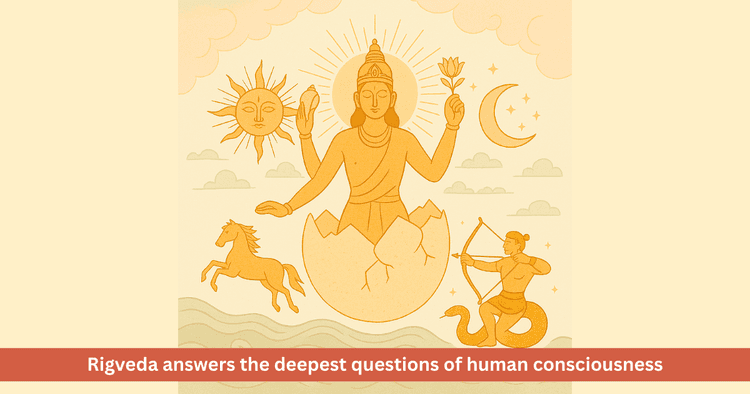
Table of Contents
Among the oldest texts of Indian civilization, the Rigveda holds a unique and foundational place. Beyond hymns and ritual invocations, the Rigveda explores profound questions of creation, cosmic order, existence and the mysterious forces that sustain the universe. It is not merely a religious text but a window into the earliest human inquiry into life and the cosmos.
The First Stir of Creation: The Mystery of Hiranyagarbha
In the beginning there was neither light nor darkness, only an infinite silent void.
From this emptiness emerged Hiranyagarbha, the “Golden Embryo”, the first spark of creation.
From this source arose all possibilities: light and shadow, life and death, movement and stillness.
Creation and dissolution existed together in delicate balance.
The Rise of the Sun and the Gods
When Hiranyagarbha unfolded, the Sun appeared and became the center of life.
In the Rigveda, the Sun is not just a celestial body but the embodiment of Rta, the cosmic law.
Indra, Agni, Vayu, Varuna and Soma serve as guardians of this cosmic order.
They symbolize dynamic forces that maintain harmony within the universe.
The Creative Struggle: Gods vs Asuras
Rigvedic narratives show a constant tension between the Devas (order) and Asuras (chaos).
Asuras were not demons in the later sense but forces of imbalance and material tendency.
The most renowned story is the battle between Indra and Vritra, where Indra’s thunderbolt releases the life-giving waters.
This symbolizes the restoration of order and life.
The Importance of Soma: The Nectar of Immortality
Soma is one of the most sacred elements of the Rigveda.
It is not just a drink but a divine consciousness that energizes mind and spirit.
Through Soma, sages and gods experience exhilaration, clarity and vitality.
It is a symbol of immortality but also a reminder that power misused can lead to destruction.
The Mystery of Yajna: The Cosmic Dance
Yajna is the axis of Rigvedic cosmology.
It is the creative act through which life, renewal and balance are sustained.
According to the Purusha Sukta, the universe emerged from the sacrificial act of the cosmic being.
This reveals that creation, transformation and dissolution are interlinked processes.
The Nasadiya Sukta: The Riddle of Existence
The Nasadiya Sukta is one of the deepest philosophical hymns of the Rigveda.
It questions the origin of creation: “Who truly knows? Do even the gods know?”
It acknowledges that the mystery of existence may lie beyond human comprehension.
This hymn invites reflection on the unknown depths of reality.
Summary Table: Creation and Cosmic Balance
| Topic | Description |
|---|---|
| Hiranyagarbha | The golden seed of creation |
| Sun and Gods | Cosmic order and sustenance |
| Deva-Asura conflict | Balance between chaos and order |
| Soma | Nectar of immortality and divine energy |
| Yajna | Creative sacrifice that sustains the cosmos |
| Nasadiya Sukta | Philosophical inquiry into origin |
Rigveda: An Unending Quest for Meaning
The Rigveda reminds us that the universe is not static but ever evolving, rhythmic and mysterious.
The Sun, air, water, fire and Soma are all expressions of a cosmic dance in which humanity is also a participant.
The Rigveda invites us to discover our place in this vast creation and recognize the spark of the primordial truth within us.
FAQ
1. Why is the Rigveda considered the oldest Indian text?
Because it preserves the earliest poetic and philosophical reflections of ancient Indian civilization.
2. What does Hiranyagarbha signify?
The golden cosmic embryo from which creation first emerged.
3. What is the meaning of the Deva-Asura conflict?
It represents the tension between cosmic order and chaotic tendencies.
4. Why is Soma described as nectar?
Because it symbolizes energy, immortality and the upliftment of consciousness.
5. What makes the Nasadiya Sukta unique?
Its bold acknowledgment that the origin of the universe may remain unknowable.
Get your accurate Kundali
Generate KundaliDid you like it?
Author

Pt. Sanjeev Sharma (63)
Experience: 20
Consults About: Family Planning, Career
Clients In: Punjab, Haryana, Delhi
Share this article with friends and family
About ZODIAQ
ZODIAQ is an online Vedic Astrology platform. It connects clients seeking astrological advice to experienced astrologers with deep knowledge. Our users also generate kundali and perform kundali milan for free. ZODIAQ also offers services to the Astrologers. Astrologers utilize various offerings by ZODIAQ to serve their clients effectively.
If you are a User
Consult with experienced astrologers and seek their guidance. You can also order handwritten Janm Patrika report with life prediction prepared by experienced astrologers. Generate accurate Kundali, perform Kundali Matching and check horoscope and muhurat. Utilize our online library for all the necessary astrological and spiritual information.
If you are an Astrologer
Create accurate kundali for your clients and perform Kundali Matching for up to 5 people at a time. Write comprehensive Janm Patrika report for your clients with ZODIAQ. Check client details anytime by saving it in client directory. Become more productive by tracking how many clients you guide every day.
WELCOME TO
ZODIAQ
Right Decisions at the right time with ZODIAQ
