How Hanuman Became the Only Devotee Who Perceived Lord Rama Everywhere
By Aparna Patni
How devotion knowledge humility and service helped Hanuman see Rama in every atom of existence
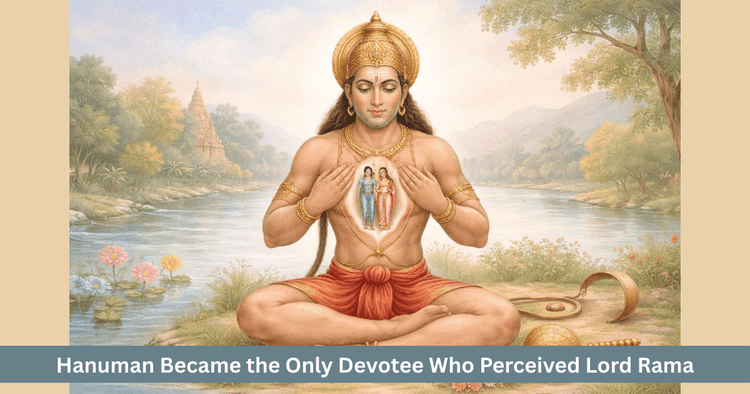
Table of Contents
Among all the shining figures of the Ramayana, Hanuman stands out not only as a hero but as a window into what devotion can become at its highest point. To some, Rama was a king to be obeyed. To others, He was an avatar to be worshipped. But to Hanuman, Rama became something far more intimate and pervasive a living presence felt in every being, every situation, every breath and in the very core of his own consciousness.
Reaching such a state did not happen by accident. It was the fruit of a life shaped by a divine mission, the total surrender of heart and mind, deep scriptural understanding, tireless selfless service, rare mastery over the senses and an astonishing humility that refused to take credit. Together, these qualities transformed Hanuman’s relationship with Rama from distant worship into constant perception.
1 A Birth Marked By Divine Purpose
Hanuman’s journey begins not on the battlefield but in the way he comes into existence. He is born to Anjana and Kesari, with the wind god Vayu acting as his spiritual father. In that single fact, the tradition compresses an entire symbolism. The wind is invisible yet powerful, subtle yet unstoppable, gentle yet capable of storms. Hanuman inherits these qualities in both body and soul.
Even as a child, he is not ordinary. The well known tale of him leaping toward the rising sun, imagining it to be a fruit, captures both his innocence and the magnitude of his strength. This is not the mischief of an average child but the spontaneous play of a being whose capacities stretch beyond normal limits. The subsequent curse, which makes him forget his powers until reminded, is important. It ensures that his strength will not be misused for egoic adventures. It waits quietly for the moment when his energy can be aligned with a higher purpose his meeting with Rama.
When Hanuman first meets Rama and Lakshmana in the forests near Kishkindha, something profound happens beneath the surface of the simple conversation. In serving as their guide to Sugriva, he recognizes an inner pull, a sense that this is the Lord he has always been meant to serve. From then on, his life is no longer a collection of random feats. It is a clear path, radiating outward from one center Rama.
2 Surrender That Redefined “I”
Most of us live with a solid sense of “I” at the center of everything we do. Even when we pray, that I is often bargaining “Give me this, save me from that, bless my plans.” Hanuman starts from the same human ground but moves step by step toward a radically different orientation.
As his devotion ripens, the “I” that once wanted recognition, success and security starts to melt into Ramas name. He still acts, thinks and speaks but inwardly he feels, “I belong to Rama, I exist for Rama, I move by Rama.” His identity shifts from being an independent doer to being an instrument.
The famous image of Hanuman tearing open his chest to reveal Rama and Sita inside expresses this in a single powerful symbol. What does it mean for a heart to be so filled with the divine that there is no room left for separate self importance. For such a devotee, God is not an occasional visitor who drops by in moments of ritual. God becomes the very content of consciousness.
In this state, Hanuman does not fight Ramas will. He is not calculating how choices affect his status. He accepts hard tasks as readily as easy ones, anonymity as readily as glory, because the question “What about me” has lost its grip. The only meaningful question is “How can I serve You more completely.”
3 Devotion Anchored in Scriptural Insight
Emotional love, though beautiful, is easily shaken if it is not grounded in understanding. Hanuman does not remain at the level of feeling alone. As a student of Surya, he studies grammar, language, dharma and the philosophical teachings of the Vedas and Upanishads. This learning is not a separate hobby it feeds directly into his perception of Rama.
Through scripture, Hanuman comes to recognize that Rama is not simply a moral king or a great spiritual teacher. He begins to see Rama as the personal form of the same infinite, formless Absolute described in the Upanishads the one reality that pervades all, supports all and shines as the Self in every heart.
Because of this, Hanuman’s devotion has multiple dimensions at once. On the devotional plane, he bows at Ramas feet as a servant. On the philosophical plane, he understands that the same Rama resides as the innermost Self in all beings. On the cosmic plane, he perceives the world itself as a field of Ramas play. This layered vision prevents his devotion from collapsing under doubt, because he knows that even when forms change, the Rama he loves is the unchanging truth behind them.
4 Selfless Service as Unbroken Worship
If we look at Hanuman’s life from the outside, it seems like one impossible mission after another. He organizes armies, carries messages, leaps oceans, confronts demons, finds Sita in Lanka, burns down portions of the city and brings healing herbs from distant mountains. Yet what is most striking is not what he does but how he does it.
He never asks, “What will I get in return” or “Will I be remembered.” Each task is accepted as an opportunity to serve Ramas purpose. Each success is quietly offered back to Rama as though Hanuman had nothing to do with it. Even his greatest achievements are narrated as “Ramas grace” rather than “my talent.”
This attitude transforms action into continuous worship. For most people, worship is an activity squeezed between other things. For Hanuman, every movement of his body, every thought in his mind, every risk he takes, becomes a kind of prayer in motion. In this way, service becomes a fire that slowly burns up selfish motives, jealously and the need for approval. As these tendencies weaken, his inner world becomes more transparent and calm.
In that clarity, the line between sacred and ordinary starts to blur. Delivering a message, leaping, searching or fighting stops being just work and becomes an arena in which he meets Rama again and again in different forms as the one who commands, as the one who is served, as the one who lives in those he protects.
5 Mastery Over Mind and Senses
To perceive the divine in everything requires a certain quietness inside. If our senses are always chasing stimulation, if our mind constantly jumps from anxiety to excitement to resentment, we simply do not have the inner stillness needed to notice the subtle presence of the divine.
Hanuman trains his inner faculties through his entire life. His legendary strength is mirrored by a rare steadiness of attention. When he prepares to cross the ocean, he gathers all his prana, all his scattered energies and focuses them on a single resolve. His small frame grows to a vast form ready to span hundreds of miles. This scene is a visual metaphor for what our own mind can do when it is unified around a pure intention.
He does not get lost in praise or crushed by criticism. Comfort does not soften his commitment and danger does not derail his focus. Because his senses and thoughts are relatively disciplined, they become tools instead of masters. This frees a huge amount of attention that would otherwise be eaten up by inner drama.
With more attention available, Hanuman can notice things others miss the quiet guidance of Rama in unexpected places, the lessons hidden within hardships, the echoes of the divine even in people who oppose dharma. For such a person, life stops being a chaotic sequence of unrelated events and starts to feel like a carefully crafted teaching.
6 Humility That Expanded His Vision
Achievements often create a subtle prison. When we cling to what we have done, we may unconsciously start expecting the world to revolve around us. Hanuman avoids this trap completely. The more he proves himself indispensable, the more eager he is to call himself insignificant.
When Rama praises him for finding Sita, Hanuman bows his head and speaks as though he has done nothing unusual. When he carries the mountain to save Lakshmana, he does not ask for any special honor. He insists again and again that he is simply a servant, that the power and intelligence at work is Ramas alone.
This humility keeps his awareness wide and generous. Because he does not occupy the central throne in his own mind, there is room to see and honor the divine in others as well. He can respect Vibhishana’s righteousness even though Vibhishana is the brother of Ravana. He can feel compassion for the suffering of ordinary citizens in Lanka despite the fact that he is there as an enemy agent.
Humility in Hanuman is not weakness but a doorway. It opens him to a larger reality in which he is a beloved part but not the center. In that larger reality, Rama is the true center and every being is related to that center in some way. Seeing the world like this is what allows Hanuman to feel Ramas presence everywhere.
7 When Devotion Becomes a Lens on Reality
Most of us know devotion as a mood. It comes perhaps while listening to a bhajan, visiting a temple or facing a crisis. Then it recedes and we go back to seeing the world in purely practical terms. In Hanuman’s case, devotion matures into something more stable and more profound a lens through which he views reality itself.
Teachers sometimes speak of Hanuman as operating from three levels of identity:
- From the highest non dual standpoint, he can say, “Rama and I are one. Only He exists.”
- From the loving devotional standpoint, he says, “I am Ramas servant, forever at His feet.”
- From the worldly standpoint, he introduces himself simply as, “Ramas messenger.”
In all three, the reference point is Rama, not Hanuman. This shows how deeply his consciousness has shifted. The world he sees is not a random collection of separate egos. It is a living fabric woven around the presence of his Lord.
In such a vision, every event carries meaning. Every joy is a gift, every wound a lesson, every delay an invitation to deepen trust. Hanuman does not need constant miracles to believe. The ordinary flow of life itself has become miraculous because he can feel Rama moving through it.
8 What Hanuman’s Vision Offers to Our Time
Living in a modern world of deadlines, traffic, notifications and noise, it is easy to assume that such a vision is reserved for mythic times and rare souls. But Hanuman’s story remains relevant precisely because it touches something we still long for a sense that life is not just mechanical survival but carries a sacred dimension.
He shows that devotion does not mean abandoning intelligence or responsibility. It means aiming both toward something higher than ego. He shows that service is not slavery but a way of becoming free from our own inner burdens. He shows that humility is not humiliation but clarity about where our gifts come from and whom they are meant to serve.
For someone today, walking even a small distance on Hanuman’s path could look like this beginning the day with a brief inner offering to the divine, doing work as carefully as possible and seeing it as service, making time for some study or reflection, noticing the urge to boast and gently letting it go and asking in difficult moments, “What is the most dharmic way to respond here.”
Step by step, such practices clean the inner lens. And as that lens clears, something subtle begins to shift. People who were just obstacles start to look like fellow travelers. Situations that were only irritating start to reveal hidden lessons. Moments that felt empty begin to carry a quiet sense of presence. That is the beginning of seeing, in a very small way, what Hanuman saw in a total way that the divine is not far away but closer than our own breath.
Frequently Asked Questions
1 Was Hanuman literally the only devotee who could see Rama everywhere
In a strict sense, no scripture says others cannot reach that state. But the tradition highlights Hanuman as the most complete and vivid example of such all pervading perception, so that devotees have a clear ideal to look up to.
2 How is his devotion different from average ritualistic worship
Average worship often revolves around asking, fearing and bargaining. Hanuman’s devotion is centered on giving, trusting and serving. It is supported by understanding, cleansed by service and protected by humility, which makes it far less fragile.
3 Can someone living a busy modern life still apply Hanuman’s example
Yes, not by copying his outer actions but by adopting his inner attitudes offering work to a higher purpose, cultivating honesty, practicing small acts of selfless help, controlling impulsive reactions and remembering the divine name or presence through the day.
4 Does seeing God everywhere mean ignoring problems in the world
For Hanuman, seeing Rama everywhere made him more sensitive to others’ suffering and more determined to act against injustice. True spiritual vision does not erase problems, it deepens our sense of responsibility and gives us strength to address them without hatred.
5 What is the simplest starting point for someone inspired by Hanuman
A simple beginning is to take one daily task you already do your job, your studies or caring for family and consciously treat it as service to the divine, done as carefully and honestly as possible, while inwardly repeating the name of Rama or whatever divine name you love. Over time, that single shift can change the flavor of your entire day.
Get your accurate Kundali
Generate KundaliDid you like it?
Author

Aparna Patni (63)
Experience: 20
Consults About: Family Planning, Career
Clients In: Punjab, Haryana, Delhi
Share this article with friends and family
About ZODIAQ
ZODIAQ is an online Vedic Astrology platform. It connects clients seeking astrological advice to experienced astrologers with deep knowledge. Our users also generate kundali and perform kundali milan for free. ZODIAQ also offers services to the Astrologers. Astrologers utilize various offerings by ZODIAQ to serve their clients effectively.
If you are a User
Consult with experienced astrologers and seek their guidance. You can also order handwritten Janm Patrika report with life prediction prepared by experienced astrologers. Generate accurate Kundali, perform Kundali Matching and check horoscope and muhurat. Utilize our online library for all the necessary astrological and spiritual information.
If you are an Astrologer
Create accurate kundali for your clients and perform Kundali Matching for up to 5 people at a time. Write comprehensive Janm Patrika report for your clients with ZODIAQ. Check client details anytime by saving it in client directory. Become more productive by tracking how many clients you guide every day.
WELCOME TO
ZODIAQ
Right Decisions at the right time with ZODIAQ
