How To Emotionally Detach From Anyone Without Anger Or Hate The Gita Way
By Pt. Amitabh Sharma
When you stop trying to win over others and start mastering your own mind even distance becomes an act of self respect not revenge
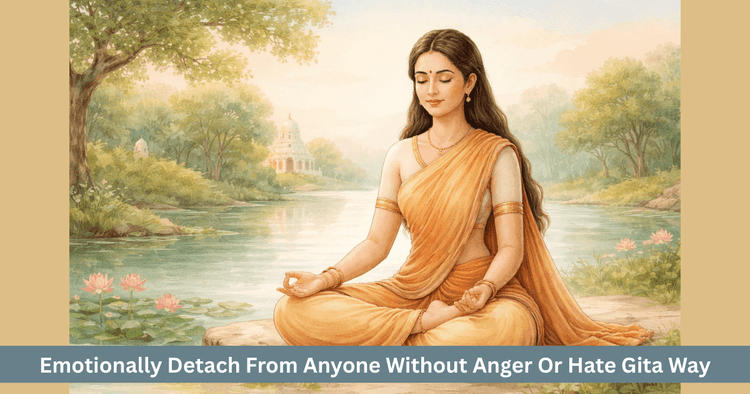
Table of Contents
There comes a point where you stop explaining your pain to the very people who caused it. You stop saying “I didn’t deserve this” on repeat, not because it was okay but because you realize healing doesn’t come from convincing the blind to see your worth. Healing begins when you quietly walk away, with your peace intact. The Gita’s spirit is clear one who conquers his own mind is greater than the one who wins a thousand outer battles. Protecting your energy is that inner victory.
This way of detaching is not about becoming cold or bitter. It is about reclaiming authorship over your inner world. You are no longer begging someone else to change so that you can feel okay. You are learning to change your relationship with your own thoughts, triggers and expectations, so that no one outside can fully hijack your calm.
1 Stop chasing snakes, start treating the wound
When a snake bites you, you don’t chase it asking why. You don’t argue with it. You treat the wound. In relationships we often do the opposite. We keep chasing the person who hurt us for explanations, apologies, closure and validation. We send long messages, rehearse arguments, post indirect stories, all in the hope that they will finally admit they were wrong.
The Gita way is to move attention from the snake to the wound. The real work is not “make them understand” but “let me understand what this did to me and how I want to live now.” Every time you go back to the same person asking for emotional justice, you re-open your own wound. Detachment here means I see what you did, I won’t pretend it was okay but I also won’t spend my life chasing your understanding.
Silence, in this sense, is not passive aggression. It is choosing treatment over debate, recovery over drama.
2 Where your energy is leaking
The Gita explains that when senses and mind run unregulated, they destroy both worldly knowledge and spiritual wisdom. In emotional terms, that looks like this you know something is bad for you but you keep returning to it. You keep stalking profiles, replaying conversations, drafting unsent texts, obsessively checking who viewed your story. The body is sitting still but the mind is sprinting.
Detachment begins by noticing where your energy is actually going. Is it going into your body, craft, prayer, rest or into loops of “why did they do this,” “what are they doing now,” “how do I make them regret it.” The more energy you feed those loops, the more drained and resentful you feel.
The Gita’s invitation is to shift from controlling life outside to clarifying life inside. You can’t force someone to become different but you can stop giving your energy to patterns that are slowly burning you out.
3 A nightly ritual to call back your energy
One practical Gita style practice is a simple nightly recall of your scattered energy. Before sleep, sit quietly for a few minutes. Notice the people, situations and memories your mind keeps circling around. Then, in your own words, invite your energy home. You might say something like:
“I call back my energy from every person, place and moment where I have left it stuck in overthinking, resentment or over-giving. I release what is not mine to carry their reactions, their choices, their stories. My loyalty now is to the peace of the divine within me.”
As you say this, imagine thin threads of light gently unhooking from old scenes and returning to your chest. Nothing magical needs to happen. What matters is the decision I am no longer pouring myself into places that cannot hold me. Over time, this shifts your default from “chase and explain” to “observe and return.”
The more you pour back into yourself, the less desperate you feel for others to pour into you and paradoxically, the more naturally magnetic you become.
4 Sense control applied to triggers, not just pleasures
When the Gita talks about controlling the senses, many imagine only food, sex or luxury. But in emotional detachment, the biggest “sense indulgence” is often mental checking, re checking, imagining, arguing with people in your head. You are not eating or buying anything but your attention is constantly consuming the other person.
Sense regulation here looks like simple, concrete limits no checking their profile today, no re reading old chats, no re telling the story to a new audience just for validation. This is not repression. It is you acknowledging every time I touch this wound that way, I inflame it. So I will touch it more gently and less often, while directing my energy into activities that actually make me stronger.
The Gita describes the senses like gates of a fortress. If you guard the gates, the enemy cannot storm the mind. In your case, the “enemy” is the old pattern that keeps pulling you back into the same emotional battlefield. Guarding the gates means not giving every impulse a green signal.
5 Heal the pattern, not just this person
Most of us were raised around some pattern over giving, never saying no, mistaking people pleasing for kindness, equating love with self sacrifice. When Krishna says it is better to live one’s own dharma imperfectly than perform another’s perfectly, this can point straight into relationships.
Your dharma may be to learn honest boundaries, even if your voice shakes. Someone else’s dharma may be to finally face the consequences of their behaviour. When you keep rescuing them from those consequences or keep explaining your worth to them, you are trying to perform their dharma instead of your own. That is why you feel tired and unseen.
Breaking a generational pattern often feels wrong at first because it is unfamiliar. You may hear “you’ve changed,” “you have become selfish.” The Gita reminds you that inner alignment matters more than outer approval. Ending a cycle of self betrayal is not a sin; it is deep service to your own soul and to those who will come after you.
6 From “why did they” to “what do I do now”
After a hurt, the mind is addicted to “why” questions Why me Why did they say that Why couldn’t they just be honest. The Gita shifts attention from “why” (which often has no satisfying answer) to “what now.” What is the next right action available to me that honours my values and my health
This doesn’t mean suppressing emotion. It means allowing emotion and then choosing action from clarity, not from the storm. Instead of “they owe me,” the question becomes “what do I owe my own soul in this situation” truth, rest, distance, a hard conversation or a silent exit. Detachment is not sitting on the sidelines of your own life. It is choosing responses that protect your dharma, not just your ego.
That shift from why to what now is where your power sits.
7 Stop chasing, start honouring
Every time you chase someone who has shown consistent disrespect, you send a message to your own nervous system my worth depends on their response. The Gita keeps saying the soul is full, radiant and complete in itself. When you chase validation, you temporarily forget this.
Honouring yourself in the Gita sense is not ego inflation. It is remembering that the same divine presence you bow down to in temples lives quietly in your chest. You don’t scream “do you know who I am” at others. You whisper it back to yourself when you are tempted to accept crumbs. Then distance becomes a form of worship I will not keep placing the divine within me before someone who keeps stepping on it.
Detachment here is really a re attachment from their opinion to your inner center.
8 Boundaries without hate, distance without drama
A lot of people equate boundaries with blocking, insulting, exposing. The Gita style boundary is quieter and more sustainable. You don’t need to announce, perform or threaten. You simply change what you give. Less explanation. Less access. Less instant availability. More time spent in places and practices that make you feel honest and alive.
You may still wish the other person well but from afar. You don’t deny the good memories but you stop using them as a reason to tolerate ongoing harm. You let the past be a chapter, not a prison. Protecting your energy, then, is not coldness. It is clarity about what your nervous system, your dharma and your future can no longer afford.
At that point, walking away is not an act of anger. It is an act of alignment.
Frequently asked questions
1. Does emotional detachment mean cutting someone off completely
Not always. Detachment means they are no longer the centre of your emotional weather. Sometimes that requires physical distance, sometimes just inner distance less checking, less explaining, less hoping they will suddenly become different.
2. How can I detach without feeling guilty or cruel
Guilt often comes from old conditioning that equates love with self sacrifice. Remind yourself that respecting your own limits is not cruelty and that enabling harmful behaviour is not love. You can still wish them well while choosing not to keep paying the price for their patterns.
3. What if I still want an apology or closure from them
Wanting it is human but making your healing depend on it keeps you stuck. Real closure comes when you accept that you may never get the version of the story or apology you deserved and you decide to close the chapter from your side anyway, through your actions and focus.
4. What is one small, concrete practice to start detaching the Gita way
Pick one behaviour where you keep giving energy away re reading chats, checking their updates, replaying arguments. For the next few days, gently but firmly stop that one behaviour and use that time for journaling, prayer, exercise or learning. Notice how your inner field shifts when you do not constantly poke the wound.
5. Can detachment and love coexist or does letting go mean I never cared
True detachment makes love cleaner, not weaker. You can genuinely care for someone and yet refuse to participate in dynamics that harm both of you. Letting go of attachment to how they “should” be does not erase the love you felt; it simply stops you from sacrificing yourself to keep an unhealthy story alive.
Get your accurate Kundali
Generate KundaliDid you like it?
Author

Pt. Amitabh Sharma (56 Years)
Experience: 20
Consults About: Family Planning, Career
Clients In: Punjab, Haryana, Delhi
Share this article with friends and family
About ZODIAQ
ZODIAQ is an online Vedic Astrology platform. It connects clients seeking astrological advice to experienced astrologers with deep knowledge. Our users also generate kundali and perform kundali milan for free. ZODIAQ also offers services to the Astrologers. Astrologers utilize various offerings by ZODIAQ to serve their clients effectively.
If you are a User
Consult with experienced astrologers and seek their guidance. You can also order handwritten Janm Patrika report with life prediction prepared by experienced astrologers. Generate accurate Kundali, perform Kundali Matching and check horoscope and muhurat. Utilize our online library for all the necessary astrological and spiritual information.
If you are an Astrologer
Create accurate kundali for your clients and perform Kundali Matching for up to 5 people at a time. Write comprehensive Janm Patrika report for your clients with ZODIAQ. Check client details anytime by saving it in client directory. Become more productive by tracking how many clients you guide every day.
WELCOME TO
ZODIAQ
Right Decisions at the right time with ZODIAQ
