How To Emotionally Detach Without Becoming Cold According To Vedanta
By Pt. Suvrat Sharma
Vedanta teaches that true detachment comes not by suppressing emotions but by witnessing them and dropping clinging while keeping the heart open
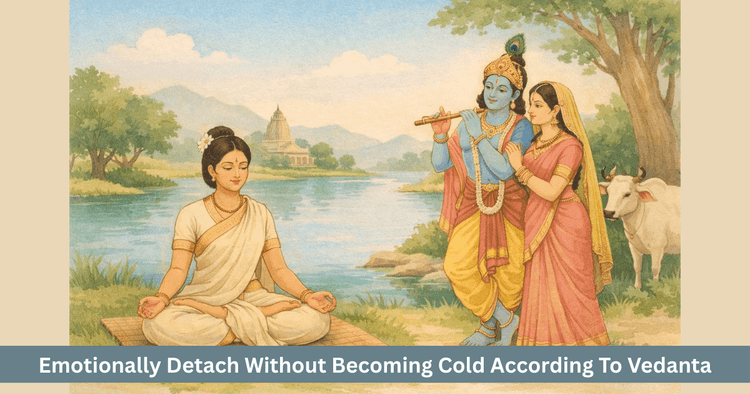
Table of Contents
Modern life keeps demanding emotional involvement from family, work and even online interactions. Many people end up emotionally tired. They long for peace but they don’t want to become indifferent or numb. Vedanta, one of India’s classical schools of philosophy, offers a different path of detachment not as escape from life but as a deeper, wiser way of being involved.
For Vedanta, the main issue is not emotion itself but emotional bondage. We suffer most when we cling, when we build our identity and peace entirely on changing people and outcomes. Detachment here is not a shutdown of feeling, it is a shift in how we relate to feelings.
1 What is emotional detachment in Vedanta
Vedanta does not ask you to give up relationships or feelings. It speaks of vairagya, a kind of inner looseness toward objects, results and self images. This does not mean apathy. It means you are no longer a slave to every emotional wave that rises in the mind.
At its core, Vedanta teaches that your real self, the inner witness, is higher than body, mind and emotions. That self is not damaged by gain or loss, praise or blame. Emotional detachment in this light is discerning the ability to feel fully and yet know, “This is passing through me. It is not my whole identity.”
2 Detachment does not mean coldness
A common misconception is that a detached person becomes emotionally unavailable, distant or dry. Vedantic teachers often say the opposite: the truly detached person can be more loving, more generous and more steady, because their joy is not chained to outcomes or ego gratification.
If you are supporting someone in grief and you are drowning in your own triggered emotions, you cannot hold space for them. But if you are inwardly grounded, you can be fully present, gentle and attentive. This is Vedantic detachment emotionally available but not emotionally hijacked, heart open but center stable.
3 Attachment, not love, creates the deepest suffering
The Bhagavad Gita repeatedly points out that suffering comes not from caring but from clinging to results, roles, ideas of “me” and “mine.” You don’t suffer because you love; you suffer because you insist that life must match your script.
Vedanta invites a different stance you can love deeply and still allow others their path. That does not reduce your love; it refines it. When you try to possess, fear of loss grows. When you loosen your grip, space opens up for both of you to breathe. Detachment then is not the end of love; it is love without chains.
4 From ego to witness practicing sakshi bhava
One of Vedanta’s core practices is becoming the sakshi the inner witness. Instead of merging with each thought or emotion, you learn to notice it. Practically, this can be as simple as saying inwardly, “This is anger; I am seeing it,” or “This is fear; it is appearing in me.”
This tiny shift creates a gap. You are no longer “I am angry”; you are “I am aware of anger.” You do not have to suppress the feeling but you do stop being possessed by it. Over time that gap becomes a quiet inner space from which you can respond more wisely, instead of reacting blindly.
5 Seeing the impermanence of emotions
Vedanta reminds us that all mental states happiness, sadness, attraction, aversion are impermanent. Feelings rise, stay for a while and pass, like waves on an ocean. You are not the wave; you are the ocean in which waves appear.
When this becomes clear, you stop clinging so hard to highs or pushing away lows. You still feel but you don’t make every feeling into a fixed identity. This reduces fear of emotions. You know “This joy will pass, this pain will also pass and something in me remains untouched through all of it.”
6 Letting go of compulsive doership
Another major source of emotional strain is the belief “Everything depends on me.” Vedanta challenges this sense of absolute doership. It doesn’t tell you to stop acting but to act without inner heaviness of “I alone control all outcomes.”
You still do your duty as a parent, partner, professional but you see that results arise from many factors, not your will alone. This humility softens your anxiety and self blame. You can care and act strongly without letting success or failure decide your worth.
7 Using discrimination ego reaction or needed response
Viveka, the power of discrimination, is a key Vedantic tool. In moments of emotional turbulence, you can ask yourself simple questions “Is this emotion coming mainly from wounded ego or from real danger” “Is this reaction actually needed or is it just an old habit”
Even this much reflection creates space. You may still feel hurt or angry but you are less likely to send the long message, escalate the conflict or act in ways you later regret. You move from automatic reaction to conscious response.
8 Keeping compassion alive through surrender
Vedanta does not see detachment as a dry withdrawal. Through bhakti (devotion) it channels emotion toward something higher than the divine, dharma or a larger good. Instead of holding all feelings inside a tight personal story, you offer them up “I feel this, I don’t hide it but I rest it in a wider trust.”
This kind of surrender lets you remain warm and sensitive while slowly loosening personal obsession. You still care but you allow life or Ishvara, to have the final say. This is detachment with devotion not numbness but a softer, humbler heart.
9 Vedantic detachment in everyday roles
You don’t need to live in a cave to practice this. As a parent, you can love your children deeply without tying your entire identity to their grades or achievements. As a professional, you can work sincerely without reducing yourself to feedback and titles. In relationships, you can love fully and yet survive distance, breakup or change without losing your core.
In all these cases, you are not withdrawing from life. You are engaging with life from a deeper center, less controlled by fear and craving. That is Vedantic detachment in action.
10 Emotional strength, not emotional suppression
From Vedanta’s view, detachment is advanced emotional intelligence. It is the capacity to notice feelings, honour them and still respond from a calm inner ground. It lets you love without clinging, serve without ego and go through pain without hardening into bitterness.
In that sense, detachment is not a weakness. It is emotional strength at a spiritual level, the strength to stay open in a changing world without being shattered every time something moves.
Frequently asked questions
1. Can I be emotionally detached and still genuinely care about others
Yes. In fact, Vedanta says that detachment can deepen your care, because you are no longer helping from neediness or control. You support others’ growth, even when it doesn’t feed your ego or match your preferences.
2. Does emotional detachment mean avoiding or suppressing emotions
No. It means allowing emotions to arise and be felt, while observing them. You neither dramatize nor deny them. You recognise that they are real experiences but not your permanent identity.
3. How is Vedantic detachment different from being cold or indifferent
Coldness closes the heart and reduces sensitivity. Vedantic detachment keeps the heart open but frees it from grasping. You still feel and respond but you are not ruled by fear of loss or hunger for constant validation.
4. What is one simple practice to start cultivating this kind of detachment
Begin with sakshi bhava. A few times a day, especially during strong emotion, silently name what you feel “Anger is here,” “Sadness is here” and breathe slowly. This gently trains the mind to see feelings instead of becoming them.
5. Will detachment make my relationships weaker or less intense
It may make them less dramatic but often more stable and honest. When you are less clingy and afraid, you give others more space to be themselves. That space can actually strengthen love, because it removes possessiveness and constant pressure.
Get your accurate Kundali
Generate KundaliDid you like it?
Author
Pt. Suvrat Sharma (63)
Experience: 20
Consults About: Family Planning, Career
Clients In: Punjab, Haryana, Delhi
Share this article with friends and family
About ZODIAQ
ZODIAQ is an online Vedic Astrology platform. It connects clients seeking astrological advice to experienced astrologers with deep knowledge. Our users also generate kundali and perform kundali milan for free. ZODIAQ also offers services to the Astrologers. Astrologers utilize various offerings by ZODIAQ to serve their clients effectively.
If you are a User
Consult with experienced astrologers and seek their guidance. You can also order handwritten Janm Patrika report with life prediction prepared by experienced astrologers. Generate accurate Kundali, perform Kundali Matching and check horoscope and muhurat. Utilize our online library for all the necessary astrological and spiritual information.
If you are an Astrologer
Create accurate kundali for your clients and perform Kundali Matching for up to 5 people at a time. Write comprehensive Janm Patrika report for your clients with ZODIAQ. Check client details anytime by saving it in client directory. Become more productive by tracking how many clients you guide every day.
WELCOME TO
ZODIAQ
Right Decisions at the right time with ZODIAQ
