How Ved Vyasa and Ganesha Created the Mahabharata Together
By Pt. Suvrat Sharma
The Divine Partnership of Wisdom, Intellect and Sacrifice
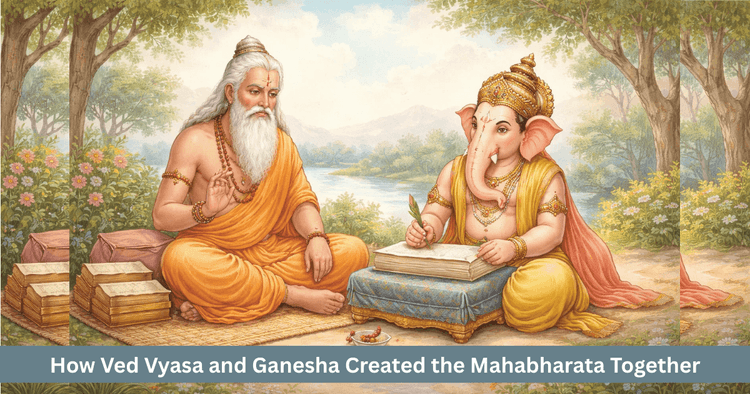
Table of Contents
The Mahabharata, one of the greatest epics ever composed, is far more than a story about dynasties, wars and dharma. It also embodies a profound tale of collaboration between two divine figures: Ved Vyasa, the sage who envisioned and dictated this monumental work and Lord Ganesha, the divine scribe who inscribed it for eternity. Their partnership was not a simple transaction but a cosmic union of wisdom, intellect, patience and sacrifice-a spiritual synergy that bestowed upon humanity an undying treasure of knowledge and guidance.
One Vyasa's Vision and the Quest for a Scribe
The Challenge of a Vast Epic
Ved Vyasa, renowned as the compiler of the Vedas and the author of many Puranas, recognized that his magnum opus, the Mahabharata, was no ordinary tale. Its sheer size, complexity and depth made it impossible to be preserved accurately through oral tradition alone. Spanning over one hundred thousand verses and encompassing philosophy, mythology, morality, ethics and cosmic principles, the epic demanded a written form to ensure its transmission to future generations.
Vyasa sought a scribe of unparalleled intellectual caliber, patience and spiritual discipline-someone who could keep pace with his rapid flow of thought while grasping the profound layers of meaning within every verse. According to tradition, only one being was truly worthy: Lord Ganesha, the elephant-headed god renowned as the remover of obstacles and the embodiment of wisdom and intellect.
The Need for a Divine Scribe
Vyasa knew that the Mahabharata was not merely a story but a complete education on dharma, karma, ethics and spirituality. It contained everything from battlefield scenes to political intrigues, from family conflicts to philosophical dialogues. It needed to be recorded not just verbatim but with its essence preserved. This required not just a mechanical scribe but an intelligent collaborator who could understand the significance of each verse.
This quest led Vyasa to Ganesha, who was not only the god of wisdom but also the one known for removing all obstacles. The task of writing the Mahabharata was indeed a formidable obstacle, a task that demanded divine intervention.
Two The Divine Agreement Balancing Speed with Comprehension
Terms of Mutual Respect
The collaboration began with a pact reflecting mutual respect and deep understanding of the writing process. Ganesha's condition was that he would write only if Vyasa recited without pause. If Vyasa stopped, Ganesha would stop writing immediately. This ensured that the scribe's concentration would not waver. This condition was to maintain the flow of the epic, a continuous narrative that would not stutter or break.
Vyasa's condition was that knowing the complexity of his verses, Vyasa stipulated that Ganesha must fully understand each verse before writing it down. This required Ganesha to read, comprehend and absorb the meaning-preventing mechanical transcription and ensuring fidelity. This condition ensured that the Mahabharata would not be a superficial copy but a deeply understood text.
Balancing Brilliance
This clever negotiation balanced flow and comprehension, preventing the dictation from becoming a hurried transcription or a stalled hesitation. It guaranteed that the Mahabharata would be both continuous in narration and profound in meaning. Vyasa's condition ensured that Ganesha would be forced to think, while Ganesha's condition ensured that Vyasa would be forced to remain creative and focused.
In this way, both conditions became complementary to each other. Vyasa would have to compose complex verses to force Ganesha to pause, giving him time to compose subsequent verses. Ganesha would have to use his full intellect to understand and record the continuously flowing knowledge. This was not merely a relationship between a scribe and a speaker but a dance between two great intelligences.
Three The Flow of Knowledge Rhythm in the Writing Process
The Sacred Dictation
As the sacred dictation commenced, Vyasa recited in a continuous, flowing rhythm. Ganesha wrote with unwavering focus, his pen never faltering. Each complex or multi-layered verse forced Ganesha to pause thoughtfully while understanding its depth. This pause gave Vyasa additional time to compose and prepare subsequent verses. Together, their rhythm created a seamless and profound text, both expansive and precise.
The Fusion of Complexity and Clarity
The Mahabharata contains both simple narrative verses and highly complex philosophical passages. When Vyasa recited simple verses, Ganesha wrote quickly. When Vyasa spoke verses with complex metaphors, multi-layered meanings or deep philosophical concepts, Ganesha had to pause, comprehend each layer, ensuring that he truly understood what Vyasa was communicating.
In this way, the Mahabharata became not merely a sprawling narrative but a carefully structured ocean of wisdom. Each verse resonated with philosophical insights and moral teachings. The Bhagavad Gita, which is within the Mahabharata, is the perfect example of this balance. Its verses are beautifully lyrical yet deeply philosophical. This was only possible because both Vyasa and Ganesha ensured that every word had meaning and purpose.
Four The Broken Tusk A Symbol of Devotion and Sacrifice
The Unexpected Challenge
During the marathon process, an unexpected event deepened the symbolic richness of the collaboration. As Ganesha was writing, his pen broke-a significant challenge for a text so vast and continuous. Tradition tells us that Ganesha was bound by Vyasa's condition: if the dictation stopped, he would stop writing. Searching for a new pen would interrupt the flow and potentially jeopardize the entire project.
An Act of Self Sacrifice
In an act of sheer determination and devotion, Ganesha broke off his own tusk and used it as a writing instrument rather than interrupt the flow. This self-sacrifice not only demonstrated his commitment but gave rise to one of his most famous epithets: Ekdanta, meaning "One-Tusked." This episode transformed Ganesha's image forever. His broken tusk became not just a physical characteristic but an eternal symbol of dedication to higher purpose.
The Deeper Symbolism
This act symbolizes that true dedication often demands personal sacrifice. In spiritual pursuits, the willingness to give up comfort, ease or even parts of oneself is vital for the successful transmission of wisdom. Ganesha, despite being a deity, was willing to sacrifice part of his body so that humanity could receive knowledge. This was the ultimate expression of devotion and selflessness.
The story of the broken tusk also teaches that great works often come with unexpected challenges. But with determination and creativity, these challenges can be overcome. Ganesha transformed his limitation into his strength. His broken tusk did not stop him but propelled him forward. This is a testament to the power of resilience and adaptability.
Five A Legacy for Humanity The Eternal Epic
The Result of Divine Partnership
The result of this divine partnership is the Mahabharata, the longest epic poem known, weaving together epic tales of courage, injustice, valor and devotion. Profound contemplations on dharma, morality, karma, mortality and spirituality. Philosophical dialogues including the iconic Bhagavad Gita. Cultural narratives forming the foundation of much of Indian civilization.
Because of the combined effort of Vyasa's visionary wisdom and Ganesha's perseverance, the Mahabharata has been preserved for thousands of years. It has become not just a story but a living spiritual guide that continues to inspire and instruct.
The Timeless Impact
The Mahabharata has shaped Indian culture, religion, philosophy and art for generations. Its characters have become examples of dharmic ideals and cautionary warnings. Its battles have become metaphors for moral dilemmas. Its dialogues, especially the Bhagavad Gita, have become sources of spiritual guidance. All of this was made possible by the extraordinary partnership of Vyasa and Ganesha.
Today, the Mahabharata is studied in universities, recited in temples, performed in plays and films and revered by millions worldwide. This is the enduring legacy of Vyasa's wisdom and Ganesha's sacrifice-a legacy that extends beyond time and space.
The Timeless Lesson Wisdom Patience and Collaboration
Universal Truths in Teamwork
The story of Vyasa and Ganesha transcends the realm of myth and becomes a universal lesson in teamwork and devotion. Wisdom alone is not enough; it must be coupled with patient perseverance. Intellect must be applied with depth of understanding, not mechanical repetition. Sacrifice and humility underpin genuine creation. True greatness emerges through partnership, where different abilities combine to fulfill a monumental task.
Lessons for Modern Times
In today's world, where individualism and competition are often emphasized, the story of Vyasa and Ganesha reminds us of the power of collaboration. It teaches that the greatest achievements happen when diverse strengths and talents come together. Vyasa had the vision and knowledge. Ganesha had the intellect and perseverance. Neither could have created the Mahabharata alone. Together, they created something immortal.
The story also teaches that the willingness to sacrifice is essential for great works. Ganesha gave his tusk. Vyasa gave years of tireless effort. Both sacrificed personal comfort and convenience for a higher purpose. This dedication, this commitment to what truly matters, is what creates lasting legacy.
The Union of Divine Energies
At its core, their collaboration reflects how divine energies unite, manifesting timeless knowledge through human-medium cooperation. It is the eternal reminder that wisdom flourishes when supported by dedication and understanding. When knowledge meets patience, when vision meets intellect, when sacrifice meets purpose, what is created stands the test of time.
The story of Vyasa and Ganesha invites us to create such partnerships in our own lives. To seek collaborations where our strengths complement others' strengths. To be patient with each other's limitations and respectful of each other's abilities. And most importantly, to be willing to sacrifice for what truly matters. This is the path on which the Mahabharata was created and this is the path on which greatness can still be created today.
Frequently Asked Questions
Why was Ganesha chosen as the scribe for the Mahabharata?
Ganesha was chosen as the scribe for the Mahabharata because he was known as the remover of obstacles and the embodiment of wisdom and intellect. Vyasa needed a scribe who could not only write rapidly but also comprehend the depth of complex and multi-layered verses. The Mahabharata was not just a story but a vast compendium of philosophy, ethics and spirituality encompassing over one hundred thousand verses. Only someone with divine intelligence like Ganesha was deemed suitable to accurately record such a monumental work. His wisdom and patience ensured that the Mahabharata's vastness and complexity would be preserved without any error or misunderstanding.
What were the terms of the agreement between Vyasa and Ganesha?
The agreement between Vyasa and Ganesha had two key conditions that complemented each other. Ganesha's condition was that he would write only if Vyasa recited without pause. If Vyasa stopped, Ganesha would immediately stop writing as well. This ensured the continuous flow of the epic. Vyasa's condition was that Ganesha must fully understand each verse before writing it down. This ensured that the writing was not mechanical transcription but a thoughtful process. These conditions balanced flow and comprehension. Complex verses forced Ganesha to think, giving Vyasa time to compose subsequent verses. In this way, both worked together to create a seamless and profound text.
Why did Ganesha break his tusk and what is its symbolic significance?
During the dictation of the Mahabharata, Ganesha's pen broke. Ganesha was bound by Vyasa's condition that if the dictation stopped, he would stop writing. Searching for a new pen would interrupt the flow. therefore in pure determination and devotion, Ganesha broke off his own tusk and used it as a writing instrument. This self-sacrifice gave him the epithet Ekdanta, meaning "One-Tusked." Symbolically, this act teaches that true dedication demands personal sacrifice. In spiritual pursuits, one must be willing to give up comfort, convenience or even parts of oneself. Ganesha's broken tusk became an eternal symbol of dedication to higher purpose, demonstrating that great achievements often require sacrifice.
What was the importance of collaboration in creating the Mahabharata?
The creation of the Mahabharata is an ideal example of the power of collaboration. Vyasa had the vision and knowledge but needed someone to record it. Ganesha had the intellect and patience but needed the content. Neither could have created the Mahabharata alone. Their partnership showed how diverse strengths and talents unite to create something extraordinary. Vyasa recited continuously while Ganesha wrote with understanding. Complex verses gave Ganesha time to think, which gave Vyasa time to compose. Their rhythm created a seamless and profound text. This collaboration teaches that the greatest achievements happen when we respect each other's strengths, have patience for each other's limitations and work together toward a shared purpose.
What does the story of Vyasa and Ganesha teach modern times?
The story of Vyasa and Ganesha offers several important lessons for modern times. It teaches that knowledge or skill alone is not enough. Greatness comes from collaboration where diverse talents unite. It demonstrates the importance of willingness to sacrifice. Ganesha gave his tusk and Vyasa gave years of effort. Both sacrificed personal comfort for a higher purpose. The story also demonstrates the power of patience and understanding. Ganesha took time to understand each verse, ensuring quality was not compromised. In today's fast-paced world where superficiality and quick results are often valued, the story of Vyasa and Ganesha reminds us that truly lasting things take time, dedication and collaboration. It is the triumph of teamwork over individualism, cooperation over competition and quality over speed.
What does Nakshatra reveal about me?
My NakshatraDid you like it?
Author
Pt. Suvrat Sharma (63)
Experience: 20
Consults About: Family Planning, Career
Clients In: Punjab, Haryana, Delhi
Share this article with friends and family
About ZODIAQ
ZODIAQ is an online Vedic Astrology platform. It connects clients seeking astrological advice to experienced astrologers with deep knowledge. Our users also generate kundali and perform kundali milan for free. ZODIAQ also offers services to the Astrologers. Astrologers utilize various offerings by ZODIAQ to serve their clients effectively.
If you are a User
Consult with experienced astrologers and seek their guidance. You can also order handwritten Janm Patrika report with life prediction prepared by experienced astrologers. Generate accurate Kundali, perform Kundali Matching and check horoscope and muhurat. Utilize our online library for all the necessary astrological and spiritual information.
If you are an Astrologer
Create accurate kundali for your clients and perform Kundali Matching for up to 5 people at a time. Write comprehensive Janm Patrika report for your clients with ZODIAQ. Check client details anytime by saving it in client directory. Become more productive by tracking how many clients you guide every day.
WELCOME TO
ZODIAQ
Right Decisions at the right time with ZODIAQ
