India's Ancient Epic Sites: Mysteries, History and Cultural Heritage
By Pt. Suvrat Sharma
Detailed study of Ramayana Mahabharata’s historical sites, archaeological evidence and living traditions
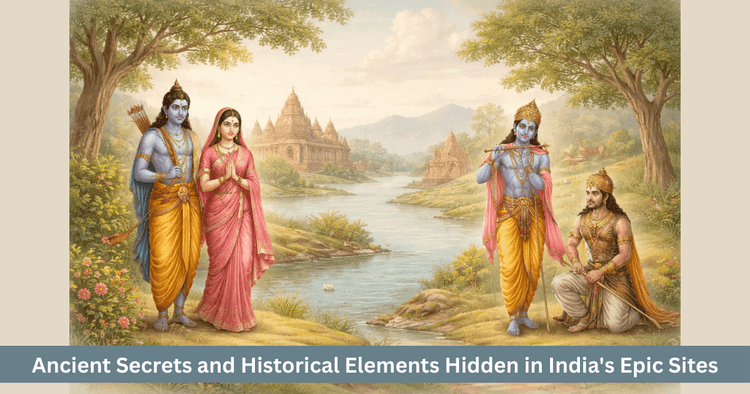
Table of Contents
India's great epics the Ramayana and the Mahabharata are not merely religious texts or mythological stories; they are living testimonies to the geographical, cultural and spiritual history of the Indian subcontinent. The locations described in these epics exist in reality today and continue to be centers of faith for millions. These sites hold not only religious significance but are also invaluable from archaeological, historical and geographical perspectives. Let us delve deep into these sacred lands to understand their hidden secrets and historical importance.
Sacred Sites of the Ramayana and Their Deep History
Ayodhya: The Origin of Civilization and Birthplace of Maryada Purushottama
Located on the banks of the Sarayu River in Uttar Pradesh, Ayodhya is one of India's oldest and most sacred cities. Archaeological excavations have uncovered artifacts over 3,000 years old. According to the Ramayana, this was the capital of the Kosala kingdom and the residence of Suryavanshi King Dasharatha.
Religious and Historical Significance of Ayodhya
Ayodhya witnessed Lord Rama's birth, childhood, preparation for coronation order of exile and triumphant return after 14 years. The Ram Janmabhoomi Temple remains a pilgrimage destination for millions. Sites like Hanuman Garhi, Kanak Bhavan and Sita Rasoi are connected to various Ramayana episodes.
The lamps lit in Ayodhya on Diwali symbolize Rama's victorious return from Lanka. This tradition has continued for thousands of years and is celebrated worldwide today.
Archaeological Evidence and Modern Discoveries
According to Archaeological Survey of India (ASI) reports, ancient bricks, sculptures and inscriptions found in Ayodhya provide evidence of a prosperous urban civilization. Coins, pottery and artifacts discovered here indicate a civilization dating back to before the Common Era.
Janakpur: The Sacred Birthplace of Vaidehi Sita
Located in Nepal's Terai region, Janakpur (ancient Mithila) was the capital of the Videha kingdom. King Janaka here was known as a philosopher and wise ruler. He adopted Sita as his daughter when she emerged from the earth while he was plowing.
The Sacred Land of Swayamvara and Marriage
The competition to break Shiva's bow took place in Janakpur, where Rama's victory led to Sita's swayamvara. The Janaki Temple is the main pilgrimage site, built in the 19th century. Mithila's culture, art and language still preserve the sacred memory of Sita-Rama.
Cultural Heritage of Mithila
Mithila paintings, primarily created by women, prominently feature stories of Sita-Rama. The tradition of Sanskrit learning centers, Vedic scholarship and philosophical studies remains vibrant here.
Chitrakoot: Sacred Land of Spirituality and Sacrifice
Located on the border of Uttar Pradesh and Madhya Pradesh, Chitrakoot is where Rama, Lakshmana and Sita spent the initial and most significant period of their exile. The natural beauty, hills, forests and water bodies provided an ideal environment for forest life.
Major Religious Sites of Chitrakoot
- Kamadgiri Hill: Considered the heart of Chitrakoot, where Rama, Lakshmana and Sita resided
- Bharat Milap Temple: Where Bharat met Rama requesting his return to Ayodhya
- Gupt Godavari: A cave where Rama and Lakshmana held secret consultations
- Sati Anusuya Ashram: The penance site of sage Atri and Anusuya
- Hanuman Dhara: Where Hanuman cooled his burning body
Spiritual Significance of Chitrakoot
Tulsidas lived here for several years and wrote important portions of Ramcharitmanas. Devotees still perform the Chitrakoot parikrama, approximately 12 kilometers long.
Dandakaranya: Forest Land of Hardships and Penance
The vast forest region spanning Chhattisgarh, Jharkhand, Odisha and Andhra Pradesh was known as Dandakaranya in ancient times. This dense jungle was both the penance site of many sages and the dwelling place of demons.
Rama's Experiences in Dandakaranya
Here Rama met Shurpanakha, killed the demon Viradha and met several sages who sought protection from demons. The ashrams of sages Sarabhanga, Sutikshna and Agastya were in this region.
Dandakaranya in Present Times
Today's Dandakaranya is among India's densest forests. Numerous tribes live here whose culture and traditions still remind us of ancient times. Regions like Bastar, Surguja and Kalahandi are part of this Dandakaranya.
Panchavati: The Tragic Site of Sita's Abduction
Located in Nashik, Maharashtra, Panchavati witnessed the most important and sorrowful event of the Ramayana Sita's abduction. This place on the banks of the Godavari River was called Panchavati due to five banyan trees.
Major Events and Places in Panchavati
- Shurpanakha Episode: Where Lakshmana cut off Shurpanakha's nose
- Khara-Dushana Killing: Destruction of the demon army
- Maricha Episode: Maricha in golden deer form lured Sita
- Sita's Abduction: Ravana's deception and Sita's kidnapping
Modern Pilgrimage Sites of Panchavati
- Sita Cave: Where Sita used to rest
- Kalaram Temple: Famous temple with black Rama idol
- Trimbakeshwar: Nearby Jyotirlinga
- Ramkund: Sacred bathing ghat where Rama bathed
Kishkindha: The Glorious Kingdom of Vanaras
The Hampi region in Karnataka is considered the ancient Kishkindha kingdom. The countless hills, caves and massive rock formations match the Ramayana descriptions. This was the capital of Vanara king Sugriva and Hanuman's birthplace is also believed to be here.
Historical Sites of Kishkindha
- Rishyamukh Parvat: Where Sugriva met Rama
- Anjaneyi Hill: Hanuman's birthplace
- Sugriva Cave: The Vanara king's residence
- Vali Cave: Battle site of Vali and Sugriva
Vijayanagara Civilization of Hampi
Interestingly, the later Vijayanagara Empire was established here, which was the most powerful Hindu royal power in South India. The Vijayanagara kings considered themselves carriers of the Ramayana tradition.
Rameswaram: Bridge Construction and Shiva Worship
From the Rameswaram island in Tamil Nadu, Rama's army built a stone bridge (Ram Setu or Adam's Bridge) to Lanka. This site is important not only from the Ramayana perspective but also due to its geographical position in the Indian Ocean.
Sacred Sites and Traditions of Rameswaram
- Ramanathaswamy Temple: One of the 12 Jyotirlingas
- Agni Tirtha: The most sacred water body
- Dhanushkodi: Starting point of Ram Setu
- Vibhishan Kund: Vibhishan's coronation site
Scientific Perspective and Ram Setu
According to marine geology, there was actually a natural bridge between India and Sri Lanka that existed thousands of years ago. Satellite images still show its remains under the sea.
Lanka: Ravana's Golden Empire and Battlefield
While scholars debate the exact location of Ravana's Lanka, most believe it to be modern-day Sri Lanka. According to the Ramayana, Lanka was an extremely prosperous and beautiful island with advanced architecture and culture.
Important Places of Lanka
- Ashok Vatika: Where Sita was held captive
- Ravana's Palace: The golden Lanka
- Hanuman's Lanka Burning: Hanuman's fire in Lanka
- Battlefield: The arena of the great war between Rama and Ravana
Traces of Ramayana in Sri Lanka
Even today, several places in Sri Lanka are believed connected to the Ramayana. Sites like Sita Eliya (Sita Kotuwa), Hakgala (Ashok Vatika) and Ravana Ella waterfall are centers of faith for Sri Lankan Hindus.
Great Battlefields and Political Centers of the Mahabharata
Kurukshetra: Sacred Field of Dharma War and Gita
Kurukshetra in Haryana is the world's most famous battlefield where millions of warriors attained heroic death during the 18-day Mahabharata war. This is where Krishna gave the immortal teaching of the Gita to Arjuna.
Religious and Historical Sites of Kurukshetra
- Jyotisar: Where Krishna delivered the Gita teaching
- Brahma Sarovar: Sacred tirtha where solar eclipse baths occur
- Bhishma Kund: Site of Bhishma's bed of arrows
- Kurukshetra Panorama: War scene museum
Significance of Gita and Kurukshetra
The teachings Krishna gave about dharma, karma, yoga and moksha in the Bhagavad Gita are not only the foundation of Indian philosophy but also precious heritage of world literature. Gita Jayanti is still celebrated here.
Geographical Position and Strategy of War
The Kurukshetra plain was ideal for war level ground, water availability and good routes for supplies. The Archaeological department has found ancient weapons and artifacts here.
Hastinapur: The Great Capital of Kauravas
Located on the banks of the Ganga in Uttar Pradesh, Hastinapur was the capital of the Kuru dynasty. Dhritarashtra, Duryodhana and their hundred sons ruled here. Most political events of the Mahabharata occurred here.
Historical Remains of Hastinapur
- Multi-layered excavations: Remains dating back 2800 years
- Ancient fort remains: Evidence of urban planning
- Jain pilgrimage: Connection with Adinatha and other Tirthankaras
- Draupadi Ghat: Memory of Pandava era
Political Events of Mahabharata
The dice game was played here, where Yudhishthira staked even the kingdom and Draupadi. Draupadi's humiliation, Bhima's vow and the decision of 13 years exile all happened in Hastinapur.
Indraprastha: The Heavenly City of Pandavas
The area around Delhi's Old Fort (Purana Qila) is considered ancient Indraprastha. This was the magnificent capital built by the Pandavas, whose beauty and grandeur were compared to heaven.
Grandeur and Architecture of Indraprastha
According to the Mahabharata, there was a wonderful assembly hall called Maya Sabha built by the demon Maya. In this hall, Duryodhana was confused, leading to Draupadi's mockery.
Archaeological Evidence
Excavations at Delhi's Old Fort have found remains of Painted Grey Ware (PGW) culture, which match the Mahabharata period. Pottery, seals and other objects found here are evidence of ancient urban civilization.
Dwarka: Krishna's Maritime Capital
In Gujarat's Dwarka, Lord Krishna established his capital after leaving Mathura. According to marine archaeology, there is indeed an ancient city submerged in the sea here.
Marine Remains of Dwarka
- Submerged structures: City remains in the sea
- Ancient port: Evidence of commercial activities
- Dwarkadhish Temple: Main temple of Krishna
- Gomti Sangam: Sacred river confluence
Scientific Research
The National Institute of Marine Archaeology has made several important discoveries here. Walls, seals and artifacts found on the seabed provide evidence of a developed civilization.
Mathura and Vrindavan: Krishna's Playground
The Mathura-Vrindavan region in Uttar Pradesh saw Krishna's birth, childhood and youth. This place is the most sacred center of Bhagavata dharma and Vaishnavism.
Major Sites of Mathura-Vrindavan
- Krishna Janmabhoomi Temple: Birthplace in Kansa's prison
- Govardhan Hill: Mountain lifted by Krishna
- Radha Kund: Radha-Krishna's playground
- Nidhivan: Site of Rasa Lila
- Banke Bihari Temple: Famous Krishna idol
Prabhas Patan: Krishna's Death and Beginning of Kali Yuga
Prabhas Patan (Somnath) near Veraval in Gujarat is the sacred place where Lord Krishna departed his body. With this, Dvapara Yuga ended and Kali Yuga began.
Mythological Stories of Prabhas Region
The moon worshipped Shiva here, hence it's called Somnath (Lord of the Moon). Krishna was in meditation here when he died from hunter Jara's arrow.
Significance of These Sites in Modern Times
From Archaeological and Historical Perspective
Archaeological research at all these sites shows that developed urban civilization existed in India thousands of years ago. Pottery, coins, seals and inscriptions confirm the historicity of these epics.
Religious Tourism and Economy
Today these sites run a multi-billion rupee religious tourism industry. Places like Ayodhya, Vrindavan, Haridwar, Rameswaram are not only centers of faith but also main pillars of local economy.
Symbol of Cultural Unity
These pilgrimage sites spread from north to south and east to west are living proof of India's cultural unity. People speaking different languages come here with the same sentiment.
Conclusion: Preservation of Living Heritage
These sites of Ramayana and Mahabharata are not just heaps of stones and mud they are carriers of Indian culture, values and ideals. It is our responsibility to preserve and respect them. We must be careful that these sites are not harmed in the race of modern development.
These sites teach us how to live a life based on values of dharma, justice, love and sacrifice. Rama's disciplined behavior, Krishna's policies and the struggles of Mahabharata characters are still relevant today.
Frequently Asked Questions
Which geographical locations mentioned in Ramayana still exist today?
Ayodhya, Chitrakoot, Nashik (Panchavati), Rameswaram and parts of Sri Lanka still exist in reality.
What are the main locations of Mahabharata and where are they situated?
Kurukshetra (Haryana), Hastinapur (Uttar Pradesh), Indraprastha (Delhi), Dwarka (Gujarat) and Mathura-Vrindavan (Uttar Pradesh) are the main ones.
Have archaeological evidences of these sites been found?
Yes, excavations by ASI and other institutions at all these sites have found remains of ancient civilization.
Did Ram Setu actually exist?
Satellite images show remains of a natural structure between India and Sri Lanka, which might have served as a bridge in ancient times.
What are the marine remains of Dwarka?
The Marine Archaeology Department has found submerged walls, ports and other structures off Gujarat's Dwarka coast, which could be remains of an ancient city.
Get your accurate Kundali
Generate KundaliDid you like it?
Author
Pt. Suvrat Sharma (63)
Experience: 20
Consults About: Family Planning, Career
Clients In: Punjab, Haryana, Delhi
Share this article with friends and family
About ZODIAQ
ZODIAQ is an online Vedic Astrology platform. It connects clients seeking astrological advice to experienced astrologers with deep knowledge. Our users also generate kundali and perform kundali milan for free. ZODIAQ also offers services to the Astrologers. Astrologers utilize various offerings by ZODIAQ to serve their clients effectively.
If you are a User
Consult with experienced astrologers and seek their guidance. You can also order handwritten Janm Patrika report with life prediction prepared by experienced astrologers. Generate accurate Kundali, perform Kundali Matching and check horoscope and muhurat. Utilize our online library for all the necessary astrological and spiritual information.
If you are an Astrologer
Create accurate kundali for your clients and perform Kundali Matching for up to 5 people at a time. Write comprehensive Janm Patrika report for your clients with ZODIAQ. Check client details anytime by saving it in client directory. Become more productive by tracking how many clients you guide every day.
WELCOME TO
ZODIAQ
Right Decisions at the right time with ZODIAQ
