Kali: Both Mother and Destroyer , The Paradox That Defines Life
By Pt. Suvrat Sharma
Finding Perfect Freedom in the Unity of Fierceness and Love
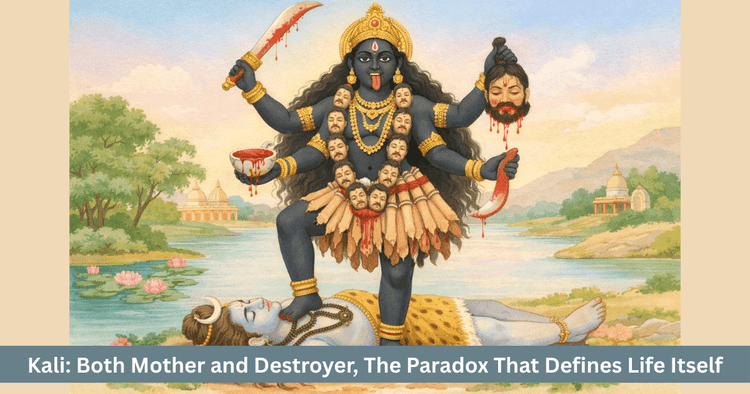
Table of Contents
Step into a temple dedicated to Kali and the immediate impression often disorients and even disturbs. The goddess stands with skin as black as the night sky. Her tongue extends bright crimson, protruding beyond her lips. A garland of freshly severed heads adorns her neck. A skirt of dismembered arms girdles her waist. In her four hands, she holds weapons still dripping with blood and a vessel collecting sacrificial fluid. Her eyes blaze with cosmic fury. Her posture expresses wild, ecstatic power.
Yet simultaneously, this very figure is called "Ma" (Mother) by millions of devoted followers. She is invoked not with fear but with love, not with dread but with absolute trust. Devotees sing to her of protection, nurturance and unconditional love. Mothers name their daughters after her. The sick call upon her for healing. The lost seek her guidance.
How can the same being be simultaneously the most terrifying and most beloved of all Hindu deities? How can she represent destruction and love, annihilation and protection, terror and tenderness in perfect simultaneity? The answer demands moving beyond Western dualistic thinking into a deeper understanding of reality itself, one that recognizes creation and destruction as inseparable partners in the dance of existence.
The Paradox Explained: Understanding Kali's Dual Nature
The Western Mind's Struggle
For those raised in Western philosophical traditions, Kali presents what appears as an impossible logical contradiction. Binary thinking teaches:
- Good and evil are absolute opposites
- Love and violence are mutually exclusive
- Creation and destruction are contradictory forces
- A nurturer cannot be a warrior
- The protective cannot be fierce
Within this dualistic framework, Kali becomes inexplicable, a contradiction that shouldn't exist. She is neither good nor evil, neither loving nor violent, she is absolutely both. This simultaneity appears to violate the law of non-contradiction itself.
But this confusion reveals the fundamental limitation of binary thinking. It exposes that Western dualism cannot adequately describe reality.
The Hindu Non-Dualistic Vision
Hindu philosophy, particularly Tantra and Kashmir Shaivism, operates within a non-dualistic framework embracing paradox as fundamental to existence:
The Teaching of Shakti: In Hindu cosmology, the universe does not result from external divine creation but manifests from the cosmic dance of Shakti, primordial creative energy. This energy is:
- Simultaneously creative and destructive: All creation contains within itself the seeds of its own eventual dissolution
- Neither good nor evil intrinsically: Shakti is amoral, a pure force operating according to cosmic principle (Rta)
- The source of all polarity yet transcending polarity: Shakti generates pairs of opposites (light-darkness, creation-destruction, love-wrath) yet transcends all duality
- The dynamic principle underlying all transformation: Without Shakti, nothing would move, nothing would evolve, nothing would transform
Kali as Shakti Personified: When Shakti manifests as Kali, she embodies cosmic energy in its raw, unfiltered state, not refracted through human moral categories but expressing the fundamental truth of existence itself.
Kali the Mother: The Fiercer Expression of Love
Misunderstanding Maternal Power
When the West hears "mother," it typically envisions softness, gentleness, passive nurturing. This reflects a profound misunderstanding of authentic maternal power. The most protective force in all nature is a mother defending her young. The most fierce energy in existence is maternal love.
The Biological Reality: Across all species, mothers are:
- Most fierce when their offspring face threat
- Most attentive to what needs healing and care
- Most precise and focused in their attention
- Most willing to sacrifice absolutely everything
- Most ruthless toward threats to their children's wellbeing
Kali's Maternal Love Operates at This Level, not as sentiment but as cosmic protective force:
She Nourishes: As the primordial Shakti sustaining the universe, Kali represents the source of all nourishment. Every being exists because of her energy flowing through creation. In this sense, all living creatures are her children and she is the ultimate Mother providing life itself.
She Attends to What Needs Healing: Like a mother who perceives the slightest illness in her child, Kali discerns what requires addressing, the ego requiring humbling, the attachments demanding breaking, the ignorance needing destruction. Her destruction is surgical precision, not random violence.
She Protects with Absolute Ferocity: When demons (symbols of destructive forces, ego, ignorance) threaten dharma, Kali demonstrates no hesitation or negotiation. She moves with swift, decisive power to eliminate the threat. This represents protection elevated to its highest expression.
She Sets Healthy Boundaries: A healthy mother does not indulge every caprice of her child; she establishes boundaries essential for growth. Similarly, Kali does not permit unlimited ego expansion or ignorance. Her fierce restraint expresses an act of love.
She Teaches Through Challenge: Like a mother who pushes her child beyond comfort toward growth, Kali challenges us to transcend our limitations. Her fierce appearance and actions serve as invitations to courage, calls to transformation.
The Tenderness of Strength
In the Kali Purana and devotional texts, Kali is portrayed with extraordinary tenderness:
- She sings lullabies to those seeking her protection
- She appears to sincere seekers in dreams with maternal affection
- She handles the most fractured and shattered souls with infinite gentleness
- She celebrates her devotees' triumphs with a mother's pride
- She grieves when her children suffer; her tears become the rivers bringing life to all
This tenderness is not separate from her fierceness; it is the complementary expression of identical love. A mother insufficiently fierce to protect her children betrays them. A mother lacking courage to establish boundaries fails them. Kali's tenderness and fierceness are two expressions of perfect maternal devotion.
Kali the Destroyer: Liberation Through Annihilation
Misunderstanding Destruction
The Western mind immediately interprets destruction as evil, waste, loss. Our entire civilization resists destruction, building monuments and accumulating possessions precisely to prevent it. We treat destruction as something fundamentally to prevent.
But this reflects fundamental misunderstanding of how existence actually functions:
The Cosmic Principle: In Hindu cosmology, destruction (Sanghar) is not opposed to creation but absolutely essential to it. The four cosmic phases are:
- Srishti: Creation, the universe manifests
- Sthiti: Maintenance, the universe persists
- Laya: Dissolution, the universe returns to unmanifest potential
- Srishti (renewed): A new cycle begins
All four phases prove necessary. If the universe only created and maintained but never dissolved, it would become static, exhausted, corrupted. Dissolution is not failure but necessity, the essential reset making new creation possible.
The Philosophical Purpose of Destruction:
Destruction Clears Space: Before anything new can be built, the old must be cleared. In the macrocosm, this is the universal dissolution at the end of each Brahmic day. In the microcosm, this is the ending of relationships, loss of jobs, shattering of beliefs that had become obstacles.
Destruction Reveals Truth: When illusions are destroyed, reality becomes visible. When false identity is demolished, the authentic self emerges. Kali's destructive power destroys not the real but the illusory, serving truth itself.
Destruction Liberates: Attachment to forms, identities and possessions constitutes the source of suffering. Destruction severs these attachments, creating freedom. In this sense, Kali functions as the ultimate liberator.
Destruction Teaches Detachment: By constantly destroying and recreating, Kali teaches that nothing is permanent, nothing deserves absolute clinging. This teaching, deeply internalized, brings peace and wisdom.
The Demons Kali Destroys
In the Devi Mahatmya and Kalika Purana, Kali's destructive exploits are detailed. Yet importantly, the demons she destroys are never ordinary beings. They are:
Mahishasura (The Buffalo Demon): Representing dull, gross ignorance and bestial consciousness
Raktabija (The Blood-Seed Demon): Representing ego that multiplies when fought, each drop of blood becoming a new demon, symbolizing how ego regenerates through resistance
Shumbha and Nishumbha: Demons representing arrogance and pride threatening cosmic order
Symbolically, Kali destroys:
- Ignorance and delusion
- Ego and pride
- Attachment and craving
- Fear and doubt
- All forces opposing dharma
She destroys these not in distant times but continuously within her devotees' hearts, removing inner obstacles to liberation.
The Sacred Symbolism: Reading Kali's Appearance Correctly
The Black Skin: Unlimited Potential
Kali's black complexion is often misinterpreted as representing evil or darkness. In fact, black represents infinite potential:
- Black is the color of unmanifest potential, before anything manifests, all possibilities exist in potential darkness
- Black is the color of space itself, the cosmic void from which all creation emerges
- Black absorbs all light and color, symbolizing Kali's capacity to contain all possibilities within herself
- Black is timeless, not visible to ordinary sight, suggesting transcendence beyond normal perception
Her blackness is not evil but infinite, undifferentiated creative potential.
The Protruding Tongue: Consumption of Illusion
Kali's extended red tongue carries multiple meanings:
- Red represents action and passion, the energy actively engaged in transformation
- The tongue protruding represents tasting, Kali "tastes" reality directly rather than merely conceptualizing
- The tongue extended in apparent surprise represents Kali's own astonishment at her power, she steps back from destructive fury, amazed at what she has unleashed
- The tongue symbolically consumes illusion, consuming the demon's blood, she consumes the ego-poison sustaining ignorance
- Some traditions interpret it as Kali recoiling in horror at the blood spilled, representing her compassion even in destruction
The Garland of Heads: Severed Ego
The garland of freshly severed heads represents:
- Destruction of individual egos imagining themselves separate from cosmic reality
- Surrender of all personal identity, those approaching Kali must surrender having their individual self "beheaded"
- The cyclical nature of existence, heads symbolizing the constant stream of births and deaths
- The fruits of ego-death, wearing these heads as jewelry, Kali demonstrates that ego-transcendence becomes adornment, not loss
The Skirt of Arms: Power Over Action
The skirt woven of severed arms represents:
- Power over all actions, arms being the instruments of action, Kali transcends individual agency
- Severance of personal will conflicting with cosmic will
- Power to act yet remain unattached to results, the arms are severed, meaning Kali's power acts but leaves no karmic traces
- Mastery over ego's desire for personal achievement, wearing arms as garments, Kali demonstrates perfect power over personal ambition
The Weapons She Holds: Instruments of Cosmic Justice
Kali typically holds:
The Curved Sword: Discriminative wisdom, cutting through illusion to reveal truth
The Severed Head: Ego destroyed, held to drink its blood (ignorance consumed)
The Blood-Collecting Vessel: Containment of released energy, ensuring released forces don't create chaos but are collected and directed
Each weapon is an instrument of transformation, not cruelty.
The Lived Teaching: What Kali Means in Daily Life
Embracing Necessary Endings
Kali teaches that endings are not failures but essential transitions:
- The end of a relationship, whether through breakup, death or distance, is not merely loss but clearing of what no longer serves growth
- Job loss or career change, destruction of outdated identity and role, creating space for authentic calling
- Loss of possessions or security, demolition of false sources of confidence, revealing inner strength
- Health crises or disability, destruction of the illusion of invulnerability, teaching wisdom about what truly matters
Rather than resisting these endings, Kali teaches moving through them consciously, recognizing them as Kali's fierce grace removing obstacles.
Balance of Love and Discipline
Kali embodies the paradox that authentic love requires firmness:
- A parent who loves must set boundaries, enforce consequences and sometimes say "no" firmly
- A teacher who cares must demand rigor and challenge students beyond comfort
- A therapist who helps must confront clients with difficult truths
- A spiritual guide must sometimes push the student through resistance
This is Kali's maternal love: not indulgent but directed toward the highest good.
The Courage to Face What Frightens
Kali's fierce appearance extends an invitation to courage:
- The fear we feel seeing Kali's image actually reflects fear of our own power and potential
- The terror she represents is actually terror of authentic transformation
- Moving toward Kali rather than away symbolizes moving toward what we most fear and discovering liberation on the other side
- Her devotees report that regular meditation or worship of Kali gradually dissolves fears, replacing terror with empowerment
The Release of Clinging
Kali teaches the essential spiritual lesson of non-attachment:
- By constantly destroying and recreating, she demonstrates that nothing is permanent
- By appearing frightening, she removes our impulse to cling to comfort
- By destroying what we love, she teaches that attachment is suffering's source
- By requiring us to face death symbolically, she liberates us from its grip
- Those who genuinely surrender to Kali experience profound peace, they have already released everything; nothing remaining can be threatened
The Sacred Marriage: How Mother and Destroyer Are One
The Unity Principle
In Hindu Tantra, this apparent paradox resolves through understanding Shakti itself:
"Shakti is the force of creation, destruction and dissolution."
No contradiction exists because:
- One force operates differently in different contexts: Water nourishes and water drowns; fire warms and fire destroys; the same force serves different functions
- One consciousness expresses complementary aspects: Just as a single person can be both gentle parent and fierce warrior, Kali is both mother and destroyer from unified consciousness
- Destruction and creation are not opposites but partners: The mother destroys her child's illusions so the true self can be born; the destroyer clears the old so the new can emerge
The Integration
The integrated person embodies both Kali aspects:
- Nurturing and fierce: Capable of infinite compassion yet uncompromising about boundaries
- Gentle and powerful: Strong enough to be soft, humble enough to be mighty
- Protective and liberating: Defending what matters while releasing what doesn't serve
- Loving and demanding: Offering unconditional support while challenging growth
Why This Matters in the Modern World
The Crisis of Imbalance
Contemporary culture suffers from profound imbalance:
- We glorify the creative but fear the destructive, leading to accumulation of outdated forms, toxic relationships and mental clutter
- We seek comfort but resist challenge, stunting growth and spiritual development
- We fragment love and strength, creating either weak compassion or heartless power
- We avoid endings, leading to prolonged suffering in situations requiring closure
Kali's Corrective Teaching
In this context, Kali offers essential wisdom:
- Destruction is not to be feared but welcomed when it serves growth
- Love expresses as both tenderness and firmness
- The fierce protector and nurturing mother are the same being
- Power and compassion are complementary, not contradictory
The Personal Application
Those who develop genuine relationship with Kali report:
- Greater courage in facing life's challenges
- Healthier boundaries in relationships
- Ability to release what no longer serves
- Freedom from fear, particularly fear of death and change
- Balanced power, expressing strength without domination and love without codependency
- Spiritual acceleration, as they consciously cooperate with necessary destruction
Conclusion: The Mother Who Teaches Freedom
Kali is called both Mother and Destroyer because she is fundamentally one cosmic principle expressing itself through complementary aspects, just as day and night, growth and decay, activity and rest are complementary aspects of one existence.
She teaches that:
- Love sometimes requires destruction of what prevents growth
- Protection sometimes demands ferocity in defending what matters
- Motherhood expresses as both nurturance and fierce boundary-setting
- True freedom requires releasing what we cling to
- Transformation requires courage to face what terrifies us
In a world often paralyzed by false choices between gentleness and strength, vulnerability and power, acceptance and action, Kali stands as the teacher showing that all these can unite in one being, one moment, one perfectly balanced consciousness.
When you see Kali's fierce form and feel fear, remember: the fear you experience is your own resistance to transformation. She is not threatening to destroy you but to destroy what limits you. She is not the enemy of life but its truest guardian, teaching that only by releasing the false can the true emerge, only by dying to the old can we be born into the new and only by embracing both her fierce protection and motherly love can we live fully.
Jay Mata Kali.
Victory to Mother Kali.
The Mother who destroys so that you might finally be free.
Frequently Asked Questions
Question 1: Why Is Kali Called Mother When Her Appearance Seems So Terrifying?
Answer: Kali is called Mother because authentic motherhood transcends mere gentleness, it includes the unshakeable power to protect one's children against any threat. The fiercest force in all nature is a mother defending her young. Kali's terrifying appearance symbolizes her protective power in absolute form. When devotees gaze upon Kali's image, they witness divine love's strength, love that establishes boundaries, punishes wrongdoing and will sacrifice anything to save its children from suffering. Thus Kali's apparent ferocity actually represents motherhood's highest expression, not its negation. Her fierce form teaches that a mother's love must include unwavering boundaries and protective power. The combination of her weapons and her maternal essence demonstrates that true love sometimes requires firmness, discipline and even the destruction of what threatens growth.
Question 2: Why Is Destruction So Important on the Spiritual Path?
Answer: In Hindu philosophy, destruction or Sanghar is not opposed to creation but represents its essential complement. The universe undergoes four phases: Srishti (creation/manifestation), Sthiti (maintenance/preservation), Laya (dissolution/return to potential) and Srishti renewed (new creation). If the universe only created and maintained but never dissolved, it would become static, exhausted and corrupted. Dissolution is the necessary reset enabling new creation. Similarly, spiritually, the destruction of old attachments, false identities and limiting beliefs is essential for liberation. Kali teaches that freedom comes through consciously embracing necessary destruction. In personal practice, meditation on Kali helps practitioners release outdated patterns, ego constructs and attachments. This destruction is not loss but liberation, making space for authentic consciousness to emerge. Those who understand this teaching experience freedom rather than grief.
Question 3: What Does Kali's Black Skin Actually Symbolize?
Answer: Kali's black complexion is frequently misinterpreted as representing evil or darkness but this reflects a fundamental misunderstanding. The color black symbolizes infinite, undifferentiated potential. Before anything manifests into visible form, all possibilities exist in potential darkness. Black is the color of the cosmic void, the primordial space from which all creation emerges. Black absorbs all light and color, symbolizing Kali's capacity to contain all possibilities within herself. Her blackness suggests transcendence beyond normal perception and ordinary understanding. therefore Kali's black skin is not evil or negative, it represents pure, infinite, creative potential. Understanding this transforms our interpretation of her appearance from fearful to awe-inspired, from threatening to deeply protective. Her darkness contains all light; her emptiness contains all fullness.
Question 4: Is It Safe to Worship Kali?
Answer: Yes, Kali worship is completely safe and actually profoundly beneficial. Millions of sincere devotees practice Kali worship and experience significant spiritual growth, increased courage and genuine liberation. Kali worship represents an invitation to transformation. When practitioners approach Kali, they confront their deepest fears, understand their limitations and discover their authentic power. Regular Kali practice transforms fear into courage, attachment into freedom and narrow personal identity into expanded cosmic consciousness. Practitioners consistently report that devotion to Kali brings peace, not danger, the peace that comes from having already released everything. What can threaten someone who has surrendered completely? The fierce appearance actually becomes a source of safety because it destroys the illusions that cause fear. Those committed to genuine transformation find Kali worship to be profoundly protective and liberating.
Question 5: How Can Kali's Teachings Be Applied to Modern Life?
Answer: Kali's teachings are deeply relevant to contemporary existence. When you experience a relationship ending, job loss or belief system collapsing, you witness Kali's destructive work. Rather than resist, understand that she is clearing old forms to make space for new growth. Kali teaches that authentic love requires the courage to set firm boundaries. Modern culture often prioritizes comfort but Kali worship teaches that genuine liberation requires accepting challenge. She instructs us to release clinging, embrace endings and discover inner strength. Many contemporary people lack healthy boundaries because they confuse love with indulgence, Kali resolves this confusion. Her teachings transform how we experience loss, helping us recognize dissolution as often being grace rather than tragedy. Deeper engagement with Kali awakens courage, wisdom and authentic power. Her example shows that we can be simultaneously strong and compassionate, fierce and loving, demanding excellence while offering unconditional acceptance.
Get your accurate Kundali
Generate KundaliDid you like it?
Author

Pt. Suvrat Sharma (63)
Experience: 20
Consults About: Family Planning, Career
Clients In: Punjab, Haryana, Delhi
Share this article with friends and family
About ZODIAQ
ZODIAQ is an online Vedic Astrology platform. It connects clients seeking astrological advice to experienced astrologers with deep knowledge. Our users also generate kundali and perform kundali milan for free. ZODIAQ also offers services to the Astrologers. Astrologers utilize various offerings by ZODIAQ to serve their clients effectively.
If you are a User
Consult with experienced astrologers and seek their guidance. You can also order handwritten Janm Patrika report with life prediction prepared by experienced astrologers. Generate accurate Kundali, perform Kundali Matching and check horoscope and muhurat. Utilize our online library for all the necessary astrological and spiritual information.
If you are an Astrologer
Create accurate kundali for your clients and perform Kundali Matching for up to 5 people at a time. Write comprehensive Janm Patrika report for your clients with ZODIAQ. Check client details anytime by saving it in client directory. Become more productive by tracking how many clients you guide every day.
WELCOME TO
ZODIAQ
Right Decisions at the right time with ZODIAQ
