Ninety-Nine Children of Krishna: The Forgotten Sons and Daughters
By Pt. Amitabh Sharma
The Vast Family of Krishna and Stories of His Prominent Sons According to Bhagavata and Vishnu Purana
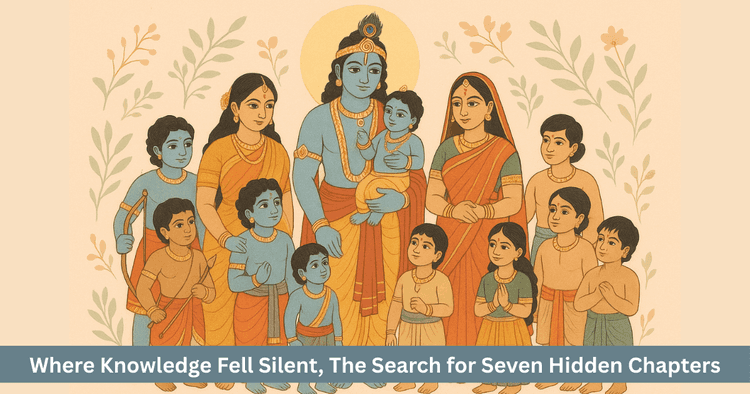
Table of Contents
Whenever the name Krishna resounds, the collective imagination conjures vivid images, his playful childhood stealing butter in the lanes of Gokul, his divine wisdom imparted through the [translate:Bhagavad Gita] on the battlefield of Kurukshetra or his eternal love for Radha, dancing under the moonlight of Vrindavan. These facets of Krishna are well known: the mischievous cowherd, the philosopher, the lover and the warrior. however a lesser-known and rarely explored aspect is Krishna the father, his role as the progenitor of an immense lineage.
Ancient scriptures reveal that Krishna married 16,108 wives, including eight principal queens and thousands of rescued women. Remarkably, he is said to have fathered around 180,000 sons. Out of this vast progeny, 99 children have been distinctly named and honored in traditional genealogies, especially those born to his chief queen Rukmini and other foremost wives. These 99 children are often lost to popular narratives but carry immense significance for the Yadava dynasty's continuity, the socio-political fabric of Krishna’s era and the fate of Dwarka, the golden city.
Understanding the Immense Scope of Krishna’s Family
Krishna’s household was vast and symbolized more than mere biological expansion:
- Total Wives: 16,108, including eight primary queens plus 16,100 women rescued from the demon Narakasura.
- Total Sons: Approximately 180,000, with each wife allegedly bearing about ten sons through Krishna’s yogic ability.
- Named Children: 99 prominently recorded in puranic genealogies.
- Principal Lineage: Primarily traced through Rukmini, Krishna’s chief queen.
These numbers reflect not mere population growth but represent Krishna's divine consciousness manifesting in multiple forms simultaneously across numerous royal lineages throughout ancient India, establishing dharma and righteous governance.
Detailed Accounts of Principal Sons
1. Pradyumna (Son of Rukmini)
Pradyumna, Krishna's eldest son, is regarded as a partial incarnation of Kamadeva, the god of love and desire, who was reduced to ashes by Shiva’s fiery eye and reborn through Krishna’s lineage. His birth itself is steeped in dramatic mythology:
- Shortly after birth, demon Shambara abducted him, fearing death foretold at the child's hands.
- Shambara cast the infant into the ocean, where he was swallowed by a giant fish.
- Mayavati, Shambara’s palace cook and actually Rati, Kamadeva’s widow reincarnated, discovered Pradyumna inside the fish.
- She secretly raised him until revealing his divine identity.
- Pradyumna later killed Shambara, reclaiming his rightful place in Dwarka, marrying Mayavati.
As the heir apparent, Pradyumna assumed crucial roles:
- Commanded Dwarka’s armies against invading forces.
- Navigated complex political alliances and diplomatic negotiations.
- Fathered Aniruddha, who continued the most significant branch of Krishna’s lineage.
- Symbolized divine continuity, affirming Krishna’s essence beyond mortal form.
Pradyumna’s story emphasizes the perpetuation of Krishna’s divine energy through generations, sustaining dharma beyond the avatar’s earthly presence.
2. Samba (Son of Jambavati)
Samba's narrative serves as a tragic cautionary tale of ego, karma and predestined consequences, even within divine families.
- Exceptionally handsome and skilled warrior, his arrogance birthed calamity.
- He and other young Yadava princes disguised a companion as a pregnant woman to mock revered sages including Vishvamitra, Durvasa and Narada.
- They provocatively asked whether the “woman” would bear a son or daughter.
- The insulted sages cursed her to give birth to an iron club destined to annihilate the Yadava clan.
Despite Krishna’s foresight and efforts, the curse was fulfilled:
- The iron club was ground to powder and cast into the ocean.
- Grass sprouted from the powder, which became as hard as iron during a festival in Prabhasa.
- Intoxicated, the Yadavas turned the iron grass weapons on each other, leading to fratricidal destruction.
- Krishna witnessed helplessly as karma’s decree fulfilled itself.
Samba’s tale vividly illustrates that no divine lineage escapes the inescapable law of karma. Hubris and disrespect toward sacred wisdom eventually lead to downfall.
3. Charudeshna (Son of Rukmini)
Charudeshna embodies the ideal Yadava warrior: disciplined, courageous and wise.
- Described in the [translate:Mahabharata] as one of Krishna’s closest military commanders.
- Maintained valor and strategic acumen without pride corrupting his duty.
- Served as an exemplar of martial discipline and leadership within Krishna’s sons.
- His career offered stability to the Yadava military power protecting Dwarka for decades.
4-5. Bhanu and Gada (Sons of Rukmini)
- Bhanu means “radiance” or “sunlight,” highlighting his role as a shining beacon of his mother's lineage.
- Gada denotes “mace,” symbolizing strength and heroic combat, recalling warriors like Bhima and Balarama.
- Both princes embodied devotion to dharma, not merely born as royalty but nurtured as stalwart defenders of righteousness.
- Their extensive training in warfare, governance and spiritual wisdom made them pillars of the Yadava dynasty.
6. Vajra (Great-grandson of Krishna, son of Aniruddha)
- Vajra was the sole survivor after the catastrophic fratricidal destruction at Prabhasa and Dwarka’s submersion.
- Likely an infant or very young during the chaos; saved by Arjuna under Pandava protection.
- Installed as king of Mathura, ensuring the survival and continuation of Krishna’s bloodline.
- Symbolizes the resilience of divine heritage, representing the principle that even when civilizations collapse, a seed remains to uphold essential teachings and lineage.
The Sons of Krishna’s Chief Queens
The 99 children largely descend from Krishna’s eight principal queens, each with distinct personalities and responsibilities:
| Wife | Sons (Selected) | Daughters |
|---|---|---|
| Rukmini | Pradyumna, Charudeshna, Charuchandra, Charugarbha, Sudangastra, Drum, Sushena, Charugupta, Charuvinda, Charuvahu | Charumati |
| Satyabhama | Bhanu, Bhimaratha, Kshupa, Rohita, Diptiman, Tamrajaksha, Jalantaka | Bhanu, Bhimarika, Tandrapaksha, Jalandhama |
| Jambavati | Samba, Sumitra, Purujit, Satajit, Sahasrajit, Vijaya, Chitraketu, Vasuman, Dravida, Kratu | Mitravati |
| Nagnajiti | Veer, Chandra, Ashvasena, Chitraguru, Vegavan, Vrisha, Aam, Shanku, Vasu, Kunti | Bhadravati |
| Kalindi | Shrut, Kavi, Vrisha, Veera, Subahu, Bhadra, Shanti, Darsha, Purnamas, Somak | - |
Nearly all sons fulfilled military, administrative and cultural duties, while daughters married into royal families to build strategic alliances, facilitating the Yadava dynasty’s political breadth.
The Forgotten Daughters: Political and Social Importance
Though obscured by patriarchal recording biases, Krishna’s daughters played critical roles by:
- Entering significant marital alliances across kingdoms.
- Extending Yadava influence through inter-dynastic relationships.
- Carrying forward Krishna’s dharmic vision and cultural values into diverse realms.
Their lesser mention reflects ancient social recording priorities rather than diminished importance.
Symbolism of the Number 99
- Represents incompleteness just prior to perfection (one less than 100).
- Embodies the notion of divine expansion tempered by human limits.
- Symbolizes the threshold between worldly existence and transcendence.
- Highlights that Krishna's legacy was more spiritual and philosophical than mere biological propagation.
Post-Dwarka Legacy and Lasting Influence
- After Krishna’s passing and Dwarka's submersion in the ocean, most of his family perished during the fratricidal internecine conflicts.
- Vajra’s survival under Pandava protection ensured the dynasty’s continuation in Mathura.
- Krishna’s teachings, especially through the [translate:Bhagavad Gita], proliferated beyond physical lineages into enduring spiritual legacies.
- Devotional streams continue to honor Krishna's divine presence, sustaining the memory of his lineage and teachings in hearts and temples world over.
Enduring Lessons from Krishna’s Forgotten Children
- Even the divine avatar faced ordinary familial challenges, conflicts and karma’s inescapable law.
- Hubris and disrespect to dharma lead to ruin, irrespective of divine birth.
- Legacy extends beyond grand narratives, it thrives in collective presence that supports civilization.
- Survival through fragments symbolizes hope and duty to carry forward dharmic values.
- The erasure of women’s stories urges modern readers to rediscover and honor feminine contributions.
- Imperfection and incompleteness are intrinsic to divine plans, emphasizing persistent but humble transmission.
Frequently Asked Questions (FAQ)
Q1: How many children of Krishna are specifically named and significant?
A: About 99 sons and several daughters are distinctly named in major Puranas.
Q2: What is the significance of Pradyumna?
A: Eldest son and an incarnation of Kamadeva, known for overcoming early peril and becoming a key military and political leader.
Q3: Why is Samba’s story pivotal?
A: His irreverence led to the Yadava clan’s curse and destruction, exemplifying the law of karma's inevitability.
Q4: Who was Vajra and why is he important?
A: The last surviving scion who upheld Krishna’s lineage post Dwarka's destruction and continued the dynasty in Mathura.
Q5: What role did Krishna’s daughters play historically?
A: They facilitated political alliances through marriages, expanding Yadava influence across kingdoms despite diminished narrative focus.
Krishna’s ninety-nine children represent living continuities of his dharma, cultural heritage and political dominion. Their stories, though often overshadowed, provide profound insights into the complex interplay of divinity, family and historical destiny beyond popular devotional tales.
Get your accurate Kundali
Generate KundaliDid you like it?
Author
Pt. Amitabh Sharma (56 Years)
Experience: 20
Consults About: Family Planning, Career
Clients In: Punjab, Haryana, Delhi
Share this article with friends and family
About ZODIAQ
ZODIAQ is an online Vedic Astrology platform. It connects clients seeking astrological advice to experienced astrologers with deep knowledge. Our users also generate kundali and perform kundali milan for free. ZODIAQ also offers services to the Astrologers. Astrologers utilize various offerings by ZODIAQ to serve their clients effectively.
If you are a User
Consult with experienced astrologers and seek their guidance. You can also order handwritten Janm Patrika report with life prediction prepared by experienced astrologers. Generate accurate Kundali, perform Kundali Matching and check horoscope and muhurat. Utilize our online library for all the necessary astrological and spiritual information.
If you are an Astrologer
Create accurate kundali for your clients and perform Kundali Matching for up to 5 people at a time. Write comprehensive Janm Patrika report for your clients with ZODIAQ. Check client details anytime by saving it in client directory. Become more productive by tracking how many clients you guide every day.
WELCOME TO
ZODIAQ
Right Decisions at the right time with ZODIAQ
