Ravana as a Devotee: Exploring Hidden Tributes in Indian Villages
By Pt. Amitabh Sharma
Unique Traditions and Beliefs of Ravana Worship in Six Indian Villages
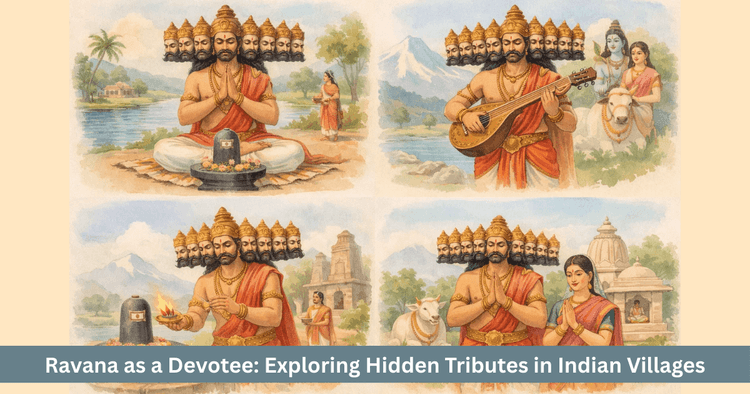
Table of Contents
The legendary monarch of Lanka from the Ramayana, Ravana, is a prime illustration of the many ways that epic heroes are interpreted in India's vast cultural and mythological milieu. While the majority of India celebrates Dussehra by burning his effigies, there are a few distinctive communities that honor Ravana as a devout Shiva bhakta, a clever scholar and a strong ruler. Using alternate narratives based on regional beliefs and customs, this article examines six such locations where Ravana is revered through ceremonies, temples and folklore.
The richness of Indian culture lies in the fact that a single character is viewed from different perspectives. Ravana, whom most people consider a villain, is worshipped in some places as a great scholar, musician and supreme devotee of Lord Shiva. This article is a journey to those unique places where Ravana is seen with honor and reverence.
Ravangram, Madhya Pradesh: Village Dedicated to Worshiping Ravana
The Madhya Pradesh village of Ravangram stands in stark contrast to the rest of India, which celebrates the victory of virtue over evil by burning effigies of Ravana during Dussehra. This village, which is in the Vidisha district, is well-known for its enduring respect for the Ramayana's Ravana, the mythical monarch of Lanka.
A ten-foot-long, reclining idol of Ravana, thought to be one of the very few in India, is located in the center of Ravangram. The residents of Ravangram view Ravana as a great scholar, a wise ruler and a devoted follower of Lord Shiva, in contrast to the vilified portrayal of him in popular myths.
Unique Traditions of Ravangram
| Feature | Description | Significance |
|---|---|---|
| Idol | Ten-foot reclining statue | Unique in India |
| Dussehra Celebration | Respect instead of effigy burning | Traditional beliefs |
| Local Belief | Considering Ravana as ancestor | Generational reverence |
| Cultural Perspective | As scholar and devotee | Positive image |
His devotion to spiritual activities, musical ability and command of the Vedas are frequently praised by the locals. Interestingly, many households in Ravangram observe ceremonies in Ravana's honor during Dussehra, viewing the day as one of respect and remembering rather than burning his effigy as is customary.
For them, Ravana is more than just a mythological figure; he is an ancestor who embodies strength, dedication and intelligence. Ravangram demonstrates that in India's varied mythological interpretations, even a character who is typically viewed as a villain can become a respected person.
Perspective of Ravangram People
- Consider Ravana a great Vedic scholar
- View him as a master of music and art
- Regard Shiva devotion as his greatest quality
- Consider Dussehra a day of mourning, not celebration
- View Ravana's death as loss of a great scholar
- Respect his intelligence and governance skills
Kakinada andhra Pradesh: Respecting the Devotee Ravana
In the Andhra Pradesh coastal town of Kakinada, Ravana is revered as a profoundly religious and learned person rather than as a villain. Some communities in this region, which have their roots in the Shaiva tradition, consider Ravana to be one of Lord Shiva's greatest devotees.
His depiction here stands in stark contrast to the prevalent narrative in the majority of India. Temples and houses resound with tales of Ravana's rigorous tapasya (penance) to obtain Lord Shiva's blessings during holy festivals like Maha Shivaratri.
Stories of Ravana's Shiva Bhakti in Kakinada
It is said that he was so devoted that he prayed and offered his own heads one by one until Shiva showed up and bestowed upon him unrivaled abilities. Some in Kakinada honor Ravana's wisdom, discipline and unshakable bhakti (devotion) rather than burning effigies or denouncing his legacy.
His stories are told to glorify his status as a strong Shiva Bhakta who was an expert in the arts, sciences and scriptures, as well as to encourage spiritual tenacity.
Characteristics of Ravana Worship in Kakinada
| Aspect | Description | Importance |
|---|---|---|
| Shaiva Tradition | Emphasis on Shiva devotion | Spiritual connection |
| Maha Shivaratri | Special ceremonies | Annual tribute |
| Penance Stories | Ten heads offered | Symbol of devotion |
| Local Belief | Scholar and saint | Positive image |
This respect in Kakinada draws attention to Ravana's complex personality, as he is not just a mythological foe but also a representation of wisdom, strength and spirituality.
Mandsaur, Madhya Pradesh: Honoring Ravana as a Son-in-Law
Ravana is regarded as a revered son-in-law rather than a demon king in the western Madhya Pradesh town of Mandsaur. There is a cultural and familial connection between the inhabitants of Mandsaur and the mythical ruler of Lanka since, according to local tradition, Ravana's wife Mandodari was from this area.
This special link has been greatly impacted by local customs. Many people in Mandsaur observe ceremonies to revere Ravana's spirit during Dussehra rather than burning his effigies as is customary.
Unique Tradition of Mandsaur
- Consider Mandodari daughter of Mandsaur
- Give Ravana status of respected son-in-law
- Do not burn effigies on Dussehra
- Perform ceremonies to seek Ravana's blessings
- Consider him powerful and wise person
- Maintain sense of familial respect
These rituals are performed to ask Ravana, who is seen as more than just the antagonist of the Ramayana but also as a strong and wise man, for blessings. As a devoted devotee of Lord Shiva, Ravana represents wisdom, power and devotion to the local populace.
Special Status of Ravana in Mandsaur
| Aspect | Reason | Result |
|---|---|---|
| Family Connection | Mandodari's birthplace | Sense of honor |
| Son-in-law Status | Marriage relation | Special traditions |
| Dussehra Celebration | Opposition to effigy burning | Alternative ceremonies |
| Cultural Identity | Local pride | Unique belief |
In contrast to other regions of India, he enjoys a position of reverence and familial regard because he is Mandodari's husband. The Mandsaur tradition serves as an example of how local interpretations of mythology can alter perceptions through connections and cultural linkages.
Bisrakh, Karnataka: Believing Ravana is a Wise Ruler
The image of Ravana takes on a remarkably different form in the peaceful village of Bisor, tucked away in the Kolar district of Karnataka. Instead of being demonized, Ravana is revered as a god, praised for his courage, wisdom and unshakable loyalty to Lord Shiva.
Here sits a unique temple to Ravana, notable for its uncommon but deeply ingrained adoration. The residents of Bisor celebrate Ravana with yearly rites, in contrast to the popular Dussehra customs that conclude with his symbolic destruction.
Features of Bisor Temple
These rituals, which frequently coincide with Dussehra, purposefully subvert the popular perception of Ravana as the Ramayana's only antagonist. Instead of seeing him as a monster, the locals see him as a wise, strong and just king.
Elements of Ravana Worship in Bisor
- Praise his devotion to spiritual activities
- Honor his mastery of the Vedas
- Sing praises of his ability to govern
- Consider Ravana multidimensional personality
- View him as combination of king, sage and devotee
- Regular worship and rituals in temple
For the locals, Ravana is a multifaceted, multidimensional figure who is a combination of monarch, sage and devotee. As a reminder of how perspective shapes mythology, Bisor's customs show how even the supposed villain may be elevated to a position of dignity and respect.
Mandya, Karnataka: Honoring Knowledge and Heritage of Ravana
In the culturally diverse area of Mandya, Karnataka, Ravana is revered for his intelligence, artistic ability and spiritual depth rather than his contentious part in the Ramayana. Because of his enormous contributions to knowledge and culture, Ravana is revered and seen with pride by some local groups.
Here, Ravana is praised for his knowledge of the Vedas, proficiency with Ayurveda and skill as a veena player aspects of his character that are frequently overlooked since he is portrayed as the antagonist in popular epic retellings.
Cultural Image of Ravana in Mandya
| Field | Expertise | Recognition |
|---|---|---|
| Music | Veena playing | Excellent artist |
| Medicine | Ayurveda knowledge | Great physician |
| Religion | Vedic knowledge | Scholar |
| Devotion | Shiva worship | Supreme devotee |
Indeed, it is stated that his veena-based musical devotion to Lord Shiva was so deep that it had the power to move the Almighty. His memory is preserved across Mandya by local folklore and tiny shrines.
Instead of concentrating on his kidnapping of Sita, these tales highlight his devotion, wisdom and status as a cultural icon. Many people view Ravana's life as a lesson in the intricacy of dharma and the quest for knowledge.
Legacy of Ravana in Mandya
- Remembered as great knower of Vedas
- Counted among early scholars of Ayurveda
- His contribution to music appreciated
- Credited with composition of Shiva Tandava Stotram
- Honored as poet, thinker and artist
- Stories preserved in local folklore
Even a so-called villain may be hailed as a sage, artist and thinker in Mandya, which honors Ravana's legacy with honor and respect and demonstrates the many and varied ways that mythical characters are interpreted in Indian culture.
Lanka, Himachal Pradesh: Honoring Ravana the Devotee
A unique and historic practice is preserved in the little-known village of Lanka, located in the tranquil Himachal Pradesh highlands close to the Chamba district. Here, Ravana is honored as a devoted follower of Lord Shiva rather than being vilified.
A modest but important temple devoted to Ravana is located in the village, offering a spiritual viewpoint distinct from the prevalent story in the majority of India. The people of Lanka feel that Ravana's devotion and penance for Lord Shiva were so great and selfless that they deserve deep respect and admiration.
Traditions of Lanka, Himachal Pradesh
His penance of offering his own heads, years of meditation and quest for heavenly understanding are regarded as spiritual turning points rather than myths. Rituals are performed in his honor to recognize his wisdom, academic endeavors and spiritual discipline rather than to exalt his involvement in conflict.
Features of Lanka Village
| Aspect | Description | Importance |
|---|---|---|
| Location | Himachal hills | Peaceful environment |
| Temple | Ravana temple | Unique worship place |
| Shivratri | Special festival | Annual ceremony |
| Local Belief | Spiritual personality | Positive perspective |
Villagers congregate to chant hymns and recount tales that emphasize his unmatched devotion to Lord Shiva during some festivals, particularly Shivratri. Lanka's distinct tradition, in which Ravana changes from a villain to a revered spiritual person, is proof that mythology can be interpreted in a variety of ways.
Cultural and Spiritual Significance of Ravana Worship
These six distinct communities provide different viewpoints that stress Ravana's knowledge, dedication and cultural achievements, illuminating the various ways he is worshipped throughout India. By demonstrating how mythology may be reinterpreted by local beliefs, these localized interpretations subvert the standard story and transform a typically demonized figure into a symbol of adoration and devotion.
Multidimensional Image of Ravana
- As great Shiva devotee
- As scholar of Vedas and scriptures
- As great knower of music and art
- As early expert of Ayurveda
- As powerful and just king
- As ascetic and yogi
These diverse interpretations reflect the richness of Indian culture, where a single character is viewed and honored from multiple perspectives. These villages that worship Ravana remind us that mythological stories are not just black and white but filled with various colors and shades.
Frequently Asked Questions
In how many places in India is Ravana worshipped? Ravana is mainly worshipped in six places in India, including Ravangram and Mandsaur in Madhya Pradesh, Kakinada in Andhra Pradesh, Bisor and Mandya in Karnataka and Lanka in Himachal Pradesh.
Why is Ravana considered a devotee? Ravana is considered a great Shiva devotee because he performed rigorous penance to please Lord Shiva and offered his ten heads one by one.
Was Ravana really a scholar? Yes, Ravana is considered a great scholar of Vedas, Ayurveda, music and scriptures. He is credited with composing the Shiva Tandava Stotram.
Why is Ravana considered a son-in-law in Mandsaur? According to local belief, Ravana's wife Mandodari was from Mandsaur, so Ravana is considered a respected son-in-law there.
Do temples dedicated to Ravana exist in India? Yes, there are temples dedicated to Ravana in Bisor, Karnataka and Lanka, Himachal Pradesh where regular worship takes place.
Get your accurate Kundali
Generate KundaliDid you like it?
Author
Pt. Amitabh Sharma (56 Years)
Experience: 20
Consults About: Family Planning, Career
Clients In: Punjab, Haryana, Delhi
Share this article with friends and family
About ZODIAQ
ZODIAQ is an online Vedic Astrology platform. It connects clients seeking astrological advice to experienced astrologers with deep knowledge. Our users also generate kundali and perform kundali milan for free. ZODIAQ also offers services to the Astrologers. Astrologers utilize various offerings by ZODIAQ to serve their clients effectively.
If you are a User
Consult with experienced astrologers and seek their guidance. You can also order handwritten Janm Patrika report with life prediction prepared by experienced astrologers. Generate accurate Kundali, perform Kundali Matching and check horoscope and muhurat. Utilize our online library for all the necessary astrological and spiritual information.
If you are an Astrologer
Create accurate kundali for your clients and perform Kundali Matching for up to 5 people at a time. Write comprehensive Janm Patrika report for your clients with ZODIAQ. Check client details anytime by saving it in client directory. Become more productive by tracking how many clients you guide every day.
WELCOME TO
ZODIAQ
Right Decisions at the right time with ZODIAQ
