Rishi Sadhu Saint Muni Sanyasi And Bhakti Yogi
By Pt. Abhishek Sharma
Clear difference between Rishi, Sadhu, Saint, Muni, Sanyasi and Bhakti Yogi in Sanatan Dharma
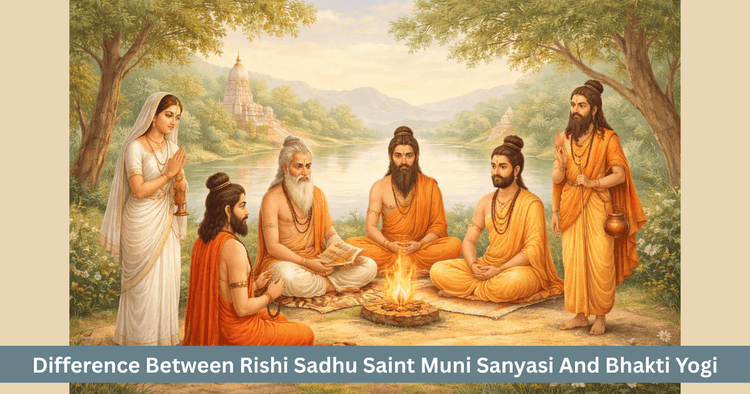
Table of Contents
Why Are There So Many Spiritual Words In Sanatan Dharma
In the Indian spiritual tradition one single word was never considered enough to describe all seekers. Different temperaments and different types of discipline needed different names. That is why words like Rishi, Sadhu, Saint, Muni, Sanyasi and Bhakti Yogi came into use.
At the surface all of them appear to be travellers on the same path of God. Yet their ways of living, their inner vows and their responsibilities differ in important ways. When a person understands these differences clearly, it becomes easier to recognise which path matches one’s own nature and inclination.
Overview Table Of The Six Paths
| Category | Core identity | Main spiritual base | Relation with society |
|---|---|---|---|
| Rishi | Seer of Vedic truth and deep wisdom | Veda, Shastra, tapas and direct insight | Guide, teacher and source of scriptures |
| Sadhu | Simple dharmic practitioner | Discipline, service, devotion and restraint | Living example of righteous conduct |
| Saint | Embodiment of love, compassion and bhakti | Name chanting, kirtan, satsang, teachings | Brings devotion to the common people |
| Muni | Silent thinker absorbed in contemplation | Manan, silence, meditation | Lives mostly in seclusion |
| Sanyasi | Complete renunciate | Sanyas vows, celibacy, Vedantic study | Limited contact but subtle guidance |
| Bhakti Yogi | Seeker of God through loving devotion | Japa, kirtan, worship and service | Spreads devotion wherever life is placed |
Who Is A Rishi And How Are Rishis Understood
In the Vedic world the word Rishi holds very high honour. The Rishi is not just a scholar. The Rishi is the one who sees the mantra. In the Vedas such a person is called mantra drashta, the seer of the hymn.
Some key points that describe a Rishi
-
Relation With Veda And Shastra
A Rishi is deeply established in the Vedas. He knows the sound, the meaning and the inner truth of the mantras. His understanding is not limited to book learning. It is based on inner experience of the reality to which the mantra points. -
Meaning Of “Rishir darshanat”
The traditional expression
“Rishir darshanat”
means that a Rishi is one who has seen the spiritual truth. This seeing is through inner vision, not with the physical eyes. -
Trust In Arsha Vachan
Sentences spoken by Rishis are called arsha vakya. Tradition treats such statements as highly reliable. The reason is that they arise from long tapas and refined insight, not from casual thinking. -
Types Of Rishis
- Maharshi - a Rishi of very high spiritual attainment
- Rajarshi - a king who is also Rishi like in his inner life
- Devarshi - a deva who holds the status of Rishi, for example Narada
- Brahmarshi - a Rishi who has realised Brahman, such as Vashishtha or Vishwamitra
In this way the Rishi stands as a pillar of the knowledge tradition. He is a source for many Shastras and a reference point for dharmic understanding.
What Is The Real Nature Of A Sadhu
In common speech many people call any ascetic a Sadhu. In the more careful language of Sanatan Dharma the word has a specific taste.
-
Core Identity Of A Sadhu
A Sadhu is one whose conduct reflects sadhuta or goodness. Such a person lives with dharma, humility and compassion. The Sadhu gradually moves away from excessive worldly involvement, yet does not reject the idea of serving others. -
Typical Lifestyle
- stays in an ashram, temple, forest or pilgrimage town
- lives with few possessions and accepts what comes with contentment
- maintains a routine that includes japa, meditation, simple food and service
-
Difference From A Rishi
- a Rishi is recognised as a seer of mantras and often as a composer of scriptures
- a Sadhu may not be such a seer, yet his life expresses straightforward dharma and kindness
Thus every Rishi has the quality of a Sadhu, yet not every Sadhu is a Rishi. The Sadhu’s main offering is his living example of simplicity and upright conduct.
Who Is Called A Saint In The Bhakti Tradition
In the context of bhakti movements the word Sant or Saint carries a special feeling. Names like Tulsidas, Surdas, Mirabai and Kabir naturally come to mind. They did not live far from people. They lived among people and brought devotion into daily life.
-
Main Features Of A Saint
- deep devotion expressed through name chanting, kirtan and poetry
- use of local language so that ordinary people can understand
- strong concern that everyone should have access to the path of God
-
Difference Between Saint And Sadhu
- a Sadhu may remain more focused on personal practice and discipline
- a Saint actively teaches and inspires large groups through songs, stories and writing
-
Role Of A Saint
- to prevent religion from becoming a dry ritual
- to connect divine principles with love, compassion and inner change
For this reason the words of saints are remembered for centuries. They bring subtle truths into the heart through very simple language.
What Does It Mean To Be A Muni
The word Muni comes from the Sanskrit root manan which means to think deeply or to reflect. The Muni turns this capacity inward.
-
Main Discipline Of A Muni
- long periods of silence
- deep contemplation and self enquiry
- careful avoidance of unnecessary talk so that mental energy is conserved
-
Traditional Explanation
A well known line says
“Maunam acharati iti munih”
which means that a Muni is one who practices silence so that his tapas is not disturbed. This silence is not forced. It is a natural outcome of deep interest in inner awareness. -
Difference Between Muni And Rishi
- the Muni’s stress is on contemplation and silence
- the Rishi adds to this a role as seer and as guide for the larger community
The Muni usually lives in seclusion, speaks very little and chooses words with great care. For such a seeker clarity of thought and steadiness of mind are the real wealth.
Who Is A Sanyasi And How Demanding Is Sanyas
The word Sanyasi is formed from sam and nyasa and points to complete renunciation. It refers to the fourth ashram in the classical scheme of life.
-
Core Vows Of A Sanyasi
- leaving behind ownership of property and social identity
- living in celibacy and restraint
- placing the search for Brahman or God at the centre of life
-
Forms Of Sanyas
Scriptures speak of different styles of Sanyasi- Parivrajaka - a wandering renunciate who does not stay long in any one place
- Yati - one who is more settled and often linked to a monastery or ashram
- Paramahamsa - one who has reached a very high state of evenness and realisation
-
Difference Between Sanyasi And Sadhu
- a Sanyasi formally accepts the vows of Sanyas with a clear ritual step
- a Sadhu may be a renunciate in practice without the same formal structure
For a Sanyasi the world appears more as a school where a role is played and set aside. The central focus becomes freedom from attachment and insight into the Self.
Who Is A Bhakti Yogi And How Is Bhakti Yoga Practised
Bhakti Yoga is the path in which love for God is considered both the means and the goal. One who walks with steady commitment on this path is a Bhakti Yogi.
-
Core Practices Of A Bhakti Yogi
- repetition of the divine name through japa
- singing of kirtan and devotional songs
- worship, offering of food and service to the chosen deity
-
Inner Attitude In Bhakti Yoga
For a Bhakti Yogi God is not only an abstract truth. God is also beloved, friend, master, parent or child. Every relationship becomes a doorway through which the heart can express love for the divine. -
Difference Between Bhakti Yogi And Saint
- a Bhakti Yogi may remain largely unknown and still be very advanced in devotion
- a Saint is usually recognised by many people and becomes a shared guide for the community
Bhakti Yoga shows that not everyone needs to follow a sharp intellectual or austere path. Pure love offered again and again can also lead to deep realisation.
Detailed Comparison Table Of The Six Paths
| Aspect | Rishi | Sadhu | Saint | Muni | Sanyasi | Bhakti Yogi |
|---|---|---|---|---|---|---|
| Main goal | Vision of truth and creation of Shastra | Purity of life and righteous conduct | Spread devotion and moral living | Direct inner understanding of truth | Liberation and realisation of Brahman | Realisation of God through loving devotion |
| Main practice | Vedic study, tapas, contemplation | Restraint, service, japa | Kirtan, teaching in simple language | Manan, silence and meditation | Renunciation, Vedantic study, discipline | Japa, kirtan, worship and selfless service |
| Place in society | High authority for dharma and knowledge | Example of dharmic life | Messenger of love and bhakti | Largely silent presence | Quiet anchor for seekers | Brings devotion into ordinary situations |
| Outer form | May look simple or special | Simple or ascetic | Usually simple and approachable | Plain and serious | Ocher robes, staff, water pot and so on | No fixed outer form required |
Do All These Paths Lead To The Same Goal
Behind all these words lies a common aspiration
- to know the Self
- to experience God
- and to become free from the cycle of suffering
The differences lie mainly in approach.
- some seek through knowledge and enquiry
- some through love and surrender
- some through discipline and renunciation
- some through silence and meditation
Sanatan Dharma does not insist that one way is superior for all. It recognises that inner tendencies vary. The many words exist so that every sincere seeker can find a path that feels natural yet still leads towards real freedom.
Frequently Asked Questions
-
Can Rishis exist in the present age
In the traditional sense a Rishi is one who has direct insight into Vedic truth and lives in constant awareness of that reality. Such masters are rare in any age, yet the stream of realisation is never considered completely closed in Sanatan thought. -
What is the main difference between a Sadhu and a Saint
A Sadhu focuses more on personal discipline and a simple dharmic life. A Saint is recognised because his or her devotion and insight reach large numbers of people through songs, writings and teachings. -
Is every Sanyasi also a Bhakti Yogi
A Sanyasi may walk mainly on the path of knowledge or on the path of meditation. A Bhakti Yogi walks mainly through love and surrender. Sometimes both qualities meet in one person, yet the two words point to different primary approaches. -
Does the silence of a Muni only mean not speaking
For a Muni silence is more than the absence of words. It is a way to quiet inner noise so that deeper insight can arise. Avoiding unnecessary talk is a tool for conserving attention and turning it inward. -
Is Bhakti Yoga only for those who leave worldly life
Bhakti Yoga is open to all, including householders. The essential need is a heart that offers love and action to God with sincerity. The external role in family or society does not block this path when intention and effort are genuine.
Get your accurate Kundali
Generate KundaliDid you like it?
Author

Pt. Abhishek Sharma (63)
Experience: 20
Consults About: Family Planning, Career
Clients In: Punjab, Haryana, Delhi
Share this article with friends and family
About ZODIAQ
ZODIAQ is an online Vedic Astrology platform. It connects clients seeking astrological advice to experienced astrologers with deep knowledge. Our users also generate kundali and perform kundali milan for free. ZODIAQ also offers services to the Astrologers. Astrologers utilize various offerings by ZODIAQ to serve their clients effectively.
If you are a User
Consult with experienced astrologers and seek their guidance. You can also order handwritten Janm Patrika report with life prediction prepared by experienced astrologers. Generate accurate Kundali, perform Kundali Matching and check horoscope and muhurat. Utilize our online library for all the necessary astrological and spiritual information.
If you are an Astrologer
Create accurate kundali for your clients and perform Kundali Matching for up to 5 people at a time. Write comprehensive Janm Patrika report for your clients with ZODIAQ. Check client details anytime by saving it in client directory. Become more productive by tracking how many clients you guide every day.
WELCOME TO
ZODIAQ
Right Decisions at the right time with ZODIAQ
