Sacred Rivers of India and Their Mystical Legends
By Pt. Narendra Sharma
When Geography Becomes Theology and Water Itself Becomes Medium of Divinity
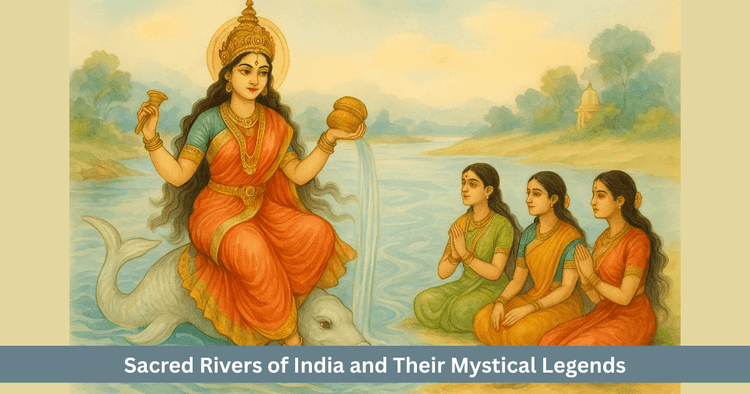
Table of Contents
When Geography Becomes Theology and Water Itself Becomes a Medium of Divinity
India's rivers are far more than geographical features carved into the landscape by millennia of flowing water. They are living deities, pulsing with divine energy, carrying within their currents the accumulated prayers of countless generations. Each river is a sacred artery through which the spiritual lifeblood of the nation flows, connecting heaven to earth, past to present, mythology to lived reality. These waterways don't merely sustain physical life-they nourish the soul. Their banks have witnessed the penances of sages, the revelations of seers, the play of gods incarnate and the devotion of millions seeking purification, blessing and liberation. To understand India's sacred rivers is to understand how geography becomes theology, how nature transforms into divinity and how water itself becomes a medium of grace. Let us embark on a journey along these hallowed waters, exploring the mystical legends that have transformed rivers into goddesses, streams into salvation and the act of bathing into communion with the divine.
Ganga: The Celestial Descent That Purified Earth
The Ganga (Ganges) stands supreme among India's sacred rivers-not merely as the longest or most revered but as the very embodiment of divine mercy descending to rescue suffering humanity. The descent of Ganga from heaven to earth was not merely a geographical event but a manifestation of divine grace prompted by the unwavering devotion of a king. This tale contains within it the extraordinary confluence of dedication, determination and divine intervention that continues to touch millions of hearts even today.
The Immortal Tale of Bhagiratha's Penance
The story of Ganga's arrival on Earth is one of mythology's most powerful tales of devotion, determination and divine intervention. This narrative has inspired generations and teaches that persistent effort and faith can make even the impossible possible.
The curse upon King Sagara's sixty thousand sons began with a terrible incident. When King Sagara was performing the Ashvamedha Yajna (horse sacrifice), his sons were filled with arrogance. In their search for the sacrificial horse, they reached the ashram of Sage Kapila who was deep in meditation. The sons, in their pride, disturbed the sage's penance. The enraged sage reduced them all to ashes with a single glance and cursed their souls to wander without peace until the sacred waters of Ganga could touch their remains. This curse persisted for many generations and the descendants of King Sagara faced the challenge of bringing Ganga to earth.
Generations of failed attempts passed. For countless years, descendants of King Sagara attempted to bring Ganga from heaven to earth but all failed. The task seemed impossible. How could a mortal compel a celestial river to leave her heavenly abode? Each failure brought disappointment, yet the ray of hope never extinguished. Finally, King Bhagiratha accepted this challenge.
Bhagiratha's unprecedented tapasya (austerity) was unique in world history. He undertook such severe penance that was unparalleled in human history. He stood on one leg for thousands of years performing austerities. He endured extreme heat and cold. Living only on air, he consumed no food or water. His determination was so firm that even the gods could not ignore his devotion. Eventually, Lord Brahma appeared and, moved by such devotion, agreed to release Ganga from heaven.
The problem of descent emerged as a new challenge. If Ganga descended directly from heaven with her full celestial force, the impact would shatter the Earth itself. Only one being possessed the strength to cushion her fall. Bhagiratha prayed to Lord Shiva, who agreed to receive Ganga's descent upon his head. When Ganga fell from heaven, Shiva caught her in his matted locks, breaking her force into seven streams that gently flowed across the Earth. Finally reaching the ocean where the ashes of the sixty thousand princes lay, Ganga's sacred waters touched them and their souls were instantly liberated.
Spiritual Significance and Profound Teachings
Ganga represents numerous profound truths that lie at the core of Hindu dharma and spirituality.
| Aspect | Meaning | Practical Practice |
|---|---|---|
| Purification | Her waters wash away sins accumulated over lifetimes | Ritual bathing, especially at sacred confluences |
| Liberation | She grants moksha to departed souls | Immersing ashes of the deceased in her waters |
| Divine mercy | She descended from heaven purely to save humanity | Viewing her as a compassionate mother goddess |
| Persistence rewarded | Bhagiratha's determination brought the impossible | Inspiration for sustained spiritual effort |
| Source of purity | Her waters remove all impurities | Daily use in worship and rituals |
Sacred sites along Ganga are centers of spiritual pilgrimage throughout India. Gangotri where she emerges from Himalayan glaciers is her source. Haridwar which means Gateway of God is where she enters the plains. Prayagraj formerly known as Allahabad is the Sangam where Ganga meets Yamuna and the invisible Saraswati. Varanasi also called Kashi is the holiest city where dying and cremation near Ganga ensures liberation. Ganga Sagar where she merges with the ocean completes her earthly journey.
Millions undertake pilgrimages to bathe in Ganga during the Kumbh Mela, the world's largest religious gathering. Devotees believe that her waters possess the literal power to cleanse karma and transform consciousness. Ganga is not merely a river but a living goddess who bestows blessings with every touch.
Yamuna: The River of Eternal Love
If Ganga represents divine mercy and purification, Yamuna embodies divine love, playfulness (leela) and the sweetness of devotion. Her dark blue waters mirror the complexion of Lord Krishna himself, with whom she shares an eternal, mystical bond. Yamuna is not merely a river but a witness to Krishna's childhood pastimes and resides at the heart of the devotional tradition.
Krishna's Sacred Playground
Yamuna's spiritual significance is inseparable from Krishna's childhood in Vrindavan. Each incident is not merely a story but contains deep spiritual teachings that demonstrate the nature of divine love and devotion. The subduing of Kaliya serpent was a significant event. When the venomous serpent Kaliya poisoned Yamuna's waters, making them deadly to drink, young Krishna danced upon the serpent's multiple heads, subduing him and restoring the river's purity. This act symbolizes divine playfulness (leela) that transforms poison into nectar, fear into love.
The Raas Leela took place on Yamuna's banks on full moon nights where Krishna performed the cosmic dance of divine love with Radha and the gopis (cowherd maidens). These moments represent the soul's longing for union with the divine, expressed through the metaphor of romantic love. The Raas Leela was not merely a dance but a symbol of the soul's union with the Supreme. Each gopi experienced dancing alone with Krishna, demonstrating that the Divine gives complete individual attention to each devotee.
Krishna's entire childhood unfolded along Yamuna. Bathing with friends, playing his flute on her banks, stealing butter and hearts with equal ease. The river witnessed and participated in these divine pastimes. Yamuna was not merely a spectator but an active participant in Krishna's leelas. Her banks are the places where the divine and human came together.
Daughter of the Sun and Sister of Death
Yamuna is also revered as Yamuna Devi, daughter of Surya (the Sun God) and sister of Yama (the god of death). According to legend, bathing in Yamuna on Bhai Dooj protects one's brother from untimely death. Those who die near her waters are spared the harshness of Yama's judgment. She intercedes with her brother on behalf of devoted souls. This tradition demonstrates the love between siblings and Yamuna's protective power.
Spiritual Practice and Beliefs
Devotees believe that dipping in Yamuna brings blessings of bhakti (devotional love). Her waters cultivate companionship with the divine. Residing near her banks makes spiritual practice easier and more joyful. She transforms ordinary consciousness into divine remembrance. The banks of Yamuna in Vrindavan remain one of India's most important pilgrimage sites, where the air itself seems saturated with Krishna's flute song and the eternal dance of divine love continues invisibly but palpably.
Saraswati: The Hidden Goddess of Wisdom
Perhaps no river in India carries more mystery than the Saraswati-a mighty river praised extensively in the Rigveda as flowing with knowledge and purity, yet invisible to modern eyes, believed to have merged underground or dried up thousands of years ago. Saraswati's tale goes far deeper than a physical river. She is the stream of knowledge flowing behind the visible world.
Vedic Descriptions and Glory
In the oldest Hindu scriptures, Saraswati was described as the mother of rivers. She was called the best of mothers, best of rivers, best of goddesses. A river flowing between the Yamuna and Sutlej, sustaining the great Vedic civilization. The river along whose banks the Rigvedic hymns were composed. These descriptions show that Saraswati was not merely a source of physical life but also of spiritual and intellectual life.
The Disappearance and Mystery
Geological and archaeological evidence suggests that around two thousand to fifteen hundred BCE, due to tectonic shifts and climate changes, Saraswati either dried up completely, went underground or merged with other river systems. Yet rather than diminishing her sacredness, her disappearance increased her mystical significance. This teaches that what is not visible is not non-existent.
The Hidden Current and Spiritual Meaning
Hindu tradition maintains that Saraswati flows invisibly underground, joining Ganga and Yamuna at Prayagraj. She represents hidden spiritual knowledge that cannot be perceived by ordinary senses. She symbolizes the wisdom tradition that flows beneath surface reality. She embodies the truth that the most powerful forces are often invisible. Saraswati's invisibility teaches us that true knowledge is seen not with external eyes but with inner vision.
As Goddess Saraswati
The river goddess Saraswati transformed into Goddess Saraswati, the goddess of learning and education worshipped by students. Goddess of music and the arts, patron of musicians and artists. Goddess of speech and eloquence invoked before important speaking. Goddess of wisdom and discrimination who distinguishes truth from illusion. During Vasant Panchami, devotees worship Saraswati, placing books and musical instruments before her image, seeking her blessing for knowledge and creativity.
Godavari: The Dakshin Ganga (Ganga of the South)
The Godavari, India's second-longest river, carries the honorific title Dakshin Ganga (Southern Ganga), recognizing her spiritual equivalence to the holiest river despite flowing through the Deccan plateau rather than the northern plains. Godavari represents Ganga for the people of South India and fulfills their spiritual aspirations.
The Legend of Sage Gautama
The Godavari's origin story involves divine intervention brought about by a sage's desperate prayer. Long ago, a devastating twelve-year drought struck the region. All water sources dried up, vegetation withered and people faced starvation. Only Sage Gautama's ashram mysteriously retained a small water supply, attracting refugees from across the land. Other sages, envious of Gautama's prominence and ashram's prosperity, conspired against him. They created an illusory cow that entered his grain field. When Gautama tried to shoo it away with a blade of grass, the illusion made it appear he had killed the sacred animal-a terrible sin.
Though innocent, Gautama accepted penance for the apparent sin. He prayed intensely to Lord Shiva, asking for a river whose waters could purify even such a grave transgression. Moved by Gautama's devotion and innocence, Shiva released the Godavari, directing her to flow through the region, bringing both physical sustenance and spiritual purification. Godavari's origin is testimony to Shiva's compassion and Gautama's righteousness.
The Pushkaram Festival
Every twelve years, when Jupiter enters a particular zodiac sign, millions gather for the Godavari Pushkaram-a massive festival celebrating the river's divine presence. Pilgrims believe bathing during this period brings merit equal to countless lifetimes of penance. The festival can draw tens of millions of devotees to the river's banks. Ritual immersion is believed to cleanse karma and grant spiritual elevation.
Sacred Geography and Important Sites
The Godavari flows through multiple spiritually significant sites. Trimbakeshwar near the river's source houses one of the twelve Jyotirlingas of Shiva. Nashik where the Kumbh Mela is held every twelve years. Bhadrachalam associated with Lord Rama's forest exile. Rajahmundry where the Pushkaram is centrally celebrated. Being called Dakshin Ganga is not mere metaphor-devotees genuinely believe that the spiritual power of Ganga flows equally through Godavari, making her accessible to those in southern India who cannot easily reach the northern sacred river.
Narmada: The River of Rebirth and Circumambulation
The Narmada holds a unique position among India's sacred rivers: it is believed that even the sight of Narmada purifies, unlike other rivers that require actual bathing. Her very presence radiates sanctifying power. Narmada's glory is unique and immeasurable.
Born from Shiva's Meditation
According to legend, Narmada emerged from Lord Shiva's deep meditation. Formed from the perspiration of his intense tapasya. Some traditions say she flowed from Shiva's body itself during cosmic dance. Others describe her as Shiva's daughter, created to purify the world. This intimate connection with Shiva gives Narmada immense spiritual potency-she carries the energy of the great god's transformative power.
The Unique Virtue and Importance of Darshan
Unlike other rivers where bathing is necessary for purification, Narmada's power operates through darshan (sight alone). Simply seeing the river cleanses sins. Living near her banks elevates consciousness. Remembering her with devotion brings merit. A traditional verse states that Ganga purifies by bathing, Yamuna by sight and Narmada by mere remembrance. This demonstrates Narmada's unique glory.
Narmada Parikrama: Journey of Transformation
The most extraordinary practice associated with Narmada is the Narmada Parikrama-the sacred circumambulation of the entire river.
| Aspect | Details |
|---|---|
| Distance | Approximately 2,500 to 3,000 kilometers |
| Duration | Traditionally takes 3-4 years to complete on foot |
| Path | Walk along one bank going downstream, return along the opposite bank going upstream |
| Rules | Walk barefoot, carry minimal possessions, rely on local hospitality, maintain spiritual focus |
| Merit | Believed equivalent to a lifetime of penance and pilgrimage |
Pilgrims undertaking Parikrama often report profound spiritual transformations. They describe the journey as a death and rebirth. Old identities dissolving in the slow walking meditation. New understanding emerging with each step. This is an inner journey that accompanies the outer journey.
Kaveri: The Daughter of the Sage, Mother of the South
The Kaveri (also spelled Cauvery) is one of the most beloved rivers of southern India, worshipped as a goddess who grants fertility, prosperity and agricultural abundance. She is the lifeline of the region and a source of nourishment for millions.
The Legend of Her Birth
The Kaveri's origin story is both mystical and touching. Sage Kavera performed intense tapasya, desiring a daughter who could bring prosperity to the parched lands of the south. Pleased by the sage's devotion, Lord Vishnu appeared and granted him a divine daughter who would manifest as a river, flowing through the land and making it fertile. The goddess came to the sage in the form of water contained in his kamandalu (water pot). When the pot eventually overturned-some say through the mischief of Ganesha in crow form-Kaveri flowed forth, beginning her sacred journey across the southern landscape.
The Goddess of Fertility
Kaveri is revered as the mother who nourishes the agricultural heartlands of Karnataka and Tamil Nadu. She is the bringer of prosperity to regions she flows through. She is the goddess of abundance, ensuring rich harvests. She is the protector of family life, blessing marriages and childbirth. The fields irrigated by her waters are lush and fertile, providing food to millions.
Brahmaputra: The Son of Brahma, Mighty River of the East
The Brahmaputra, one of the world's great rivers, carries immense spiritual significance alongside its geographic grandeur. Its very name-son of Brahma-proclaims its divine origin. This river is the lifeline of Northeast India and an integral part of Assam's culture and spirituality.
The Legend of Divine Birth
According to Hindu tradition, the Brahmaputra was born from Lord Brahma's kamandalu (water pot) during creation itself. Some texts describe the river as Brahma's son, created to purify the eastern lands. The river's immense power reflects the creative force of Brahma, the cosmic architect. Brahmaputra is not merely a river but the flow of creative power.
A River of Many Names
The Brahmaputra's journey across multiple regions gives it different names. In Tibet it is called Yarlung Tsangpo meaning the Purifier. In Arunachal Pradesh Siang or Dihang are local names. In Assam Brahmaputra meaning son of Brahma. In Bangladesh Jamuna an ancient river name. Each name reflects the local culture and relationship with the river.
Sindhu (Indus): The River of Civilization and National Identity
The Sindhu (Indus), though flowing mostly through modern Pakistan, holds profound importance for Indian civilization-it literally gave India its name. This river is not merely a geographical feature but a source of cultural and spiritual identity.
The Name-Giver
The Persians called the land beyond the Sindhu "Hindu" (their pronunciation of Sindhu). This became "India" in Greek and Latin. Thus the river's very name became the identity of an entire civilization. Sindhu gave India its identity, which makes it unique.
The Cradle of Civilization
The Indus Valley Civilization, one of the world's earliest urban cultures, flourished along the Sindhu's banks. Advanced cities like Harappa and Mohenjo-daro existed. Sophisticated urban planning with drainage systems and standardized weights was present. A culture that mysteriously declined, leaving behind questions that persist today. Sindhu carries not just water but thousands of years of history and mystery.
Conclusion: Where Geography Becomes Theology
India's sacred rivers are not mere waterways mapped by geographers or managed by engineers. They are living goddesses, each with distinct personality, mythology and spiritual power. Ganga offers purification and liberation through maternal mercy. Yamuna awakens devotional love through divine playfulness. Saraswati flows invisibly, carrying hidden wisdom. Godavari extends Ganga's grace to the south. Narmada transforms through the mere sight of her waters. Kaveri nourishes both land and spirit as the mother of fertility. Brahmaputra displays creative power in its mightiest form. Sindhu reminds us of civilizational roots and identity. These rivers remain vibrant centers of spiritual practice today and teach us that divinity permeates nature and that which flows gives life.
Frequently Asked Questions
Why is Ganga considered the holiest of all rivers?
Ganga is considered the holiest because she descended from heaven to earth through King Bhagiratha's penance and Lord Shiva received her in his matted locks. Her waters are believed to possess the power to wash away sins and grant moksha (liberation). Sacred sites like Gangotri, Haridwar, Prayagraj and Varanasi are located on her banks. It is believed that bathing in Ganga washes away accumulated sins of lifetimes and immersing the ashes of the deceased in her grants liberation to the soul. Millions bathe in her during Kumbh Mela. Ganga is not merely a river but a living goddess of divine compassion who flows eternally for humanity's welfare.
What is the relationship between Yamuna and Krishna?
Yamuna and Lord Krishna share a deep spiritual relationship because Krishna's entire childhood was spent on Yamuna's banks in Vrindavan. He subdued the Kaliya serpent in Yamuna and freed the river from poison. It was on Yamuna's banks that Krishna performed the Raas Leela with Radha and the gopis, which is the cosmic dance of divine love. Yamuna is also the daughter of Surya and sister of Yama, so bathing in her on Bhai Dooj protects one's brother. Yamuna's deep blue color reflects Krishna's complexion. Devotees believe that dipping in Yamuna brings blessings of bhakti and the experience of divine love.
Why is the Saraswati river invisible and what is its significance?
The Saraswati river, which was a mighty river in Vedic times, dried up or went underground around 2000 BCE due to geological changes. Hindu tradition believes that she still flows invisibly underground and meets Ganga and Yamuna at Prayagraj, called Triveni Sangam. Saraswati symbolizes hidden spiritual knowledge that is beyond ordinary senses. She became Goddess Saraswati, deity of education, music, speech and wisdom. Students and artists worship her. Saraswati teaches that the deepest knowledge is often invisible and requires inner vision.
What is Narmada Parikrama and what is its significance?
Narmada Parikrama is the complete circumambulation of the Narmada river, a journey of approximately 2,500 to 3,000 kilometers. Pilgrims walk barefoot, traveling downstream on one bank and returning upstream on the other. This journey traditionally takes three to four years to complete. Travelers must carry minimal possessions and depend on local hospitality. Narmada Parikrama is believed to bring merit equal to a lifetime of penance. It is a journey of profound spiritual transformation where old identities dissolve and new understanding emerges. Narmada's unique quality is that purification occurs through mere darshan (sight).
What current challenges face India's sacred rivers?
India's sacred rivers today face unprecedented threats. Pollution from industrial waste, sewage and chemical runoff is increasing. Excessive water extraction for irrigation and urban water supply is occurring. Climate change is affecting glacier-fed sources and monsoon patterns. Development pressures from dams, cities and agriculture are growing. The tragic irony is that rivers worshipped as goddesses are simultaneously being poisoned and depleted. This creates an urgent spiritual question: can reverence translate into actual protection? Worship alone is not sufficient to maintain the sanctity of rivers; practical conservation actions are necessary. It is our responsibility to keep these living goddesses pure and flowing freely for future generations.
What does Nakshatra reveal about me?
My NakshatraDid you like it?
Author
Pt. Narendra Sharma (63)
Experience: 20
Consults About: Family Planning, Career
Clients In: Punjab, Haryana, Delhi
Share this article with friends and family
About ZODIAQ
ZODIAQ is an online Vedic Astrology platform. It connects clients seeking astrological advice to experienced astrologers with deep knowledge. Our users also generate kundali and perform kundali milan for free. ZODIAQ also offers services to the Astrologers. Astrologers utilize various offerings by ZODIAQ to serve their clients effectively.
If you are a User
Consult with experienced astrologers and seek their guidance. You can also order handwritten Janm Patrika report with life prediction prepared by experienced astrologers. Generate accurate Kundali, perform Kundali Matching and check horoscope and muhurat. Utilize our online library for all the necessary astrological and spiritual information.
If you are an Astrologer
Create accurate kundali for your clients and perform Kundali Matching for up to 5 people at a time. Write comprehensive Janm Patrika report for your clients with ZODIAQ. Check client details anytime by saving it in client directory. Become more productive by tracking how many clients you guide every day.
WELCOME TO
ZODIAQ
Right Decisions at the right time with ZODIAQ
