Satarupa: The First Woman on Earth in Hinduism
By Pt. Nilesh Sharma
The story of Manu and Satarupa and the deeper truth of feminine creative energy
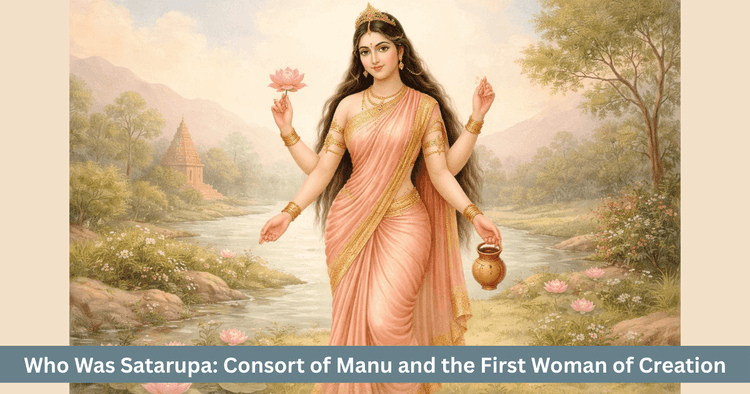
Table of Contents
Imagine a time before time when there were no days or nights no mountains no rivers not even a sky you could point at only an endless stillness full of possibilities. In that vast silence a thought arose in the mind of Brahma and creation began to move. From that first impulse Hindu tradition says two beings emerged from his mind Manu and Satarupa. Manu was the first man Satarupa the first woman yet they are much more than just two people at the start of a family tree. Together they embody a deeper union between consciousness and nature between the impulse to create and the power that makes creation real.
The name Satarupa itself is like a small scripture. Sata means hundred and rupa means forms. She is the one with a hundred forms which really means infinite forms the capacity to become soil sea sky breath emotion and living bodies. By giving this name to the first woman the tradition hints that the feminine is not just a social role but the living face of nature itself.
1 More Than a Birth Her Creation as a Cosmic Event
When the texts say that Brahma created Manu and Satarupa from his mind they are not only telling us about some miraculous birth. They are also saying that at the root of existence lies mind intention and awareness. Manu represents the conscious masculine principle the one that thinks plans organizes and directs. Satarupa represents the field of nature the feminine power that receives intention holds it and turns it into living reality.
If there were only Manu and no Satarupa the universe would be a world of ideas patterns and plans but no actual trees or rivers or bodies or experiences. If there were only Satarupa and no Manu there would be raw energy everywhere but no clear direction or structure. By letting both appear together the story tells us that every oak tree every child every civilization every work of art is a joint project between consciousness and energy.
Satarupa here is not a helpless first woman thrown into the world but the original Shakti that says yes to creation allows it to settle in her and then gives it shape in countless ways. Just as an artist needs both imagination and hands both concept and canvas Brahma’s creative urge needs Satarupa to become visible as a living world.
2 The Controversial Story Where Desire Also Appears
One part of Satarupa’s story makes many readers uncomfortable at first glance which is why some people skip it. But if we treat it symbolically rather than literally it opens up a profound reflection about mind and desire.
The story says that when Satarupa emerged her beauty and radiance captivated Brahma himself. Feeling exposed and uneasy under his fixed gaze Satarupa began to move away turning this way and that toward each of the four directions. Wherever she went Brahma manifested a new head facing that way so that his eyes would not lose sight of her. That is how he came to have four heads.
Up to this point the story can be read as a picture of the creator admiring the beauty of his own creation the way an artist might gaze at a sculpture in wonder. But when Satarupa moved upward and Brahma developed a fifth head pointed above the mood changes. It is no longer just appreciation it starts to look like fixation. Desire attachment and possessiveness creep into a space that is supposed to be clear and luminous.
At this turning point Shiva enters the scene. Shiva is not only the god of destruction he is the principle of correction balance and renunciation. He sees the imbalance sees that the creator is losing himself in his own creation and cuts off the fifth head. The image is dramatic but its message is simple even the highest creative power must stay under the discipline of dharma. When desire grows beyond its limits it must be checked.
In this episode it is easy to blame Satarupa but the story is not about her guilt. She stands for the raw power and beauty of nature which is innocent in itself. The real question is how does the mind relate to that beauty with reverence and restraint or with obsession.
3 Satarupa Manu and the Long Journey of Humanity
Once this intense scene passes the story returns to its main path. Satarupa is united with Manu and the focus shifts from cosmic drama to the beginning of human life on earth. Together they are entrusted with carrying the seed of humanity forward. From their union the texts trace the rise of lineages sages clans and royal families. For this reason they are remembered as the original father and mother of mankind.
Some narratives link them also to the cycle of great floods. In these tellings when a vast deluge threatens to wipe out all life Manu receives a warning prepares a boat and preserves different forms of life until the waters recede. After such a destruction Manu and Satarupa once again stand at a new dawn repopulating the earth and re establishing human society. They are not only the first parents but also guardians of continuity after chaos.
Seen this way the feminine is placed right at the center of survival. Even when the world breaks it is the mother principle here Satarupa that holds life quietly in her lap until it can stand again. In daily terms this is not so different from how many families survive storms through the quiet endurance and holding power of the women who keep them together.
4 Satarupa’s Name as a Key to Nature’s Hundred Faces
Her name is not just poetic it is a key to seeing the world differently. If Satarupa is the one with a hundred forms then every form around us becomes a reminder of her presence. The ground we walk on the air we breathe the food we eat the river that quenches thirst the tree that gives shade the fire that warms us each of these is one of those forms.
The inner landscape is no less her domain. The feelings that rise and fall in the heart love tenderness anger jealousy peace inspiration all of them are waves in the ocean of nature working inside us. When you feel creative fire when you feel the urge to nurture when you suddenly sense compassion even for a stranger these too can be seen as moments when Satarupa shows one more of her countless faces through you.
Hindu thought often says that Shakti the feminine power is everywhere. Satarupa is one of the earliest human forms given to that idea. Forgetting her is not just forgetting a character in a story it is forgetting that human life is woven into the life of rivers and forests and animals and skies. When a culture abuses earth exploits nature or degrades women somewhere deep inside it has lost contact with Satarupa.
5 Partnership not Hierarchy Masculine and Feminine Together
A strong message running through the story of Manu and Satarupa is that masculine and feminine are partners not rulers and ruled. They have different functions but equal importance. A seed may look complete but if it never meets good soil it will remain a dry grain forever. Soil may be rich and fertile but without seeds it will show no harvest. The relationship between seed and soil is the sort of relationship Manu and Satarupa model.
Modern society often struggles with this. On one side there are traditions where men have treated women as helpers extensions or property. On the other there are reactions where the entire masculine principle is mistrusted or dismissed. The story of Satarupa and Manu invites both sides to pause. It suggests that the dance of creation looks truly beautiful only when both stand in their own strength and honor the role of the other.
In practical terms this means a relationship where decision responsibility and emotional work are shared. It means valuing intuition as much as logic nurture as much as ambition caring as much as achieving. Satarupa reminds us that the feminine is not an obstacle to progress she is half of the power that makes any progress meaningful.
6 Satarupa as the Quiet Original Mother
In temples today we hear many divine names sung Lakshmi Durga Kali Parvati Saraswati and others. Each of these goddesses highlights a particular mood of Shakti wealth courage fierce protection wisdom. Satarupa rarely appears in such everyday worship she is more like a name hidden in older texts and discussions. Yet as the first woman and partner of the first man she stands behind them all as a quiet original mother.
Not remembering her does not erase her role. It simply means that we have let one of our deepest symbols fade from view. To bring her back into awareness is to bow to the source itself to that first feminine presence who holds the thread of human life. It is also to recognize the sacredness of every woman who carries births raises and shapes life because in each of them a little of Satarupa is walking on earth.
Her story also gently dissolves many sharp borders. When we see ourselves as children of Manu and Satarupa labels like race caste nation and tribe begin to look smaller. Underneath these differences we share the same ancient parents the same breath of consciousness the same field of nature. We are all in some way walking expressions of their partnership.
Frequently Asked Questions
1 Is Satarupa literally the first woman in Hindu tradition
Yes many traditional narratives present Satarupa as the first woman manifested in creation paired with Manu the first man and together they are seen as the symbolic parents of humankind.
2 Is Satarupa Brahmas daughter or simply his creation
She is often described as mind born emerging from Brahmas thought or from a division of his being into male and female aspects. Because of this she is called both his daughter and his feminine form depending on the telling.
3 How should we understand the story of Brahma desiring Satarupa
Instead of taking it as literal scandal it is more insightful to see it as a teaching picture showing that even the highest intellect can be disturbed by unchecked desire and that such imbalance must be corrected to protect the purity of creation.
4 What does Satarupa represent in relation to Shakti
Satarupa personifies Shakti in human terms the creative and nurturing energy that turns divine will into living worlds. She embodies nature that receives shapes and sustains making Brahmas role as creator complete.
5 Why is Satarupa relevant for people today
Because her story reminds us that the feminine principle is central to life that creativity needs both vision and nurture and that desire and power must stay within the frame of dharma. She offers a lens to rethink gender ecology relationships and inner balance in a more integrated way.
Get your accurate Kundali
Generate KundaliDid you like it?
Author

Pt. Nilesh Sharma (63)
Experience: 20
Consults About: Family Planning, Career
Clients In: Punjab, Haryana, Delhi
Share this article with friends and family
About ZODIAQ
ZODIAQ is an online Vedic Astrology platform. It connects clients seeking astrological advice to experienced astrologers with deep knowledge. Our users also generate kundali and perform kundali milan for free. ZODIAQ also offers services to the Astrologers. Astrologers utilize various offerings by ZODIAQ to serve their clients effectively.
If you are a User
Consult with experienced astrologers and seek their guidance. You can also order handwritten Janm Patrika report with life prediction prepared by experienced astrologers. Generate accurate Kundali, perform Kundali Matching and check horoscope and muhurat. Utilize our online library for all the necessary astrological and spiritual information.
If you are an Astrologer
Create accurate kundali for your clients and perform Kundali Matching for up to 5 people at a time. Write comprehensive Janm Patrika report for your clients with ZODIAQ. Check client details anytime by saving it in client directory. Become more productive by tracking how many clients you guide every day.
WELCOME TO
ZODIAQ
Right Decisions at the right time with ZODIAQ
