Spiritual Lessons from the Eight Chiranjeevis
By Pt. Suvrat Sharma
Deep Life and Dharma Teachings from Immortal Souls
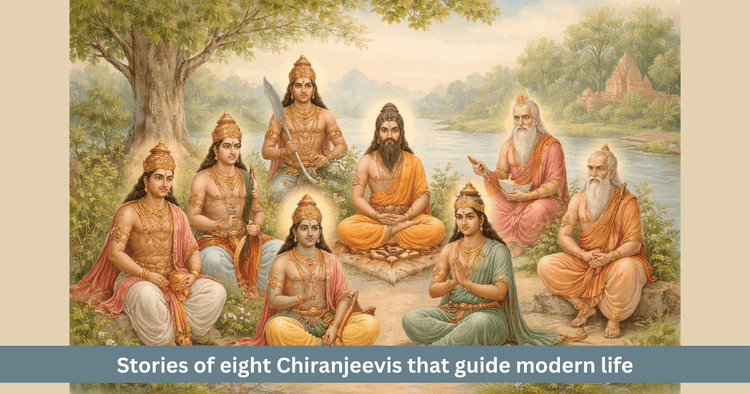
Table of Contents
In the timeless landscape of Sanatan Dharma, time is not just a line moving forward. It is also a living memory that carries impressions from age to age. Some lives fade into the background of history. Others continue to shape minds long after their stories were first told. The beings known as Chiranjeevis belong to this second kind.
Chiranjeevi does not merely mean “one who does not die.” It also means a life whose impact refuses to end. The eight Chiranjeevis remembered in tradition are not preserved as museum figures. They are living symbols of qualities that remain as relevant in the present as they were in the ancient world.
Each of them stands for a distinct inner strength - devotion, discipline, wisdom, restraint, surrender, faith, integrity and moral courage. When these qualities appear in human life, it is as if the Chiranjeevis themselves are present.
Hanuman: Strength That Bows Before Love
To understand Hanuman is to see what strength looks like when it kneels in love. He could leap across oceans, uproot mountains and shatter armies. Yet, when asked who he was, he chose to say, “I am the servant of Rama.”
From childhood his life was surrounded by miracles. Blessings from gods, extraordinary power, fearlessness. Still, his heart found its anchor in service. In the search for Sita, in the burning of Lanka, in carrying the Sanjeevani-bearing mountain, he never once asked, “What do I gain from this?” His only measure was, “Does this serve my Lord's purpose?”
Hanuman teaches that devotion is not escape from responsibility. It is the deepest way to live one’s responsibility. In a time where achievements often inflate the ego, his example whispers a different lesson - the higher you rise, the more beautiful your humility needs to become.
Parashurama: When Fierce Action Springs from Conscience
Parashurama stands at a point where tapasya and battle meet. He is often remembered as the warrior who wielded his axe against corrupt kings. Yet beneath that image stands a man of intense austerity and inner discipline.
He did not rage because his personal pride was wounded. He acted when the arrogance of power began to crush justice. His story is uncomfortable, because it shows that even in the name of dharma, intensity can cross into excess. After his battles, Parashurama is shown retreating into the silence of the forest, turning his weapon inwards as self-examination.
Through him, Sanatan Dharma suggests that anger is not automatically evil. Unchecked anger is dangerous. Anger directed by conscience, after deep reflection, can sometimes become a tool against oppression. In modern life, where inertia often hides behind the word “peace,” Parashurama asks us to consider where we must speak, stand and act firmly, without hatred.
Ved Vyasa: The One Who Gave Memory a Body
If knowledge had a human form, it would look a lot like Vyasa sitting by a river bank, calmly arranging the vast streams of wisdom flowing through him. It is through him that the Vedas were divided for easier understanding, that the Mahabharata took shape and that the Puranas were composed as stories for ordinary hearts.
Without Vyasa, much of what is now considered the backbone of Indian spirituality might have remained scattered or inaccessible. He did not keep insight locked inside the quiet of hermitages. He brought it into language, rhythm and narrative so that it could travel from mouth to ear and heart to heart.
His “immortality” lies in every verse from the Gita that is recited today, in every child who first hears the story of the Pandavas, in every seeker who finds comfort in the stories of the Puranas. Vyasa reminds the modern mind that knowledge is responsibility. To understand deeply is to accept the duty of passing clarity forward.
Ashwatthama: A Life That Shows the Weight of a Single Moment
Ashwatthama’s name carries the echo of tragedy. Trained as a warrior, raised by Dronacharya, blessed with great strength, he could have become a guardian of dharma. Instead, at the end of the war, blinded by grief and rage over his father's death, he chose a path that crossed the last boundaries of righteousness.
Entering the camp at night, striking down sleeping warriors, attacking the innocent sons of the Pandavas - these acts did not simply break rules. They broke something inside the fabric of justice itself. The immortality he received was a curse, a life stretched out with constant pain and remembrance.
His story is not told to frighten but to awaken. It shows how a single decision taken in the storm of uncontrolled emotion can stain lifetimes. In a world where reactions come faster than reflection, Ashwatthama stands as a stark reminder: power without self-control leads not to greatness but to lifelong regret.
Kripacharya: Quiet Integrity in the Midst of Conflict
Kripacharya moves through the Mahabharata almost like a shadow. He is present in the formative years of the princes, training them in weapons and discipline. He serves in the Kuru court, sees its rise and fall and yet is never loud in his claims.
He taught both sides. He remained in the Kaurava camp during the war, bound by obligations. Yet tradition remembers him as a Chiranjeevi not for taking a glorious stand on the battlefield but for the steady honesty with which he performed his role.
In Kripacharya, one sees the figure of a teacher who does his work well even when surrounded by political games and moral confusion. For the modern world, where workplaces and institutions are often tangled in complex loyalties, his presence reminds us that inner integrity can survive even when outer circumstances are far from ideal.
King Bali: The Ruler Who Offered His Head
King Bali's story is filled with strength, prosperity and unexpected surrender. As a ruler, he was generous and fair. His people loved him. His fame reached the heavens. It was in his sacrificial arena that Vamana, the dwarf incarnation of Vishnu, appeared asking only for three paces of land.
Bali agreed without hesitation. When two steps of Vamana covered earth and sky, there was no place left for the third. In that moment Bali understood. He did not argue, run or bargain. He bowed and offered his own head as the final resting place for the divine foot.
His immortality shines in this gesture. In him, leadership reveals its highest form - the willingness to give up even power itself when truth asks for it. Today, in an age where leadership often clings tightly to position and privilege, Bali's story quietly asks: “Can you step aside with grace when duty demands it?”
Markandeya: A Young Heart That Refused to Let Go of Faith
Markandeya was granted only a brief lifespan. From childhood he knew his days would be few. Yet instead of sinking into fear, he turned toward devotion with a rare intensity. When the time of his death arrived and the messenger of Death came to claim him, Markandeya clung to a Shiva lingam and poured his heart into prayer.
The story says Shiva himself appeared, breaking the noose and granting him freedom from untimely death. Whether one reads this literally or symbolically, the essence remains the same. Markandeya’s real victory was not over biological death. It was over the paralyzing grip of fear.
In a world that often swings between anxiety and numbness, Markandeya’s presence whispers that deep trust is not naive. It is a power that can transform the very quality of whatever time one has been given.
Vibhishana: Standing with Truth When It Costs Everything
In the golden city of Lanka, Vibhishana lived in the shadow of a powerful brother. Ravan was brilliant, ambitious and feared. When he abducted Sita, Vibhishana did what few dare to do in a family torn between pride and righteousness. He spoke up.
Again and again, he advised Ravan to return Sita, to avoid a war that would destroy their house. When his counsel was mocked and rejected, he faced a choice. Remain silent for the sake of family and safety or walk away for the sake of dharma. He chose to leave, to cross the sea and to stand with Rama.
His immortality lies in that choice. He shows that sometimes, truth demands that one steps out of one’s own circle and faces the label of “traitor” for a higher loyalty. In offices, communities and homes today, similar choices appear in quieter forms. Vibhishana’s story gives strength to those who refuse to support wrongdoing simply because it comes from their own side.
Why the Chiranjeevis Still Matter
The eight Chiranjeevis do not survive as distant, untouchable beings hidden in some secret corner of the universe. They remain present in the qualities they represent. Every time someone uses strength to serve rather than dominate, Hanuman lives again in that moment. Every time someone stands firm against injustice while seeking inner balance, Parashurama’s spirit is near.
Vyasa breathes through every honest effort to preserve and share wisdom. Ashwatthama’s pain echoes whenever anger threatens to cross its limits. Kripacharya’s simplicity appears in those who keep their work clean even in messy systems. Bali smiles through acts of selfless leadership. Markandeya’s faith returns in every person who refuses to surrender hope. Vibhishana’s courage shines in each quiet decision to choose right over comfortable wrong.
The Chiranjeevis are immortal because their stories continue to ask living questions of every generation.
Frequently Asked Questions
1. What exactly does the word Chiranjeevi mean?
It refers to a being whose presence and influence extend beyond an ordinary lifespan, living on through values, stories and spiritual impact.
2. Are the Chiranjeevis described as physically alive even today?
Scriptures portray them as timeless and ever-present. In a practical sense, they remain alive in the virtues they embody and inspire.
3. Why is Ashwatthama's immortality considered a curse rather than a blessing?
Because it carries unhealed suffering and constant remembrance of a grave wrong, showing how unchecked rage can turn life itself into punishment.
4. What is the single most important lesson the Chiranjeevis offer modern seekers?
That true dharma is lived through daily choices - in courage, restraint, honesty, devotion and willingness to sacrifice comfort for what is right.
5. Can ordinary people genuinely live by the ideals of the Chiranjeevis?
Yes. Their stories exist precisely to show that while their lives are vast in scale, the qualities they stand for can be practiced in small, consistent acts every day.
Get your accurate Kundali
Generate KundaliDid you like it?
Author
Pt. Suvrat Sharma (63)
Experience: 20
Consults About: Family Planning, Career
Clients In: Punjab, Haryana, Delhi
Share this article with friends and family
About ZODIAQ
ZODIAQ is an online Vedic Astrology platform. It connects clients seeking astrological advice to experienced astrologers with deep knowledge. Our users also generate kundali and perform kundali milan for free. ZODIAQ also offers services to the Astrologers. Astrologers utilize various offerings by ZODIAQ to serve their clients effectively.
If you are a User
Consult with experienced astrologers and seek their guidance. You can also order handwritten Janm Patrika report with life prediction prepared by experienced astrologers. Generate accurate Kundali, perform Kundali Matching and check horoscope and muhurat. Utilize our online library for all the necessary astrological and spiritual information.
If you are an Astrologer
Create accurate kundali for your clients and perform Kundali Matching for up to 5 people at a time. Write comprehensive Janm Patrika report for your clients with ZODIAQ. Check client details anytime by saving it in client directory. Become more productive by tracking how many clients you guide every day.
WELCOME TO
ZODIAQ
Right Decisions at the right time with ZODIAQ
