Spiritual Truth Why Ganesha’s Mouse Matters More Than You Think
By Aparna Patni
The tiny mouse at the feet of the mighty remover of obstacles shows that what we call small can actually become the key to mastering mind and action
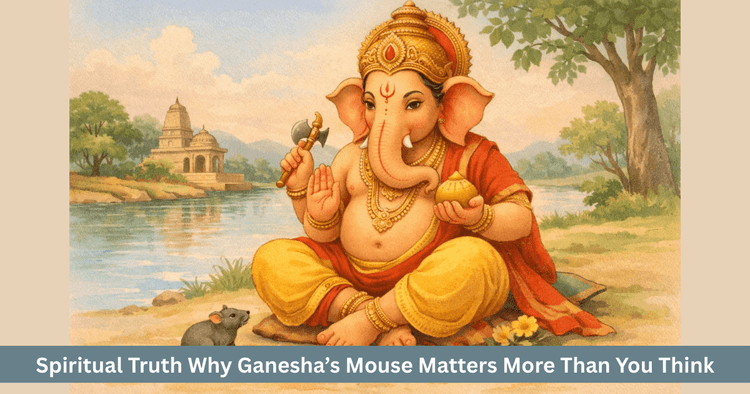
Table of Contents
When you look at an image of Lord Ganesha, your eyes are first drawn to the large head, the gentle eyes, the round belly and the modak in his hand. But near his feet sits a tiny mouse, often almost hidden. At first glance, it can seem like just a decorative detail. Yet in the language of symbols, this small creature carries a profound teaching about the mind, desire and humility.
The pairing of a mighty deity with a tiny vehicle looks strange only if we see it literally. Seen symbolically, it conveys a simple but powerful message real greatness is not about crushing what is small but about calmly guiding it. Ganesha’s mouse is not a random animal. It is a mirror held up to our own restless, curious, ever hungry mind.
1 The story of Mushika from chaos to service
One traditional story tells of a powerful being named Mushika who caused trouble for sages and seekers. He could change his size at will, slip into any place and disturb their peace. When the gods turned to Ganesha for help, Ganesha subdued Mushika without effort. When the defeated being surrendered, Ganesha did not destroy him. Instead, he transformed him into his vehicle.
This shift from enemy to vehicle is the core of the teaching. Mushika’s nature did not vanish; it was reoriented. The same speed, agility and ability to enter any corner now served a divine purpose. In us, Mushika is the tendency that sneaks into every situation ego, agitation, compulsion. When that force bows to higher wisdom, it becomes a carrier instead of a saboteur.
The message is clear our energies do not have to be annihilated; they need to be claimed and guided.
2 What the mouse says about our mind and desires
The mouse is small, fast and always searching. It slips into dark corners, nibbles at whatever it finds and rarely sits still. Our thoughts often behave in the same way jumping from worry to fantasy to resentment, rarely resting. Our desires too tend to be indiscriminate wanting one thing after another simply because it is available, not because it is truly needed.
The mouse’s habit of eating without discrimination reflects how the ego tries to feed on all experiences. It is rarely satisfied. Ganesha seated on the mouse says the mind and desires are not enemies by themselves; they become destructive when left ungoverned. When they are held under the weight of awareness and wisdom, they can move but they move in the right direction.
Seeing the mouse at Ganesha’s feet can be a daily reminder my mind is like this little creature. The question is not “How do I kill it” but “Who is it serving.”
3 Small vehicle, vast burden what this paradox teaches
Visually, it seems impossible that such a tiny creature could carry a large deity. Symbolically, it shows that size is not the measure of significance. Small things, handled rightly, can carry immense weight. A single word can heal or hurt. A brief habit repeated daily can transform a life. A short prayer can anchor a wandering mind.
In Indian life this truth appears everywhere in the seed that becomes a tree, in a mother’s everyday care that shapes a child, in the unnoticed worker whose effort keeps a system running. Ganesha’s mouse fits into this pattern. It restores respect for what looks small small tasks, small acts of kindness, small disciplines.
It also suggests that the divine is willing to work through whatever is available. No capacity is too humble to become a vehicle for grace when placed in the right hands.
4 Lessons for everyday living
The symbol of Ganesha and his mouse offers simple, practical life lessons
- Notice where your mind runs and gently guide it instead of letting it rule you.
- Recognise your desires without letting them become dictators.
- Channel ambition into service and growth instead of ego display.
- Do not despise small jobs or hidden efforts; they hold your life together.
- Before acting, pause and “sit” on your impulse the way Ganesha sits on the mouse.
Used this way, the image stops being only decoration and becomes a tool for self observation. Each time you see it, you can ask “Am I riding my mind today or is my mind riding me”
5 Bringing the symbol into your practice
In temples, many devotees glance quickly at Ganesha and miss the mouse entirely. Next time you visit, let your eyes rest on the little figure as well. Silently you might think, “This is my mind, my cravings, my smallness. May they serve something higher, not pull me away from it.”
At home, during Ganesha worship, along with offering sweets and flowers, you can offer a small promise to reduce one restless habit, to complete one small duty with care, to speak one less harsh word. The mouse reminds you that transformation often begins at the level of the tiny and repeatable, not the grand and rare.
In this way, the symbol travels with you beyond the shrine, into study, work, relationships and the small choices that actually shape your destiny.
Frequently asked questions
1. Is the mouse always a negative symbol
Not exactly. It begins as a symbol of restlessness, greed and hidden mischief but once surrendered to Ganesha it becomes a symbol of energy in service. The same traits that once created chaos become helpful when guided by higher intelligence.
2. Why didn’t Ganesha simply destroy the troublesome being instead of turning him into a vehicle
Because the deeper teaching is about transformation, not erasure. Parts of us that cause trouble often contain raw power. When they submit to wisdom and devotion, they do not have to disappear; they can be redirected toward constructive goals.
3. How can I use the mouse symbol to deal with overthinking
You can start by noticing when your thoughts are scurrying like a mouse especially into small grievances and fears. When you see this, pause, take a few slow breaths and imagine placing that “mouse” under Ganesha’s feet, choosing one more grounded action instead of another round of mental chewing.
4. What does the mouse teach about small tasks in daily life
It teaches that no task is beneath dignity if it supports something meaningful. Cleaning, cooking, listening, filing, small acts of service these are like the mouse carrying Ganesha. Without them, the larger journey cannot move smoothly.
5. Does understanding this symbol automatically make me spiritually advanced
Understanding is the first step; embodiment is the real journey. The symbol can remind you to practice self control, humility and mindful action but change comes as you make different choices day after day riding your mind instead of being dragged by it.
Get your accurate Kundali
Generate KundaliDid you like it?
Author

Aparna Patni (63)
Experience: 20
Consults About: Family Planning, Career
Clients In: Punjab, Haryana, Delhi
Share this article with friends and family
About ZODIAQ
ZODIAQ is an online Vedic Astrology platform. It connects clients seeking astrological advice to experienced astrologers with deep knowledge. Our users also generate kundali and perform kundali milan for free. ZODIAQ also offers services to the Astrologers. Astrologers utilize various offerings by ZODIAQ to serve their clients effectively.
If you are a User
Consult with experienced astrologers and seek their guidance. You can also order handwritten Janm Patrika report with life prediction prepared by experienced astrologers. Generate accurate Kundali, perform Kundali Matching and check horoscope and muhurat. Utilize our online library for all the necessary astrological and spiritual information.
If you are an Astrologer
Create accurate kundali for your clients and perform Kundali Matching for up to 5 people at a time. Write comprehensive Janm Patrika report for your clients with ZODIAQ. Check client details anytime by saving it in client directory. Become more productive by tracking how many clients you guide every day.
WELCOME TO
ZODIAQ
Right Decisions at the right time with ZODIAQ
