The Esoteric Night of Diwali: Aghori Tantric Mahakali Worship
By Pt. Sanjeev Sharma
Inner Transformation Through Worship of Mahakali
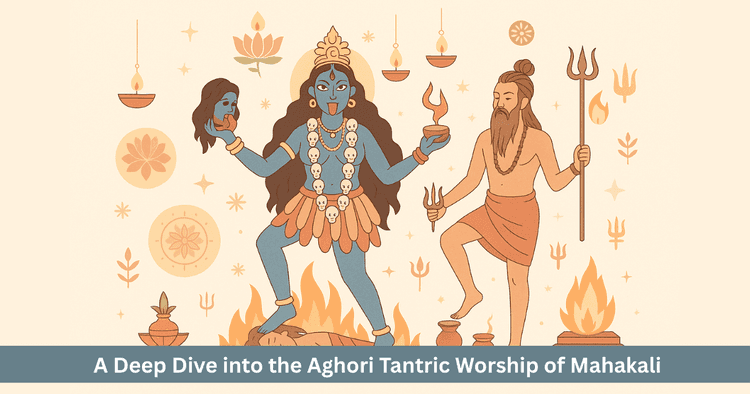
Table of Contents
While the world celebrates Lakshmi’s blessings and the glow of lamps, a parallel and hidden ritual unfolds in the shadows. On Diwali’s Amavasya night, the Aghoris, ascetics devoted to Shiva, perform their most profound tantric practices dedicated to Goddess Mahakali.
For them, this night is a transformation's forge, when death and rebirth fuse into a singular dance of consciousness.
Diwali in Tantric Understanding
For householders, Diwali glorifies prosperity and light. For tantric adepts, the absence of the Moon signifies dissolution, the fertile void (shunyata) where illusion collapses, revealing primal truth. The darkness of Amavasya is viewed not as absence but as potential.
In this nocturnal silence, Aghoris invoke Mahakali, the embodiment of fierce compassion and destruction of ignorance. She absorbs chaos and returns clarity; her dance is both the annihilation and regeneration of time itself.
Aghoris and the Cremation Grounds
The Aghori path seeks liberation through confronting decay, taboo and fear. Cremation grounds, pulsating with energies of transition, become the chosen temples.
In Varanasi’s Manikarnika Ghat, Ujjain and sacred pyres, Aghoris perform ascetic rites that pierce the boundary between the living and the infinite.
Principal Rituals
- Symbolic Blood Bath: Represents shedding ego and karmic residue. Colored herbal liquids signify vital energy redirected toward transformation.
- Corpse Meditation: Meditation on the transient body, merging awareness with Shiva and Kali amidst the dance of dissolution and rebirth.
- Standing on Burning Pyres: Called Agni Tattva Sadhana; symbolizes purification through divine fire and the triumph of spiritual strength over fear.
- Esoteric Mantras and Offerings: Chanting powerful Sanskrit invocations to Kali and Shiva using sacred substances like ash, fermented offerings and fire oblations to harness divine forces.
- Use of Implements: Skulls, tridents and fire pits act as conduits of Shakti, transforming destruction into awakening.
Philosophy of the Aghori Path
To ordinary perception, their rites appear extreme, yet they rest on a profound principle, divinity encompasses both purity and impurity.
By engaging with death and decay consciously, they dissolve illusion and duality. Cremation grounds represent the dissolving matrix where identity ends and awareness begins.
Each ritual becomes an act of purification, of the senses, the mind and the karmic body. In the Aghori view, fear itself is the final veil before enlightenment.
Cautions and Misconceptions
Scriptures warn that such practices demand disciplined initiation and years of austerity. Tantric texts insist that only realized yogis, purified of worldly desire, may tread this path safely.
Imitating Aghori rites without guidance invites imbalance or harm; hence, householders should remain observant, not practitioners.
Their secrecy and solemnity preserve both the sanctity of Tantra and the safety of those unprepared for its intensity.
Symbolism and Hidden Power
In tantric vision, the cremation ground is sacred, not as a place of death but as the womb of rebirth.
Fire represents illumination through dissolution. Mahakali’s frightening beauty reminds seekers that liberation demands surrender of ego and false identity. Through her, destruction becomes enlightenment.
By performing such rites on Diwali night, practitioners align with the cosmic rhythm, death transforming into divine light.
Comparison: Social Diwali and Tantric Diwali
| Aspect | Mainstream Diwali | Aghori Tantric Rites |
|---|---|---|
| Focus | Prosperity, family harmony | Self-transformation, fearlessness, spiritual power |
| Location | Homes and temples | Cremation grounds, secret ghats |
| Rituals | Lakshmi Puja, lighting lamps | Corpse meditation, fire invocation, mantra rites |
| Symbolism | Light conquering darkness | Ego’s dissolution; death as gateway |
| Approach | Public and communal | Esoteric, solitary, initiatory |
| Public Perception | Revered openly | Kept hidden, revered in silence |
The Inner Message
At its heart, the Aghori observance of Diwali reveals a single truth, illumination demands confrontation. One cannot dispel darkness without first entering it.
The Mahakali rituals remind that light is not born by denying the dark but by transmuting it into awareness.
Reflections
What appears terrifying on the surface hides the purest essence of transformation. The fire, the ashes, the skull, all point to transcendence of duality.
In cosmic rhythm, both the family’s lamp and the ascetic’s pyre tell the same story: from shadow to illumination.
Diwali therefore mirrors two paths, external celebration and internal surrender. Together they fulfill the festival’s eternal message: Only by embracing the dark can one become the light.
Frequently Asked Questions
Q1: Why do Aghoris perform rituals on Diwali night?
A: Because Kartik Amavasya offers the ideal alignment for invoking Mahakali and dissolving ego within cosmic darkness.
Q2: Are these rites dangerous?
A: Without proper initiation and guidance, yes. They are intended only for advanced practitioners with spiritual maturity.
Q3: What does Mahakali symbolize in Tantra?
A: She is both destructive and compassionate, the force that devours illusion and reveals truth.
Q4: Why are cremation grounds considered sacred?
A: They embody the transition between death and rebirth, symbolizing the end of ego and beginning of awakening.
Q5: What lesson does this esoteric Diwali convey?
A: That awakening arises not by fleeing darkness but by transforming it into radiant consciousness.
Get your accurate Kundali
Generate KundaliDid you like it?
Author

Pt. Sanjeev Sharma (63)
Experience: 20
Consults About: Family Planning, Career
Clients In: Punjab, Haryana, Delhi
Share this article with friends and family
About ZODIAQ
ZODIAQ is an online Vedic Astrology platform. It connects clients seeking astrological advice to experienced astrologers with deep knowledge. Our users also generate kundali and perform kundali milan for free. ZODIAQ also offers services to the Astrologers. Astrologers utilize various offerings by ZODIAQ to serve their clients effectively.
If you are a User
Consult with experienced astrologers and seek their guidance. You can also order handwritten Janm Patrika report with life prediction prepared by experienced astrologers. Generate accurate Kundali, perform Kundali Matching and check horoscope and muhurat. Utilize our online library for all the necessary astrological and spiritual information.
If you are an Astrologer
Create accurate kundali for your clients and perform Kundali Matching for up to 5 people at a time. Write comprehensive Janm Patrika report for your clients with ZODIAQ. Check client details anytime by saving it in client directory. Become more productive by tracking how many clients you guide every day.
WELCOME TO
ZODIAQ
Right Decisions at the right time with ZODIAQ
