The Forgotten Story of Jalandhara , Born of Shiva’s Fire
By Aparna Patni
The Divine Tale of Fire and Water , The Birth and Fall of Jalandhara
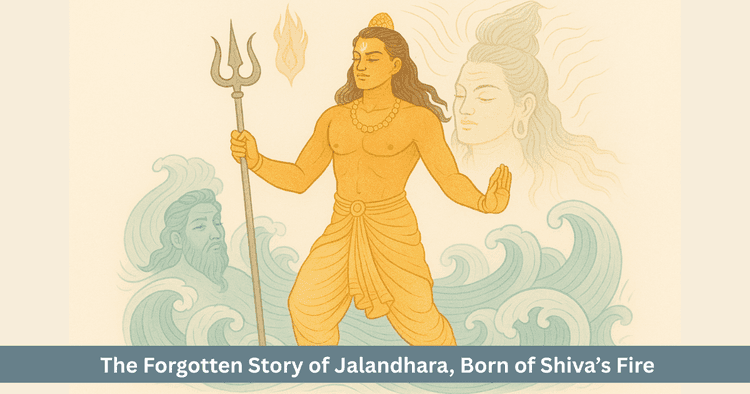
Table of Contents
Every ancient myth holds within it an echo of the human spirit. The tale of Jalandhara is one such luminous narrative. It endures not because of spectacle or victory but because of its emotional and spiritual truth. This is not the story of a mere demon destroyed by gods; it is about a being born differently , from Lord Shiva’s own fire, a spark of divine fury transformed into life itself, powerful enough to shake heaven’s foundations.
Beneath his fierce strength lies a story of pride and devotion, love and grief and destiny’s inevitable play with flame.
The Birth from Fire , When Rage Became Life
In an age when chaos ruled and devas felt powerless, mountains trembled and seas roared. Amid such turmoil, the universe wavered on the edge of dissolution. Then, from Shiva’s third eye burst forth a spark of cosmic anger , not plain fury but divine energy made living. The spark flew, plunging into the vast, rolling ocean.
There, fire met water; destruction embraced creation.
From that meeting arose a radiant boy, glowing like molten gold, born of fire yet cooled by the calm of the waves. He was named Jalandhara , “He who was born in water” or “He who holds water.”
Raised by the Ocean God
The ocean deity Varuna adopted the child as his own. In palaces of coral and pearl beneath the waves, Jalandhara grew to unparalleled might:
- His body gleamed like molten gold.
- His strength surpassed gods and demons alike.
- His courage reflected both flame and depth.
- His presence inspired awe and terror in equal measure.
Yet the same fire that had birthed him had already written his fate , to one day consume him.
The Asura King’s Rise , Fire Challenges the Gods
Unlike most asuras, Jalandhara was not born of darkness. He emerged from divine energy , Shiva’s essence , and so his rebellion began not in hatred but conviction. He saw the flaws and pride of gods and asked: Why should imperfect beings claim absolute power?
The heavens grew uneasy. His power spread swiftly, his charisma undeniable. Even Indra, lord of the devas, trembled with uncertainty.
The Challenge to Heaven
Jalandhara gathered legions of asuras but his real weapon was conviction. His war was against divine hypocrisy, not creation itself.
Victory followed victory:
- Celestial armies retreated.
- Weapons lost their strength.
- The heavens echoed his name with fearful reverence.
But within that fiery heart lay a pure devotion, his love for his wife Vrinda.
Vrinda’s Devotion , The Shield of Love
Vrinda was the embodiment of fidelity and righteousness. Her chastity and faith created an invisible shield around her husband.
| Source | Nature | Effect |
|---|---|---|
| Jalandhara’s birth | Fire of Shiva | Divine strength |
| Vrinda’s devotion | Perfect loyalty | Invulnerability |
| Combined force | Love and Power | Near-absolute protection |
As long as Vrinda’s devotion remained untouched, no god, not even Shiva, could defeat him. Yet destiny hides paradox within perfection: her love became both his shield and his flaw.
Vishnu’s Deception , The Gods’ Desperate Plan
As Jalandhara’s victories grew, the gods, unable to vanquish him, turned to Vishnu. The preserver recognized the secret: Jalandhara’s armor lay not in his body but in his wife’s virtue.
Thus began a painful divine stratagem. Vishnu assumed the form of Jalandhara and appeared before Vrinda. Mistaking him for her husband, she welcomed him with open heart. In that moment, her purity was shattered and Jalandhara’s mystical protection dissolved.
Vrinda’s Curse and Transformation
When realization dawned, Vrinda’s grief turned to righteous fury. She cursed Vishnu, saying that he too would suffer the agony of separation from his beloved. The curse fulfilled itself in Vishnu’s incarnation as Rama, enduring pain of losing Sita.
Vrinda’s mortal body perished but her spirit transformed into Tulsi, the sacred basil, forever worshipped for purity and devotion. With her fall, Jalandhara’s invincibility faded.
The Last Battle , Fire Returns to Its Source
News of Vrinda’s fate kindled both grief and rage within Jalandhara. His fiery essence flared anew. He ascended from the ocean to confront Shiva himself.
The universe held its breath:
- The sky darkened.
- The seas roared in mourning.
- Mountains quivered.
- Gods and demons watched in silence.
This was not a battle of mere might, it was creation meeting creator, flame confronting flame.
The Inevitable End
The clash was cosmic. Fire and fire collided in destructive splendor. Shiva fought not in hate but in realization, this warrior was his own emanation, his own spark given form. Yet destiny demanded closure. The fire must return.
Raising his Trishul, Shiva ended Jalandhara’s mortal form. At that instant, fire met its source and was at peace. There was no triumph, only solemn silence.
Lessons Written in Fire
Power without Humility Destroys Itself
Jalandhara’s might matched the gods but pride clouded wisdom, leading to collapse.
Love’s Dual Nature
Vrinda’s devotion made him invincible, yet its betrayal brought his fall.
Even Gods Face Consequences
Vishnu’s deception preserved order but earned a curse that echoed across incarnations.
Not All Adversaries Are Evil
Born of divine essence, Jalandhara was driven by conscience, not corruption.
The Reflection of Humanity
At its core, this is a human story clothed in divine form. It speaks of power and restraint, faith and downfall and the eternal dance between destiny and choice. Jalandhara mirrors the light and shadow within every soul, the divine flame that can illuminate or consume.
A Tale Written in Water and Fire
From Shiva’s fire to the ocean’s womb, Jalandhara’s journey reveals that birth does not fix fate; love cannot always save; power without wisdom breeds ruin; and even gods must bear the weight of consequence.
His story endures because it reflects truth: every being, born of sacred flame, must choose whether that fire will enlighten or destroy.
Frequently Asked Questions
1. How was Jalandhara born?
He emerged from the spark of fire flowing from Shiva’s third eye into the ocean’s depths.
2. What made him strong?
Divine energy from Shiva and Vrinda’s faithful love combined to form his invincibility.
3. Why did Vrinda curse Vishnu?
Because his deception broke her sacred fidelity, the source of Jalandhara’s power.
4. Who killed Jalandhara?
Lord Shiva ended his life with the Trishul in the final cosmic battle.
5. What became of Vrinda?
She became the sacred Tulsi, symbolizing devotion that transcends death and deceit.
Get your accurate Kundali
Generate KundaliDid you like it?
Author

Aparna Patni (63)
Experience: 20
Consults About: Family Planning, Career
Clients In: Punjab, Haryana, Delhi
Share this article with friends and family
About ZODIAQ
ZODIAQ is an online Vedic Astrology platform. It connects clients seeking astrological advice to experienced astrologers with deep knowledge. Our users also generate kundali and perform kundali milan for free. ZODIAQ also offers services to the Astrologers. Astrologers utilize various offerings by ZODIAQ to serve their clients effectively.
If you are a User
Consult with experienced astrologers and seek their guidance. You can also order handwritten Janm Patrika report with life prediction prepared by experienced astrologers. Generate accurate Kundali, perform Kundali Matching and check horoscope and muhurat. Utilize our online library for all the necessary astrological and spiritual information.
If you are an Astrologer
Create accurate kundali for your clients and perform Kundali Matching for up to 5 people at a time. Write comprehensive Janm Patrika report for your clients with ZODIAQ. Check client details anytime by saving it in client directory. Become more productive by tracking how many clients you guide every day.
WELCOME TO
ZODIAQ
Right Decisions at the right time with ZODIAQ
