The Mythological Story of Maa Durga's Vahan: How The Lion Became Her Divine Companion
By Pt. Sanjeev Sharma
When Courage United With Devotion To Protect Dharma
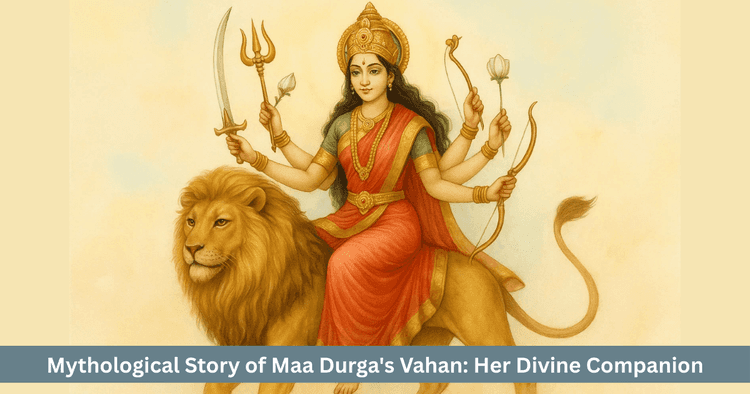
Table of Contents
When Courage United With Devotion To Protect Dharma
In the rich iconography of Hindu mythology, few images are as instantly recognizable and spiritually powerful as Maa Durga astride her magnificent lion. The goddess, radiating divine fury and compassionate protection in equal measure, sits majestically upon the king of beasts-her multiple arms wielding weapons gifted by the gods, her serene face betraying no fear despite facing the most terrible demons of cosmic order. But this partnership between goddess and lion is far more than artistic convention or mythological decoration. The lion serves as Maa Durga's vahan (divine vehicle)-a sacred companion that represents not merely transportation but the embodiment of her essential qualities, the physical manifestation of her spiritual power and a profound teaching about the relationship between divinity and the natural forces of existence. Every deity in Hinduism rides a carefully chosen vahan that reveals something fundamental about their nature: Vishnu's Garuda represents transcendent vision, Shiva's Nandi embodies patient devotion, Ganesha's mouse signifies the ability to overcome obstacles regardless of size. Similarly, Durga's lion represents the raw power of courage, the sovereignty of righteousness and the fierce protective instinct of the Divine Mother. But how did this relationship begin? Why did the goddess of protection choose the jungle's most fearsome predator as her eternal companion? The answer lies in stories that blend cosmic warfare, divine penance and the transformation of wild ferocity into sacred service.
The Nature of the Vahan: More Than Divine Transportation
Understanding the Vahan Concept
Before exploring Durga's specific relationship with her lion, we must understand the vahan concept itself-a uniquely Hindu theological innovation that transforms animals into living symbols of divine attributes. A vahan is not merely a "vehicle" in the modern sense of transportation. Rather, it represents complementary power-the quality the deity controls or embodies. Symbolic teaching-visual representation of spiritual truths. Sacred partnership-mutual relationship between deity and nature. Cosmic balance-integration of seemingly opposite forces. When Durga rides the lion, feminine grace is mounted upon masculine ferocity.
The lion (simha in Sanskrit) has carried profound symbolic weight across human civilizations. In nature, it is the apex predator, possessing overwhelming physical power, strategic intelligence, social organization and fearless courage in the face of any threat. In mythology, it is universally recognized as the "king of beasts"-representing sovereignty, nobility, courage and the right of the strong to protect the weak. In spiritual symbolism, it embodies controlled power-fierce when necessary, dignified in repose, protective of its pride and commanding respect through mere presence rather than constant aggression. When Durga rides the lion, she demonstrates that divine consciousness has mastered the most powerful forces of nature, transforming raw ferocity into sacred protection.
The Battle Against Mahishasura: How Crisis Birthed Divine Partnership
The most famous story connecting Durga with her lion vahan emerges from the Devi Mahatmyam (Glory of the Goddess), which recounts the cosmic crisis precipitated by Mahishasura-a demon whose very name means "buffalo demon."
The Demon Who Could Not Be Defeated
Through severe penances to Lord Brahma, Mahishasura obtained a boon that made him virtually invincible-he could not be killed by any man or god. This seemingly absolute protection inflated his ego beyond all bounds. Armed with this supernatural invulnerability, Mahishasura conquered the heavens, driving Indra and the gods from their celestial abodes. He installed himself on Indra's throne, usurping divine authority. He spread chaos across the three worlds-earth, heaven and the netherworlds. He disrupted cosmic order (dharma) by preventing gods from receiving sacrifices and prayers. He created an existential crisis that threatened the very fabric of reality.
For the first time in cosmic history, the assembled powers of the gods-Brahma the Creator, Vishnu the Preserver, Shiva the Destroyer-found themselves powerless against a single demon. Their weapons could not harm him, their curses could not touch him and their combined might could not dislodge him.
The Birth of the Goddess
In their desperate fury and combined determination, the gods did something unprecedented: they pooled their divine energies, causing them to merge and coalesce into a new form of divinity-a goddess who embodied the combined power of the entire divine hierarchy. From this cosmic fusion emerged Durga (literally "the Inaccessible" or "She Who Cannot Be Conquered"). Her face shone with the radiance of Shiva. Her arms emerged from Vishnu's energy. Her feet manifested from Brahma's power. Her torso formed from the strength of Indra. Each god contributed an aspect of their essence to her being.
Each deity then gifted her with their signature weapon. Shiva gave the trident (trishul). Vishnu provided the discus (Sudarshana chakra). Indra offered the thunderbolt (vajra). Agni presented a flaming dart. Vayu contributed a bow and arrows. Surya gave rays captured in her hair. Yama offered a staff and noose. Varuna provided a conch shell. Kala gave a sword and shield. With each divine weapon came the wisdom to wield it and the purpose to direct its power exclusively toward the restoration of cosmic order.
The Gift of the Lion
Among all these divine gifts, one stood out for its living, breathing significance: Himavat (the Himalaya mountains personified and father of Parvati) presented Durga with a magnificent lion as her mount. This was no ordinary lion but a creature that embodied Himalayan majesty-the grandeur and permanence of the world's greatest mountain range. Untamed power-ferocity that had never been domesticated or diminished. Natural sovereignty-the right to rule that requires no crown or ceremony. Fearless courage-willingness to face any opponent regardless of size or supernatural advantage.
The significance of the gift-giver is deeply meaningful. As Parvati's father, Himavat represents the earthly foundation of divine power. As the greatest mountain range, he symbolizes stability and permanence. His gift suggests that earth itself provides the foundation for divine intervention. The lion represents nature's own contribution to the restoration of cosmic order.
The Nine-Day Battle
Mounted upon her lion, wielding the weapons of heaven, Durga rode forth to confront Mahishasura. What followed was a battle that lasted nine days and nights-each day representing a stage in the cosmic struggle between order and chaos. Days 1-3 saw Durga's forces engage Mahishasura's demon armies, gradually pushing through layers of his military protection. Days 4-6 brought direct confrontation with Mahishasura himself, who repeatedly shape-shifted between his buffalo and human forms. Days 7-9 witnessed the final, intense combat where Mahishasura employed every supernatural trick, magical weapon and divine boon at his disposal.
On the tenth day (Vijayadashami), at the climactic moment, when Mahishasura transformed back into his buffalo form believing himself invincible, Durga leaped from her lion, placed one foot on the demon's chest and severed his head with her sword-exploiting the loophole in his boon (which protected him from gods and men but not from a goddess).
Throughout this cosmic battle, the lion was not merely transportation but an active participant. Its intimidating roar struck fear into demon armies before combat even began. As a combat partner, the lion attacked independently, tearing through enemy ranks. Its symbolic presence demonstrated that natural courage supports divine righteousness. As a psychological weapon, it showed that even the king of beasts bows before the Divine Mother. The message was unmistakable: if the mightiest predator of nature serves the goddess, what chance do demons have against her?
The Story of Parvati's Penance: When Patience Tamed Ferocity
A Different Origin Narrative
While the Mahishasura story explains how Durga used the lion in battle, another beautiful legend explains how the lion first became domesticated to divine service-through the power of patient devotion rather than martial necessity. This story begins with Mata Parvati's intense penance to win Lord Shiva as her husband. After Sati's self-immolation in her previous birth, her essence was reborn as Parvati, daughter of the mountain king Himavat. But to reunite with Shiva-who had retreated into deep meditation after losing Sati-she would need to perform tapasya of extraordinary intensity.
During her penance, Parvati's skin darkened from exposure to the elements and the intensity of her spiritual fire. When Shiva finally visited her, he playfully called her "Kali" (the dark one), intending it as affectionate humor but inadvertently touching a sensitive point. Hurt by this comment, Parvati decided to perform even more intense penance to regain her fair complexion and demonstrate that her commitment transcended all physical concerns.
The Hungry Lion Arrives
During this second, more intense period of meditation, a magnificent but starving lion, drawn by hunger and the scent of prey, came upon the motionless figure of Parvati deep in meditation. Everything in the lion's nature urged it to attack-here was food, defenseless, unaware, easily taken. But as the lion drew closer and truly saw Parvati-her radiant serenity, the luminous aura surrounding her meditative form, the palpable power of her concentrated devotion-something extraordinary happened. Instead of attacking, the lion simply sat down. And waited. And continued waiting as hours became days, days became weeks and weeks perhaps became months or even years.
When Parvati finally completed her tapasya and opened her eyes, she found the lion sitting patiently before her, never having disturbed her meditation. Its hunger clearly evident but subordinated to respect for her spiritual practice. Its wild nature voluntarily restrained by recognition of something greater than itself. Its fierce gaze now carrying devotion rather than predatory intent.
Deeply moved by this display of patience, respect and spontaneous devotion, Parvati approached Lord Shiva with a request. "Make this lion my divine vahan," she asked, "so that its courage, which chose patience over predation, might serve the protection of righteousness throughout the cosmos." Pleased by both the lion's transformation and Parvati's compassionate recognition of it, Lord Shiva granted this boon immediately. From that moment, Parvati became known as Sherawali Mata (the goddess who rides the lion). She manifested her warrior aspect as Durga. The lion became eternally bound to divine service. Its wild nature was not destroyed but sanctified-transformed from threat to protection.
The Spiritual Significance: What The Lion Teaches Devotees
The relationship between Durga and her lion transcends mythological narrative to become living spiritual teaching relevant to practitioners across centuries.
Courage in Facing Life's Battles
The primary teaching is that just as Durga rides fearlessly into battle against cosmic demons, devotees must face their life challenges with equal courage. Modern application includes personal demons like fear, addiction, harmful patterns and traumatic memories. External obstacles such as injustice, oppression, difficult circumstances and threatening situations. Spiritual challenges including doubt, despair, temptation and spiritual dryness. The lion's message is clear: you possess the courage necessary for whatever challenges you face. Like the lion, that courage may need to be awakened, trained and directed-but it exists within you.
Controlled Power: Mastering Inner Forces
The symbolic insight reveals that Durga rides the lion-she is not carried away by it, thrown by it or controlled by it. She sits firmly, directing its movement with subtle guidance. The psychological parallel shows that the lion represents our own powerful instincts and emotions: anger that could destroy or protect, sexual energy that could degrade or create, aggression that could harm or defend, passion that could obsess or motivate. Spiritual practice teaches that like Durga, we must not suppress these forces but master and direct them toward righteous purposes.
Integration of Masculine and Feminine Principles
The visual teaching of a feminine deity mounted upon a masculine animal creates a powerful integration. Durga (feminine) brings wisdom, strategy, compassion, nurturing, graceful demeanor and multiple aspects. The lion (masculine) provides raw power, strength, fierce protection, fearsome roar and focused ferocity. The integration manifests as wise application of force, compassionate warrior, grace under pressure and complexity with direction. Psychological wholeness requires that each person integrate both masculine and feminine energies regardless of physical gender. Spiritual maturity requires integrating both rather than exaggerating one and suppressing the other.
Nature Serves the Divine
The ecological message shows that the lion-representing wild nature at its most powerful-voluntarily serves the goddess, teaching that nature is not opposed to spirituality but can be its vehicle. Natural instincts can be sanctified rather than merely suppressed. The wildest forces have a place in the cosmic order when properly aligned. Even predatory energy serves life when directed by wisdom. Contemporary relevance shows that this teaching opposes views that see nature as merely fallen, corrupt or needing to be transcended.
The Iconography: What We See When We See Sherawali Mata
When Maa Durga is portrayed in temples, paintings and sculpture, several consistent elements appear. Durga's position shows her seated side-saddle or standing upon the lion, maintaining perfect balance despite the beast's movement. This posture demonstrates effortless mastery rather than struggling control, graceful authority rather than forceful domination and confident partnership rather than fearful riding. The lion's posture is usually shown in mid-stride, mouth open in a roar or engaged in combat with demonic forces, revealing active participation in the cosmic battle, fearless engagement with forces of chaos and protective stance defending both goddess and dharma.
The combined image of goddess-upon-lion creates instant recognition of divine feminine power made visible and accessible, courage manifest in physical form, the triumph of cosmic order over demonic chaos and shakti (divine feminine energy) activated and directed.
The Festival Celebration: When The Lion Lives Among Us
The nine nights of Navratri culminating in Durga Puja represent the most elaborate celebration of the goddess and her lion. Days 1-3 (Kali) represent the destruction of negative tendencies-the lion embodies the ferocity needed to tear away harmful patterns. Days 4-6 (Lakshmi) represent the creation of positive qualities-the lion demonstrates courage in building new spiritual practices. Days 7-9 (Saraswati) represent the cultivation of wisdom-the lion shows how power serves knowledge. Day 10 (Vijayadashami) celebrates victory over Mahishasura-the lion reminds us that with divine grace, all battles can be won.
During these festivals, devotees engage with the lion-goddess image through elaborate statues installed in homes and pandals, rituals that honor both the goddess and her vahan, processions through streets allowing the entire community to witness the symbol and immersion ceremonies symbolizing that protective power returns to the cosmic source but remains available when called upon again.
Conclusion: The Eternal Partnership
The story of how the lion became Maa Durga's divine companion transcends simple mythological narrative to offer multilayered spiritual teachings that remain vibrantly relevant. At the cosmic level, the partnership demonstrates that divine order requires both wisdom and power working in perfect integration. At the psychological level, the image teaches that our most powerful instincts need not be enemies of our spiritual aspirations but can become their vehicles when properly aligned. At the practical level, the goddess riding the lion reminds us that we must engage life's battles courageously, trusting that divine grace provides necessary strength. At the devotional level, the relationship models how fierce devotion provides the foundation upon which divine consciousness can manifest in the world.
Each time we see an image of Sherawali Mata-the goddess who rides the lion-we encounter not merely an ancient story but a living spiritual reality present in every act of courage against overwhelming odds, in every moment of standing for justice despite personal risk, in every instance of protecting the vulnerable with fierce determination and in every practice of harnessing our own wild energies for sacred purposes.
The lion became Durga's vahan not through conquest but through mutual recognition: the goddess saw in the lion the perfect embodiment of courage needed to protect dharma; the lion recognized in the goddess a purpose worthy of its fierce devotion. And so the image extends an invitation to each seeker: Will you tame your inner lion by directing it toward righteous purposes? Will you mount your courage, facing life's battles with confidence that divine grace provides necessary strength? Will you serve as a vehicle for the divine, allowing your natural gifts to be sanctified through alignment with cosmic order?
The goddess sits upon her lion, facing the demons of chaos with calm determination, reminding us that we too can embody this sacred partnership-courage serving wisdom, power serving compassion, the wild serving the sacred-in every moment of every day. The lion roars. The goddess smiles. And together, they ride forth to remind the world that righteousness, when armed with courage, remains eternally invincible.
Jai Maa Durga. Victory to the Divine Mother who rides the lion. Victory to the courage that serves the sacred. Victory to the power that protects all beings.
Frequently Asked Questions
Why is Maa Durga's vahan a lion and what is its significance?
Maa Durga's vahan is a lion because it represents courage, power and righteousness. The lion is nature's apex predator, symbolizing fearlessness and sovereignty. When the goddess rides the lion, it demonstrates that divine consciousness has mastered the most powerful forces of nature and transformed raw ferocity into sacred protection. The vahan is not merely transportation but an embodiment of the deity's essential qualities. The lion teaches that courage, when directed by wisdom, becomes invincible power. It also shows that natural forces, when aligned with dharma, serve divine purpose.
How did Maa Durga get her lion?
Two main stories explain how Durga received her lion. In the first, when the gods created Durga to fight Mahishasura's tyranny, Himavat (Parvati's father and personification of the Himalayas) gifted her a magnificent lion. This lion was nature's own contribution to restoring cosmic order. In the second story, when Parvati was performing tapasya, a hungry lion approached her but recognizing her spiritual power, chose to wait patiently instead of attacking. Moved by this devotion, Parvati asked Shiva to make the lion her vahan. Both stories demonstrate the integration of courage and devotion.
What is the symbolism of Durga riding the lion?
Durga riding the lion carries profound symbolism. It represents controlled power where consciousness masters powerful instincts and emotions. It demonstrates the integration of masculine and feminine principles where wisdom directs strength and grace balances ferocity. It shows that nature's wildest forces can serve the divine when properly aligned. The lion represents our own inner courage that must be awakened to face life's challenges. The goddess riding the lion teaches that we should not suppress our powerful energies but direct them toward righteous purposes.
What was the lion's role in the battle against Mahishasura?
In the nine-day battle against Mahishasura, the lion was not merely transportation but an active combat partner. Its roar struck fear into demon armies before battle even began, serving as powerful psychological warfare. The lion independently attacked enemy ranks, tearing through them and clearing the path for Durga. Symbolically, it demonstrated that natural courage supports divine righteousness. The fact that even the king of beasts serves the Divine Mother sent the message that demons had no chance against the goddess. The lion's presence restored cosmic balance where power serves wisdom.
How can we apply the lion vahan's teachings in our lives?
The lion vahan offers numerous practical teachings. First, courageously face life's challenges as the lion fearlessly enters battle. Second, master your powerful emotions and instincts-don't suppress them but direct them positively. Third, integrate your inner masculine and feminine energies rather than letting one dominate the other. Fourth, understand that your natural powers and talents are not obstacles to spiritual growth but can be its vehicles. Fifth, channel energies like anger, passion and aggression toward righteous actions. Sixth, practice patience and devotion as the lion did during Parvati's tapasya. The key is transformation, not suppression-turning wild energy into sacred service.
What does Nakshatra reveal about me?
My NakshatraDid you like it?
Author
Pt. Sanjeev Sharma (63)
Experience: 20
Consults About: Family Planning, Career
Clients In: Punjab, Haryana, Delhi
Share this article with friends and family
About ZODIAQ
ZODIAQ is an online Vedic Astrology platform. It connects clients seeking astrological advice to experienced astrologers with deep knowledge. Our users also generate kundali and perform kundali milan for free. ZODIAQ also offers services to the Astrologers. Astrologers utilize various offerings by ZODIAQ to serve their clients effectively.
If you are a User
Consult with experienced astrologers and seek their guidance. You can also order handwritten Janm Patrika report with life prediction prepared by experienced astrologers. Generate accurate Kundali, perform Kundali Matching and check horoscope and muhurat. Utilize our online library for all the necessary astrological and spiritual information.
If you are an Astrologer
Create accurate kundali for your clients and perform Kundali Matching for up to 5 people at a time. Write comprehensive Janm Patrika report for your clients with ZODIAQ. Check client details anytime by saving it in client directory. Become more productive by tracking how many clients you guide every day.
WELCOME TO
ZODIAQ
Right Decisions at the right time with ZODIAQ
