The Niyog Tradition of the Mahabharata: Understanding an Ancient Practice of Dynastic Succession
By Pt. Abhishek Sharma
The Complex Reality of Ancient Social Systems
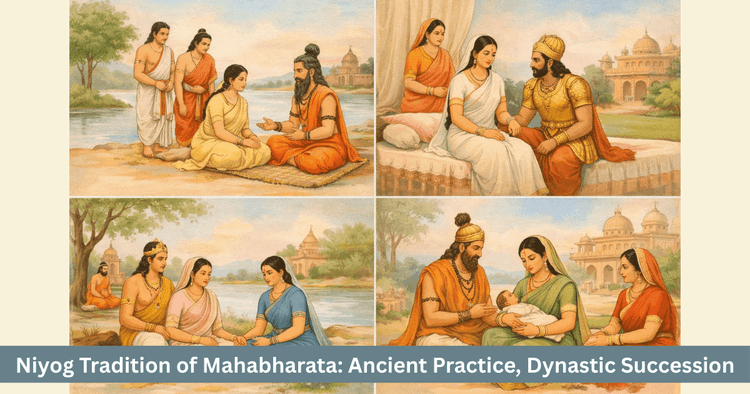
Table of Contents
The Complex Reality of Ancient Social Systems
In the narrative of the Mahabharata, one encounters a practice that contemporary readers often find perplexing or morally troubling: the Niyog tradition. This ancient custom, though operating within vastly different social and ethical frameworks than modern sensibilities, reveals profound insights about how ancient Indian societies addressed fundamental challenges: the continuation of royal lineages, the status of widows and the maintenance of dharma, cosmic order, when conventional means failed.
The Niyog system was not a casual or arbitrary practice but a carefully regulated social institution with strict protocols, ethical boundaries and specific circumstances under which it could be invoked. Understanding it requires moving beyond contemporary moral judgments to comprehend the actual logic and constraints that governed its use in the ancient Mahabharata period.
What Was the Niyog System
The Formal Definition
Niyog literally means appointment or engagement. In the context of ancient Hindu law, it referred to a specific procedure through which a widow or in some cases a wife whose husband was infertile or impotent, could conceive a child with another man, typically a man of high spiritual or social status, under strictly defined circumstances.
The Core Principle
The essential premise of Niyog was simple but profound: if a husband died without producing heirs or if he was incapable of producing children, the social and legal crisis could be addressed through a carefully regulated procedure rather than leaving the widow without issue or the dynasty without continuity.
The Strict Conditions for Its Use
Niyog could only be practiced under very specific circumstances. Husband's death: husband must have died without producing children. Husband's impotence: husband was proven incapable of fathering children. Consent: wife's formal consent was required, not assumed. Family authorization: in-laws or guardians must officially authorize the practice. Selection of partner: the man selected must be of exceptional character and spiritual standing, often a sage or Brahmin. Explicit intent: the purpose must be explicitly for procreation, not for pleasure or companionship. Limited repetition: strict limits on how many times a woman could engage in Niyog. Legal clarity: the child born would belong to the original husband's lineage, not the biological father.
What Niyog Was NOT
It is crucial to understand what Niyog explicitly was not. Not a casual affair: it was not a license for sexual relations outside marriage. Not a pleasure-seeking practice: the explicit intent was procreation for dynastic continuation. Not unlimited: women could not engage in Niyog repeatedly or without clear justification. Not binding on the biological father: the man who fathered the child had no ongoing rights or responsibilities. Not a degradation of the woman: while it involved complex negotiations around a woman's body and agency, it was theoretically designed to protect her status and ensure her security through having children.
The Theoretical Purpose: Social and Dynastic Logic
The Problem Niyog Addressed
Ancient Indian society faced a genuine crisis when a king died without heirs, threatening dynastic continuity and political stability. A woman was left widowed without children, facing social vulnerability and loss of status. The royal lineage faced extinction, creating chaos in succession. In these circumstances, Niyog represented a practical solution within the constraints of the time's understanding of marriage, duty and social obligation.
The Hierarchy of Solutions
When faced with a situation requiring dynastic continuation, the preferred options were hierarchical. The widow's remarriage to another suitable man was most preferred. The widow's practice of Niyog with a relative was preferred if remarriage was impossible. The widow's practice of Niyog with an unrelated suitable man was acceptable under strict conditions. Celibacy and acceptance of dynasty's end only if all else failed. Niyog, therefore was not the first choice but a necessary alternative when other options were unavailable.
The Protection of the Widow
From one perspective, Niyog offered protection to widows in a society with limited options for their survival. Without children, a widow had no legal claim to family property and could be cast out. Widowhood without issue made her vulnerable to poverty and social abandonment. Niyog, while involving complex negotiations, potentially preserved her status by allowing her to bear children who would support her. however it must be acknowledged that this protection came at the cost of the woman's agency and bodily autonomy, which contemporary perspectives rightly find problematic.
The Specific Examples from the Mahabharata
The Crisis of the Kuru Dynasty
The most famous application of Niyog in the Mahabharata involved the Kuru royal family, providing context for how this practice actually operated. The succession problem: Shantanu, the great king of Hastinapur, fathered Bhishma with Ganga and later Chitrangada and Vichitravirya with Satyavati. Bhishma, bound by a solemn vow of lifelong celibacy taken in a previous incident, could not marry and produce heirs. Chitrangada, Vichitravirya's elder brother, died in youth without children. Vichitravirya, married to the princesses Ambika and Ambalika of Kashi, also died young without fathering children. The dynasty faced existential threat: without heirs, the Kuru line would end, creating political chaos and leaving the widows without protectors.
The Decision to Invoke Niyog
In this crisis, Satyavati, the widows' mother-in-law and queen, made a pivotal decision. The options considered: remarrying Ambika and Ambalika to other men was not preferred as it would dilute the Kuru bloodline. Bhishma's vow made his marriage impossible despite him being the most suitable candidate. The only viable alternative was invoking Niyog. The solution implemented: Veda Vyasa, also called Krishna-Dwaipayana, a great sage and Satyavati's son from a previous relationship, was selected as the biological father. His spiritual standing, wisdom and connection to the family made him an appropriate choice under Niyog law. The explicit understanding was that children born would be legitimate heirs of Vichitravirya, not of Veda Vyasa.
The Births Through Niyog
From these practices: Ambika conceived and gave birth to Dhritarashtra, who later became king though blind. Ambalika conceived and gave birth to Pandu, who would rule the kingdom. Ambika's maidservant, in some accounts engaged with permission, conceived and gave birth to Vidur, who became a crucial advisor. All three were considered legitimate members of the Kuru dynasty, born of Vichitravirya through the Niyog practice, despite being fathered by Veda Vyasa.
The Crucial Understanding
This example reveals how Niyog actually functioned. The biological father had no paternal rights over the children. The children belonged legally and socially to the deceased husband's lineage. Veda Vyasa played no further role in the children's upbringing or governance. The practice was understood as a duty, not a pleasure or ongoing relationship. The widow's remarriage to Veda Vyasa was explicitly not intended in this case.
The Strict Rules Governing Niyog
Rules Regarding the Selection of Partner
The man chosen for Niyog had to meet exacting criteria. High spiritual standing: typically a sage, Brahmin or man of exceptional character. Reputation for virtue: his moral character had to be beyond reproach. Non-attraction: he should not be personally attracted to the woman, suggesting lack of lust motivation. Age appropriateness: often an elderly, spiritually advanced man. Willingness: he had to agree voluntarily to the practice.
Rules Regarding Frequency and Repetition
Limited repetitions: a woman could not engage in Niyog repeatedly, typically once or twice at most. Specific purpose: each instance had to serve the specific purpose of conception. Waiting periods: there were often prescribed intervals or conditions before Niyog could be attempted again.
Rules Regarding the Woman's Consent and Agency
While problematic by modern standards, ancient Niyog laws theoretically required the widow's explicit agreement: she could not be forced into Niyog. Family authorization: consent from guardians or family heads. Ritual formalization: the arrangement typically involved formal ceremonies and witnesses. Clear understanding: the woman understood the purpose and implications.
Rules Regarding the Child's Status
Legitimate inheritance: the child had full inheritance rights as if born to the deceased husband. Social legitimacy: no stigma attached to the child; he or she was a legitimate heir. No ongoing obligation: the biological father had no further responsibilities.
The Explicit Prohibition of Pleasure
Ancient texts emphasize that Niyog was not to be practiced for sexual pleasure. The arrangement should involve minimal interaction beyond the biological act. Elaborate courtship or emotional engagement was explicitly disapproved. The practice was purely transactional, focused solely on conception.
The Controversial Aspects: How Ancient Rules Acknowledged Ethical Problems
Even in ancient times, Niyog was recognized as ethically complex and potentially problematic. This is evident from:
The Strict Regulations
The very existence of so many rules suggests that the practice was understood as requiring careful limitation. If it were considered entirely legitimate or unproblematic, there would be less need for such restrictions.
The Requirement of High Status Partners
The insistence that only men of spiritual or moral standing could participate suggests an attempt to minimize exploitation. By requiring sages or spiritually advanced men, the tradition attempted to ensure that the practice would be conducted with discipline rather than lust.
The Rejection of Pleasure
The explicit prohibition against treating Niyog as a pleasure-seeking activity suggests awareness that without such restrictions, the practice could easily devolve into exploitation.
The Limitation of Repetitions
By restricting how many times a woman could engage in Niyog, the tradition attempted to prevent abuse of widows through repeated forced pregnancies.
The Mothers' Prominence: Why Children Were Called by Mother's Names
The Naming Convention
In the Mahabharata period, heroes and important figures were frequently introduced by their mother's name. Kuntiputra Arjun, Arjun son of Kunti. Kuntibhoj Bhima, Bhima son of Kunti. Gangaputra Bhishma, Bhishma son of Ganga. Devkinandan Krishna, Krishna son of Devaki.
What This Suggests
This naming convention reveals several things. Maternal prominence: mothers held significant social and spiritual status, not merely as birth-givers but as defining figures in their children's identities. Spiritual authority: by emphasizing the mother's name, the society acknowledged the mother's spiritual role in the child's conception and birth, sometimes more than the biological father's. Legitimacy through the mother: in cases of Niyog, emphasizing the mother's name asserted that the child belonged to the mother's family line and the deceased husband's dynasty, not to the biological father. Gender respect: the prevalence of this naming convention suggests mothers were respected and honored in ways that, while limited by modern standards, exceeded the status of women in many other ancient societies.
The Ethical Complexity: Modern Perspective
What Niyog Reveals About Ancient Society
The Niyog system reveals several truths about ancient Indian civilization. Pragmatism over ideology: despite strong ideals about marriage and sexuality, the society pragmatically adapted rules when circumstances required it. Women's vulnerability: the very need for such a practice highlights the precarious position of widows in a patriarchal society where women's security depended entirely on male relatives. Protection and exploitation: the practice attempted to protect widows from complete destitution while simultaneously violating their bodily autonomy and reducing them to vessels for procreation. Hierarchical thinking: the careful restrictions surrounding Niyog reveal a hierarchical understanding where the widow's feelings were secondary to family interests, the widow's choice was constrained by economic desperation and the widow's body was understood as serving dynastic needs.
What We Cannot Say
While acknowledging the practice's problems, we should avoid simple moral condemnation without understanding the actual constraints women faced. Romanticizing the practice as though it were empowering. Assuming modern consent standards could apply to ancient societies with radically different power structures. Ignoring that even within these constraints, some women had agency in negotiating terms.
Conclusion: The Niyog System as Historical Mirror
The Niyog tradition of the Mahabharata period represents a complex intersection of practical social problems, ensuring dynasty continuity and protecting widows. Patriarchal constraints, women's limited options and men's control over succession. Attempted ethical frameworks, strict rules, spiritual requirements and child legitimacy. Moral compromises, bodily autonomy violated and women's agency constrained.
The practice cannot be fully understood through either modern feminist critique alone or romantic historical nostalgia. Rather, it must be viewed as a window into how ancient societies balanced competing concerns: the need for dynastic continuity, the vulnerability of widows and limited attempts to regulate power and prevent exploitation.
The stories of Dhritarashtra, Pandu and Vidur, all born through Niyog, became central to the Mahabharata narrative itself. Their very existence through this practice raises questions that the epic itself grapples with: What makes a legitimate heir? What are the obligations of family and duty? What happens when we violate conventional rules for what are deemed necessary reasons?
In the end, the Niyog tradition reveals that even ancient societies understood themselves as balancing justice, necessity and pragmatism, often imperfectly and sometimes at the cost of those with the least power. Understanding this history helps us recognize that our own contemporary practices will likely be viewed with similar complexity by future generations, prompting reflection on what we take for granted and what we rationalize.
Frequently Asked Questions
What was the Niyog system and how was it regulated?
Niyog was an ancient Hindu practice whereby a widow or wife with an infertile husband could conceive a child with a man of high spiritual status. It was not casual but strictly regulated. It could only be invoked when a husband died without heirs or was incapable of producing children. The woman's consent and family authorization were required. The chosen man had to be of exceptional character, often a sage or Brahmin. The purpose was explicitly procreation, not pleasure. The child born belonged to the deceased husband's lineage, not the biological father. Women could engage in Niyog in limited repetition, typically once or twice. These strict rules were designed to prevent abuse and ensure the practice served dynastic continuity, not exploitation.
How was Niyog used in the Mahabharata?
The most famous example of Niyog in the Mahabharata was the Kuru dynasty. When King Vichitravirya died without heirs, his widows Ambika and Ambalika were in crisis. Bhishma, bound by a vow of celibacy, could not marry. To save the dynasty, Queen Satyavati summoned her son, the sage Veda Vyasa, for Niyog. Ambika gave birth to Dhritarashtra. Ambalika gave birth to Pandu. A maidservant gave birth to Vidur. All three were considered legitimate heirs of Vichitravirya, not Vyasa. Vyasa had no further paternal role. This example shows how Niyog was a practical solution to dynastic crises while maintaining legal and social norms.
What distinguished Niyog from casual relationships?
Niyog was not a casual relationship but a carefully regulated social institution. It required specific circumstances: a dead or impotent husband. Formal consent from both the woman and family. Partner selection limited to sages or men of high moral standing. Explicit intent for procreation, not pleasure. Legal clarity that the child belonged to the deceased husband. Limited repetition; women could not repeatedly engage in Niyog. Ritual formalization involving formal ceremonies and witnesses. Prohibition of pleasure; texts explicitly rejected Niyog for sexual gratification. These strict rules fundamentally distinguished it from casual relationships and show it was designed to prevent exploitation, though imperfectly.
How did Niyog help or harm widows?
Niyog affected widows in complex ways, both helpful and harmful. Helpful aspects: without children, widows had no claim to family property and could face poverty. Niyog allowed them to bear children who would support them. It helped widows maintain social status and security. It sustained dynasties on which they depended. Harmful aspects: it violated their bodily autonomy. Their choice was constrained by economic desperation. It reduced them to reproductive vessels. It reinforced patriarchal control. While Niyog provided some protection from complete destitution, it came at the cost of women's agency. Modern perspectives rightly find this problematic but it's important to understand it attempted to address real crises widows faced, though imperfectly.
How should we understand the Niyog tradition today?
Niyog should be understood complexly, avoiding both modern moral condemnation and historical romanticization. It's important to recognize it violated bodily autonomy and reflected patriarchal control. To understand the context of real crises faced by widows who had few options. To acknowledge it was an imperfect attempt to balance justice, necessity and pragmatism. To recognize that strict rules attempted to prevent exploitation, though inadequately. To understand it shows us how societies grapple with complex problems like dynastic continuity and women's vulnerability. To acknowledge our own contemporary practices will face similar scrutiny in the future. Niyog is a historical mirror revealing both the complexities of ancient society and reflection on our own assumptions.
Get your accurate Kundali
Generate KundaliDid you like it?
Author

Pt. Abhishek Sharma (63)
Experience: 20
Consults About: Family Planning, Career
Clients In: Punjab, Haryana, Delhi
Share this article with friends and family
About ZODIAQ
ZODIAQ is an online Vedic Astrology platform. It connects clients seeking astrological advice to experienced astrologers with deep knowledge. Our users also generate kundali and perform kundali milan for free. ZODIAQ also offers services to the Astrologers. Astrologers utilize various offerings by ZODIAQ to serve their clients effectively.
If you are a User
Consult with experienced astrologers and seek their guidance. You can also order handwritten Janm Patrika report with life prediction prepared by experienced astrologers. Generate accurate Kundali, perform Kundali Matching and check horoscope and muhurat. Utilize our online library for all the necessary astrological and spiritual information.
If you are an Astrologer
Create accurate kundali for your clients and perform Kundali Matching for up to 5 people at a time. Write comprehensive Janm Patrika report for your clients with ZODIAQ. Check client details anytime by saving it in client directory. Become more productive by tracking how many clients you guide every day.
WELCOME TO
ZODIAQ
Right Decisions at the right time with ZODIAQ
