The Silent Grace of Saraswati: Realizing Wisdom, Not Memorizing Words
By Pt. Narendra Sharma
The Profound Difference Between Realized Wisdom and Memorized Information
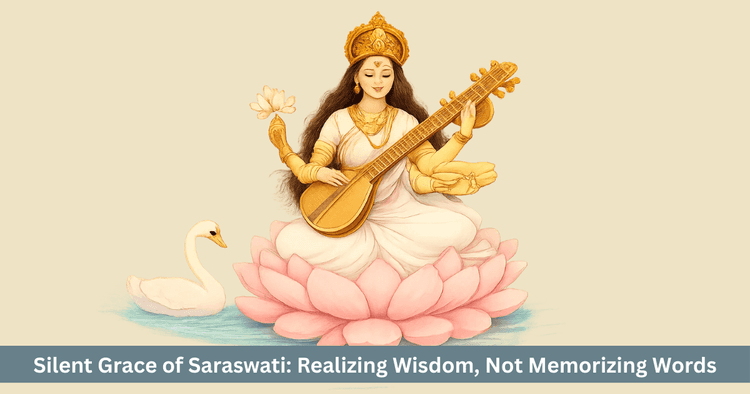
Table of Contents
Knowledge is not memorized but realized. Saraswati sits with the still-hearted, not the loud-minded. In an age of relentless information, streaming data and the proud accumulation of credentials, we have forgotten something profoundly important about the nature of wisdom itself. We have mistaken knowledge for information, memorization for understanding and the noise of learning for the silence of realization. In this confusion, we have lost touch with what Saraswati, the goddess of wisdom in Hindu tradition, truly represents.
The image of Saraswati perched on a lotus, veena in hand, dressed in pristine white, is one of the most recognizable in Hindu iconography. Yet she remains one of the most fundamentally misunderstood deities. She is invoked by students before exams as though she were a supernatural tutor, honored in schools as though she were the patroness of grades and achievements and worshipped in temples as though she could be bribed with flowers and chants to grant knowledge like a celestial librarian issuing books from an infinite collection. But this understanding barely grazes the profound truth that Saraswati embodies. She is not the goddess of information or intellectual accumulation. She is the goddess of realized wisdom, the grace that illuminates consciousness itself when the mind achieves sufficient stillness to receive it.
The Goddess of Silence Not Sound
The Paradox at the Heart
There exists a beautiful paradox at the center of Saraswati's nature. She is associated with Veda, meaning both knowledge and that which is heard. She is connected with sound, music, speech and learning. Yet her truest manifestation is in silence. This is not a contradiction but a profound teaching. All genuine sound emerges from silence. All true speech flows from the still source. All authentic learning arises from the absence of noise.
Consider the veena that Saraswati plays. Before music, there is silence. The musician must be still to play perfectly. The notes are beautiful because they contrast with silence. The greatest music contains spaces of silence between the notes. The veena is not merely an instrument for making sound but a teacher of the relationship between sound and silence. Saraswati's mastery lies not in her ability to produce volume but in her understanding of when to play, when to pause and when to rest in perfect quiet.
The Goddess Beyond Noise
In the modern world, we have created an environment of unprecedented noise. Information noise exists where endless data streams, notifications and streams of content flow. Mental noise exists where racing thoughts, anxiety and constant internal chatter persist. Emotional noise exists where reactivity, craving for recognition and fear of inadequacy dominate. Social noise exists where the ceaseless demand to be heard, to prove oneself and to make an impact prevails. Technological noise exists where beeping, buzzing and constant connectivity never cease.
In this cacophony, Saraswati has become nearly inaccessible. Not because she has withdrawn but because the loud cannot hear the still voice of wisdom. She has not abandoned the world; rather, the world has grown too loud to perceive her presence. The Rig Veda describes Saraswati with extraordinary poetry. May Saraswati, the inspirer of true knowledge and wisdom, flow richly for the one performing the sacred inner sacrifice. Notice what is not mentioned: degrees, achievements, competitions or the accumulation of information. Instead, the invocation speaks of Saraswati flowing for those engaged in sacred inner sacrifice, suggesting that wisdom comes to those who sacrifice their ego, their noise, their constant seeking.
The Lost Art of Realization From Shruti to Aparoksha Anubhuti
The Ancient Understanding and Vedic Perspective
The ancient rishis approached knowledge in a way fundamentally different from modern education. They did not study the Vedas but heard them. Shruti means that which is heard. But this hearing was not passive reception of information. It was an active process of receptivity, where consciousness itself became the listening instrument. The sounds were perceived not with ordinary ears but with the inner ear of the awakened heart.
More profoundly, the tradition speaks of Aparoksha Anubhuti, direct and unmediated experience of truth. This is the opposite of Paroksha Jnana, indirect knowledge gained through concepts, words and secondhand information. It is opposite to intellectual understanding, grasping ideas without embodying them. It is opposite to memorized wisdom, knowing what the scriptures say without realizing what they mean.
Aparoksha Anubhuti is the immediate and personal realization of truth, experienced directly by consciousness itself, beyond all words and concepts. This is knowledge that transforms your being because it is not intellectual understanding but living realization.
The Inadequacy of Words
One of the most startling proclamations in the Upanishads directly addresses the limitation of knowledge transmitted through language. The Kena Upanishad states that from which words return, not having attained it, along with the mind. This statement is radical. It suggests that the highest truth is beyond words and thought, that language itself fails when confronting ultimate reality.
This creates a troubling paradox for anyone seeking wisdom through reading, study or intellectual learning. If the highest truth cannot be expressed in words, how can it be transmitted through scriptures? If the mind cannot grasp it, how can books convey it? The answer lies in understanding that scriptures do not transmit wisdom but point toward it. They are like fingers pointing at the moon. Infinitely more valuable is actually seeing the moon than memorizing the finger's position.
The Ego Based Knowledge Trap
The Kena Upanishad contains another profound statement about the nature of knowing. He who thinks he knows, does not know. He who knows he does not know, truly knows. This encapsulates a crucial distinction. False knowledge is believing you have understood when you have merely memorized. This is the state of accumulated ego, where the mind becomes convinced of its own comprehension and closes to further revelation. True knowledge is recognizing the limits of conceptual understanding and remaining open to direct realization. This is the state of fertile ignorance, where the mind remains receptive because it understands its own insufficiency.
Herein lies a devastating truth about modern education and learning. The more you memorize, the more convinced you become that you understand. The ego-based learner's greatest obstacle is their own confidence. A filled cup cannot receive new water. A proud mind cannot contain wisdom. Saraswati flows only into the vessel of genuine humility.
The Difference Between Scholar and Sage
Consider the fundamental difference. The scholar obtains knowledge from external sources: texts, teachers and study. Their knowledge is based on memorization and intellectual understanding. The sage obtains knowledge from direct inner realization. Their knowledge comes from meditation, self-inquiry and direct experience. The scholar's knowledge can be lost or forgotten because it is stored in the mind. The sage's knowledge becomes their very being, so it cannot be lost. The scholar's expression is eloquent speech and debate. The sage's expression is silent presence and authenticity.
| Aspect | Scholar | Sage |
|---|---|---|
| Source | External texts and teachers | Direct inner realization |
| Process | Memorization and analysis | Meditation and integration |
| Knowledge | Can be lost or forgotten | Becomes being itself |
| Expression | Eloquent speech and debate | Silent presence and authenticity |
| Fruit | Recognition and credentials | Peace and discernment |
| Relationship to Ego | Feeds it | Dissolves it |
A scholar can recite a thousand verses from the Bhagavad Gita while remaining bound by ego, attachment and desire. A sage might never have read the Gita but embodies its teachings through direct realization. Saraswati does not honor the former but inhabits the latter.
Saraswati's True Companions The Hamsa and Viveka
The Swan as Symbol of Discrimination
In Saraswati's traditional iconography, she is depicted riding or accompanied by a hamsa, a swan. This is far more than aesthetic choice. The hamsa is a profound symbol of viveka, discrimination between truth and illusion. An ancient story illustrates the hamsa's significance. The hamsa can separate milk from water mixed together. Offered a mixture of both, the swan will drink only the milk, leaving the water untouched.
What does this teach spiritually? The capacity to distinguish truth from falsehood, wisdom from mere information, essence from form. In Hindu philosophy, viveka is considered one of the foundational spiritual qualities. It is the capacity to discern what is eternal from what is temporary, what leads to liberation from what leads to bondage, what is true from what merely appears true, what feeds the soul from what merely feeds the ego.
Without viveka, one cannot truly benefit from any teaching. With viveka, even simple statements reveal infinite depths. This is why Saraswati cannot be accessed through mere intellectual study. She requires the discriminating faculty, the ability to sense when words point toward truth and when they obscure it, when concepts serve realization and when they impede it, when knowledge uplifts and when it inflates ego.
The Still Hearted
Saraswati's true devotees, therefore are not those who speak most eloquently or accumulate the most credentials. They are the still-hearted, those who no longer chase recognition for their knowledge, who find joy in inner clarity rather than external confirmation, who are not swayed by the loudest voice or the latest trend, who listen deeply to the whispers of wisdom beneath the noise, who have sacrificed their need to prove themselves.
The perfect example in Hindu mythology is Nachiketa from the Katha Upanishad. A young boy, he sits in patient silence before Yama, the god of death, not debating, not arguing, not trying to impress with his knowledge. In that silence, he receives the knowledge of immortality, not taught as information but awakened as direct realization. By contrast, the loud-minded are like the crow chasing its echo. No matter how hard it caws, it only hears itself. The more it seeks to dominate the air with its voice, the less it can hear the genuine sounds of wisdom around it.
The Mystery of Remembrance Learning as Awakening
Knowledge as Remembrance
One of the most profound concepts in Hindu philosophy is the idea that true knowledge is not new learning but remembrance. Smriti. This suggests something extraordinary. The soul already knows the ultimate truths. Learning is the process of removing obstacles to remembering what is eternally known. This teaching appears in the Bhagavad Gita where Krishna says to Arjuna that never was there a time when I did not exist, nor you, nor all these kings. Nor will any of us cease to exist in the future. This is not new information to be learned but eternal truth to be remembered and realized.
Meditation as the Gateway to Remembrance
If learning is remembrance, then what is the mechanism of this remembrance? Meditation, the stilling of the mind through Dhyana. In meditation, the surface noise of the mind settles, the deep knowing of the soul rises, the eternal truths which are always present become perceptible and direct experience replaces conceptual knowledge.
The great eternal proclamations of Vedantic wisdom such as Aham Brahmasmi meaning I am Brahman, Tat Tvam Asi meaning Thou art That and Sarvam Khalvidam Brahma meaning All this is Brahman are not intellectual ideas to be debated but echoes of your own being, waiting for the silence to be heard again.
The Case of Ramana Maharshi
Perhaps no modern example illustrates this principle better than Sri Ramana Maharshi. Born in eighteen seventy-nine, he had little formal education. He never studied the scriptures extensively or underwent years of guru training. Yet at the age of sixteen, while sitting alone, he underwent a spontaneous realization of the Self through what he called deathlike inquiry, simply turning attention inward to observe the nature of the I that seemed to exist.
In that moment of direct experience, he realized what centuries of study cannot convey: the eternal nature of consciousness, the illusory nature of individual identity, the peace that surpasses all understanding and the direct evidence of immortality. When asked later about his knowledge of scriptures, Ramana acknowledged that while he could not recite them extensively, he had realized their essential truth directly. He had not memorized the Upanishads but had become them.
This is the difference between Saraswati as academic goddess and Saraswati as the revealer of realized wisdom. She is not impressed by how much one knows but is moved by how deeply one has realized.
The Path to Saraswati The Way of Surrender
How One Invites Saraswati
The irony is profound. Saraswati cannot be acquired through the usual strategies of acquisition. She cannot be shouted at through loud chanting of mantras without feeling or understanding, debated into submission through clever arguments about Vedanta, shown off through displays of knowledge and credentials, demanded through aggressive study and cramming or purchased through expensive education and status-seeking.
Instead, Saraswati arrives through humility, recognizing the limits of one's understanding and remaining teachable. She arrives through quietude, creating space through meditation and contemplation for wisdom to emerge. She arrives through purity, cleansing the mind of excessive desires, attachments and ego-based motivations. She arrives through devotion, approaching knowledge not as commodity to be seized but as grace to be received. She arrives through presence, being fully present in the moment rather than constantly reaching for new information.
The Inward Sanctuary
Saraswati's true abode is not a temple with golden doors or a fancy university building. It is the silent shrine of the heart. She dwells in the sanctuary that opens when the storm of desires settles, the winds of ego-seeking fall still, the turbulent waters of ambition grow calm and the noise of constant seeking finally ceases. Only then does she appear, not with fanfare but with the gentle grace of revelation.
The Prayer of Surrender
The Gayatri Mantra, considered Saraswati's supreme expression, beautifully illustrates this principle of surrendering to wisdom rather than grasping for it. Om Bhur Bhuvah Svah Tat Savitur Varenyam Bhargo Devasya Dhimahi Dhiyo Yo Nah Prachodayat. The essence of the prayer is contained in the final phrase: Dhiyo Yo Nah Prachodayat, meaning May she illuminate our intellect.
Notice what this prayer does not ask for: wealth or power, victory or recognition, achievement or status, fame or influence. Instead, it humbly requests only one thing: illumination of the intellect, the dawning of clarity and wisdom. The prayer itself is remarkable in its quality of inward humility. It does not command or demand but surrenders and asks for grace. It acknowledges that illumination is not something we can force but something we must become open to receive.
The Deepest Truth All Knowledge is Silence
The Mystery of Mouna
In the Sanskrit tradition, there is a concept called Mouna, silence. But this is not the mere absence of sound. Mouna is the silence of knowing, the quiet of realization, the peace that comes when all questions dissolve. There is a famous teaching: The greatest teaching is silence. This does not mean that nothing is being communicated; rather, the most profound transmission occurs beyond words, in the direct mind-to-mind transfer of understanding between teacher and student in moments of profound presence.
Saraswati's truest manifestation is Mouna, the teaching given without words, the wisdom communicated through presence, the revelation that requires no explanation. The Upanishads speak of Nada, the unstruck music of consciousness, the eternal sound that is not produced by striking anything but emanates from the very fabric of existence.
This Nada is the foundation upon which all other sounds rest, the silence out of which all speech emerges, the cosmic vibration from which all manifestation arises and the hum of reality itself. When the individual mind becomes still enough, it can perceive this Nada, not through ears but through consciousness itself. In that perception, all intellectual knowledge reveals itself as superficial and true knowledge, the knowledge of one's own eternal nature, becomes obvious.
The Antahkarana The Inner Instrument
Finally, there is the concept of Antahkarana, the inner instrument of awareness, the purified consciousness through which wisdom manifests. Saraswati's temple is not made of stone but of the purified inner awareness of the seeker. She manifests through a mind cleansed of excessive desires, an intellect freed from the compulsion to prove itself, a heart opened through genuine devotion and an awareness expanded through meditation and self-inquiry.
The Paradox of Modern Learning Versus Ancient Wisdom
The Crisis of Noise
We live in an age of unprecedented access to information yet unprecedented confusion about its meaning. We have more books than ever before yet less depth of understanding, more degrees and credentials yet less wisdom in leadership, more data than ever yet less clarity about what matters, more speed of transmission yet less integration of knowledge and more noise than ever yet less hearing of the still small voice.
The problem is not lack of information but excess of noise. We are drowning in data and starving for wisdom. We are accumulating knowledge like someone hoarding food during a famine, yet we remain spiritually malnourished.
The Cost of Mistaking Information for Wisdom
When we confuse information with wisdom, several tragic consequences follow. The ego inflates. Having memorized facts, we believe we understand. Our pride grows with each credential, our certainty with each test passed. Yet Saraswati retreats from the proud. Wisdom remains elusive. Despite acquiring vast information, we lack the lived understanding that transforms consciousness. We can speak eloquently about non-attachment while remaining bound by desire, debate detachment while drowning in ego.
The heart remains closed. Information can be transmitted to a closed heart but wisdom requires an open one. In focusing on data, we neglect the heart's purification necessary for genuine wisdom to dawn. We mistake knowledge for transformation. We believe that knowing something changes us, when in truth, only the embodiment of knowing, the realization of truth, actually transforms consciousness.
Conclusion The Return to Silence
The Final Teaching and Saraswati's Message
The most profound teaching Saraswati offers in this noisy age is simple: all genuine knowledge is ultimately silent. Not silent as in the absence of expression but silent as in the transcendence of conceptual understanding. The sage speaks but speaks from silence. The teacher teaches but teaches from the wordless knowing. The guide guides but from a place of having transcended the need for guidance.
The Invitation and the Peace of the Heart
Saraswati extends an eternal invitation to each seeker. Let the mind shout and she disappears. The more you seek knowledge through the force of will, through competition and ego, through the desperation to prove yourself, the more Saraswati retreats. She is not attracted to noise, no matter how scholarly its content.
Let the heart still and she arrives. When you finally stop chasing, stop proving, stop accumulating, Saraswati appears. Not because you have earned her through effort but because you have finally become the empty vessel into which she can pour. She does not argue but reveals. She does not shout but whispers in silence. She does not come with pride but arrives with purity. She is grace itself, waiting for the moment when you finally fall silent enough to hear her.
The Deepest Mystery
In the end, the greatest knowledge is this: You already know the truth. All of it. Eternally. The soul remembers its own nature as consciousness, as the eternal witness, as the very ground of being itself. What you call learning is simply the removal of the obstacles to this remembrance. And Saraswati, the goddess of wisdom, is not the one who gives you knowledge but the grace that removes the veils between you and the knowledge you have always possessed.
When next you sit in silence, when next you find yourself in a moment of genuine quietude, you might perceive her presence, not as something arriving from outside but as the silence itself becoming aware of its own profound wisdom.
Frequently Asked Questions
Why is Saraswati called the goddess of knowledge when she dwells in silence?
Saraswati is the goddess of knowledge because she represents realized wisdom, not merely the accumulation of information. Silence does not mean the absence of sound but the deep stillness in which true knowledge manifests. Just as music emerges from silence and returns to silence, genuine knowledge emerges from the stillness of mind. Saraswati teaches that noise and chatter are obstacles to knowledge, not its medium. Only when the mind becomes completely still can true knowledge reveal itself. therefore silence is Saraswati's true manifestation.
What is the fundamental difference between a scholar and a sage?
The scholar obtains knowledge from external sources: texts, teachers and study. Their knowledge is based on memorization and intellectual understanding. The sage obtains knowledge from direct inner realization. Their knowledge comes from meditation, self-inquiry and direct experience. The scholar's knowledge can be forgotten because it is stored in the mind. The sage's knowledge becomes their very existence, so it cannot be lost. The scholar can feed the ego because knowledge becomes achievement. In the sage, the ego dissolves because knowledge brings humility. Saraswati dwells in the sage, not merely in the scholar.
Why is the hamsa (swan) Saraswati's companion and what does it teach?
The hamsa symbolizes viveka, the ability to discriminate truth from illusion. According to ancient stories, the hamsa can separate and drink only milk from a mixture of milk and water. Spiritually, this represents the capacity to separate essence from form, wisdom from mere information and the eternal from the temporary. Viveka is essential for spiritual development because without it, one cannot distinguish between genuine knowledge and mere information. The hamsa teaches that Saraswati comes to those who have developed discrimination, who know what is true and what is merely noise, what nourishes the soul and what merely inflates the ego. Without viveka, all study is futile because one cannot separate essence from form.
What is Aparoksha Anubhuti and how does it differ from intellectual knowledge?
Aparoksha Anubhuti means direct and unmediated experience of truth. It occurs when you do not merely know about something but experience it directly. Intellectual knowledge is Paroksha, meaning indirect. You learn through books, teachers and concepts. This knowledge is stored in the mind and can be forgotten. Aparoksha Anubhuti is direct. You experience truth yourself, in your own consciousness. This knowledge becomes your existence. For example, you can read about the heat of fire, which is intellectual knowledge. But when you actually touch fire and feel the heat, that is direct experience. The same is true for spiritual truth. You can read about Brahman or you can directly experience Brahman as your own consciousness in meditation. Only the latter is transformative.
What is the main problem with the modern education system that blocks true knowledge?
The main problem with the modern education system is that it confuses information with knowledge. It focuses on memorization, testing and credentials rather than genuine understanding and inner transformation. Students are encouraged to memorize facts rather than directly experience truth. This system feeds the ego because emphasis is placed on achievement and recognition. It creates noise because students must constantly compete and prove themselves. Most importantly, it does not teach the stillness of mind that is essential for real knowledge. Students know much but understand little. They have information but not discernment. They can speak but cannot listen in the silence where Saraswati dwells. For true knowledge, education must turn inward, incorporate meditation and self-inquiry and place realization above memorization.
Get your accurate Kundali
Generate KundaliDid you like it?
Author

Pt. Narendra Sharma (63)
Experience: 20
Consults About: Family Planning, Career
Clients In: Punjab, Haryana, Delhi
Share this article with friends and family
About ZODIAQ
ZODIAQ is an online Vedic Astrology platform. It connects clients seeking astrological advice to experienced astrologers with deep knowledge. Our users also generate kundali and perform kundali milan for free. ZODIAQ also offers services to the Astrologers. Astrologers utilize various offerings by ZODIAQ to serve their clients effectively.
If you are a User
Consult with experienced astrologers and seek their guidance. You can also order handwritten Janm Patrika report with life prediction prepared by experienced astrologers. Generate accurate Kundali, perform Kundali Matching and check horoscope and muhurat. Utilize our online library for all the necessary astrological and spiritual information.
If you are an Astrologer
Create accurate kundali for your clients and perform Kundali Matching for up to 5 people at a time. Write comprehensive Janm Patrika report for your clients with ZODIAQ. Check client details anytime by saving it in client directory. Become more productive by tracking how many clients you guide every day.
WELCOME TO
ZODIAQ
Right Decisions at the right time with ZODIAQ
