The Tale of Aranyani - The Mysterious Goddess of Forests
By Pt. Nilesh Sharma
The Vedic Spirit of Nature and Ecological Awareness
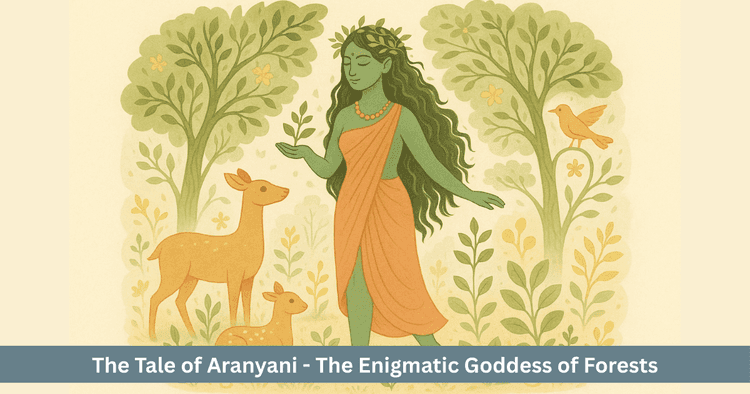
Table of Contents
Hidden within the hymns of the Rigveda and the murmured songs of rural India dwells the quiet goddess Aranyani, the living spirit of forests. She stands apart from gods who rule grand temples or receive festive offerings. Aranyani’s realm is the deep wilderness; her temple, the living forest itself. Her story is a hymn to origin, balance and the mystical bond between humanity and nature. To encounter Aranyani is to touch the pulse of the earth itself.
1. Aranyani as the Living Forest
The name Aranyani arises from Aranya, meaning forest or wilderness. Yet she is not merely a protector of trees, she is the forest incarnate.
- The scent of moist soil clings to her unbound hair.
- New saplings bloom wherever her feet tread.
- Her breath is the murmur of wind through leaves.
In her, light and shade, growth and stillness, wilderness and calm, all coalesce into divine harmony.
2. The Enchanting Elusiveness
Legends proclaim that no mortal has ever beheld Aranyani’s true form. She reveals herself only through the subtleties of nature:
- The jingling of unseen anklets at twilight.
- A sudden bloom carpeting the shaded earth.
- Footprints vanishing in the morning dew.
Her mystery reflects nature’s hidden soul, felt deeply, sensed profoundly, yet never fully known. She embodies the unseen whisper that breathes life into silence.
3. Nurturer and Guardian of Life
As the universal mother of the wilderness, Aranyani’s compassion flows to every creature:
- She guides lost animals toward food and water.
- She preserves rare herbs for healing generations of humankind.
- She oversees the sacred rhythm between seed and flower, pollinator and wind.
In many villages, people still offer grains, honey and blossoms at the roots of ancient trees, asking her blessing for crops and herds.
4. Aranyani in the Rigveda
Aranyani’s hymn in the Rigveda celebrates her beauty and mystery. The goddess is praised for light, abundance and grace.
| Attribute | Description | Significance |
|---|---|---|
| Beauty | Like sunlit woods and moonlit clearings | Symbol of nature’s elegance |
| Abundance | Provider of fruits and herbs | Source of nurture and sustenance |
| Mystery | Dancer of shadow and light | Essence of nature’s spirit |
This ancient verse portrays her as both giver and guardian, the divine reminder of humanity’s dependence on the forest’s generosity.
5. Symbol of Ecological Wisdom
Though seldom worshipped in temples today, Aranyani’s message resonates powerfully in modern times:
- Forests are not mere resources but sentient communities.
- Biodiversity is sacred; every species holds purpose.
- Humanity’s survival is bound to nature’s well-being.
Her story speaks directly to contemporary ecological ethics: to live in reverence, to protect with gratitude, to honor the sacred balance of all life.
6. The Eternal Dance - Aranyani’s Presence in Nature
Her essence is woven into all natural movements and sounds of the world.
| Element | Aranyani’s Presence | Meaning |
|---|---|---|
| Rustling leaves | Her whispering breath | The voice of wind and spirit |
| Song of birds | Her morning hymn | Renewal of life each day |
| Blooming flowers | Her creative dance | Expression of divine joy |
| Flowing streams | Her compassionate tears | Nourishment and healing |
This perpetual rhythm affirms that the sacred dance of creation continues eternally. Each sound, fragrance and motion carries her unseen touch.
The Invisible Shrine - A Call to Reverence
Aranyani’s worship is inward, not ritualistic. She calls humanity to look, listen and protect.
- Listen to the delicate voice of streams and trees.
- Regard the forest as a living sanctuary.
- Defend wilderness as an extension of one’s own spirit.
To revere her is to enter into harmony with the living earth. Civilization and wilderness are not opposites but intertwined threads in the same divine fabric. In every leaf’s silence and every breeze’s murmur, the goddess eternally moves, unseen, unending.
Frequently Asked Questions (FAQ)
1. Who is Aranyani?
She is the Vedic goddess of forests, symbolizing the soul of nature and the protector of all beings.
2. Does Aranyani have a temple?
No permanent temple is dedicated to her; the forest itself is her sacred abode.
3. How is Aranyani worshipped even today?
Villagers offer grains, fruits and honey beneath trees to seek blessings for fertility, crops and balance in nature.
4. How does her story connect with modern times?
Her teachings embody ecological awareness, conservation and respect for biodiversity.
5. Can one see Aranyani?
She is unseen to the eyes but felt through the heart, perceived in every sound, scent and stillness of the forest.
Get your accurate Kundali
Generate KundaliDid you like it?
Author

Pt. Nilesh Sharma (63)
Experience: 20
Consults About: Family Planning, Career
Clients In: Punjab, Haryana, Delhi
Share this article with friends and family
About ZODIAQ
ZODIAQ is an online Vedic Astrology platform. It connects clients seeking astrological advice to experienced astrologers with deep knowledge. Our users also generate kundali and perform kundali milan for free. ZODIAQ also offers services to the Astrologers. Astrologers utilize various offerings by ZODIAQ to serve their clients effectively.
If you are a User
Consult with experienced astrologers and seek their guidance. You can also order handwritten Janm Patrika report with life prediction prepared by experienced astrologers. Generate accurate Kundali, perform Kundali Matching and check horoscope and muhurat. Utilize our online library for all the necessary astrological and spiritual information.
If you are an Astrologer
Create accurate kundali for your clients and perform Kundali Matching for up to 5 people at a time. Write comprehensive Janm Patrika report for your clients with ZODIAQ. Check client details anytime by saving it in client directory. Become more productive by tracking how many clients you guide every day.
WELCOME TO
ZODIAQ
Right Decisions at the right time with ZODIAQ
