The War of Brothers: How Ravana Stole Lanka from Kubera
By Pt. Suvrat Sharma
The Divine Treasurer and His Golden Kingdom
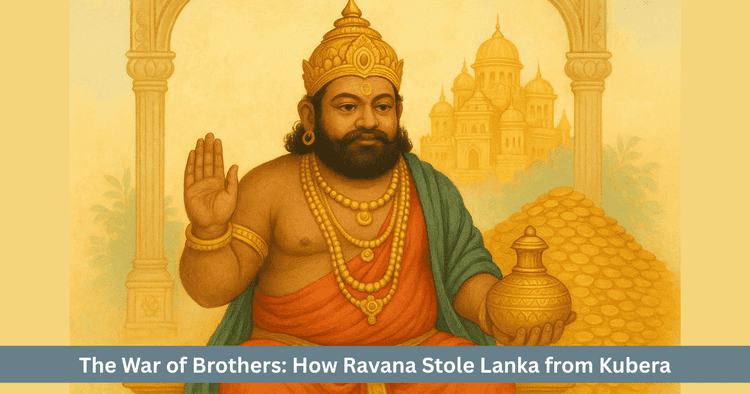
Table of Contents
The Divine Treasurer and His Golden Kingdom
In the vast hierarchy of Hindu cosmology, where gods oversee different domains of existence, Kubera holds a position of singular importance: he is the Lord of Wealth, the Divine Treasurer of the Three Worlds and the guardian of prosperity itself. Yet his story is less celebrated than those of more martial deities, overshadowed by tales of his younger half-brother's conquest. This obscurity is itself significant, for it reflects a deeper truth about Hindu spirituality: legitimate wealth earned through virtue receives less dramatic attention than ambitious power seized through force.
The Noble Birth and Sacred Appointment
Kubera's lineage carried the mark of divine election from his very conception. Born to Sage Vishrava and his first wife Devavarnini, a noblewoman of celestial descent, Kubera inherited a spiritual pedigree that suggested his destined greatness. Vishrava himself was a sage of extraordinary spiritual attainment, son of Prajapati and blessed with the capacity to perceive divine truths.
From birth, Kubera was appointed as Lord of Wealth (Dhanapati), Guardian of the North (Uttar Dikpala), Custodian of Treasures of all three worlds and Divine Accountant of cosmic abundance. This was not a role he seized through conquest or divine competition but one he inherited through merit and spiritual deservingness-suggesting that his very being aligned with principles of proper distribution and ethical stewardship of resources.
Lanka: The Golden Utopia
Under Kubera's benevolent rule, Lanka transformed from a simple island into a legendary realm of unparalleled beauty and prosperity. Crafted by Vishwakarma, the divine architect himself, Lanka became a city of wonders. Streets of crystal reflected sunlight into patterns of dancing light. Palaces of pure gold seemed to touch the heavens themselves. Gardens of enchanted flora bloomed perpetually in all seasons. Fountains of precious waters granted health and vitality to all who drank. Towers adorned with jewels glowed with inner radiance. Gates of burnished metal stood impregnable yet welcoming to the righteous.
The city represented not mere material abundance but spiritual wealth made visible-a manifestation of what prosperity should create: beauty, harmony and the elevation of consciousness itself.
The Kubersabha: Seat of Cosmic Counsel
Perhaps most significantly, Kubera established Kubersabha (the Court of Kubera)-a sacred assembly that became a gathering place for sages and philosophers who debated cosmic truths, Gandharvas (celestial musicians) whose melodies elevated the soul, Apsaras (divine dancers) whose movements expressed the dance of creation, Devas (gods) who came to counsel on matters of universal importance and beings of wisdom from across the three worlds.
This court symbolized that true wealth is not hoarded but creates gathering places for wisdom, that abundance naturally generates spaces where consciousness elevates and beings of different realms can commune in harmony.
The Pushpaka Vimana: The Crown Jewel
Among all Kubera's possessions, none compared to the Pushpaka Vimana-a divine aerial chariot gifted by Lord Brahma himself. Its extraordinary properties included being self-propelling (requiring no external force), adaptive size (could expand to accommodate armies or contract for one person), cosmic speed (traveled faster than thought itself), cosmic reach (could traverse all three worlds) and eternal durability (never weakened, never required repair).
The Pushpaka Vimana represented more than a vehicle-it symbolized mobility of consciousness, the ability to traverse different dimensions of reality while maintaining one's essential nature unchanged. That it was self-propelling suggested that legitimate power requires no external force to sustain it.
A Reign of Radiance
Under Kubera, Lanka flourished. Righteousness (dharma) was upheld in all transactions. Justice was administered with compassion and wisdom. Prosperity was distributed fairly among all classes. Knowledge flourished in the Kubersabha and throughout the realm. Peace reigned because there was enough for all, making conflict unnecessary.
Kubera's reign demonstrates a fundamental spiritual truth: true power resides in abundance so complete that competition becomes irrelevant. When wealth is genuinely shared and justly distributed, the need for warfare vanishes.
The Shadow Arrives: Birth of Ambition and Envy
But divine and earthly realms alike follow the law of karma-action generates reaction, choice creates consequence. Sage Vishrava's life took a dramatic turn when external pressures forced him into a choice that would ultimately shatter family harmony. Sumali, a powerful Rakshasa king, applied intense pressure on Sage Vishrava, eventually compelling him to marry Kaikesi, a Rakshasi princess. This was not a union of love or spiritual compatibility but of political necessity and external coercion.
The Birth of Ambition Incarnate
From this union were born four children, each carrying the complex heritage of both divine bloodline and asura nature: Ravana (the eldest, who would become the protagonist of this tragic tale), Kumbhakarna (a warrior of legendary strength), Vibhishana (who would later demonstrate that dharma transcends family loyalty) and Surpanakha (whose actions would eventually trigger cosmic consequences).
Ravana's exceptional nature set him apart. Born with unmatched intellect capable of mastering complex philosophies and strategic thought. Possessing supernatural strength that increased through austerities and divine boons. Endowed with magnetism and charisma that attracted followers and inspired loyalty. Driven by an unquenchable thirst for supremacy that no achievement could satisfy. Trained in Vedic knowledge by the greatest sages, making him dangerous because his intellect matched his ambition.
As Ravana matured, a poison grew in his heart: "How is it that my brother Kubera, born of the same father, sits upon the golden throne of Lanka while I, mightier and more capable, remain in shadow? Why should legitimacy triumph over strength?"
Ravana represented a dangerous spiritual principle: the belief that power should determine hierarchy rather than virtue. Unlike Kubera, who accepted his role as part of cosmic order, Ravana believed that might creates right, that the strongest should rule and that traditional legitimacy should yield to demonstrated superiority.
The Spark That Ignited Fury: Rambha and the Curse
If ambition was the kindling, then unchecked lust became the spark that ignited the conflagration. During a visit to Kubera's palace, Ravana encountered Rambha, a celestial apsara of extraordinary beauty. But Rambha was not merely an object of desire-she was the wife of Nalakubera, Kubera's own son, making her protected family and sacred trust.
The Violation
In a moment that revealed the true darkness within Ravana's nature, he overpowered Rambha despite her resistance, violated her against her will and desperate pleas, disgraced her before the entire court and betrayed the sacred bonds of family and hospitality. This act was not a momentary weakness but a revelation of Ravana's true nature: beneath the intelligence, beneath the charm, beneath the divine boons lay an utterly corrupted moral center.
When Nalakubera learned of this transgression, his rage reached cosmic intensity. As Kubera's son, he possessed divine authority and the right to pronounce curses. Standing before Ravana, his voice thundered with justice:
The Curse That Would Define Destiny
"You who have violated the sanctity of family, who have used your strength against the helpless, who have betrayed sacred trust-hear now the consequence of your actions: If ever you force yourself upon another woman against her will, your head shall shatter into a hundred pieces!"
This curse, intended as terrible punishment, would ultimately become Ravana's only restraint on his absolute corruption. For years to come, even in his moments of greatest power, even when he kidnapped Devi Sita herself, this curse remained like an invisible shackle. He could desire her, imprison her, threaten her, boast of his possession-but he could never violate her.
The very curse meant to destroy him became the force that, paradoxically, preserved some measure of his honor. For if Ravana had violated Sita as he violated Rambha, his downfall would have come not through Rama's arrows but through cosmic retribution instantaneous and absolute.
The Fraternal War: When Ambition Conquered Legitimacy
The curse shattered whatever remained of fraternal connection between Kubera and Ravana. What had been family rivalry transformed into open hostility. Though heartbroken by his brother's violation and his nephew's suffering, Kubera did not resort to conquest or revenge. Instead, he recognized the depth of Ravana's corruption, understood that coexistence had become impossible, accepted that force would be necessary and prepared to defend his kingdom while holding no personal hatred.
Ravana, now inflamed by both ambition and the festering anger of the curse, set out to conquer what he believed should have been his. He summoned his growing army of rakshasas, deployed magical powers granted by his severe austerities and marched against Lanka with the certainty of one convinced that might alone determines rightness.
The Unequal Combat
The battle that followed was profoundly unequal. Ravana possessed unmatched martial prowess, magical powers and supernatural abilities, an army of fierce demons and the advantage of aggression and absolute determination. Kubera was not primarily a warrior but an administrator oriented toward preservation rather than conquest, governing by consent and wisdom rather than fear and ideologically opposed to unnecessary violence.
Though Kubera fought bravely and with divine blessing, he was ultimately defeated by his younger brother's superior military skill and ruthlessness. The battle was not won through right but through superior force deployed without moral restraint.
The Seizure of Everything
Once victorious, Ravana usurped the throne of Lanka, claimed the Pushpaka Vimana for himself, seized all of Kubera's treasures which had been earned through centuries of virtuous stewardship, declared himself "Lankeshwar" (Lord of Lanka) and established a new dynasty based on conquest rather than merit.
Kubera's Dignified Retreat
But here the story takes an unexpected turn. Rather than plotting revenge or seeking to reclaim his throne, Kubera made a decision that reveals his true nature. He retreated to Mount Kailasa, the sacred abode of Lord Shiva. He became Shiva's attendant and devoted devotee, finding in spiritual service what political power could not offer. He accepted his new role without bitterness or resentment. He continued to perform his cosmic duties as Lord of Wealth from his new location, now serving broader dharmic purposes than merely administering one kingdom.
This retreat was not a defeat but a spiritual victory-Kubera recognized that legitimate power transcends political territories, that true authority flows from dharmic alignment and that service to the divine supersedes possession of realms.
The Rise and Inevitable Fall: Ravana's Trajectory
Ravana's rule over Lanka began in spectacular fashion. The city grew even more magnificent under his aggressive expansion. His armies swelled as conquered kingdoms contributed fighters. His name became synonymous with fearlessness across the three worlds. Gods themselves trembled at his approach. He obtained numerous boons through severe penances, making him nearly invincible.
The Paradox of Ill-Gotten Gain
Yet even during Lanka's apparent prosperity under Ravana, a fundamental spiritual law was operating: What is seized unjustly can never be truly possessed. While the city remained outwardly splendid, something had changed. The Kubersabha lost its power to elevate consciousness-now it was merely a court of flattery and fear. The gardens grew less fragrant for those who truly perceived spiritual realities. Wealth accumulated but brought no peace, for it was founded on violation and theft.
The Pride That Preceded Ruin
As Ravana's power consolidated, a fatal flaw crystallized in his consciousness: pride-the oldest enemy of kings and gods alike. Ravana began to believe his own mythology: that he had earned his supremacy through superior capability, that laws of dharma did not apply to one of his power, that consequences were meant for lesser beings, that he was essentially untouchable, even by cosmic law.
This pride manifested in his decision to kidnap Sita, wife of Lord Rama. In his arrogance, he believed he could defy the cosmic order represented by Rama, possess what belonged to another because his power entitled him and overcome destiny through superior force.
The Unforeseen Consequences
But the universe operates according to principles transcendent to individual will. Ravana's abduction of Sita triggered a cosmic conflict. Rama, with Hanuman's aid, invaded the kingdom and in a devastating war, Ravana's empire was reduced to ashes. Ironically, it was the very restraint imposed by Nalakubera's curse that contributed to his destruction. On the battlefield, facing Rama, Ravana encountered not a more skilled warrior but a representative of cosmic order itself. He fell not because Rama was stronger but because he had violated the fundamental principles upon which reality rests.
The Legacy: What Changed, What Endured
When the smoke cleared, Lanka was devastated, reduced to ash and ruin. The golden city that had shone so brilliantly lay in darkness. The Pushpaka Vimana returned to Lord Brahma. Ravana's dynasty vanished without a trace. Later, according to tradition, the kingdom was restored and given to Vibhishana, Ravana's righteous brother, who had sided with Rama despite family bonds. Under Vibhishana, Lanka regained some of its former splendor but it was never again the wonder it had been under Kubera.
Meanwhile, Kubera remained at Mount Kailasa, close to Lord Shiva, continued administering cosmic wealth from his new location, never sought revenge or attempted to reclaim his kingdom, became a model of spiritual acceptance for those who lose material power and maintained his cosmic authority, which proved more lasting than any throne.
Centuries later, when temples were built and worship prescribed, it was Kubera to whom prayers were offered for prosperity, not Ravana. The legitimate authority proved more enduring than the seized power.
The Spiritual Teachings: Beyond Mythology
Kubera's Message: Legitimate Prosperity
Kubera embodies several crucial spiritual principles. Dharmic wealth flows from alignment with cosmic order, not from personal ambition. Service transcends possession-Kubera found his greatest fulfillment not in ruling Lanka but in serving Shiva. Acceptance and dignity-even in apparent defeat, Kubera maintained his spiritual integrity. Universal authority-Kubera's power to influence wealth and prosperity continued after losing his kingdom because his authority was cosmic, not territorial.
Ravana's Warning: The Perils of Ambition
Ravana's trajectory teaches equally powerful lessons. Power without virtue corrupts. Might does not create right-the conquest of Lanka did not make Ravana's rule legitimate. Pride before ruin-Ravana's belief in his own invincibility blinded him to universal laws. Violation creates chains-the curse on Ravana was the natural consequence of his violation activated.
| Aspect | Kubera | Ravana |
|---|---|---|
| Source of authority | Divine appointment, earned merit | Conquest and force |
| Foundation of rule | Dharma and wisdom | Power and ambition |
| Response to loss | Spiritual transcendence | Continued conquest |
| Lasting legacy | Universal respect and worship | Cautionary tale of failure |
| True power | Administers all worlds from any location | Confined to a stolen throne |
| Final status | Eternal presence and authority | Memory of defeat and ruin |
Conclusion: The War That Never Ended
The war between Kubera and Ravana was never truly about a single kingdom or a single throne. It represents the eternal cosmic struggle between two fundamental principles: Order versus Chaos, Legitimate versus Seized, Service versus Dominion, The Sacred versus The Profane.
Yet the war had a decisive victor-not in military terms but in cosmic reality. Kubera endured. His name remains spoken in prayers and mantras. Millions invoke his blessings daily for prosperity. His role continues eternally. Ravana was forgotten-though his name is remembered in the Ramayana, it is remembered as a warning, not an inspiration.
The Contemporary Resonance
In our modern world, where ambition is celebrated and power is worshipped, the story of Kubera and Ravana whispers essential truths. Rapid acquisition means rapid loss. True wealth transcends possession. Violation always creates consequences. Humility preserves power; pride destroys it.
The Final Wisdom
Perhaps the deepest teaching lies in this: When Kubera lost his kingdom to his brother, he did not lose himself. When Ravana gained a kingdom, he lost his own soul. True power, the story whispers across the ages, is not measured by what we possess but by what we remain when everything is stripped away. Kubera, stripped of his throne, remained divine, honored and eternal. Ravana, crowned with a kingdom, remained unfulfilled, feared and ultimately, forgotten-except as a symbol of what ambition without dharma ultimately produces: ashes.
The golden city of Lanka stands as a monument not to Ravana's triumph but to the spiritual principle that whatever is seized unjustly carries within it the seeds of its own destruction. And somewhere on Mount Kailasa, Kubera smiles-not in triumph but in the serene satisfaction of one who chose service over seizure, dharma over domination and eternal spiritual authority over temporary territorial possession.
Frequently Asked Questions
Who was Kubera and how did Lanka become his kingdom?
Kubera was the God of Wealth and the Divine Treasurer of the three worlds. He was the son of Sage Vishrava and Devavarnini and from birth was appointed as Dhanapati (Lord of Wealth) and Uttar Dikpala (Guardian of the North). Lanka was a golden city crafted by Vishwakarma, the divine architect, which became a realm of unparalleled beauty and prosperity under Kubera's rule. The city featured crystal streets, golden palaces, enchanted gardens and towers adorned with jewels. Kubera established the Kubersabha where sages, Gandharvas, Apsaras and gods would gather. Under his rule, dharma, justice and peace flourished. He also possessed the Pushpaka Vimana, a self-propelling divine chariot gifted by Brahma.
Why and how did Ravana steal Lanka from Kubera?
Ravana was Kubera's younger half-brother, born to Vishrava and Kaikesi, a Rakshasi princess. Ravana was powerful and ambitious, believing he was more deserving than Kubera. Jealousy grew in his heart that his brother sat on the golden throne while he, superior in strength, remained in shadow. The situation worsened when Ravana violated Rambha, wife of Nalakubera (Kubera's son). Nalakubera cursed Ravana that if he ever forced himself upon another woman, his head would shatter into a hundred pieces. After this, Ravana attacked Lanka with his demon army. Though Kubera fought bravely, Ravana's superior military skill and magical powers proved victorious. Ravana seized the throne, the Pushpaka Vimana and all treasures, establishing his rule through conquest rather than merit.
What did Kubera do after losing Lanka?
Kubera's response demonstrated profound spiritual maturity. Rather than seeking revenge or attempting to reclaim his kingdom, he chose to retreat to Mount Kailasa, the sacred abode of Lord Shiva. He became Shiva's devoted servant and devotee, finding fulfillment in spiritual service that political power could not provide. Significantly, he continued his cosmic duties as Lord of Wealth from his new location. His authority was cosmic, not territorial, so losing Lanka did not diminish his real power. This demonstrates that legitimate power transcends political territories and comes from spiritual alignment. His acceptance of loss paradoxically preserved his eternal authority.
How did Nalakubera's curse affect Ravana's destiny?
Nalakubera's curse became a crucial turning point in Ravana's story. When Ravana violated Rambha, Nalakubera cursed him that if he ever forced himself upon another woman, his head would be shattered. This curse paradoxically became Ravana's only restraint on his complete corruption. Later, when he abducted Sita, the curse prevented him from violating her. Had he done so, the curse would have immediately destroyed him. Instead, the narrative continued, allowing Rama to enter and karmic consequences to unfold through proper cosmic justice. The curse demonstrates that violations create inescapable karmic consequences.
What lessons do we learn from the story of Kubera and Ravana?
This story offers numerous profound teachings. First, legitimate versus seized power-Kubera's dharmic authority proved more lasting than Ravana's forced conquest. Second, power without virtue corrupts, as Ravana's intellect and strength without moral foundation led to destruction. Third, true wealth transcends possession, as Kubera's authority continued after losing his kingdom. Fourth, humility preserves power while pride destroys it. Fifth, violation creates consequences, as Ravana's attack on Rambha demonstrated. Sixth, spiritual values are more important than material possessions. Seventh, what is unjustly taken carries the seeds of its own destruction. These teachings remain as relevant today as they were in ancient times.
Get your accurate Kundali
Generate KundaliDid you like it?
Author

Pt. Suvrat Sharma (63)
Experience: 20
Consults About: Family Planning, Career
Clients In: Punjab, Haryana, Delhi
Share this article with friends and family
About ZODIAQ
ZODIAQ is an online Vedic Astrology platform. It connects clients seeking astrological advice to experienced astrologers with deep knowledge. Our users also generate kundali and perform kundali milan for free. ZODIAQ also offers services to the Astrologers. Astrologers utilize various offerings by ZODIAQ to serve their clients effectively.
If you are a User
Consult with experienced astrologers and seek their guidance. You can also order handwritten Janm Patrika report with life prediction prepared by experienced astrologers. Generate accurate Kundali, perform Kundali Matching and check horoscope and muhurat. Utilize our online library for all the necessary astrological and spiritual information.
If you are an Astrologer
Create accurate kundali for your clients and perform Kundali Matching for up to 5 people at a time. Write comprehensive Janm Patrika report for your clients with ZODIAQ. Check client details anytime by saving it in client directory. Become more productive by tracking how many clients you guide every day.
WELCOME TO
ZODIAQ
Right Decisions at the right time with ZODIAQ
