Was Ravana Only A Villain
By Aparna Patni
Ravana through Ayurveda, Jyotish and Shiva devotion
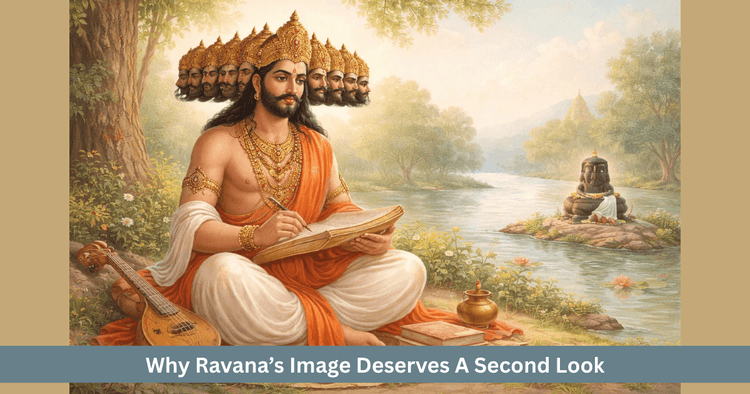
Table of Contents
Why Ravana’s Image Deserves A Second Look
When people hear the name Ravana, the mind usually recalls the king of Lanka who abducted Sita and fought a great war with Shri Rama. On the day of Dusshera his effigy is burnt as a sign that evil should be destroyed. In everyday conversation this picture becomes so strong that Ravana is remembered almost only as a symbol of arrogance and injustice.
Yet ancient texts, traditions of Ayurveda and lineages of Jyotish show a very different side of the same person. The same Ravana who is blamed as the demon king appears there as a deep scholar of Ayurveda, a refined astrologer, a devoted follower of Lord Shiva and a serious student of the Vedas. Because of this many thinkers say that to see Ravana only as a villain is to ignore a very large part of his personality.
The story invites the reader to a deeper ground where a person is not judged only by one act but also by knowledge, inner discipline and the long journey of the soul. This is the distinctive strength of Sanatan Dharma that it values karma and gyan, rather than only birth or a simple label of good and bad.
Lineage And Identity Of The King Of Lanka
The word Ravana is usually understood as one who roars or whose voice creates fear. In stories he is called a Rakshasa king, yet his family line goes back to the sage Pulastya who is known among the Saptarishi. Through this lineage Ravana is also seen as a Brahmin, which helps explain his deep involvement in Vedic and spiritual study.
Ravana cannot be counted among ordinary Rakshasas. He was well versed in Shastra, skilled in statecraft, trained in Ayurveda and capable in music, dance, literature and warfare. The golden city of Lanka did not stand only on physical power. It stood on planning, administration and knowledge. This is why some traditions remember him as a great king and capable ruler, even while they do not ignore his grave mistakes.
In this way his identity becomes complex. He was both a powerful ruler and a seeker of knowledge, both feared in battle and respected in assemblies of scholars.
Was Ravana Truly A Master Of Ayurveda
Within the stream of Ayurveda Ravana is given a special place. Ancient belief credits him as the author of a work called Ravana Samhita which is said to contain insights on healing, herbs and methods of diagnosis. For many practitioners this text stands as a bridge between classical medical knowledge and subtle observations on life force.
Ayurveda is not a mere list of medicines. It is a complete view of body, mind and prana. It speaks of
- balance of dosha
- dhatu and mala
- the role of rasa, virya and ojas
- seasonal rhythm, food and lifestyle
To contribute meaningfully to such a system demands an intellect that can hold many factors together. The association of Ravana with detailed knowledge of herbs, pulse reading and hidden causes of disease shows a very different image from the simple label of destroyer.
In this light Ravana appears not only as a warrior but also as a healer who understood that protection of life is a sacred duty. This does not erase his wrong deeds, yet it expands the picture of who he was.
Table: Ravana And His Place In Ayurveda
| Theme | Description |
|---|---|
| Main text | Ravana Samhita |
| Focus areas | Herbs, diagnosis, treatment methods |
| View of health | Link between body, mind and time |
| Position in tradition | Remembered as a scholar and researcher |
Mastery Of The Sixty Four Arts
Traditional accounts describe Ravana as a master of the sixty four kalas or refined arts. These arts include music, dance, theatre, poetry, painting, architecture, warfare, archery, Jyotish, mantra shastra, Vedic recitation and many more disciplines.
In that older vision of education a ruler was expected to grow in arts, sciences and spiritual practices together. Physical strength alone was never enough. Ravana fulfils this ideal almost completely. His talent is seen not just on the battlefield but also in royal courts, in places of learning and in sacred gatherings. Even devas and rishis are said to have acknowledged his brilliance.
In today’s world education is often narrowed down to one profession. Ravana’s image as a many sided learner reminds us that ancient Indian thought respected a person who could hold music, logic, administration and meditation in one life.
Ravana As Astrologer And Vedic Scholar
Ravana is also described as one of the finest astrologers of his era. In Sanatan understanding Jyotish is not simply the art of prediction. It is a way to read the flow of kala, the movement of the planets and the pattern in which life events unfold.
These traditional descriptions state that
- he could recognise auspicious and inauspicious periods from planetary positions
- he knew correct recitation and inner meaning of Vedic mantras
- he understood the rules of yajna and ritual in great detail
Ravana Samhita is believed to contain Jyotish related material along with medical insights. This suggests that for him health was never separate from time and karma. Body, mind, planets and actions were seen as parts of a single web. Ravana is sometimes called a Brahma gyani, one who has contemplated the nature of Brahman or ultimate reality.
Thus he stands not only as a political figure but also as a thinker who wove Vedic learning into practice. Knowledge in his life did not remain theory, it turned into application.
How Did Devotion To Shiva Shape Ravana’s Life
The image of Ravana as a devotee of Lord Shiva is very prominent in many Puranic stories. These accounts tell of severe austerities through which Ravana pleased Shiva and received many boons. There is a famous scene in the Shiva Purana in which Ravana attempts to lift Mount Kailash, the abode of Shiva. In response Shiva presses the mountain with only one toe. Ravana feels intense pain and realises his limit.
It is then said that Ravana sings a deep hymn to Shiva that later becomes known as Shiva Tandava Stotra. In this form he appears not as a proud king but as a singer of praise, holding a veena and pouring out his devotion.
Main features of his Shiva worship
- skill in veena playing connected with stotra recitation
- readiness to undergo penance for the grace of Shiva
- inner link between strength and surrender
This side of his life shows that a person who is otherwise trapped in anger and attachment may still strive for higher connection with the divine. The journey is uneven, yet the longing for Shiva gives his life another dimension.
Was Ravana Purely Evil Or A Complex Person
Retellings of Ramayana often present a sharp line between Shri Rama as dharma and Ravana as adharma. Such a view is simple and easy to narrate, yet the older tradition allows more nuance. It accepts that one human being can carry great wisdom and deep error together.
Ravana illustrates this clearly. On one side stands
- his knowledge of Veda
- his skill in Ayurveda and Jyotish
- his focused devotion to Shiva
On the other side stands the act of abducting Sita, the dominance of ego and the refusal to correct himself even when wise advisors warned him.
The picture that emerges is not of a flat villain but of a person whose gifts and flaws rise side by side. This asks the reader to think carefully about how dharma operates in real life, where choices are rarely black and white.
Lessons From Ravana’s Fall
The fall of Ravana is not only the end of a war. It is the unfolding of consequences that follow pride, desire and disregard of dharma.
Some key lessons are as follows
-
Limit Of Ego
No amount of learning can protect a person whose pride is left unchecked. Ravana’s defeat shows that the belief in one’s own invincibility is itself a serious weakness. -
Force Of Karma
The abduction of Sita was rooted in lust and arrogance. That single action opened the path to his destruction. Tradition stresses that actions which go against dharma bring their fruit sooner or later, whatever the status or power of the doer may be. -
Bhakti Alone Is Not Enough
Ravana’s devotion to Shiva was intense, yet his behaviour with others did not reflect the same depth of righteousness. This contrast reminds readers that worship must touch conduct too. If puja remains only at the level of ritual, the inner change remains incomplete. -
Subtle Nature Of Dharma
Dharma cannot always be drawn in one straight line. Context, intention and outcome all play a part. The story of Ravana gives space to reflect on this subtler understanding of right conduct.
Table: Strengths And Weaknesses In Ravana’s Character
| Aspect | Description |
|---|---|
| Main strengths | Learning, Ayurveda, Jyotish, devotion to Shiva |
| Main weaknesses | Ego, anger, desire, abduction of another’s wife |
| Inspiration | Human capacity to raise knowledge to great heights |
| Warning | Actions against dharma lead toward downfall |
Ravana In Indian Memory And Regional Traditions
Indian cultural memory does not hold only one image of Ravana. In some regions of India and in Sri Lanka he is remembered as a brave ruler, an able administrator and a generous king. Folk songs and local versions of the Ramayana sometimes place more emphasis on his courage and his tragic flaw instead of only highlighting his defeat.
In lines of Ayurveda and Jyotish the name of Ravana continues through study of Ravana Samhita. Practitioners value it as a treasure of older observations. For them it is less important whether the author is seen as a villain in some stories. What matters is the usefulness of the principles recorded there for healing and for understanding planetary influence.
This dual remembrance shows how Indian thought can criticise a person’s actions and still respect their knowledge. It does not rush to erase a contribution only because the contributor was flawed.
What Makes Ravana’s Story Relevant Today
For a reader living in the present age, Ravana’s story is not just an old epic episode. It speaks directly to questions of power, responsibility and inner growth.
Some practical reflections stand out
- to remain humble even when education or position grows
- to remember that authority over others must be balanced by restraint
- to avoid crossing ethical limits in personal desire
- to bring alignment between spiritual practice and daily behaviour
Seen in this way Ravana’s life holds both caution and inspiration. It warns that misuse of power leads to suffering and it inspires by showing how much a human being can learn and achieve when intellect and discipline are cultivated.
Above all, the story encourages a more thoughtful approach to history. Instead of looking only for simple heroes and villains, it invites the reader to recognise that greatness and imperfection can dwell together in the same person. True understanding begins when that complexity is accepted with honesty.
Frequently Asked Questions
-
Can Ravana really be called an Ayurvedic authority
Traditional accounts associate Ravana with Ravana Samhita and describe him as a knower of herbs and healing methods. This suggests that he was regarded not only as a king or warrior but also as someone who had serious understanding of Ayurveda. -
If Ravana was so learned why did he fall
Learning by itself does not prevent downfall. Ravana’s fall arose from unchecked ego and actions that went against dharma, such as the abduction of Sita. His story shows that wisdom must be joined with humility and self control. -
Is Ravana respected in any tradition
In some regions Ravana is respected as a brave ruler and devotee of Shiva. People there focus more on his learning, valour and rule over Lanka, while still acknowledging that his wrong deeds brought grave consequences. -
What is the importance of Ravana Samhita
Ravana Samhita is valued for its combined insights on Ayurveda and Jyotish. It is said to discuss disease, planetary periods, remedies and the link between karma and health. Students of these subjects study it as a serious text. -
What central message can a modern reader take from Ravana’s life
The central message is that light and shadow coexist within every human being. Knowledge, devotion and strength must be balanced with ethical action. Before fixing a final label on any person, it is wise to consider the full range of their life and choices.
Get your accurate Kundali
Generate KundaliDid you like it?
Author

Aparna Patni (63)
Experience: 20
Consults About: Family Planning, Career
Clients In: Punjab, Haryana, Delhi
Share this article with friends and family
About ZODIAQ
ZODIAQ is an online Vedic Astrology platform. It connects clients seeking astrological advice to experienced astrologers with deep knowledge. Our users also generate kundali and perform kundali milan for free. ZODIAQ also offers services to the Astrologers. Astrologers utilize various offerings by ZODIAQ to serve their clients effectively.
If you are a User
Consult with experienced astrologers and seek their guidance. You can also order handwritten Janm Patrika report with life prediction prepared by experienced astrologers. Generate accurate Kundali, perform Kundali Matching and check horoscope and muhurat. Utilize our online library for all the necessary astrological and spiritual information.
If you are an Astrologer
Create accurate kundali for your clients and perform Kundali Matching for up to 5 people at a time. Write comprehensive Janm Patrika report for your clients with ZODIAQ. Check client details anytime by saving it in client directory. Become more productive by tracking how many clients you guide every day.
WELCOME TO
ZODIAQ
Right Decisions at the right time with ZODIAQ
