Was Ravana Really A Villain
By Pt. Narendra Sharma
Ten habits of Ravana that reveal his wisdom, devotion and leadership beyond the villain image
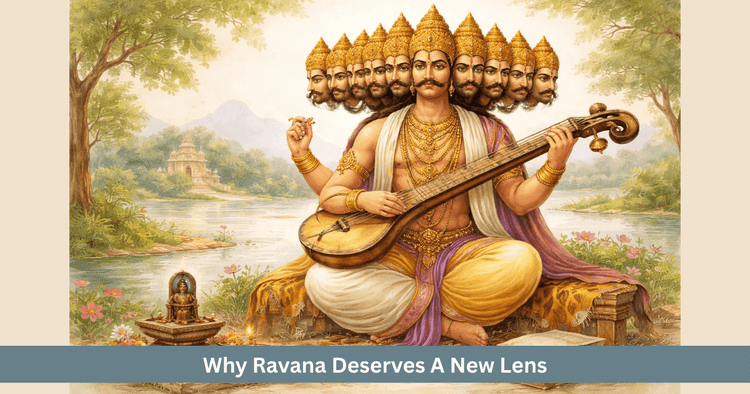
Table of Contents
Why Ravana Deserves A New Lens
In popular retellings of the Ramayana, the name Ravana brings to mind the ten headed king of Lanka who abducted Sita and fought a fierce war against Shri Rama. For generations he has been presented as the face of adharma and his effigy is burnt each year as a reminder that evil must fall. For many readers this single image has become the entire truth.
Yet when one steps back from this emotional picture and looks carefully at traditional descriptions, a far more layered Ravana appears. He was a mighty warrior, yet not only a warrior. He was born in a Rakshasa lineage, yet he was not only destructive. Within him lived a scholar, artist, devotee and far sighted ruler. This does not erase his serious wrong actions but it does show that his life also carries habits that can inspire even today.
Ravana’s Ten Remarkable Habits At A Glance
| No. | Habit | Core quality |
|---|---|---|
| 1 | Intense and focused devotion to Shiva | Surrender and spiritual depth |
| 2 | Relentless search for knowledge | Curiosity and scholarship |
| 3 | Mastery of arts and music | Sensitivity and creativity |
| 4 | Strong governance of Lanka | Vision and care for public welfare |
| 5 | Respect for talent and wisdom | Love for honest counsel |
| 6 | Deep attachment to family | Loyalty and emotional sensitivity |
| 7 | Courage to walk his own path | Confidence and risk taking capacity |
| 8 | Commitment to promises and refuge | Integrity and sense of fair warfare |
| 9 | Very high ambition | Ability to aim beyond limits |
| 10 | Acceptance of his fate at the end | Self reflection and graceful surrender |
When these habits are viewed together, they do not turn Ravana into a saint, yet they prevent him from being reduced to a flat caricature. His life becomes a study in how greatness and flaw can live side by side.
Was Ravana Truly A Deep Devotee Of Shiva
Both Ramayana and Shaiva traditions describe Ravana’s devotion to Lord Shiva. Long before he appears as a king on the battlefield, he is shown as a tapasvi whose heart turns again and again towards Kailash.
Some important features of his devotion
- long austerities and regular worship
- bhakti that came from attraction and love, not only from the desire for boons
- a willingness to offer even his own body in his act of worship
One well known story says that Ravana began to offer his own heads to Shiva as part of his penance. After nine were offered, just before he could offer the tenth, Shiva appeared and stopped him, moved by the depth of that devotion. Whether taken literally or symbolically, the story underlines that his bhakti was not casual.
From this, a clear lesson emerges. The value of worship lies in inner sincerity, not in outer drama. When ego gives way to surrender, devotion gains real depth. Ravana’s habit of intense devotion shows that even a powerful ruler can kneel completely before the divine.
How Far Did Ravana Go In His Pursuit Of Knowledge
To see Ravana only as a violent king is to miss the scale of his learning. Tradition presents him as deeply trained in the Vedas, Upanishads, astrology, Ayurveda, music and warfare.
Key aspects of his knowledge seeking
Study Of Veda And Shastra
Ravana is described as being well versed in the four Vedas and many Upanishads. He did not remain at the level of memorising verses. He engaged with their inner meaning.
Mastery In Other Disciplines
- Jyotish, which reads the movement of time and planets
- Ayurveda, which demands understanding of the body and the properties of herbs
- statecraft and military science, needed to run and defend a large kingdom
Readiness To Learn From Sages
Accounts mention that Ravana travelled and approached sages to learn directly from them. For a ruler of his stature, this shows humility before higher wisdom, not just pride in his own power.
This habit sends a message that titles and power are secondary. The willingness to keep learning is what keeps life dynamic. The day curiosity dies, inner growth halts, no matter how grand the outer position may be.
What Does Ravana’s Artistic Side Tell Us
Many readers are surprised to hear that the same Ravana who fought Rama is also associated with refined music and poetry. Yet traditional descriptions show him playing the veena and composing powerful hymns.
Skill In Veena
Ravana is said to have played the veena with great mastery. The sound of his music was believed to influence not only people but also the mood of the surrounding environment.
Association With Shiva Tandava Stotra
A famous hymn in praise of Shiva, known for its forceful rhythm and language, is linked in many traditions with Ravana. Whether this link is historical or symbolic, it points to his command over meter, rhythm and devotional emotion.
Balance Of Warrior And Artist
This artistic habit shows that bravery and sensitivity are not opposites. A life that contains only hardness is incomplete. A life that contains only softness lacks strength. True maturity comes when courage and creativity walk together.
For a modern reader this suggests that even in a demanding career, keeping space for art and creativity refines the mind and gives direction to one’s power.
Was Lanka Really A Well Governed Kingdom
Descriptions of Lanka in the Ramayana mention shining buildings, systematic streets and great prosperity. These are signs that Ravana was more than a fighter. He was also an able organiser and ruler.
Some highlights of his governance
- strong economy that protected people from hunger and basic insecurity
- planned cities with attention to cleanliness and safety
- a system of law and order that gave citizens a sense of justice
Folk traditions often say that during Ravana’s rule the common citizens experienced a measure of stability and prosperity. The crisis lay not in daily administration but in personal decisions born of ego and desire.
This habit points to an important truth. Leadership should be measured not only by victories in war but also by how people live under that rule. Good governance is a real form of strength, separate from the power of weapons.
Did Ravana Truly Honour Wisdom And Talent
Many rulers prefer the company of flatterers. Ravana’s court, as described in stories, included advisors who sometimes disagreed with him openly.
Space For Honest Speech
His brother Vibhishana strongly advised him to return Sita and avoid war and did so in front of others. That such debate was even possible shows that Ravana did not completely close his doors to opposing views.
Value Given To Scholars And Artists
Ravana gathered learned priests, scholars and musicians and engaged with them. He often sought conversation with those who knew more than him in certain fields.
Gap Between Hearing And Acting
It is equally true that he did not always follow the wise counsel he received. Yet the habit of allowing counsel itself is noteworthy, especially when compared to rulers who silence every differing voice.
From this one can draw a simple conclusion. Listening to different viewpoints does not guarantee right action but refusing to listen almost guarantees error.
How Did Ravana Relate To His Family
Public images often paint Ravana only as harsh and cruel. At the personal level, however many descriptions show him as deeply attached to his family.
Bond With Mandodari
Mandodari is remembered as intelligent and morally grounded. Ravana respected her and heard her advice, even though he often chose a different path. Their relationship stands as more than a formal royal arrangement.
Loyalty To Siblings
Ravana’s extreme response to the insult of his sister Shurpanakha arose from a raw sense of loyalty, although his way of expressing it was gravely wrong. He also fought to support or avenge his brothers when needed.
Love For His Mother
Stories mention his affection for his mother Kaikesi. Family played a visible role in shaping his emotional choices.
These patterns show that a person can be loving and caring in one circle of life and still act destructively in another. Emotion alone is not enough. Right direction for those emotions is equally important.
What Does Ravana’s Courage To Stand Alone Reveal
One of Ravana’s striking traits was his readiness to walk a path that differed sharply from the mainstream. While many kings tried to keep the gods pleased and the heavenly order undisturbed, Ravana often challenged that order.
In his mind
- strength and resources were tools meant to push boundaries
- it was better to shape one’s own path than to remain a follower only
This mindset carried a bright side, in the form of courage and bold initiative and a dark side, in the form of disregard for limits and others’ rights.
For people today, this habit can be read as a call to dream big yet stay aware of ethical boundaries. Great ambition without inner checks can turn into a force that harms both self and others.
How Did Ravana Treat Promises And The Idea Of Refuge
Less discussed, yet important, is the way Ravana is sometimes shown holding to his word.
- he honoured the idea of giving refuge to those who sought his protection
- he followed certain rules of war, even when he had the power to break them
- he tried to keep his public promises, even when his private motives were flawed
These features do not wash away his adharma but they complicate the picture. They show that a person may be strict about some principles while ignoring others.
The lesson is that human character does not come in clean blocks of white and black. Integrity in one area does not cancel wrongdoing in another, yet it is still a part of the full picture.
Ravana’s Ambition And Its Two Faces
Ravana did not dream small. He wanted influence across all three worlds rather than merely ruling Lanka.
His ambition has two faces
- an inspiring side, where he refused to be limited by ordinary expectations
- a destructive side, where the same fire pushed him to ignore the rights and dignity of others
In modern life, ambition plays a similar double role. It can drive growth in work, study and creativity. It can also push someone into unhealthy competition and ethical compromise. The crucial point is to keep ambition rooted in values.
Did Ravana Understand Himself At The End
The most moving scene in Ravana’s life is the final one, when he lies wounded on the battlefield. In that moment, Shri Rama stands before him.
Traditional descriptions say that at this time
- Ravana does not curse Rama
- he does not attempt to justify his choices
- he acknowledges Rama’s greatness and accepts his own mistakes
This moment lifts him from being just a stubborn enemy to being a tragic yet dignified figure. Pride gives way to clarity. There is a sense of acceptance rather than bitterness.
From this, a powerful insight appears. Even after a life filled with grave errors, the willingness to face truth at the end brings a kind of inner lightness. Honest acceptance does not rewrite the past, yet it changes the spirit in which one leaves the world.
How Can We Understand The Ravana Within
Taken together, these ten habits draw the outline of a very complex human being.
- in the same heart we see deep devotion and deep ego
- in the same life we see great wisdom and great misjudgement
- in the same rule we see order and prosperity and also one act that breaks dharma completely
This mixture reminds us that there is a bit of Ravana living within every person.
- a part that wants to learn without limit
- a part that wants to lead and create
- and a part that can slip into pride or impulse when tested
Sanatan Dharma invites the seeker to look at this complexity without fear. From Ravana’s life one can learn that
- devotion is valuable only when it softens ego
- knowledge must be tied to character
- ambition must stay within the frame of dharma
Then even a strong inner fire can be used for growth rather than destruction.
Frequently Asked Questions
1. Is it right to see Ravana as more than a villain
It is accurate to say that his actions, especially the abduction of Sita and the war driven by ego, were gravely wrong. At the same time it is also true that he had rare devotion, knowledge and administrative skill. To see only one side is to miss the full teaching his life offers.
2. What can a seeker learn from Ravana’s devotion to Shiva
Ravana’s tapas shows that genuine worship flows from deep feeling and surrender. When a person offers even personal comfort and pride at the feet of the divine, that bhakti gains depth, even if other parts of life remain flawed. It is an invitation to bring more sincerity into one’s own practice.
3. Does Ravana’s learning excuse his misdeeds
No. Learning and talent do not cancel moral responsibility. In fact, the more a person knows, the greater the duty to act with care. Ravana’s fall teaches that knowledge without humility and control can become dangerous.
4. Was Ravana an ideal king because Lanka prospered
He was certainly a capable ruler and organiser but not an ideal king. True kingship requires both prosperity and moral restraint. His personal choices brought great harm and that cannot be covered by the success of his administration.
5. Which of Ravana’s habits can be seen as most inspiring today
Many find two habits especially inspiring. One is his tireless hunger for knowledge. The other is his final willingness to accept the truth of his situation. Together they suggest a way of living in which one keeps learning till the end and, when the time comes, faces reality with honesty and poise.
Get your accurate Kundali
Generate KundaliDid you like it?
Author

Pt. Narendra Sharma (63)
Experience: 20
Consults About: Family Planning, Career
Clients In: Punjab, Haryana, Delhi
Share this article with friends and family
About ZODIAQ
ZODIAQ is an online Vedic Astrology platform. It connects clients seeking astrological advice to experienced astrologers with deep knowledge. Our users also generate kundali and perform kundali milan for free. ZODIAQ also offers services to the Astrologers. Astrologers utilize various offerings by ZODIAQ to serve their clients effectively.
If you are a User
Consult with experienced astrologers and seek their guidance. You can also order handwritten Janm Patrika report with life prediction prepared by experienced astrologers. Generate accurate Kundali, perform Kundali Matching and check horoscope and muhurat. Utilize our online library for all the necessary astrological and spiritual information.
If you are an Astrologer
Create accurate kundali for your clients and perform Kundali Matching for up to 5 people at a time. Write comprehensive Janm Patrika report for your clients with ZODIAQ. Check client details anytime by saving it in client directory. Become more productive by tracking how many clients you guide every day.
WELCOME TO
ZODIAQ
Right Decisions at the right time with ZODIAQ
