What If Hindu Mythology Is Incomplete? The Seven Pages That Vanished from Time
By Pt. Abhishek Sharma
Where Knowledge Fell Silent , The Search for Seven Hidden Chapters
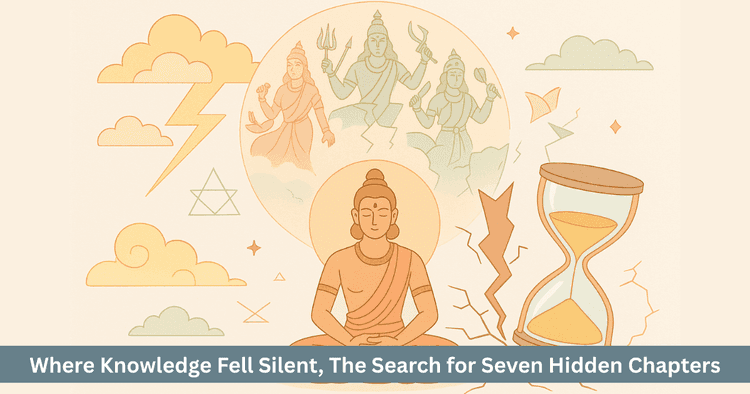
Table of Contents
“There is no knowledge higher than truth, yet some truths are not meant to be spoken.”
, Rig Veda (alternative interpretation)
Perhaps the world we know is not the full design but only a curated glimpse, a version of history shaped for survival. The ancient sages may have concealed certain revelations because humanity was not ready or because even gods feared their echoes. Across yugas and scriptures, Hindu mythology is a tapestry stretched between revelation and silence. What remains untold might be just as sacred as what is remembered.
Below lie the seven lost chapters, mythic mirror fragments reflecting truths erased, hidden or withheld for cosmic balance.
1. The Vanished Eighth Manu , When Time Collapsed and Restarted
Hindu cosmology speaks of fourteen Manus. Each rules a Manvantara, a distinct epoch of humanity’s evolution under divine law. Yet scattered allusions describe an Eighth Manu, a mysterious ruler whose name was struck out of cosmic records, as if reality itself had been rewritten.
The Age That Disappeared
Unlike other ages that faded into natural dissolution, his era ended violently. Some scriptures whisper of an experiment that destabilized the fabric of existence itself.
| Theory | Ancient References | Implication |
|---|---|---|
| Divine Civil War | Mentions of conflict among creator gods, “when heavens turned upon themselves.” | The celestial hierarchy fractured; creation rebelled against its source. |
| Forbidden Knowledge Released | References to “mantras that unmade the maker.” | Humans or other beings, tasted godhood prematurely. |
| Experiment Gone Wrong | Texts speak of “worlds collapsing into each other.” | Time’s continuity itself failed. |
| Law of Dharma Broken | Mentions of “the rule that corrupted all rules.” | Cosmic ethics reached contamination, demanding deletion. |
Thus the eighth epoch was erased. Time restarted, realities reset. Our present creation, perhaps, exists atop the ashes of that deleted timeline.
2. The Forbidden Veda , The Scripture That Could Rewrite Fate
Beyond the four canonical Vedas, whispers speak of a Fifth Veda unknown to ordinary beings. This hidden scripture, according to secret lineages, contained not hymns of praise but codes of creation, knowledge potent enough to alter time, karma and destiny itself.
The Lost Knowledge of Power
Legends describe capabilities such as:
- Temporal Spells: Mantras capable of reversing or accelerating the cosmic clock.
- Command Invocations: Methods to compel divine entities.
- Reality Formulas: Keys to altering the karmic web, redefining birth, death and cause itself.
- Blueprints of Creation: Explanations of how consciousness becomes matter.
Why Concealed?
The Fear Thesis: Humanity’s nature to dominate could have destroyed creation through misuse.
The Preservation Thesis: Gods veiled this power to maintain cosmic hierarchy.
A Hidden Motive: Some claim divinity hid it not to save mortals but to preserve its own secrets, the manual of how gods themselves could be unmade.
Fragments of this scripture may survive encrypted within tantric chants, revealed only through initiation, not writing.
3. Shiva’s Erased Twin , The Shadow God Beyond Order
The scriptures celebrate Shiva as the ascetic, the cosmic dancer, the destroyer-transformer. Yet obscure traditions narrate that Shiva once had a twin, a reflection equal in power but opposite in essence: chaotic, lawless, absolute freedom incarnate.
The Shadow of the Divine
This “dark twin” challenged order itself, embodying the principle that beyond dharma and adharma lies pure awareness without obligation. He was wisdom unrestrained, truth before structure, raw consciousness that no god could contain.
The Reason for Erasure
Such an idea threatened the foundations of all theology. If Shiva, symbol of cosmic balance, had a counterpart beyond law, then the divine unity would fracture into infinite paradox. The sages silenced this revelation to protect metaphysical harmony. Only esoteric sects remember in whispers that creation’s destroyer still has an untamed mirror.
4. Ravana’s Redemption , The Chapter That Disappeared
Ravana’s villainy defines the Ramayana, yet deeper traditions hold him as a complex spirit: scholar, devotee, ruler and rebel. In certain accounts, as Rama’s arrow struck him, a dialogue of realization unfolded.
The Unwritten Dialogue
Ravana, wounded and calm, accepted his role as divine instrument. Rama acknowledged him as more than a foe, a participant who fulfilled destiny’s design by choosing the fall to enable Rama’s rise. In that awareness, Ravana attained liberation.
The Reasons for Removal
- Moral Simplicity: A redeemed villain blurs educational clarity for society.
- Political Function: A tragic Ravana challenges authority and obedience.
- Doctrinal Tension: Liberation for an antagonist undermines rigid structures of sin and virtue.
Yet perhaps the lost passage was never error, it was a sacrifice of nuance for the sake of instruction.
5. The Woman Who Saw the End of Time
In marginal notes and forgotten verses, there appears a mysterious figure, a woman seer who foresaw not another rebirth of the cosmos but its absolute end beyond cycles.
The Forgotten Oracle
She warned that creation would not perish by fire or flood but through neglect; knowledge would exist but remain unused and awareness would fade as beings forgot how to remember.
Some believe she was an unacknowledged manifestation of Kali, the voice of time itself. Others see in her an immortal sage cursed to wander ages repeating her warning in futility. And to philosophers, she personifies pure awareness: the conscious witness that observes even the vanishing of consciousness.
Her prophecy might still echo, encrypted in temple walls, preserved in songs few understand, awaiting an age brave enough to listen.
6. The Hidden Yuga , The Deleted Age of Experimentation
The traditional cycle of Satya, Treta, Dvapara, Kali appears symmetrical. But early mythic texts hint at an anomalous period, a fifth Yuga erased from chronology, when dharma was suspended for divine experimentation.
Description of the Lost Age
- The Trial of Equality: Mortals received godlike powers to test moral evolution.
- Merged Realms: The physical and the divine intertwined, creating hybrid worlds.
- Chaos Unleashed: Without dharmic limits, existence spun uncontrollably.
When balance collapsed, the gods purged that age and reset time itself.
Submerged cities, Dwarka under the Arabian Sea, Kumari Kandam beneath the southern ocean, may be geological scars of that forgotten experiment.
The omission of an entire epoch indicates not ignorance but intentional amnesia, ensuring continuity at the cost of truth.
7. Krishna’s Final Warning , The Verse Never Recorded
Among the 700 verses of the Bhagavad Gita survives profound completeness. Yet certain schools whisper that before Krishna’s departure, he uttered an additional revelation now absent from all texts.
The Unspoken Prophecy
He foretold that in the final age:
- Dharma will decay not by rebellion but by routine.
- Spirituality will become performance, devotion a profession.
- Knowledge will be accessible to all yet embraced by none.
- Humanity will remember what is right and simply not care to act upon it.
This verse, too close to home, was never canonized. For to hear it would be to realize the fault lies not in demons or destiny but within ourselves.
The Silence of the Gods , The Sacred Nature of Omission
These missing pages suggest not accident but deliberate restraint. Revelation has limits, drawn not of ignorance but mercy. If humanity grasped every mystery, the architecture of meaning would collapse beneath its weight.
Mystery is therefore preservation; silence is doctrine. The gaps hold divinity’s compassion, the unspoken safeguard between knowledge and disaster.
Living Within the Mystery
To accept incompleteness is itself a spiritual act. The unknown invites humility, reflection, curiosity. The seven lost pages remind us that creation, too, is a manuscript with margins left blank for future seekers to write upon.
The truth, perhaps, was never entirely lost. It simply waits, for a consciousness capable of reading between lines, for a listener who understands that sometimes the gods speak most clearly through silence.
Frequently Asked Questions
1. Are there really missing pages in Hindu mythology?
There are strong indications and esoteric traditions suggesting that parts of ancient knowledge and narratives were deliberately hidden or erased to maintain cosmic balance.
2. What is the mystery of the Eighth Manu?
The Eighth Manu represents a lost cosmic age that ended catastrophically and was erased, implying that our present universe is a rebooted, reconstructed reality.
3. What is the Forbidden Veda?
The Forbidden Veda is a secret scripture containing mantras and knowledge capable of altering time, karma and the fabric of existence, accessible only through tantric initiation.
4. What was Shiva’s shadow twin?
Shiva’s shadow twin was an unruly, free and law-defying divine entity erased from mainstream theology to preserve cosmic order.
5. Why was Ravana’s redemption chapter removed?
Because it complicated the moral clarity of the Ramayana, portraying Ravana as more than a villain, which challenged traditional social and religious interpretations.
6. Who was the woman who saw the end of time?
She is considered a divine sage or goddess who foresaw the final end of existence, a prophecy too unsettling even for the gods to accept.
7. Why was Krishna’s final warning removed?
Because it forced humanity to confront a harsh spiritual truth about complacency leading to dharma’s decline, which was too uncomfortable to preserve officially.
Get your accurate Kundali
Generate KundaliDid you like it?
Author

Pt. Abhishek Sharma (63)
Experience: 20
Consults About: Family Planning, Career
Clients In: Punjab, Haryana, Delhi
Share this article with friends and family
About ZODIAQ
ZODIAQ is an online Vedic Astrology platform. It connects clients seeking astrological advice to experienced astrologers with deep knowledge. Our users also generate kundali and perform kundali milan for free. ZODIAQ also offers services to the Astrologers. Astrologers utilize various offerings by ZODIAQ to serve their clients effectively.
If you are a User
Consult with experienced astrologers and seek their guidance. You can also order handwritten Janm Patrika report with life prediction prepared by experienced astrologers. Generate accurate Kundali, perform Kundali Matching and check horoscope and muhurat. Utilize our online library for all the necessary astrological and spiritual information.
If you are an Astrologer
Create accurate kundali for your clients and perform Kundali Matching for up to 5 people at a time. Write comprehensive Janm Patrika report for your clients with ZODIAQ. Check client details anytime by saving it in client directory. Become more productive by tracking how many clients you guide every day.
WELCOME TO
ZODIAQ
Right Decisions at the right time with ZODIAQ
